
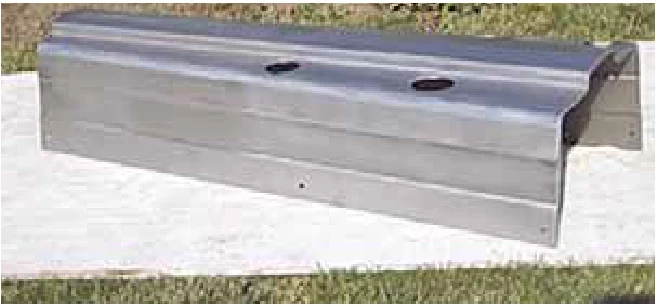
If you need a hood for a tractor you’re restoring, Dave Geyer can help. For the past 14 years, Geyer has made hoods and other sheet metal parts. He has shipped orders to customers in each of the 48 continental states, Canada, England and elsewhere.
“I don’t restore old hoods; I fabricate new replacements,” says Geyer.
“I have 30 to 40 different products that I make, from hoods to side panels, nose cones and more. In addition, I do custom fabrication.” Geyer got his start with hoods when his dad needed one for an old style G. He decided to try making one, and when it worked out, he made more. While he makes hoods for other brands, he specializes in Deere, making both unstyled (pre 1941) and styled.
“The unstyled have a very simple look to them,” says Geyer.
“The fancy styled look came in around 1941 or so. Mostly, it was a cosmetic improvement.” The extra work involved in the styled hoods comes at a premium. While prices vary, styled hoods for the M, 40, 320, 330 and 430 sell for $420. Unstyled hoods, like those used on pre 1940 A and B Deere tractors, are priced at only $150. Shipping for both styled and unstyled hoods is $35. Geyer laser cuts the hoods and parts listed in his catalog, but hand cuts custom orders.
“If the hood you need isn’t on my list, you can send the original or a blue print,” he says.
“I’ve done a lot of special orders. The oldest was a hood for a 1923 Deere D. The most unusual was a 7-ft. long hood for a Huber and one for a Rock Island.” Contact: FARM SHOW Followup, Dave Geyer, 1251 Rohret Rd. S.W., Oxford, Iowa 52322 (ph 319 628-4257; [email protected]).
Reproduced from the published FARM SHOW entry. Prices, coupons, availability and contact details are historical, not current offers. Reader methods are not universal instructions: follow manufacturer guidance, proper supports and safety practices, and consult a qualified professional when needed.
Comments and votes
Have you tried this idea? Mark it helpful and share how it worked in your shop.