
Like most farmers, Gerald Peters occasionally faced the prospect of replacing the bearings on the packers of his air drill.
“The bearings on my Flexi-Coil 5000 drill last quite some time, so when they go, it’s often impossible to pull them off the packers to change them out,” Peters says.
“They’re manufactured with surprisingly thin steel, so damaging or completely wrecking them is easily done as they get seized to the shaft.”
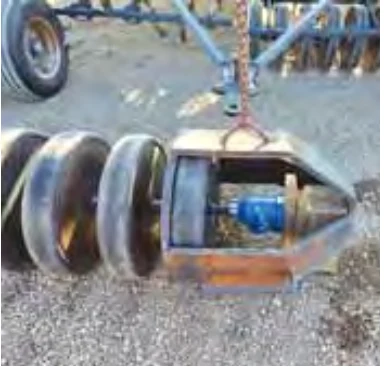
Peters imagined a puller that applied pressure to both the packer wheel and the weld on the center pipe might work, so he designed the pieces for an open-to-the-bottom puller and had them cut at a local welding shop. From there, he welded the three 1-in. thick side and top pieces together. To manage the weight, he uses a small yard tractor loader and a chain to support and position the heavy puller.
“I slide the puller over the top of the wheel, and it fits precisely through the slot, snug enough to pull on the weld,” he says.
“I use a 20-ton bottle jack to apply the pulling force.” Peters says that occasionally he might apply some heat and pound on the puller a little to get things moving, but he’s changed 14 bearings without damaging a single wheel.
He made the puller longer to reach the bearings between the second and third packer wheels. Once the wheels are removed, he has free access to cut off the bearing remnants.
He estimates he spent about $500 to $600 building the unique puller.
Contact: FARM SHOW Followup, Gerald Peters, La Crete, Alberta, Canada (ph 780-821-0986).
Reproduced from the published FARM SHOW entry. Prices, coupons, availability and contact details are historical, not current offers. Reader methods are not universal instructions: follow manufacturer guidance, proper supports and safety practices, and consult a qualified professional when needed.
Comments and votes
Have you tried this idea? Mark it helpful and share how it worked in your shop.