Practical ideas from FARM SHOW MagazineSubscribe · Free issue · Send us your shop tip
Subscribe to FARM SHOW
Issues / Vol. 30, No. 1 (2006)

Vol. 30, No. 1 (2006)

Money-Saving Repairs & Maintenance Shortcuts · Printed section pp. 36–39

36 selected entries · Complete text of selected entries

This issue’s section includes reader tips and feature-length shop stories. Held items and editorial notices are not reproduced.

Archive text: prices, coupons, availability and contact details reflect the original publication, not current offers. Reader methods are not universal instructions; follow manufacturer guidance and proper safety practices.

Reader shop tips

From the archive · Full text
Reader shop tip

Fred Dunlop

Fred Dunlop, Stayner, Ontario; [email protected]

“We have a Deere 1850 30-ft. wide air seeder that we pull behind a 787 air tank. The 1850 has the same coulter setup as the 750 Deere no-till drill. It plants very accurately and works great except for the cast iron closing wheel at the rear. The bearings wear out due to a poor dust seal.

“Has anyone come up with a better seal to keep the dirt out? If so, I’d sure like to hear about it.”

From the archive · Full text
Reader shop tip

Marvin Kroontje

Marvin Kroontje, Magnolia, Minn.

“I just want to send a warning that could save lives. My experience was with a flexible corrugated gray-coated LP gas connector for hooking up gas appliances. I bought it at a local hardware store and it was made in Mexico. When I opened the bag it was in, the hose had sharp bends at each end even though the instructions that came with it said not to bend the connector sharply. After I installed the connector, I smelled gas occasionally and it kept getting worse. I finally found the small leak by using a grill lighter in one hand and a wet wash cloth in my other hand, and sure enough a 2-in. high flame came from the curved area of the pipe which I put out with a wet wash cloth. I would not advise this method on a larger leak. But I could not find it with soap suds. My advice is to buy a stainless steel pipe or a coated pipe that hangs straight on a store rack. Also, be wary of gold or brass uncoated connectors as they can corrode.”

From the archive · Full text
Reader shop tip

Thomas A. Batchelor

Thomas A. Batchelor, Lake Ariel, Penn.

“I work for a power company and changing teeth on an auger with a hammer and punch is a knuckle buster. I’ve found it’s a lot easier to use a 3-ft. ground rod and jack hammer. The teeth come right off.”

From the archive · Full text
Reader shop tip

John Buvala

John Buvala, Ashland, Wis.

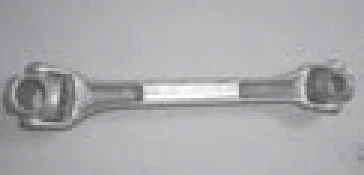
“I was reading a story in your last issue about a “new” oil wrench that works on most oil drain plugs. I’m sending you a picture of a wrench that has been on our farm for two generations now. I don’t know where my Dad bought it but it’s been a great time saver over the years. I’ve never seen another like it. It looks like the same design as the one in your last issue. This one was made by J.H.Williams & Co. and is called a Multisocket.”

From the archive · Full text
Reader shop tip

Final Charge Extended-Life Antifreeze

Final Charge Extended-Life Antifreeze

Heavy-duty engines that get a lot of use are prime candidates for extended-life anti-freeze like “Final Charge”. It lasts for 600,000 miles of on-road use or 6 years or 12,000 hours of off-highway use without supplemental coolant additives. The only maintenance required is the addition of an “extender” additive at 300,000 to 400,000 miles or 3 years of off-highway use. Final Charge is compatible with all cooling systems in heavy-duty diesel, gasoline and natural gas engines, and is in use by big truck fleets around the country as well as city road maintenance fleets.

For more information, go www.finalcharge.com or call 800 323-5440 or 847 559-2000.

From the archive · Full text
Reader shop tip 1 of 2

Cary Urka

Individual tip 1 of 2 from this reader’s published contribution.
Cary Urka, Bretheren, Mich.

“When it comes to getting the lowdown on welding, it’s hard to beat website bulletin boards. Two that I really like and participate in are www.hobartwelders.com/mboard and www.shopfloortalk.com. I’ve been really impressed with the people who post questions and answers on the sites. They are information hungry and smart enough to know when they don’t know. The experience spectrum runs from first time users all the way to engineers. A lot of questions get answered and by a variety of people, not just career welders.

“One of the questions that gets asked often is what’s the difference between a $300 machine and a $600 machine. The only virtue of cheap is that it’s cheap. Pay a little more and get into quality with a Hobart, Miller or Lincoln. Even Hobart engineers on their site will provide good information about competitors’ machines and not badmouth them. Site members don’t promote one welder over an-other, but they do promote service.

From the archive · Full text
Reader shop tip 2 of 2

Cary Urka

Individual tip 2 of 2 from this reader’s published contribution.
Cary Urka, Bretheren, Mich.

“Another best buy is used golf carts. On our berry farm, we have four. They are great for workers to get around quickly and cheaply. Anybody can drive them, from kids to older people, and they run on an eyedropper of fuel. I made boxes for them and load them up as rolling toolboxes.”

From the archive · Full text
Reader shop tip

George Gouvas

George Gouvas, Janesville, Calif.

Here’s a simple way to rig up a vehicle for towing that will avoid ripping off a bumper. Bolt a tow chain from one side of the vehicle’s frame rail to the other. You can mount the chains at either the front or rear of the frame rails and leave them there permanently.

From the archive · Full text
Reader shop tip

Jayson Williams

Jayson Williams, Mulvane, Kan.

“We find that metal pallet racks work great for storing used parts and other supplies in our shop. The racks are designed to snap together. We have a couple of racks in our shop and each one is 5 ft. wide, 10 ft. long, and 10 ft. high. We bought both racks used from a local surplus store for $75.

“We load wood pallets with stuff, then use a small loader tractor equipped with forks to lift the pallets up onto the racks. We add shelves to the racks as needed.”

From the archive · Full text
Reader shop tip

Arthur Wiedenhoft

Arthur Wiedenhoft, Grand Rapids, Minn.

“If I can’t get a small gas engine to start in cold weather, I use STA-BIL fogging oil to do the job. It comes in an aerosol can and is designed to winterize motors on outboard boats. Once you get the boat motor running, you pull off the gas line and wait until the engine starts to run out of gas before you spray the fogging oil into the carburetor. The oil coats the cylinders to prevent rust from forming.

to “I use the product in cold weather to start my 2003 Arctic Cat ATV. After I spray the oil into the air intake and turn the key, the engine fires right up. I also use STA-BIL on my riding mower and on my garden rototiller. The same fogging oil can be used to winterize those rigs, too.

“In my opinion, too much starting fluid isn’t good for a small gas engine. Starting fluid contains ether and is meant to be used mainly on diesel engines, which have high compression. Ether is highly explosive and can therefore blow the heads on a small gas engine. Too much ether can dry out the cylinders, too.

“STA-BIL fogging oil won’t damage engines because it’s an aerated oil. I think it’ll help start any small gas engine.”

From the archive · Full text
Reader shop tip

Wayne E. Miller

Wayne E. Miller, Belle Center, Ohio

“For a long time I’ve searched for a good marking pen to use on steel. I own a welding shop and have a constant need for a marker. Finally I discovered a pen that seems durable and is recommended for hard-to-mark dark surfaces. It’s a Sharpie silver metallic fine point ink pen, no. 39108. I buy them at Wal-Mart.”

From the archive · Full text
Reader shop tip

Gary Agrimson

Gary Agrimson, Agrimson Tool Co., 4092 83rd Ave. N., Brooklyn Park, Minn. 55433 ph 763 566-3446; [email protected]; www.agrimsontool.com

Gary sells a wide variety of replacement parts and accessories for Allis C h a l m e r s equipment, including power steering name plates, steering wheel caps, re-ceiver hitch adapters, and cylinders bars. They also offer twine guards for the Allis Chalmers Roto-Baler and tail light lenses for D series tractors.

The Power Steering name plates are die cast, chromed, and painted. The nameplate has an orange-colored background. The nameplate also looks nice on the company’s receiver hitch adapters. They sell for $20 apiece.

The company’s steering wheel cap features a round decal in the center. It sells for $12.50.

The receiver hitch adapter features all stainless steel construction and mounting holes for either colored name plate. It’s available to fit either 2 or 1 1/4-in. openings.

The cylinder bars are for All Crop Harvester models 40, 60, 66, 72, 90, and 100. They’re sold in sets of 8 bars and sell for $250 per set.

The tail light lenses for D series tractors are new OEM replacement parts, not refurbished. They sell for $10 apiece.

The twine guard fits all models of Roto-Balers and prevents the twine from wrapping around the press roll. It sells for $45.

Also available are Roto-Baler belts, brake pinpullers, brake pins, brake pin pullers, and a spring set with knife. The company also offers rebuild kits for all makes of tractors.

From the archive · Full text
Reader shop tip

Norris M. Evans

Norris M. Evans, Fair Oaks, Calif.

“There are a lot of moveable vice stands around but this one is really special. The base is a sewer manhole cover that I bought at a surplus store. The manhole cover is heavy which makes it stable and it’s round, so it’s easy to roll around our shop. We used existing holes in the manhole cover to attach the vice’s three legs. Works great.”

From the archive · Full text
Reader shop tip

Samuel B. Shirk

Samuel B. Shirk, Penn Yan, N.Y.

“Deere 350 series crawler tractors use 4 5/8-in. studs to hold the transmission case and reverser housing together. If these studs loosen even slightly, there will be a shifting action between the two cases because of torque reversals from the reverser. This causes wear in the castings around the hardened bushings that lock the housings in place. And when this happens it becomes impossible to keep the studs tight. The studs will either break off or strip their threads, as I found out after I replaced the original studs with æ-in. studs on my crawler. Then the housings separate slightly and eventually strip the splines on expensive shafts inside.

“This problem has sent many a 350 crawler to an early retirement at a scrap yard. I solved the problem on my crawler by drilling four holes, two from underneath and two from the top, directly centering the holes where the housings join. I used a reamer to fit the holes at precisely 5/8 in. and then drove a hardened pin into each hole to lock the housings solid again.

“My crawler has been running like that for several years now and the studs are still tight. I suggest shimming the casings apart by several thousandths of an inch while drilling and reaming, then removing the shims to make a tighter fit and to clamp the hardened pins in place.”

From the archive · Full text
Reader shop tip

Chad Travis

Chad Travis, Drasco, Ark.

“Perhaps some of your readers may have the answer to a problem I have with my 2000 Dodge Ram 3500 4-WD pickup, which is equipped with a 6-speed transmission. The problem is that oil constantly leaks out the rear seal. I’m now on my third seal and it’s leaking, too. The shaft that the seal runs on is satin smooth and I don’t have a problem with driveline vibration. Rotating the seal so the weep hole is in a different position doesn’t help. If anyone knows of something that would help fix this problem, I’d like to hear from them.”

From the archive · Full text
Reader shop tip 1 of 3

Shawn Nelson

Individual tip 1 of 3 from this reader’s published contribution.
Shawn Nelson, Kotzebue, Alaska

“I live 30 miles above the Arctic Circle and had frozen drain lines in the house, causing some of them to crack. As I’m located in a remote area with limited resources, I couldn’t just drive into town for parts. I solved the problem by using 3M’s 5200 boat hull sealant to seal the drain lines, and to this day I’ve had no more problems with them.

From the archive · Full text
Reader shop tip 2 of 3

Shawn Nelson

Individual tip 2 of 3 from this reader’s published contribution.
Shawn Nelson, Kotzebue, Alaska

“I have extra narrow feet so it’s hard to find foot gear that fits correctly. That’s why I was saddened when my good-fitting Lacross Pack boots started developing cracks. I tried using tire patches, wader repair kits, and Zodiak boat repair kits with no luck. I was about to throw away the boots, which are no longer on the market, when I figured I’d try using the same 3M 5200 boat hull sealant as a last resort. It worked great.

From the archive · Full text
Reader shop tip 3 of 3

Shawn Nelson

Individual tip 3 of 3 from this reader’s published contribution.
Shawn Nelson, Kotzebue, Alaska

Since then I’ve also used this product to fix a fuel fitting and to seal a rusty gas tank. This stuff remains flexible when cured and resists gas and oil with a rubber-like constancy.”

From the archive · Full text
Reader shop tip 1 of 4

Ben Burlingame

Individual tip 1 of 4 from this reader’s published contribution.
Ben Burlingame, Charlton, Mass.

“The battery on my 1972 Sears Custom 10 garden tractor wouldn’t hold a charge. After being quoted sky high prices for a new charging system, I bought a Chevy alternator from a local junk yard. Now that battery charges like new, and it only cost me about $30.

From the archive · Full text
Reader shop tip 2 of 4

Ben Burlingame

Individual tip 2 of 4 from this reader’s published contribution.
Ben Burlingame, Charlton, Mass.

“In my opinion, 95 percent of NAPA parts are better than O.E.M. and almost always a good deal less expensive.

From the archive · Full text
Reader shop tip 3 of 4

Ben Burlingame

Individual tip 3 of 4 from this reader’s published contribution.
Ben Burlingame, Charlton, Mass.

“If you have any old earth movers to paint, buy Deere yellow paint in 5-gal. buckets. It’s a reasonably priced, tough paint, and it’s a lot easier to find than most other brands.

From the archive · Full text
Reader shop tip 4 of 4

Ben Burlingame

Individual tip 4 of 4 from this reader’s published contribution.
Ben Burlingame, Charlton, Mass.

“We keep a 55-gal. drum in one corner of our garage to drain oil into. With all our trucks and equipment, it sure is nice to be able to put the oil in one place. When the barrel is full, we bring it to a friend who owns a waste oil furnace, and he gives us another empty drum.”

From the archive · Full text
Reader shop tip

Dan Neuman

Dan Neuman, Loami, Ill.

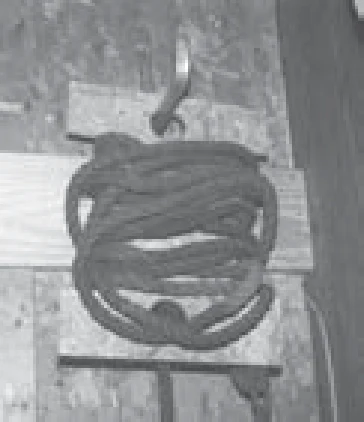
You don’t have to be a navy boatswain’s mate to get neat control of your ropes, says Dan. He uses 15 by 12-in. sections of plywood to make this quickie rope storage system. Both sides of the plywood are notched to make it look like a big letter “I”. Then he drills a hole into both the top and bottom of the plywood, making it easy to hang it on the wall.

Shop feature stories

From the archive · Full text
Feature story

Heavy Duty, Pull-Down Staircase

Featured source: Ray Rowden

Most pull-down staircases are too flimsy to support big loads carried up and down them. Ray Rowden, Springfield, Ill., made a heavy duty, 30-in. wide staircase for his shop that’s raised and lowered by an electric winch.

“It lets me carry big, wide objects up into my loft,” says Rowden.

Rowden had Greg Kruger, a carpenter friend, build the staircase and a specially designed, heavy duty hinge to support its weight. The hinge consists of a pair of 8-in. wide steel plates. A salvaged truck axle serves as a spindle and runs through the plates and through a pair of U-shaped brackets that support the upper end of the staircase.

The shop and staircase is part of a new 30 by 50-ft. building Rowden put up last year. The loft is designed to hold a lot of weight. Every third truss is doubled. The building houses Ray’s prize Hudson and Terraplane collector automobiles.

“The staircase is so heavy that without the winch I would need another person to help me lift it,” says Rowden, who plans to box off the raised staircase so that it will blend in with the ceiling.

“I plan to use Nudoboard insulation around the staircase, which will blend in with the rest of the ceiling.”

Contact: FARM SHOW Followup, Ray Rowden, 1556 Wildrose Lane, Springfield, Ill. 62712 (ph 217 522-4926).

From the archive · Full text
Feature story

New Fix For Deere Combines

Featured source: Mark Petty

If you own a Deere 9000 series combine, chances are you’ve had problems with the concave adjustment actuator rod. If the rod bends or the nut pulls out, you’ve got to replace the entire actuator motor, and that can get expensive.

In Canada, the cost is about $900 not including labor and down time. That’s why a customer who had to replace the actuator three times, asked Mark Petty, a repair shop operator in Blackstock, Ontario, to find an alternative.

Petty created a thicker stainless steel rod with a bronze nut that fits into the motor.

“It’s a permanent solution to the problem,” he says.

It takes about an hour to replace the piece.

“It’s not hard to do.”

Petty says the original piece, made by Warner Electric, may have been put on other combines, but he doesn’t know which ones.

“Up here, Deere is the most common combine.” He says newer Deere machines don’t have the problem.

Sells for $240 (Can.) plus S&H.

Contact: FARM SHOW Followup, Mark Petty, 2850 Church St., Blackstock, Ontario L0B 1B0 Canada (ph 905 986-1521; [email protected]).

From the archive · Full text
Feature story

“A” Frame Tool Holder On Wheels

Featured source: John Gruman

“I got tired of always cleaning off a cluttered workbench,” says John Gruman, who created a tool holder on wheels he calls the “A-Frame Tool Tote.”

The wooden tool carrier is 6 ft. long, 20 in. wide at the base and 6 in. wide at the top. It rides on heavy-duty caster wheels and has a handlebar at each end.

“The number of tools it’ll hold is up to you,” Gruman says, adding that he hangs the tools using screw hooks and finishing nails.

Six hammers, mallets and other tools fit into the holes along the top.

“When loaded with tools, this thing can weigh between 350 and 400 lbs.,” he says.

Gruman says the four drawers on each end of his tool holder are 24 in. deep.

“The drawers could go clear to the center, though,” he notes.

Instead of using rollers, he has the drawers slide on pieces of angle iron.

“This works better on rough floors,” he says.

Gruman says his favorite thing about the tool holder is that it’s a time saver.

“I can use a wrench, turn around and hang it up. I don’t lay it on the machine or under the hood or anywhere else,” he says.

“It goes right back on the peg. It’s a discipline thing and therefore I always know where it’s at.”

The A-Frame tool carrier has been so popular with friends and family that Gruman has put together plans for sale.

Contact: FARM SHOW Followup, Buggymaker Products, 911 S. Ordway Rd., Waterloo, Iowa 50703 (ph 319 233-1918; [email protected]).

From the archive · Full text
Feature story

He Machines Drill Bits

Featured source: Robert Rottinghaus

Here’s a tip for do-it-yourself machinists submitted by Robert Rottinghaus of Jesup, Iowa.

He used his lathe to convert two large drill bits with a Morse taper to an R-8 shank.

“A lot of today’s drill presses don’t have enough vertical clearance to use Morse taper adapters with a big drill. For example, I have a Bridgeport mill that doesn’t have thrust bearings in it and is made for milling only. As a result, I can’t crank the drill press up high enough to put all my adapters on. If I do, the sleeves will hit the table.

“So instead I chucked the drill bit into my lathe and machined it down to fit the R-8 spindle. Do the machining before you saw off the Morse taper flat. You then will have a counter sink hole for the tail stock on your lathe.”

Contact: FARM SHOW Followup, Robert Rottinghaus, 5121 S. Canfield Rd., Jesup, Iowa 50648 (ph 319 827-1311; fax 319 827-2425).

From the archive · Full text
Feature story

Simple Grounding Device For Welding Tables

Featured source: Morgan Plant

“One of the handiest gadgets in my shop is an auxiliary grounding device for my welding table. It’s cheap and easy to make and is a real neat way to complete a welding task without burning up welding gloves,” says Morgan Plant, Meridian, Idaho.

He started with a pair of 7-in. vise grips and attached a 4-ft. length of flexible-stranded no. 10 wire to it by drilling and tapping a 1/4 by 20 thread into the vise grip body. He attached the wire to the handle next to the adjusting screw in order to keep the wire parallel to the vise grip handles.

At the other end of the wire, he drilled and tapped a 1/4 by 20 thread to a small piece of 1/4-in. thick flat stock. He ground off the pro-truding thread so the bar would lay flat on the welding table, held down by a regular spring grounding clamp.

“When welding parts together in odd or unique positions, use the vise grips to grab that piece and hold it in the desired position. This action gives the grounding function a two-way chance to complete the grounding circuit, and it provides a neat way to hold small parts,” says Plant.

Contact: FARM SHOW Followup, Morgan Plant, 300 S. Locust Grove Rd., Merid-ian, Idaho 83642.

From the archive · Full text
Feature story

Magnet Traps Metal Inside Oil Filter

Featured source: James Friend

You can capture even the tiniest metal filings in any engine or hydraulic system with this new oil filter magnet.

It’s designed to be inserted through the center hole of any spin-on filter with a metal core. For best results the company recommends using fresh magnets at every oil change. The magnet attracts up to 40 times more grit than the filter alone, without re-stricting oil flow.

“It catches metal fragments that are too small for an oil filter to stop, generally particles less than 30 microns in size,” says James Friend of Kleen Lube, Blue Springs, Mo. He says Magna-Guard has been on the market since 1999 but has primarily been used in the heavy equipment and truck industry.

“With prices for fuel and lubricants on the rise, we feel it’s a good time to introduce the product to farmers,” he told FARM SHOW.

According to Friend, Magna-Guard works better than wrap-around oil filter magnets “which are only 40 to 70 percent efficient because they’re on the outside of the oil screen. Our magnets go inside the filter and are in direct contact with the fluid, so they’re able to remove many times more contaminants.”

The number of magnets needed depends on the capacity of the filter. The company recommends using one standard size magnet per 16 oz. of filter fluid capacity. So if you have a 1-quart filter or less, you need just one magnet. Quart-sized filters found on some pickups require two magnets. Tractor trailer rigs with 1-gal. primary filters should use eight standard size magnets.

The standard size magnets are about 1/4 by 3/8 by 1 1/2 in. and the mini size are 3/16 by 3/8 by 3/4 in. Two “minis” are the equivalent of one standard magnet.

Both the standard size and mini Magna-Guard magnets sell for $5.99. One package of two standard size magnets sells for $9.95. A 6-pack of four standard size magnets and two pairs of mini magnets sells for $19.95. Lower priced bulk packs are also available.

Contact: FARM SHOW Followup, Kleen Lube, 1200 Corporate Centre, Blue Springs, Mo. 64015 (ph 816 686-5348; [email protected]; www.kleenlube.com).

From the archive · Full text
Feature story

Where To Go For Chain Saw Parts, Accessories

Featured source: Cutter’s Choice

If you do a lot of chain saw work, here’s where to go for replacement parts and wood cutting accessories.

Cutter’s Choice carries saw chain, bars and sprockets, chaps, hardhats, gloves and other safety items. The company also offers log handling and log milling tools and accessories; small engine parts for Briggs & Stratton, Tecumseh, Honda, and Kohler engines; and parts for lawn mowers, weed trimmers, cut-off saws, and snowblowers.

If you’re looking for a specific part you can call them up and have them search their catalog, or you can do it yourself at their website.

“Our online ordering system is easy and practical, offering quality outdoor machines, parts and accessories at some of the best prices on the internet,” says the company.

Contact: FARM SHOW Followup, Cutter’s Choice, 2008 East 33rd St., P.O. Box 10308, Erie, Penn. 16514 (ph 888 288-8371 or in Canada 888 817-4707; fax 800 983-7278; [email protected]; www.cutterschoice.com).

From the archive · Full text
Feature story

High Performance Paddles For NH Forage Harvesters

Featured source: Luke Keller

Anyone with a New Holland FP230 or 240 forage harvester will be interested in these new high performance paddles that simply bolt on in place of the originals.

You simply unbolt the original paddles and bolt the new ones on in their place.

Inventors Luke Keller and his son, Dan, recently contacted FARM SHOW to explain why they came up with the idea.

“In March 2000 we bought a New Holland FP 240 forage harvester. We were very dis-appointed in the way it blows,” says Luke.

“We had a lot of trouble with hay plugging up right where it enters the blower and shearing the auger shear bolt. We also noticed that the blower housing was getting very hot. The problem was that haylage was getting pinched between the paddle and blower housing, which caused the paddle and blower housing to wear out prematurely.”

Luke says two years ago New Holland sent out a news bulletin admitting they were having problems with the paddles and cross auger.

“The company recalled the first year’s 230 and 240 models and replaced them with new paddles and augers, but that failed to fix the problem. The paddles still wore out within a year. The company thought they had a problem with the auger, but the problem was re-ally with the paddle,” he explains.

He got fed up with all the problems he was having but didn’t want to spend the money to trade machines. So he designed and patented new paddles and an air inlet. The bottom half of the new paddle has a cupped design.

“I know from years of farming that if you want to move silage you need a cupped paddle. It pulls material away from the side of the blower housing and also increases the air flow,” says Luke.

“Our new paddles and air inlet allow the forage chopper to blow haylage all the way to the back of a 20-ft. chopper wagon.”

“Our paddle does a better job of sucking material away from the auger and eliminates the problem. Its wear is now comparable to that of the New Holland 900 series choppers.”

On his own chopper, Keller cut a 1-ft. long, 8-in. wide hole in the top of the auger housing and tach welded an air inlet screen into it. The screen allows more air to flow into the blower.

Luke says he has sold several sets of paddles to farmers in his area and all are pleased with their performance.

The paddles sell for $59 apiece plus $10 S&H per set.

Contact: FARM SHOW Followup, High Performance Paddle LLC, 841 Burkettsville-St. Henry Rd., Ft. Recovery, Ohio 45846 (ph 419 375-4491 or 419 375-2608).

From the archive · Full text
Feature story

Do-It-Yourself Powder Coating System

Featured source: Kevin Schlosser

There’s now a one-of-a-kind portable powder-coating machine on the market that allows any do-it-yourselfer to do what only high-tech manufacturing setups could do in the past.

Kevin Schlosser of Punnichy, Sask. is the exclusive Canadian distributor for the Xiom 1000 Plastic Coating System, and he bubbles with excitement about its revolutionary nature.

“Because of this brand new portable system, it’s possible to powder coat anything, of any size, indoor or out - and the kicker is that it’s inexpensive!” he says.

With conventional powder-coating systems, paint is applied as a really fine dust, and an electric charge is used to stick it to the metal. Then, the powder-coated objects must be cured in big ovens. That’s what makes conventional powder coating extremely costly, Schlosser says.

The new Xiom system weighs only 70 lbs. (not including gas cylinders) and it can be used anywhere compressed air is available. It works by mixing propane from a standard propane tank, oxygen from any size of cylinder, and compressed air to provide a perfect flame. This flame heats up the specially designed powdered plastic coatings to their melting point and ejects them onto the surface that needs to be plastic coated. The melted plastic chemically bonds to the surface and hardens and cures instantly. There is no dripping and no hanging parts to dry!

“With the portable Xiom system, you can coat anything - including things that would have incinerated in an oven, like cardboard. You can also do interior walls, your bathtub, or any other object of any size,” he says.

“Because the type of paint that’s applied is actually a hard plastic, it’s more durable and water resistant than regular powder coating.

“The paint itself is very cheap and you can do the work right on site. To set up a very basic, modest, conventional powder coating system, it used to cost between $100,000 and $150,000, but the Xiom system costs only $10,500 (Can.),” Schlosser says.

“Regarding operating costs, you can run it steady for $100 per week. Also, its ease of operation means that anyone can learn how in a matter of hours. You don’t need extensive training.”

The system is made up of two components. A console controls the pressures and flow of each of the three gases, as well as the delivery of the coating material. A gun diffuses the gases to form a proper flame and allows the user to stop or start the coating process. The gun spray options are a 1-in. wide spray (standard heat-applied version) or a 9-in. wide spray (electric version, which is coming soon).

Contact: FARM SHOW Followup, Kevin Schlosser, Jaddak Creations, Box 37, Punnichy, Sask., Canada S0A 3C0 (ph 866 314-1819 or 306 835-2427; [email protected]; www.jaddak.com).

From the archive · Full text
Feature story

“Bucket-A-Day” Stove Pre-Heats Hot Water

Featured source: Tom Hicswa

“I use it to pre-heat the water that goes into my 30-gal. electric hot water heater,” says Tom Hicswa, Hammonton, N.J., about the “bucket-a-day” wood stove he uses in his basement.

He calls it “bucket-a-day” because every day he uses two 5-gal. buckets of wood in the stove. Water is pumped from his well to a 30-gal. tank next to the stove. Water circu-lates from the tank to the stove and back into the tank. The water is pulled from the tank to the hot water heater as needed. Because the water is preheated by the stove, very little electricity is used.

“I’ve been using my bucket-a-day stove since 1969. It saves me 30 to 50 cents a day,” says Hicswa.

“The stove pre-heats the water to between 100 and 200 degrees. If the water in the tank gets any hotter it blows the safety valve. Even if the water sits in the tank for a while before it’s piped out, it’s still at 70 degrees. It takes less electricity to heat up 70 degree water than it does to heat 52 degree well water so I still save money.

“The stove was originally built in 1922 and was designed to burn either coal or wood to provide hot water. The stove has an ash pit at the bottom, which I clean out about five times a month.”

Contact: FARM SHOW Followup, Tom Hicswa, 2169 Elwood Road, Hammonton, N.J. 08037 (ph 609 561-7623; [email protected]).

From the archive · Full text
Feature story

Home-Built Track Utility Vehicle

Featured source: Martin Guenther

Martin Guenther’s homemade hunting cart has gotten hung up, but not for long. Using a built-in winch, he has quickly pulled free. The 8 1/2-ft. long, 5-ft. wide, all steel body handle just about anything and go anywhere, thanks to its homemade tracks.

“I can take it more places than I can an ATV,” says Guenther.

“It gets up to 12 mph and will climb a 45 degree angle.”

After years of thinking about making an all terrain hunting buggy, Guenther went to work on the project.

His first step was to have steel plate bent to form a one-ft. high, one-piece lower body, negating the need for a frame. Everything else was simply mounted to it.

Guenther pulled a 1.8-liter Subaru engine from an old car to power the machine. He installed a governor on the motor and mounted it behind the driver’s seat. A new tandem hydraulic pump capable of producing up to 20 gpm was attached to the engine to power new hydraulic motors that were installed to run the tracks.

Guenther used conveyer belt and four 8 by 4-in. wheels to make the tracks. The conveyer belt has a 5-in. section in the middle with a 5-in. section to either side. He cut 14-in. long, 1-in. wide pieces of 12 ga. cold rolled steel for outside cleats and the same size 14-ga. steel for inside cleats. The cleats were formed into channels and bolted together to either side of the conveyer belt.

Guenther even made his own drive and tightener sprockets. He cut 12 steel, cog shaped plates and enough similarly shaped pieces of conveyer belt to make four 4-in. thick sprockets. Each sprocket has a steel plate on each side and in the center to keep the canvas cog rigid.

Drive sprockets mount directly to shafts from the hydraulic motors at the front of the tracks, while the tightener cogs are mounted at the rear on a cam attached to a hydraulic ram. To tighten the track, Guenther merely increases the hydraulic pressure as needed.

For the upper foot of the body, headlight panel and engine hood, he made molds and covered them with fiberglass.

“I bought tractor seats to mount ahead of the engine,” says Guenther.

“That left a cargo area behind the engine. Two levers, one for each side, control the drive motors, forward and reverse.”

He has made very few changes to the cart since building it and sees little need to change it.

“I had a couple of flat tires when out hunting the first couple of years,” he recalls.

“I added foam to the tires, and that took care of the problem.”

Contact: FARM SHOW Followup, Martin Guenther, Box 120, R.R. 4, Saskatoon, Sask. S7K 3J7 (ph 306 931-2514).

From the archive · Full text
Feature story

Awesome Wagon Built To Last Generations

Featured source: Kai Grundt

Chances are good you’ve never seen a children’s wagon like this one. Its creators wanted to make something that would be fun for kids and useful for parents. In fact, its many special features may make it the kind of possession that might become a family heirloom.

Kai Grundt of Muskoka, Ont., enjoys building unusual mechanical devices in his spare time. He has young children so the wagon was a natural. The idea to custom-build and sell them resulted from the sheer demand Grundt experienced every time he took it out in public.

“For example, we went to watch our local Santa Claus parade with it the other day, and we were mobbed by people wanting to know where we got it,” he explains.

Together with business partner Kerry Phibbs, Grundt has turned the project into a commercial venture.

“The wagon has a front-mounted manual crank that lowers the rear tailgate in a slow, controlled manner. Once fully lowered, it locks the rear wheels to prevent any unwanted fore and aft movement,” Phibbs explains.

“Children can climb up the back of the tailgate using the panels as ladder rungs. Once aboard, the parent rotates the hand crank in the opposite direction, raising the tailgate back up. Once the tailgate is closed, it can’t be forced open from the inside.”

The wagon rolls effortlessly and rattle-free on large diameter pneumatic tires that allow it to smoothly walk over curbs.

The floor of the wagon is transparent so kids can watch the wheels and suspension components as the wagon moves.

High quality components ensure that it will be around for reliable service and enjoyment for generations to come, the partners point out. Corrosion isn’t a concern since the rig is made with stainless steel hardware, cadmium and powder coating, and high quality polymer panels.

The front and rear suspension feature 6 in. of travel. All suspension arms and components have rod ends and sealed bearings with no bushings. There are eight nitrogen gas-filled springs, complete with 16 rod ends that can be lubricated.

It includes an aluminum extension handle with dual retention springs that keep the handle in an upright position when not in use.

Grundt requires a three to four week lead time to fill order requests.

Contact: FARM SHOW Followup, Kai Grundt, 32 Sellens Ave., Bracebridge, Ontario, Canada P1L 1R3 ([email protected] or [email protected]; www.v8snow blowers.com).

From the archive · Full text
Feature story

Simple Idea Smoothes Out Hitch

Featured source: Fred Windsor

When pulling a 2-axle manure or fertilizer spreader, Fred Windsor, Cambridge, Md., puts a bushing under the trailer tongue on the hitch pin to minimize the up and down movement of the tongue.

He says the idea works especially well when there’s not much weight on the tongue. The bushing can be an old bearing or an over-size nut - anything that will fill up the space.

Contact: Fred or George Windsor, 5855 Mt. Holly Rd., East New Market, Md. 21631 (ph 410 943-8389).