Practical ideas from FARM SHOW MagazineSubscribe · Free issue · Send us your shop tip
Subscribe to FARM SHOW
Issues / Vol. 37, No. 6 (2013)

Vol. 37, No. 6 (2013)

Money-Saving Repairs & Maintenance Shortcuts · Printed section pp. 36–39

31 selected entries · Complete text of selected entries

This issue’s section includes reader tips and feature-length shop stories. Held items and editorial notices are not reproduced.

Archive text: prices, coupons, availability and contact details reflect the original publication, not current offers. Reader methods are not universal instructions; follow manufacturer guidance and proper safety practices.

Reader shop tips

From the archive · Full text
Reader shop tip

Dwayne Oxford

Dwayne Oxford, Holladay, Tenn

“Here’s how I store good pull-start springs off small engines. I drill a hole in the center of a suitable size lid, then wind the spring into the lid, beginning with the outer end. Then I thread 14 or 16-ga. solid copper wire through the hole and across the spring to keep it in place. I also label the top of the lid with the name of the motor it came out of.”

From the archive · Full text
Reader shop tip

Scott Willis

Scott Willis, Monroe, Wash.

“To the fellow in FARM SHOW who uses automatic transmission fluid (ATF) in his air tools – I’m not sure that’s a good idea. Some of the oil in air tools ends up as a fine mist and you breathe it. Engine and transmission oils may contain paraffins, carcinogens, etc. Air tool oil is better for your health. I know some people have used ATF for a long time without noticing any adverse health effects. But the ones who got sick probably didn’t write in.”

From the archive · Full text
Reader shop tip

Harvey Malon

Harvey Malon, Rapid City, S. Dak.

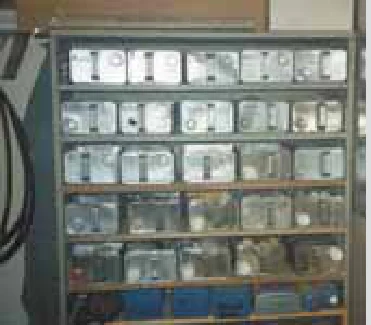
“Ordinary 1-gal. square metal cans work great to store nuts, bolts, screws and small parts. Cut out one side of the can and then build a simple cupboard with shelves as deep as the cans and as wide as you want. The distance between the cans should be about 1 1/2 the depth of the cans so that you can overload them and still see what’s in them. Be sure to put a back on the cupboard. Mark the cans with a masking pen.”

From the archive · Full text
Reader shop tip

Jacob Schrock

Jacob Schrock, Trenton, Mo.

“When the pto U-joint went out on my New Holland 489 haybine, the entire driveshaft pulled out when I tried to fix it. Rather than taking the tongue off the machine, I cut a small access hole by the rear joint so that I could reach in and line up the driveshaft. It was quicker and easier than anything else I could have done.”

From the archive · Full text
Reader shop tip

Raymond Werner

Raymond Werner, Winfield, Iowa

“I use an old tire as an in-field air transfer system. It lets me fill a flat tire in the field with enough air that I can get back to my shop or to a tire repair garage. All I do is attach one clip-on air fitting to the tire’s valve stem and another fitting to a short length of hose.”

From the archive · Full text
Reader shop tip

Al Reed

Al Reed, Elmwood, Ill.

“The best feature we’ve built into our shop is a large gantry-style crane made out of an old IH planter frame and large caster wheels. It will lift 5 tons – and just clears the lights on our 16-ft. ceiling. It’s great for handling big equipment we’re working on.”

From the archive · Full text
Reader shop tip 1 of 2

Scott R. Layfield

Individual tip 1 of 2 from this reader’s published contribution.
Scott R. Layfield, Lima, N.Y.

“If you have a bolt that breaks off, you can weld a bigger nut over the broken end of the bolt, working through the center of the nut. It will come right out.

From the archive · Full text
Reader shop tip 2 of 2

Scott R. Layfield

Individual tip 2 of 2 from this reader’s published contribution.
Scott R. Layfield, Lima, N.Y.

“Old bicycle inner tubes work well to hold trash bags in trash cans. Simply stretch them over the top of the can.”

From the archive · Full text
Reader shop tip

Ed Wozniak

Ed Wozniak, Florence, Miss.

“I had a rusted-out rim on the front of my 1949 Ferguson tractor. I found out you can retain the center part of the wheel and just replace the outer rim. All you have to do is reweld the original plug welds. Works great.”

From the archive · Full text
Reader shop tip 1 of 2

Lloyd R. Lucas

Individual tip 1 of 2 from this reader’s published contribution.
Lloyd R. Lucas, High Springs, Fla.

“I was going through a lot of air filters on my Kubota UTV until I made this change. I ran a long piece of pvc from the filter up through the roof of the vehicle. Pulls in clean air. Big improvement and I’m running with a clean filter much longer.

From the archive · Full text
Reader shop tip 2 of 2

Lloyd R. Lucas

Individual tip 2 of 2 from this reader’s published contribution.
Lloyd R. Lucas, High Springs, Fla.

“I also had a problem with vibration cracking the flanges on the muffler. So I cut the solid pipe off and replaced it with flexible exhaust pipe. It solved the problem because it’s less rigid.”

From the archive · Full text
Reader shop tip

Bruce Branstad

Bruce Branstad, Gransburg, Wis.

“I had a problem using ethanol fuel in my chainsaw. I had to have the carburetor rebuilt twice in a period of one year. The mechanic told me to use 91 octane non-oxygenated gas and I haven’t had a problem since.”

From the archive · Full text
Reader shop tip

Kim Klocke

Kim Klocke, Arlington, Iowa

“The fuel line that runs along the rear side of the engine on my Deere 5500 tractor developed a leak. Rather than having to raise the cab, I just threaded a rubber line beside it, cut the steel line, and hose-clamped the rubber one to bypass the leak. A simple, quick solution.”

From the archive · Full text
Reader shop tip

Duane Johnson

Duane Johnson, Lohrville, Iowa

“I have renovated several wagon gears over the years when the front ends froze up. I built a cage that slips on the end and accommodates a 12-ton hydraulic jack to press out the L-shaped front spindles. Once out it’s easy to clean out the rust and dried grease in the holes and on the spindles. It’s like putting the front end in a press but a lot easier!”

From the archive · Full text
Reader shop tip

Linda Smith

Linda Smith, Salem, N.J.

“I have some vision problems. A friend of mine taught me to clean and then spray paint all the grease fittings on my equipment. Makes them very easy to see.”

From the archive · Full text
Reader shop tip

Jim Gore

Jim Gore, Ulster, Penn.

“The brakes on my 80-06 Deutz didn’t work well – sometimes they wouldn’t work at all. I noticed that the brake fluid reservoir was mounted lower than the wheel cylinders. So I clamped a small hose to the reservoir and ran it up into the cab to another reservior. They work like they should now. No problems.”

From the archive · Full text
Reader shop tip

Arthur Perrea

Arthur Perrea, Burke, N.Y.

“I had to dig a 1-ft. deep trench across a driveway. It was so hard-packed, a plow and a rototiller just bounced off it. So I tried a high-pressure washer and it ate right down through the gravel. Made an easy job of it. But it was messy – wear goggles and a raincoat.”

From the archive · Full text
Reader shop tip

Sandy Jackson

Sandy Jackson, Etowah, Tenn.

“I have a 6807 Deutz tractor that doesn’t like to start under 35 degrees. I have cattle to feed so this is a problem. After using larger batteries and a lot of boosting for years, I finally bought a kerosene torpedo-type heater that puts out about 75,000 btu’s. After about 5 min. of blowing on the side of the tractor exhaust manifold, it then starts like it’s the 4th of July. I just have to get the exhaust so it’s warm to the touch. Doesn’t seem like it strains the starter at all.”

From the archive · Full text
Reader shop tip

Mark Vroman

Mark Vroman, Buffalo, S. Dak.

“I mounted a 6-in. vise on a piece of pipe that slides into a bigger pipe mounted on my pickup’s receiver hitch and also into a pipe mounted on two stacked pickup rims in my shop. Let’s me get a lot more use out of one vise.”

From the archive · Full text
Reader shop tip

Robert McMahon

Robert McMahon, Knoxville, Tenn.

“We use a small 4-WD Kubota loader tractor and a 3-pt. mounted, 6-ft. Woods finish mower to cut grass. We farm a lot of rough terrain and when we made a sharp turn with the tractor, we accidentally bent the spindles on the mower’s caster wheels.

“To solve the problem I replaced the 1-in. spindles with stronger 4140 tool steel. The tougher spindles worked better, but after a few years they finally bent causing the support arm bushings to wear out. That made the mower’s wheels drag, which caused the deck to cut into the ground.

“Factory replacement arms and spindles cost more than $500, so I went to www.trailerpart.com, an internet trailer parts supplier, and bought four weld-on 1,750-lb. axle spindles and hubs for a total cost of about $200. The spindles and hubs come as a kit to build your own trailer axle. The trailer spindles and hubs are much stronger than the factory ones on the mower. The photos show ‘before and after’ photos of the conversion.

“I cut the original 1-in. dia. spindle off each mower wheel and welded on a new spindle in its place. The kit came with a 1/2-in. thick steel plate that was made to fit the 5-bolt pattern on a trailer’s wheel hub. I drilled 5 holes into the plate and also cut a big hole for the wheel hub to go through the plate, and then bolted the plate to the hub on the caster wheel. Then I welded the plate to the support arm already on the mower deck. The new setup has 2-in. dia., true tapered double roller bearings just like on a trailer, which should last much longer than the mower’s original bearings.

“My wife does most of the mowing and says she likes the job a lot better now because the mower always cuts even.”

Shop feature stories

From the archive · Full text
Feature story

Propane Tank Toolbox

Featured source: Brenden Janssen

“I used a 10-lb. propane bottle to build a handy toolbox that’s bolted on back of my Deere 946 mower conditioner. It really comes in handy to hold wrenches, ratchets, sockets, grease tubes and a complete set of new knives for the mower. Whatever I need for the machine stays with the machine, and my tractor cab remains uncluttered,” says Branden Janssen, Vega, Alta. The toolbox is bolted to metal brackets that U-bolt onto the frame on back of the mower conditioner. It has a hinged door on top. Janssen removed the valve from the bottle and cut the stand and top handle off, then used a disc grinder to cut out the door. He used 1/4-in. ID pipe to make a piano-type hinge for the door. A T-handle strap is used to pull the door past center and lock it into place. Janssen welded metal pins and pipes inside the bottle to keep each of the items in place. A pair of metal pins with safety clasps are used to hold the disc knives for the mower conditioner, which come in left and right hand versions. To hold the ratchet he cut off an old socket and welded it to the bottle. The grease tube fits inside a short length of pipe that was cut partially open to form a pocket. Contact: FARM SHOW Followup, Brenden Janssen, P.O. Box 75, Vega, Alta., Canada T04 2H0 (ph 780 674-0033).

From the archive · Full text
Feature story

Million Mile Dump Truck Still Looks Like New

Featured source: Ron Peck

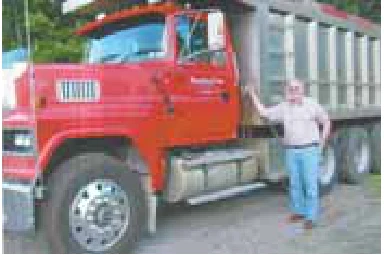
Ron Peck has driven nearly 1.1 million miles delivering gravel with his Keystone Lime Co. Ford dump truck. They weren’t easy miles. The company quarry is on the west side of the highest point in Pennsylvania, and most of the rock gets delivered to the east side of the mountain, explains Peck.

“We’ve had as much as 260 in. of snow in the winter,” he says.

“The engine is either pulling up hill or you’re riding the Jake brakes down the other side with lots of twists and turns.” Bought new in 1995, the truck has a 450 hp, 3506C engine. It has a gross vehicle rating of 75,000 lbs. and a load rating of about 23 tons. Peck reports as many as five 80-mile trips per day with minimal problems.

“The truck’s longevity has to be credited to Ron’s regular maintenance, including oil changes and greasing and treating it like it was his own,” says Melinda Gibson, Keystone Lime Co.

“Several times we have offered to buy him a new truck, but he always turns us down, opting to run the ‘million mile Ford’ one more year.” Peck has the truck serviced with an oil change every 12,000 miles. The Super City dump box is original as well. It was made in nearby Somerset, Penn. He reports the engine was lightly overhauled at 450,000 miles and went through a major overhaul at 800,000 miles. The mountainous terrain has required two clutch replacements, and two transmission bearings have been replaced.

“It still has the original block, crankshaft, rear end and fuel injector pump,” he says.

“I figure the fuel pump has had well over 200,000 gal. through it.” This isn’t the first high-miler Peck has driven in his 50 years of driving Ford trucks. He had two 500,000-mile trucks at Keystone, both of which were still going strong when he turned them over to other drivers. He has driven four trucks in 41 years at Keystone, all Fords.

“When Melinda’s father was boss, he wanted me to take a Chevy once, but I told him, ‘You knew I was a Ford man when you hired me’,” recalls Peck.

“He was a Chevy man, but he bought a Ford for me.” Peck has been good to his Fords. Gibson says even the paint job is original.

“At 1,095,300 miles, the truck has never been in an accident,” says Gibson. Peck credits his miles with the truck for its safety record. He recalls coming down a steep hill into a town and feeling that the steering wasn’t quite right.

“I pulled over, and the hub on one front wheel was broken,” says Peck.

“When you run a truck every day, it becomes familiar.” Gibson says Peck is nearing retirement. When he does, she expects to retire the truck too. Until he does, he remains the only driver.

“The boss would never put another driver in my truck,” says Peck.

“I don’t think anyone else has ever dumped a load off that truck. That makes a difference too.” Contact: FARM SHOW Followup, Keystone Lime Co., P.O. Box 278, Springs, Penn. 15562 (ph 814 662-2711; [email protected]; www.keystonelime.com).

From the archive · Full text
Feature story

Hospital Bed Makes A Great Workbench

Featured source: Jim Borden

The moment Jim Borden saw an old hospital bed at a flea market he knew it would make a great adjustable height workbench. He bought it for $20 and hauled it to his workshop.

“I threw everything away that wasn’t important and disconnected the switches that raise the head and feet,” he says.

“I just wanted it to go up and down.” Borden knew that it would lift at least 350 lbs. That’s enough to handle the antique furniture he restores. Borden built a sturdy 83 by 38-in. top out of inch-thick oak boards he cut, planed and painted, then screwed into holes drilled in the bed frame. The height – raised and lowered with a foot pedal – ranges from 16 to 34 in. The low height makes it easier to place objects on the workbench, and Borden adjusts the height so he never has to bend while working. Besides working on furniture, he’s used it to work on lawn mowers and other projects. A grinder, vise and other tools could easily be mounted on it for working on other projects.

“I wouldn’t have done anything differently,” Borden says about his bed-to-workbench conversion.

“I left the castors on so that when I’m not using it I can roll it out of the way.” Check with hospitals and universities, he suggests, for old beds. His only advice: make sure it still goes up and down before buying. Contact: FARM SHOW Followup, Jim Borden, 914 Montvale Station Rd., Maryville, Tenn. 37803 (ph 865 556-3875).

From the archive · Full text
Feature story

Remanufactured Injectors Boost Pickup Horsepower

Featured source: Performance Injection Systems

You can boost horsepower on a 7.3 Power Stroke engine with remanufactured injectors from Performance Injection Systems (P.I.S.). The company offers a variety of options and is expanding to include common rail Dodge/Cummins engines from 2003 to 2007, newer Power Stroke engines, and 6.0 Power Stroke engines from 2003 to 2007. The company also sells turbochargers and other diesel engine parts and accessories.

“Injection systems for the 7.3 account for most of our business,” says Tim Smith, P.I.S.

“We can do pretty much any size injector or modifications required for a certain set up. Most of our products are used in competition vehicles, drag race or sled pulling trucks. We have some in mud racing, which is a big sport in Florida.” The company also remanufactures and modifies injectors for daily street use. Called Stage 3 injectors, the 200CC/80% injectors’ nozzles increase flow by 80 percent over stock on Power Stroke 7.3 engines for more power and economy. With proper tuning the former stock engines will surpass 450 RWHP (rear wheel hp). Customers can send their current injection systems in for remanufacturing to their specifications. If they can’t afford or prefer to avoid down time while the set is being worked on, they can order a set to meet their needs and pay a core charge. Once their set has been replaced, they can send the old ones in and get a refund on the core charge.

“Some people prefer to reuse their own as they know the maintenance record and how they have been used,” says Smith.

“If you send a set in, we can usually turn it around in 3 to 5 days. If you order a set off the shelf, we have next day service.” Remanufactured sets start at $1,195 per set and range to $2,195 for the most expensive. The 200CC/80% injectors are priced at $1,895. All injectors are inspected, modified and flow bench tested in house. Custom tuning is available for both 7.3 and 6.0 Power Stroke injectors. Smith asks readers to call the toll free number to discuss products they would like to order or order direct from the website. He doesn’t list the postal address on the website or here to avoid people sending parts for remanufacturing before discussing the project. Contact: FARM SHOW Followup, Performance Injection Systems (ph 863 733-4122; [email protected]; www.performanceinjectionsystems.com).

From the archive · Full text
Feature story

“Poor Man’s” Mower Rack

Featured source: John Niesel

John Niesel, Palominas, Ariz., recently sent FARM SHOW photos of the “poor man’s” rack he came up with for his riding mower.

“I don’t have a fancy lift to change the blades on my riding mower. Instead, I keep the mower on my trailer, which comes with a detachable tailgate that doubles as a ramp and hinges on a 5-ft. long metal pin,” says Niesel.

“I lower the ramp until it’s level with the trailer bed. Then I place 4 jack stands at the corners of the ramp.

“I back up the mower until it’s midway between the ramp and trailer, lock the mower’s rear wheels with some wood blocks, and remove the hinge pin by rolling a hydraulic jack under the hinge point. Then I slowly pull the trailer forward until the mower is suspended between the trailer and ramp, with the front wheels on the trailer and the rear wheels on the ramp.” When he’s done with the work, Niesel reverses the process until he can swing the gate back up and lock it in place.

“The hydraulic jack keeps the ramp perfectly level so the pin is easy to line up with the hinge,” he says. He says the same idea would probably work with other kinds of equipment such as golf carts and utility vehicles. Contact: FARM SHOW Followup, John Niesel, 8510 East Sky Trail, Hereford, Ariz. 85615 (ph 602 768-1599; [email protected]).

From the archive · Full text
Feature story

“Looped Hammers” Do Lots Of Different Jobs

Featured source: Jerry Simmons

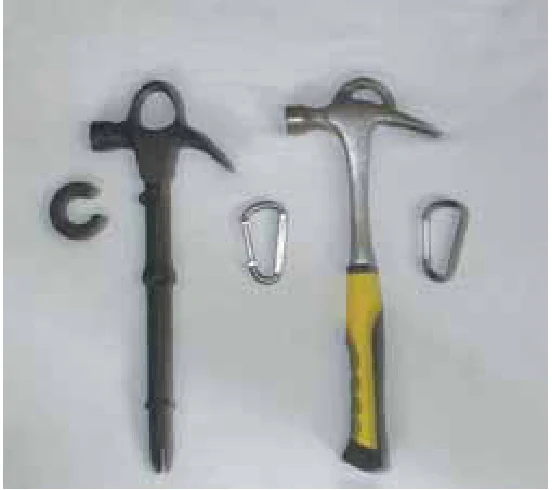
“I thought your readers might be interested in my 2 patented ‘looped hammers’ that can be used for many different jobs such as pulling up large nails and screws, cotter pins, oil seals, dowel pins, and much more,” says Jerry Simmons, Montgomery, Texas. The “Hammer with Leverage Loop” is a steel claw hammer with comfort grip. A rainbow-shaped loop on the hammer head works great for pulling out nails and screws. The loop is flattened to prevent damage to wood when pulling out the nails. You can easily clip the hammer to a belt loop with a carabineer hook.

“It pulls nails like nothing you’ve ever seen and is the perfect hammer for your everyday needs around the house,” says Simmons. The “Hammer with Leverage Loop” comes with a carabineer and sells for $10 plus S&H. The “Multi-Purpose Handheld Tool” looks like a steel claw hammer but has a crows foot pry bar at the bottom in addition to the loop.

“It works great for straightening or removing bent nails and screws, removing staples, twisting fence wire, and fastening or loosening binder straps, etc.,” says Simmons.

“It can be used to pull pins and to straighten or remove cattle gate bolts. Or you can use it as a cheater bar for loosening lug nuts on tires, etc.” A removable fencing ring (supplied) can be used with the tool. The ring has a gap, which goes on under the head of the tool, and twists around and down to the bell-shaped part of the tool to grasp fence wire, barbed wire, cable and cords, etc.

“With the ring in place, you put the wire through the gap, twist and pull the wire tight,” says Simmons.

“ The loop can be used with a come-along to pull the wire, and can also be fitted over T-posts so you can straighten them out or pull them up.” The Multi-Purpose Hand Held Tool comes with the removable fencing ring and a carabineer. It sells for $20 plus S&H. Package deals are available: Two Multi-Purpose Hand Held Tools sell for $30 plus S&H. A package with a Multi-Purpose Hand Held Tool and a Hammer with Leverage Loop sells for $25 plus S&H. Contact: FARM SHOW Followup, Jerry Simmons (ph 936 851-2040; [email protected]; www.jerryrigintools.com).

From the archive · Full text
Feature story

Small Engine Stand Makes Repairs Easy

Featured source: Jerry Maddock

Jerry Maddock didn’t want to bend over his Briggs & Stratton engines as he worked on them. So he built a stand that lets him work from a chair and rotate the engine as needed. It also serves as a handy mount for his innovative flywheel holder.

“I wanted to be able to roll up in a chair and be able to move the engine around the shop as I worked on it,” says Maddock.

“It lets me take apart an engine, work on it and reassemble it without ever taking it off the stand.” He started with a commercial H-frame engine stand with an engine support arm. He modified the base and the mounting plate. He cut off all 4 wheels and replaced them with the locking castors. They ensure the stand remains in place, even if it tips so 2 wheels come off the floor. The original stand allowed the mounting arm and engine to be rotated into one of several fixed positions. Maddock wanted infinite positions, but commercial stands with that option cost several hundred dollars. The original system involved a round steel shaft that extended through a housing on the stand’s upright and attached to the engine support arm mounting plate. A bar at the rear was turned to rotate the engine into positions at 45° intervals. Maddock replaced the bar with a salvaged worm gear drive from a winch. "I removed the cable from the winch and attached it to a round ring that I milled to fit over the mounting plate shaft," says Maddock. "The worm drive lets me easily rotate the mounting plate and engine. I use two set screws and a pin to lock the shaft in place. On these light engines, I can pull the set screws and pin, slide the winch off and free wheel the engine." Since the bulk of the engines he works on are small Briggs & Stratton's, Maddock made a bracket specific for these engines and bolted it in place of the support arm. It bolts to the engines where their starter/generator would normally attach. Other brackets work with larger engines. If he needs to work on a flywheel, he makes special brackets with a curve for the flywheel. He uses a pipe bender on a piece of steel strap to match the curve of the flywheel. A tab on the end of the curve fits over a fin on the flywheel. Once the bracket is in place, Maddock adds more tabs to “sandwich” multiple fins. "When you’re trying to torque a flywheel off or on, it wants to lift constantly, and you need someone to hold the engine down," says Maddock. "With this, I can torque the flywheel myself." Maddock has also fabricated a front engine support for his Simplicity garden tractor. It bolts to the mounting plate. "It lets me rotate the front end for welding new bearings in place and other work," says Maddock. "Whether front end or engine, the worm gear lets me adjust them as little or as much as I want." Contact: FARM SHOW Followup, Jerry Maddock, 29197 Standley Rd., Defiance, Ohio 43512 (ph 419 395-1594; [email protected]).

From the archive · Full text
Feature story

Stabilize Fuel For Up To 3 Years

Featured source: Briggs & Stratton

You can protect engines from bad gas for up to 3 years with Advanced Formula Fuel Treatment and Stabilizer from Briggs & Stratton, according to the company.

“Ours is the only 5-in-1 formula on the market that includes a triple antioxidant formula, corrosion inhibitors, metal de-activators and a detergent,” says Carissa Gingras, Briggs & Stratton Corp.

“It works with any octane level and can be used in any gasoline-powered engine. Because our Advanced Formula Fuel Treatment and Stabilizer also stabilizes fuel for storage, we recommend using it even with ethanol-free fuel.” Briggs & Stratton uses their Advanced Formula product in their own branded pre-mixed fuel. They also recommend it be added every time a consumer fills a can with gas for use with 2 or 4-cycle engines.

“Because gas begins to degrade after only 30 days, it’s critical that a treatment like ours be used to help maintain good engine health,” says Gingras. The new fuel treatment with its dual corrosion inhibitors stops chemical reactions caused by dissolved metals in fuel. Water protection inhibitors protect against the harmful effects of water in fuel due to ethanol. Detergent ingredients prevent gum and varnish build-up on engine parts.

“The detergent will help clean out gums and deposits already there,” says Gingras.

“However, there is no product on the market that can make bad gas good.”

Once opened, 5-in-1 Advanced Formula Fuel Treatment and Stabilizer has a recommended shelf life of 3 years. The 4-fl . oz. container treats 20 gal. of gas. It’s priced at $6.55. The 16-fl . oz. container treats 80 gal. of gasoline and is priced at $12.60. Contact: FARM SHOW Followup, Briggs & Stratton Corporate Headquarters, P.O. Box 702, Milwaukee, Wis. 53201 (ph 414 259-5333; www.BriggsandStratton.com; www.EnginesMatter.com).

From the archive · Full text
Feature story

Master Parts Maker For Antique Oliver Tractors

Featured source: Richard Lynch

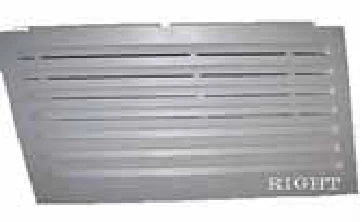
Over the past 30 years, Ohio farmer Richard Lynch has turned his ability to make sheet metal parts for Oliver tractors into a thriving business. It started almost by accident when, in 1980, Lynch was restoring an old Hart-Parr 70. He needed side panels but he couldn’t find them at collector shows or through his contacts. Another 70 owner loaned him a clean set of side panels and Lynch found a metal shop that could stamp new replacements for him. Richard asked the shop to stamp a few extras as long as they were at it. Within a few weeks, Lynch had sold those extra panels at a Hart Parr Oliver collector’s show.

“I came home from that show excited about making side panels for old Olivers,” Lynch says.

“At the same time I knew I had to learn how to do the work myself in order to make any money at it.” Although it took him nearly 10 years to acquire the know-how and equipment to do the work, Lynch was persistent. In 1990, he started Lynch Farms Tractor Parts after purchasing a milling machine at an auction. Today he and his son Ron build and stock more than 30 hoods and side panels for vintage Oliver tractors originally built between the 1930’s to the 1960’s. His reproduction panels are made for the Fleetline 66, 77 and 88’s and the later “Super” models of those same numbers. He also makes parts for Oliver 3-digit tractors, the styled 60 and 70 series, and the Hart Parr Oliver model 70 side panels.

“Restoring old Olivers must be a huge business across the country,” Ron says with first hand knowledge.

“I have to order a new stock of sheet metal every couple months.” Their business has sold replacement panels throughout the U.S., Canada and even to New Zealand.

“The cost to ship side panels ‘down under’ was outrageous,” says Ron.

“Luckily I was able to get 2 customers together. One was having a tractor shipped from the U.S. in a container, so we put the panels in with that tractor.” All of the panels sold by the business are primed and ready to be painted by the customer ordering them. Over the years, he’s acquired and restored just about every Oliver ever made. He has about 45 in his personal collection, including a unique 1946 model 70 Orchard, which gleams like it just came off the factory paint line. Richard, his wife Peggy and their sons Ron and David are also farmers, raising food-grade corn and soybeans. Between farm jobs and parts manufacturing they find time to attend tractor shows in the Midwest and distant states like California and Florida to promote their business. What began as an only replacement panels business now includes refurbishing tractors, bulldozers, plows, disks and even electric motors.

“Once a person gets started in these things it just kind of leads from one thing to another,” says the elder Lynch.

“My sons are now a part of the business, and that’s important because it means the show will go on.” Contact: FARM SHOW Followup, Richard Lynch, Lynch Farms Tractor Parts, 1624 Alexander Rd., Eaton, Ohio 45320 (ph 855 847-5900; www.lynchfarmstractorparts.com).

From the archive · Full text
Feature story

They Repair Cast Iron Cracks And More

Featured source: Gary Reed

Cracks in cast iron can be drilled and filled with Lock-N-Stitch threaded inserts that seal cracks tight or seal patches in place.

“Whether you’ve got a cracked bolt hole, a cracked block, heat cracks, impact cracks or design failure, we offer a permanent fix,” says Gary Reed, Lock-N-Stitch.

“We make the repaired surface stronger than before the fix.” Lock-N-Stitch makes a variety of inserts, locks and other tools for metal repair. They also offer repair and training services.

“We are a manufacturing company making the insert pins, locks, thread repair inserts, kits and tooling for repair work,” he explains.

“However, we are also a cast iron welding and stitching company, and 50 percent of the parts we manufacture are used by us. We have crews travelling all over the world to repair everything from heavy industry jobs down to the smallest jobs.” Reed says company products and services are used by major OEM manufacturers like Detroit Diesel, Cat and Deere, as well as by the company’s competitors. The company is currently using their products on the dome of the U.S. Capital.

“We have a 10-man crew repairing 27,000 in. of cracks in the dome,” says Reed.

“It will take them a year to do the stitching.” When Reed talks about stitching, he means drilling a hole or a set of holes using special jigs. Once stitching holes are threaded, they are filled with special inserts, depending on the situation. As the pins are tightened their heads break off above the surface. Protrusions are ground down, and then a second set of holes is drilled, slightly overlapping the first set of pins. Once these have been ground down, the repair is finished and a solid surface remains. In some cases, a standard, tapered, threaded pin is used to create radial pressure. This works if the cast has enough integrity to contain the pressure. The solid cast pushes back against the filler pins. A crack running along an edge of a casting or into a core plughole doesn’t have that integrity. Standard tapered pins will expand the crack due to what Reed describes as “cumulative spreading pressure”. Lock-N-Stitch offers a special pin design called the Castmaster. The bottom of the fastener thread is 45°, but the top is a negative 20° and acts like a hook. The shoulder of the pin has a reverse angle on it and when tightened into a matching machined counter bore, pulls up on the thread. This draws the metal together. "Castmaster pins add strength instead of spreading pressure," says Reed. The Full-Torque hole repair system uses a similar thread pattern for bolt hole repair. Reed notes that freeze or impact cracks often result in cracked bolt holes as well. Stripped or damaged threads in spark plugs and other bolt holes can also be repaired with Full-Torque inserts. "We can take a bolt hole split right down the middle, put an insert in and pull the metal back together," says Reed. "The more you torque it, the stronger it gets. If it’s repairable, we can come up with a way to do it." Reed says Full-Torque inserts create a pressure-tight seal that can withstand 3,000 psi hydraulic pressure. "We don't just do stitching," says Reed. "Damage to cast iron or other cast metals breaks into two categories. It’s either an accident or a design failure where it has cracked under normal operating conditions." In the first case, Reed uses stitching to repair the problem and bring it back to 100 percent. In the case of design failure, Reed adds reinforcements or brackets to attach. Reed points out that cast iron is preferred for its traits of staying straight under heat and not warping. However, that same trait makes it extremely hard to weld any place but edges. Welding works best with things that can stretch and bend. "Attempting to weld cast iron produces massive amounts of confined expansion and contraction that leads to more cracks, especially if the welding is in the middle of the cast," explains Reed. "Stitching avoids the heat issue." "That can't be done on site or in frame," he says. "That's where stitching with pins and our inserts come in. They let you repair on-site quickly and get back in use. We do lots of ag equipment." Contact: FARM SHOW Followup, Lock-N-Stitch, Inc., 1015 S. Soderquist Rd., Turlock, Calif. 95380 (ph 209 632-2345 or 209-614-4114; toll free 800 736-8261; www.locknstitch.com; www.fulltorque.com).

From the archive · Full text
Feature story

Ready Lift Levels Pickup Chassis

Featured source: Brian McCormick

Pickup owners often complain about their vehicle’s “nose diving” look when there’s no weight in the box. A Nevada company has a solution to that problematic situation with a product called Ready Lift. It’s an easy-to-install leveling kit that’s available for all pickup brands on the market today.

“We came up with this product because we realized that truck owners didn’t like the ‘nose down’ look, and furthermore they wanted to install larger tires,” says Ready Lift’s Brian McCormick.

“The beauty of this product is that it’s made of aircraft-quality 6061 billet aluminum, which is tough, light and rust resistant. It has a hardness rating of 10.9.” McCormick says the Ready Lift is easy to install by do-it-yourselfers. The spacers mount above the coil spring and bolt onto the spring pocket. The shocks and springs have to be loosened and removed for the leveler installation, but they don’t have to be cut or altered. Mounting studs supplied with the spacers are used to hold them in place. A wheel alignment is suggested after installation.

Since the Ready Lift provides only 2 to 3 in. of lift, depending on the vehicle, the OEM shocks are reinstalled.

“The finished installation gives the vehicle a completely level appearance, front to back,” says McCormick, “and it doesn’t affect the ride or handling at all.” Having a Ready Lift on a truck also allows the vehicle owner to install a larger 33 to 35-in. tire and wheel setup. The Ready Lift spacers are available in black, red or blue anodized finishes. Contact: FARM SHOW Followup, Ready Lift Suspension, 7490 Commercial Way, Henderson, Nev. 89001 (ph 800 549-4620; [email protected]; www.readylift.com).