Practical ideas from FARM SHOW MagazineSubscribe · Free issue · Send us your shop tip
Subscribe to FARM SHOW
Issues / Vol. 42, No. 4 (2018)

Vol. 42, No. 4 (2018)

Money-Saving Repairs & Maintenance Shortcuts · Printed section pp. 32–35

37 selected entries · Complete text of selected entries

This issue’s section includes reader tips and feature-length shop stories. Held items and editorial notices are not reproduced.

Archive text: prices, coupons, availability and contact details reflect the original publication, not current offers. Reader methods are not universal instructions; follow manufacturer guidance and proper safety practices.

Reader shop tips

From the archive · Full text
Reader shop tip 1 of 2

Andy Nelson

Individual tip 1 of 2 from this reader’s published contribution.
Andy Nelson, Webster, Minn.

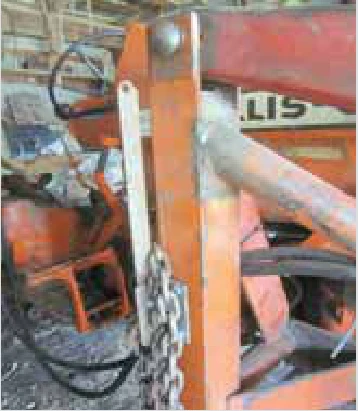
“I wanted a handy place to store chains on my Allis Chalmers 170 loader tractor, so I bolted an angle iron bracket onto one of the loader arm uprights and then bolted an 18-in. long, 2-in, wide metal strap vertically onto it. I just drop chains into a small gap between the strap and upright so they hang down from the angle iron. Works great.

From the archive · Full text
Reader shop tip 2 of 2

Andy Nelson

Individual tip 2 of 2 from this reader’s published contribution.
Andy Nelson, Webster, Minn.

“I also bolted a pair of chain hooks on back of the loader bucket, which I use with a chain to drag logs out of the woods. I drilled holes in the mounting brackets that support the bucket cylinder, then slipped each hook over the top of the bracket and inserted a bolt.”

From the archive · Full text
Reader shop tip

Grant England

Grant England, Gales Creek, Oregon

“I had several 5-gal. buckets that had been stacked inside each other. I tried to separate them but couldn’t. The buckets had been left outside all winter and were full of water that had seeped down into the lowest bucket, creating a vacuum that made it all but impossible to pull the buckets apart.

“I used my air compressor to blast air into all the places where the buckets came together, and they came apart easily.”

From the archive · Full text
Reader shop tip

LeRoy Carroll

LeRoy Carroll, Northwood, N. Dak.

“Before winter I disconnect the terminals on all my batteries and use a wire brush to clean them. Then I reconnect the terminals and coat them with Vaseline. It prevents corrosion and keeps my batteries cranking all winter long. Vaseline also works great to keep flashlight batteries from corroding.”

From the archive · Full text
Reader shop tip

William Greyerbiehl

William Greyerbiehl, Bad Axe, Mich.

“Old stainless steel swimming pool ladders, the kind used in many portable pools, work great to do maintenance work around my farm. The ladder sets over the top of the pool and has rungs on each side to climb up or down. People often get rid of these pools when the liner goes bad and sometimes sell the ladders cheap at garage sales.

“I often use the ladder with my Case backhoe tractor to do maintenance work and to fill it up with fuel. I place a 2-ft. long 2 by 12 across the top rungs to make a stable platform. The legs curve out at the bottom and have rubber tips so the ladder isn’t likely to tip over as I stand on it.”

From the archive · Full text
Reader shop tip 1 of 2

Keith Bleicher

Individual tip 1 of 2 from this reader’s published contribution.
Keith Bleicher, Shushan, N.Y.

“I’m a licensed master electrician and overhead crane technician, and also a backyard welder and mechanical designer. Since I often have to work alone, I’ve come up with some handy ideas for storing small tools and parts.

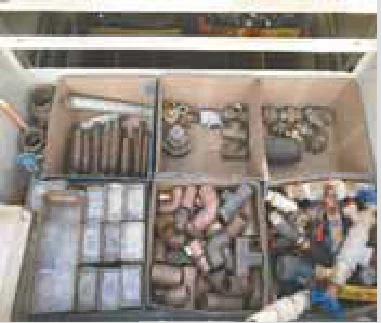
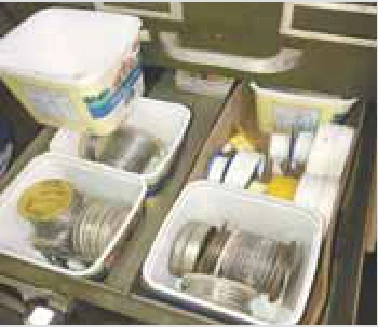
“One idea is to use the cardboard cartons that hold new spools of MIG welding wire. The boxes are about 14 in. square, and by splitting them in half and flipping them upside down, you have 2 instant bins that will fit neatly into cabinet drawers. Plastic margarine containers or baby wipe containers can be placed inside them.

From the archive · Full text
Reader shop tip 2 of 2

Keith Bleicher

Individual tip 2 of 2 from this reader’s published contribution.
Keith Bleicher, Shushan, N.Y.

“I also take a 1/2-gal. cardboard milk container and cut one side open to make small bins. The waxy material that coats the containers keeps oil and other lubricants from leaking out.”

From the archive · Full text
Reader shop tip

James Henson

James Henson, Union Mills, N.C.

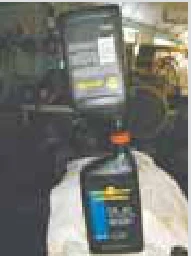
“After pouring oil out of a 1-quart plastic bottle, there’s always a little left in it. I came up with an easy way to collect it. I cut the centers out of two 1-quart bottle caps, and also cut the center out of a Gatorade bottle cap that has an inside diameter the same as the outside diameter of the oil bottle caps. I place the oil bottle caps back to back and used J-B Weld to connect them. Then I slide the Gatorade cap over the place where the oil bottle caps are glued together, and used J-B Weld to hold it in place.

“All I do then is screw a bottle onto each oil bottle cap and let oil drip through from one bottle to the other. It takes only about one minute for all the oil to drain out of the bottle.”

From the archive · Full text
Reader shop tip

Tom Smith

Tom Smith, Sturgis, Sask.

“I recently tried to dislodge a sink drain blockage, but the blockage extended just beyond the reach of my 25-ft. long snake auger. Instead of calling a plumber, I bought a length of 1/2-in. dia. plastic tubing longer than 25 ft. I made an angled cut at the leading edge of the tubing and then pushed it through the blockage and into the sewer line from a floor access opening. From this point, I could either connect a hot water hose or an air compressor to the tubing, and then slowly move the tubing back out of the blockage to clear the sewer line.

“This idea eliminates the need to mess with chemicals and degreasers. I paid less than $15 for the plastic tubing.”

From the archive · Full text
Reader shop tip

Donald Chapman

Donald Chapman, Billings, Mo.

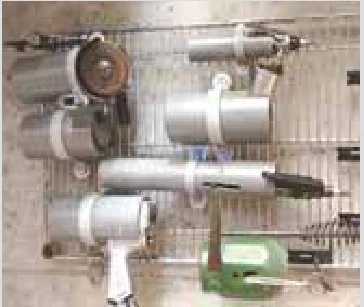
“I mounted a 4-ft. long by 20-in. wire rack on my shop wall to make a handy air tool storage rack. I cut up lengths of pvc electric conduit in order to make customized tool holders that are supported by pvc conduit hangers. I also cut notches into each holder to make room for the tool’s handle.

“I use the rack to store everything from straight die and air grinders to grinding wheels, sheet metal shears, impact hammers, impact wrenches, and so forth.

“I also hang small metal hooks on the rack to hang my welding helmet and other welding supplies.”

From the archive · Full text
Reader shop tip

Michael Antonellini

Michael Antonellini, Keysville, Va.

“A seal was leaking grease because it had worn a groove into a shaft on one of my machines. I mixed up some J-B Weld and filled in the groove. I let it set 24 hrs. and then used some emery cloth strips to sand down the J-B Weld until it was even with the shaft. No more leaking.”

From the archive · Full text
Reader shop tip

John Travis

John Travis, Dundee, N.Y.

“The pedal that’s used to raise or lower the 60-in. deck on my Ferris zero-turn riding mower was hard to push down, so hard that I eventually suffered a torn meniscus knee injury. Ferris makes a deck lift assist for some of their mowers but not mine. My neighbor, who owns a fabrication shop, suggested we could use an electro-hydraulic cylinder from an old Deere small square bale thrower to raise or lower the deck automatically.

“He removed the pedal from its vertical support lever and attached one end of the cylinder to the lever and set the other end at a fixed position. The cylinder is wired to the mower battery, so now I just use a toggle switch to raise or lower the deck.”

From the archive · Full text
Reader shop tip

Russell Nemtschk

Russell Nemtschk, Thorndale, Texas

“Here’s an idea I use when I need to change spark plugs but don’t have much room to maneuver. I attach a piece of 3/16-in. dia. vacuum hose onto the plug and then thread it into place. Twisting the spark plug this way gives me a good sense of feel so I don’t accidentally strip the threads.”

From the archive · Full text
Reader shop tip

Josh Wilks, Jr.

Josh Wilks, Jr., Tillatoba, Miss.

“To paint smaller items, I screw several wood screws part way into a couple boards so they hold the item above the surface of the wood. When I want to flip the item over to paint the other side, I put the other board over the top and flip both boards over.”

From the archive · Full text
Reader shop tip

Thomas G. Fargen

Thomas G. Fargen, Plain, Wis.

“One of the handiest additions to my shop was hanging a cheap electric winch from the rafter that I can use to lift riding mowers, wood splitters, boat motors and motorcycles. Cheap and easy.”

From the archive · Full text
Reader shop tip

Leonard O. Nolt

Leonard O. Nolt, Owen, Wis.

“We can buy 2 4-ft. LED bulbs for less than what it costs to replace the ballast in the fluorescent lights in our dairy barn. So when a ballast goes out, we remove it and then replace the lights with LED bulbs. When purchasing LED bulbs, remember that some LED’s are made to be direct replacements and work with the ballast. We use ones that bypass the ballast because they’re more efficient. You can find YouTube videos that show how to rewire the light fixtures as needed.”

From the archive · Full text
Reader shop tip 1 of 2

Gary F. Thomsen

Individual tip 1 of 2 from this reader’s published contribution.
Gary F. Thomsen, Arion, Iowa

“Our H Farmall was very hard to start. It cranked very slowly. I shortened one of the 6-volt battery cables by 10 in. Problem solved.

From the archive · Full text
Reader shop tip 2 of 2

Gary F. Thomsen

Individual tip 2 of 2 from this reader’s published contribution.
Gary F. Thomsen, Arion, Iowa

“The remote for our garage door opener stopped working. A new one would have cost a whopping $168 because the opener was 25 years old. I took it apart and found that a soft plastic plunger had deteriorated. I cut off a piece of the soft grip on a ballpoint pen and installed it into the remote. Worked great.”

From the archive · Full text
Reader shop tip

Larry J. Fenske

Larry J. Fenske, Blue Earth, Minn.

“I don’t like to heat my entire shop so I save money by keeping everything that needs to be kept warm in a 10 by 12-ft. lean-to on the side of my shop. I have a 30,000-btu non-electric propane heater to keep it warm.”

From the archive · Full text
Reader shop tip

Dan Deal

Dan Deal, Vernon Center, N.Y.

“I keep a cup of used anti-freeze to dip drill bits in when drilling instead of cutting oil. Works better to keep bits sharp, lubed, and cooled.”

From the archive · Full text
Reader shop tip 1 of 3

William Sanford

Individual tip 1 of 3 from this reader’s published contribution.
William Sanford, Roxboro, N.C.

“I had an electric clutch fail on a 140 Deere lawn tractor. Instead of paying $400 plus for a new part from Deere, I sent it off to be repaired by a clutch rebuild company at a cost of just $175.

From the archive · Full text
Reader shop tip 2 of 3

William Sanford

Individual tip 2 of 3 from this reader’s published contribution.
William Sanford, Roxboro, N.C.

“Another tip I have is to buy oil change kits from auto parts stores and substitute mower or tractor filters for the automotive filters. Saves a lot of money.

From the archive · Full text
Reader shop tip 3 of 3

William Sanford

Individual tip 3 of 3 from this reader’s published contribution.
William Sanford, Roxboro, N.C.

“The best modification I made in my shop is to put 2-in. pads of foam rubber on all my creepers. My back thanks me at the end of the day.”

From the archive · Full text
Reader shop tip 1 of 2

Ryan Van Der Bill

Individual tip 1 of 2 from this reader’s published contribution.
Ryan Van Der Bill, Sioux Falls, S. Dak.

“I hang a box fan in my shop with a square 1-in. thick furnace filter mounted on the back side. It pulls dust out of the air above my power saw. It’s probably best to use a cheap fiberglass media filter since a better pleated filter would slow down the flow of air. Just vacuum the filter off once in a while.

From the archive · Full text
Reader shop tip 2 of 2

Ryan Van Der Bill

Individual tip 2 of 2 from this reader’s published contribution.
Ryan Van Der Bill, Sioux Falls, S. Dak.

“Here’s another shop idea. If you have a small bench grinder or other tool that you don’t want to mount permanently on your workbench, mount it to a piece of plywood fitted with a couple screws that you can use to hold it tightly on your workbench when needed. Quicker and easier than using C-clamps.”

From the archive · Full text
Reader shop tip

Andy Kozlowski

Andy Kozlowski, Califon, N.J.

“I use a car bumper jack from the 1970’s to lift my zero-turn mower so I can clean the deck and sharpen blades. I put a ring on the bumper jack’s hook and then put an S-hook on that. I place a jack stand under the deck for safety. Best of all, the bumper jack takes up little space when not being used.”

Shop feature stories

From the archive · Full text
Feature story

4020 Fitted With Heavier 5010 Front End

Featured source: Lynden Jenkins

Lynden Jenkins says his brother-in-law was frequently breaking spindles on his Deere 4020 loader tractor, so he replaced the OEM spindles with the larger front end from a Deere 5010. Jenkins says fitting the heavier axles required reworking that his brother-in-law was able to do with a mechanic’s help. Long-time tractor mechanic Hank Wittrok says it’s fair to assume the 4020 spindles were breaking because the operator was using a bucket and loader that were too large for the tractor. Deere specifications call for mounting a Deere 148 loader capable of lifting 3,100 lbs. or a 158 capable of lifting 3,800 lbs. on a 4020. The breakout force of those loaders is 4,700 to 5,000 lbs. Wittrok says it isn’t uncommon to mount a larger loader with more breakout and lifting force that could easily crack or break the spindles. A Deere 4020, listed at 80 hp., had standard spindles 15.125-in. long with a 1.50-in. shaft and 1.687-in. dia. wheel mount. The 5010 is a 120 hp. tractor built on a much heavier frame and weighing almost 4,000 lbs. more than a 4020. Standard 5010 spindles are 2 in. thick. Wittrok says finding a 5010 front end nowadays can be like searching for a needle in a haystack because fewer than 10,600 of those tractors were built. In the early 2000’s mechanic Ed Beem of Iowa rebuilt Deere axles and adapted other models to 40 series tractors. He passed away in 2009 and it’s not known if anyone currently does rebuilds like those Beem did. Contact: FARM SHOW Followup, Lynden Jenkins, P.O. Box 171, Freedom, Wyo. 83120.

From the archive · Full text
Feature story

Make Rings From Springs

Featured source: Andy Kozlowski

Making steel rings for shop projects or quick fixes is easy if you have some old springs lying around. Andy Kozlowski has a foolproof method that’s fast and easy if you take the right precautions.

“Use protective eyewear, and don’t put your fingers or anything fragile or of value between the coils of large springs,” warns Kozlowski.

“Broken or discarded garage door springs and others that are strong and tight can be hard to separate. If one hand gets pinched in a spring, it will be hard to get it out with only one free hand.” The first step in cutting one or more coils loose from a spring is to run a wire or cord through the center of the spring as a restraint. It will keep the cut coil(s) from flying loose. Kozlowski points out that metal rings are two coils thick except where the ends overlap. When cutting coils loose, find the existing end and then back off from that point on the coil being cut.

“It is customary to cut the new end on a slant like the old one, but not required,” adds Kozlowski With the restraint in place, identify the spot to be cut. Use a screwdriver to separate the coils to provide access to the cutting target.

“The bigger the screwdriver, the more room you will have to work; however too large and it may stretch the coils, leaving space between them,” says Kozlowski. He suggests using a Dremel tool with a steel cutting disk. If creating a one-coil ring, simply make a lateral cut the length of the spring to release the desired number of rings.

“You can use a Dremel, an angle grinder with a cutting disc, a pair of bolt cutters or even a hacksaw for this,” says Kozlowski. When first cut away, the ends will not line up due to the coiling of the spring. The cut also leaves a space between ends; however, both problems are easily solved.

“Use 2 screwdrivers to bend the ends further out of alignment until they clear each other,” says Kozlowski.

“Using a pair of groove joint pliers, compress the ring until the space between ends is as small as desired. Then use the screwdrivers again to realign the ends.” Kozlowski suggests using a bench vise on larger spring coils. He adds that if using the rings to hold items like keys, add them to the ring before compressing and aligning ends. Rings to be closed permanently can be tack welded at the joint. For a full set of pictures and more detail visit http://www.instructables.com/id/Rings-and-Split-Rings/. Contact: FARM SHOW Followup, Andy Kozlowski, 61 Old Readingsburg Rd., Califon, N.J. 07830 (ph 908 399-8886; [email protected]).

From the archive · Full text
Feature story

From Snapper Mower To Mobile Forge

Featured source: Jim Blackford

An old Snapper riding mower inspired Jim Blackford to build the forge he had wanted for decades. He flipped the mower deck upside down and welded it to a stand that puts it at the perfect working height. And since it is on wheels, it’s easy to move wherever he needs it. After removing the mower blades, motor and seat, Jim mounted the deck to use as the firebox for the forge. He welded parts from an old chain hoist to the mower frame to create a flat area for an anvil. A used blower fan from an industrial furnace provides air for the fire.

“He had some issues with the pump, getting the air to circulate right,” Michael notes, but got it to work by adding a plate with a few drilled air holes. Blackford burns wood to make coals for his forge, and when the coals are burned up, they are easy to remove using the deck’s side chute. Since he can roll it to wherever an extension cord reaches to power the fan, Blackford uses it to fix pieces of equipment like a 3-point hitch on a sickle mower. He’s also used the forge to create knives for relatives. Contact: FARM SHOW Followup, Jim Blackford, 8926 Shelby 486, Hunnewell, Mo. 63443 (ph 660 346-6285).

From the archive · Full text
Feature story

How To Straighten Out Dodge Truck Steering

Featured source: Jeff Grantmeyer

“Chrysler has been screwing up steering since the first Dodge Ram,” says Jeff Grantmeyer at Borgeson, manufacturer of replacement steering components.

“They have a great power train, but the rest of the vehicle is lacking in several areas. One that always needs addressing is steering.” One of the problems with Dodge steering is a coupler that shows signs of wear in as little as 4,000 miles, depending on use. This creates play in the steering. The problem is even more noticeable if the truck is used for plowing, towing or with oversized tires. Borgeson claims their steering shaft assembly with precision bearing U-joints and a telescopic shaft will outperform OEM parts. It is priced from $198 to $320, depending on model. The company also offers heavy duty power steering boxes for 2003 to 2008 Dodge Ram trucks. The Borgeson Dodge Box has the largest piston diameter for the most available power assist, quicker ratio for less turns lock-to-lock, and a modern variable valve that provides stable driving and easier parking and maneuvering. The Dodge Box is priced at $695. The third steering component for Dodge trucks offered by Borgeson is the pump. Their Hi-Flow power steering pump is a direct replacement for pumps on the 1994 to 2002 Dodge Ram 2500 and 3500 trucks with the Cummins Turbo Diesel motor. The pump has output pressure/flow calibrated to 1450 to 1550 psi and 3.5 gpm. It also features a reservoir with 2 returns to support Hydro-Boost or Vacuum brake applications. The pump is priced at $195. OEM style power steering lines are also available. Contact: FARM SHOW Followup, Borgeson, 9 Krieger Dr., Travelers Rest, S.C. 29690 (ph 860 482-8283; [email protected]; www.borgeson.com).

From the archive · Full text
Feature story

Easy Ways To Patch Control Cables

Featured source: Roger Podoll

Roger Podoll has a quick fix for broken throttle or choke cables. If the outer sleeve is broken or too short, splice it with a second piece and slide a new wire through the two. He uses a variety of electrical connectors to secure one cable sleeve to another.

“You can go to any big box store like Menards or Lowes and look for #8 or #10 inline union lugs,” says Podoll.

“Just slide in the cables and tighten down the set screws. Single set screw inline lugs with a predrilled tab are also handy for securing a cable out of the way.” Podoll suggests drilling a second 3/16-in. hole in the lug at a 90-degree angle to the first. This leaves the predrilled hole in the tab for attaching to another surface. Another quick fix uses split-bolt and lug ground wire clamps.

“The holes are big enough for the choke cables and a cotter pin or nail,” explains Podoll.

“When you tighten down the lug, the cotter pin or nail locks both clamps together.” Another even quicker fix is to use shrink-wrap tubing.

“Put multiple layers on and then use a thicker wrap over the top,” says Podoll.

“The thick wraps have a sticky substance on them. Shrink them down, and they will hold.” Shrink-wrap tubing can also rescue cable that has been sitting unused and seems locked in place. Podoll uses the tubing to force oil over the wire and into the cable.

“Put one end of the tubing over the tip of the oil can and the other end over the cable,” says Podoll.

“Shrink them down and you have a tight connection between the two. You also can use it to soak a bolt and nut with penetrating oil. Shrink the tubing over the nut or bolt and leave the other end as a stem. Fill the stem with penetrating oil and let it sit over night.” Shrink-wrap tubing also works great to keep dirt out of spliced cables or as an insulator to keep them away from electrical wires. Simply slide them on the 2 cable ends before securing them with lugs or other connectors. Keeping choke cables from going bad in the first place can be as simple as making sure an engine has a good ground.

“If you ever feel a choke or throttle cable is warm, take the ground apart on the frame and shine it up, perhaps add a couple of star washers or add another ground,” says Podoll.

“Without a good ground, the electricity can try to fuse the inner cable to the outer sheath.” Contact: FARM SHOW Followup, Roger Podoll, W8772 State Rd. 21, Wautoma, Wis. 54982 (ph 920 295-2357).

From the archive · Full text
Feature story

Wheel Kit Mobilizes Battery Charger

Featured source: Robert Troyer

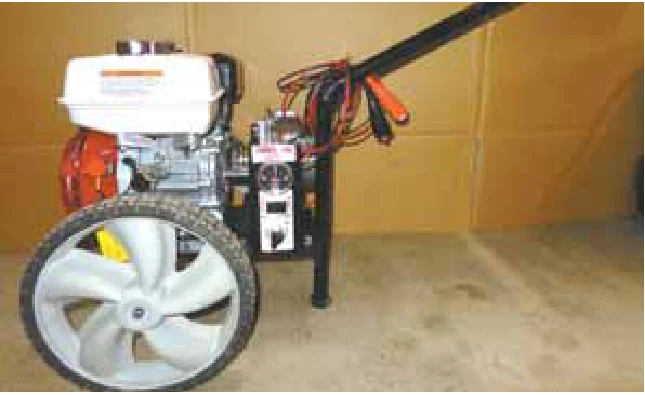
If you have a belt-drive battery charger from Power Pak, you can make it mobile with their wheel kit option. If not, Robert Troyer will be glad to sell you both charger and kit.

“It only takes 4 bolts to attach the wheel kit and handle to one of our chargers,” says Power Pak’s Troyer. Troyer sells 6, 8 or 12-volt, manually regulated battery chargers as well as a 12-volt automatically regulated charger. The chargers are available with a 4 hp. Honda engine priced at $495 or a 2.4 hp. Brilliant engine priced at $419. Chargers without motors are also available. Shipping is extra.

“The wheel kit is only $65 with free shipping and turns a stationary battery charger into a mobile one,” says Troyer.

“I’ve been selling the kits for 20 years and have received very good feedback on them.” The kits include 12-in. tires and an angle iron frame. The handle is a round steel tube. Kits and battery chargers are available direct from Power Pak or from local dealers.

“We are always looking for more dealers,” says Troyer. Contact: FARM SHOW Followup, Power Pak, 33720 CR 10, Fresno, Ohio 43824 (ph 330 897-2805).

From the archive · Full text
Feature story

Do You Have These In Your Toolbox?

Featured source: Faithfull, Bosch and Teng Tools

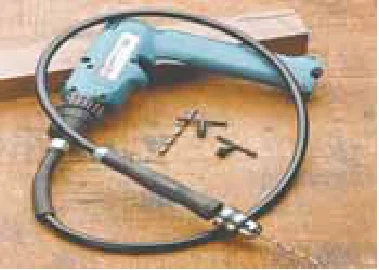
The 43-in. long Faithfull flexible driveshaft extends the reach of a power drill. One end fits into the drill’s chuck and the other end has a keyless chuck to slip in a drill bit, wire brush, grinding wheel, etc. With reinforced ends and an anti-kink design, the shaft is built to last. The Faithfull shaft sells for about $34 at Sears, Amazon and online stores. To sharpen drill bits, the Bosch drill bit sharpener ($100 at Amazon.com) can pay for itself if you have a toolbox full of blunt bits. The Bosch sharpener’s grinding wheel is powered by a drill. Just push the bit into the right size hole and twist it. That’s it. Sometimes power tools aren’t enough for a job like loosening a seized bolt, so you just have to cut your losses. Teng Tools nut splitters break nuts apart and can be used with a ratchet or power tool. We found a two-piece set on Amazon for $28. The pro-grade tool comes with a lifetime guarantee.

From the archive · Full text
Feature story

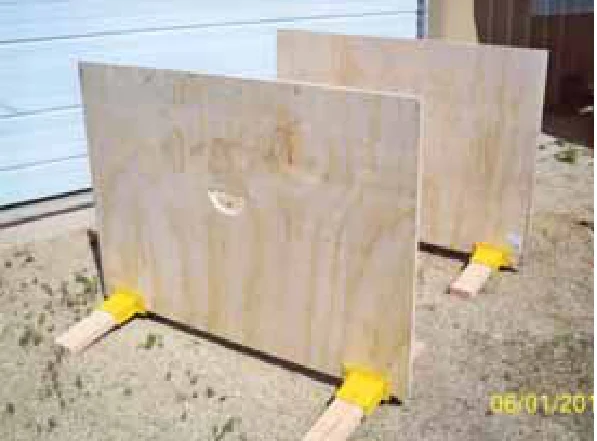
Sawhorses Made Out Of Plywood

Featured source: Larry Satur

“My new Little Mule Sawhorse lets you set your skil saw to full depth and work all day long without cutting into metal or weakening the structure of the sawhorse,” says Larry Satur, Gillette, Wyo. He sells steel brackets designed to accept short 2 by 4’s that serve as sawhorse legs. Each bracket also accepts a 3/4-in. thick sheet of plywood. The brackets are made from 1/8 and 3/16-in. steel and come with a 3/4-in. wide gap in the middle. A 2 by 4 is inserted through each side of the bracket until it contacts a rectangular plate, and is then screwed on from the top using a pre-drilled hole. A plywood sheet is then inserted into the gap and screwed into place using another pre-drilled hole in the bracket plate. Once the plywood sheets are in place you can put any kind of table you want on top of them.

“The brackets are built heavy and will last a lifetime,” says Satur.

“Each plywood sheet sets on short lengths of welded-on square tubing inside the gap, which gives the plywood more strength and keeps it from wiggling back and forth if the sawhorse is carrying a heavy load. You can cut holes for handles into the plywood in order to move the sawhorse.” He says a 12-in. long board is ideal for the legs, but shorter or longer boards can also be used.

“A 30 or 40-in. high plywood sheet will provide a comfortable working height for your table,” says Satur. He sells the brackets “bare metal, clean, deburred and ready to paint to the color of your choice.” Brackets and screws for one set of sawhorses sell for $124 including S&H. Contact: FARM SHOW Followup, Larry Satur, 26 Nathan Hale Rd., Gillette, Wyo. 82718 (ph 307 689-1365).

From the archive · Full text
Feature story

After-Market Ignition Module For Old Tecumsehs

Featured source: Dale Colvert

If your reliable, older model Tecumseh engine won’t start, a drop-in TCDI (Tecumseh Capacitive Discharge Ignition) from Overnight Solutions may be the answer. As the only bolt-in replacement available, the TCDI replaces the NLA 610748, 610855 and 610906 found on 10 hp. flat-heads through 18 hp. overhead valve models. Dale Colvert, Overnight Solutions, says the original has an aluminum housing containing all the heat-retaining elements. If any single component goes bad, the entire unit becomes a throwaway. His TCDI has all of the elements out where they have plenty of air circulation and can be replaced individually if anything fails.

“Since 2012, I’ve sold them from Israel to Jamaica and anywhere else the engines can be found,” he says.

“Those engines were used on everything from railroad track service cars and ATV’s to garden tractors and Miller welders.” Colvert says his TCDI works just like the original, but likely costs less than if the company was still making them. Most of the engines his TCDI is made for are 30 to 40 years old, but are still serviceable and often times constructed better than today’s offerings. However, one bad part can make the engine worthless. Colvert is confident he has improved on the original ignition module. Most machines like the mini-dozer have an ignition switch to allow the CDI to operate. When the switch is working properly, it is open for running or grounded to starve the circuit of energy and kill the motor.

“Since the ignition switch has 12 volts on it for accessories and solenoid operation, these older switches go leaky, which can put the 12 volts where it is not wanted and not acceptable,” he explains.

“If it sends 12 volts to the semiconductor in the CDI, it will blow out. Twelve volts should never be involved with a CDI system.” Colvert’s TCDI kits come with a diode to protect the CDI from 12-volt damage.

“With a silver band at one end facing the ignition switch, the diode stops the stray energy from going on to the CDI. While blocking 12 volts, it still allows current to find its way to ground when the switch is in the off position,” adds Colvert. The TCDI is available on eBay for $169.95. It is also available direct from Overnight Solutions for $149.95, domestic shipping included. Contact: FARM SHOW Followup, Dale Colvert, P.O. Box 3004, Merton, Wis. 53056 (ph 262 391-6670; [email protected]; www.overnight-solutions.com).

From the archive · Full text
Feature story

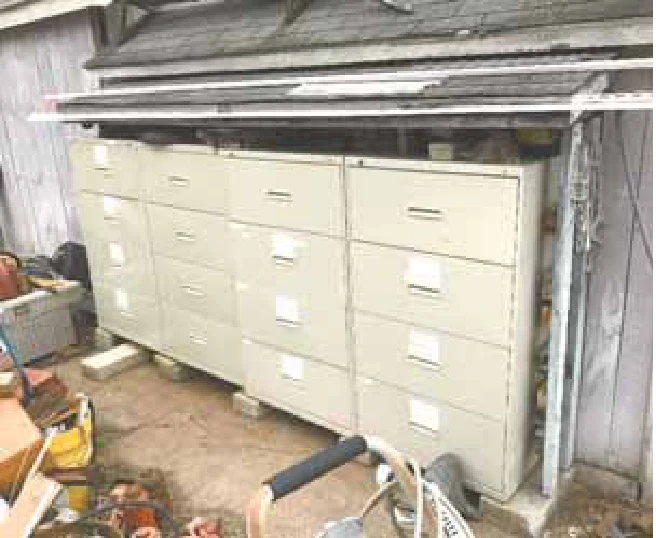
Outside File Cabinets Hold Tools, Parts

Featured source: Keith Bleicher

“I bought a bunch of used office file cabinets and attached them to an outside wall of my shop. They really work great to hold parts and tools,” says Keith Bleicher, Shushan, N.Y. Bleicher found the cabinets on Craigslist and bought others at an estate sale. Each cabinet came with 4 drawers and measures 52 in. high, 30 in. wide, and 18 in. deep. The drawers are 12 in. high and 16 in. deep. He parked the cabinets along the entire east wall of his 25-ft. long shop on a gravel base covered with sheets of diamond plate steel, setting the cabinets on 6-in. high blocks to keep the bottoms from rusting. Bleicher has purchased 8 cabinets so far, but says he plans to end up with about 16 in all. A 3-ft. overhang on the shop wall covers all the cabinets. He plans to add sliding doors under the overhang to enclose the cabinets.

“I’m far from done putting this system together, but already it has made a big difference in helping keep my tools and parts organized. It makes my entire outside shop work area much more enjoyable to work in,” says Bleicher, an electrical designer, licensed master electrician and overhead crane technician who for more than 40 years has also worked as a backyard welder and mechanical designer. He says he owns at least $25,000 worth of small shop tools.

“I often work outside the shop, and in the past if I was in a hurry or dodging storms I would sometimes leave tools and leftover parts outside in my yard or on the driveway, and then later have to drag them all back into the shop. With the cabinets outdoors and out of the weather I’ll able to access whatever I need. And everything is labeled so I’m able to find what I need quickly.

“The used cabinets were in great shape and I was able to buy them for $40 apiece, whereas new comparable cabinets would normally retail for about $700 each. The estate that sold them owned an accounting business that was going digital, so they no longer had use for them.” Contact: FARM SHOW Followup, Keith Bleicher, P.O. Box 201, Shushan, N.Y. 12873 (ph 518 854-3448; [email protected]).

From the archive · Full text
Feature story

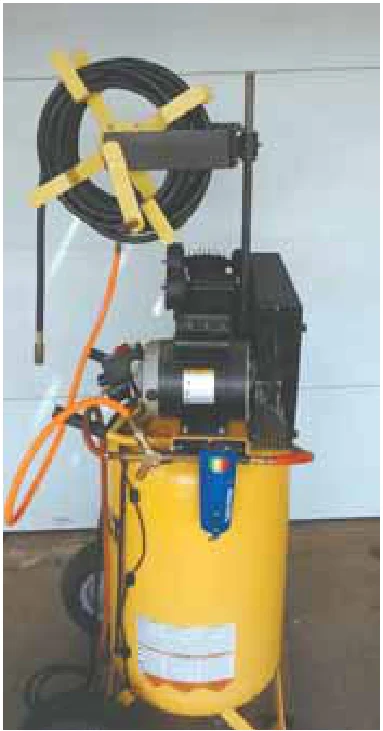
Compressor-Mounted Hose Reel Swivels In Any Direction

Featured source: Donald Chapman

“A few years ago I mounted a hose reel on my horizontal air tank compressor, so that if I needed to move the compressor to a different location my hose reel was always with me. Since then I’ve replaced the horizontal compressor with a vertical one, and made a rod-mounted swivel for the hose reel that makes it easy to pull the hose out from any direction,” says Donald Chapman, Billings, Mo. The hose reel is mounted above the compressor on a vertical metal rod that attaches to the compressor. Chapman cut the hub off a wheelbarrow axle and mounted a bearing on each end. He welded the hub to a metal plate and bolted the plate onto the hose reel mounting bracket, then slid the hub over the rod. The hub rests on a big washer which sets on top of a short metal pin that runs through the rod.

“The swivel allows the hose reel mounting bracket to rotate sideways in any direction so that the hose reel will follow with me as I pull out the hose. I use the compressor a lot in my shop to operate various tools, so this idea really comes in handy,” says Chapman. Contact: FARM SHOW Followup, Donald Chapman, 6212 South Farm Road 25, Billings, Mo. 65610 (ph 417 714-0232; [email protected]).