Practical ideas from FARM SHOW MagazineSubscribe · Free issue · Send us your shop tip
Subscribe to FARM SHOW
Issues / Vol. 45, No. 3 (2021)

Vol. 45, No. 3 (2021)

Money-Saving Repairs & Maintenance Shortcuts · Printed section pp. 32–35

38 selected entries · Complete text of selected entries

This issue’s section includes reader tips and feature-length shop stories. Held items and editorial notices are not reproduced.

Archive text: prices, coupons, availability and contact details reflect the original publication, not current offers. Reader methods are not universal instructions; follow manufacturer guidance and proper safety practices.

Reader shop tips

From the archive · Full text
Reader shop tip

Reuben Swarey

Reuben Swarey, Henry, Tenn. [email protected]

“The 15-speed powershift transmission on my Deere 4960 tractor slipped whenever I pulled a heavy implement down the road in high gear. The dealer thought the clutch was worn out so he replaced it at a cost of about $8,000. The tractor then ran okay for about 1 1/2 years, but then the transmission started slipping again. The same problem happened on another one of my 60 Series tractors.

“Then a mechanic friend in Pennsylvania gave me some advice. He said powershift transmissions have a hydraulic valve that releases power to the transmission. When you push in the clutch the valve opens, and when you release the clutch it goes against a small aluminum stop that closes the valve. However, over time the valve wears against the housing and oil leaks out, which causes the clutch to lose pressure.

“He recommends using a 3 1/2-in. hand grinder to grind about 3/8 in. off the stop, which will allow the valve to close farther and increase the clutch pressure. I tried the idea on my 4960, and the transmission stopped slipping immediately.”

From the archive · Full text
Reader shop tip

Carlen Busenitz

Carlen Busenitz, Whitewater, Kan.

“The stamped steel radiator fan pulley on our Gleaner R62 combine broke, causing the engine to quickly overheat and wearing a hole through the engine’s timing cover. We tried various ideas to solve the problem, including replacing the fan hub bearings and the fan itself, and also replacing the harmonic balancer and pulley. Nothing worked. Replacing the fan pulley and timing cover became a frustrating annual event.

“After replacing the fan pulley 3 or 4 times we found a solution. Case combines use the same Cummins 8.3-liter engine found on Gleaner combines, and have the same fan pulley problem. However, Case makes a heavier built replacement pulley that can be used instead of the Cummins pulley, so we installed one. Problem solved.”

From the archive · Full text
Reader shop tip

Charlie Kunau

Charlie Kunau, Bellevue, Iowa

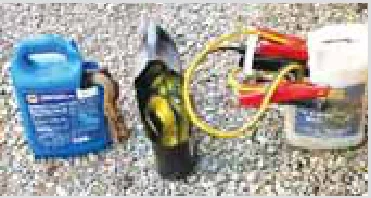
“I recently watched a YouTube video about extending the life of batteries by using Epsom Salts as the electrolyte. Through trial and error, I’ve found that increasing the amount of Epson Salts to 18.2 oz. per gallon of water produces the best charging results. The key is to make repeated rinses with clear water when flushing the battery. This idea has saved me the cost of buying a new battery that would only get occasional use anyway.”

From the archive · Full text
Reader shop tip

Ryan Kremer

Ryan Kremer, Mount Blanchard, Ohio

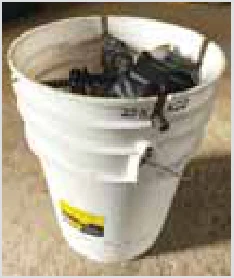
“I used a 5-gal. bucket and some rebar to make a chainsaw chain and supply-carrying tote. It keeps my saw chains and other items organized and easy to find.

“I cut two sections of rebar and wired them together perpendicular to each other to form an X that lays across the top of the bucket. I cut four slots into the top around the perimeter of the bucket, and the four arms of the X slide down into them. The chains hang from the arms.”

From the archive · Full text
Reader shop tip

Warren Schatz

Warren Schatz, Ipswich, S. Dak.

“I use silicone grease to lubricate anything that’s exposed and would normally collect dirt, because silicone grease doesn’t attract dirt. Works great on battery terminals, wheel studs, and so forth.”

From the archive · Full text
Reader shop tip

Mark Hoover

Mark Hoover, Leitchfield, Ky.

“Any time you drill large holes in steel or hard metal or have to machine steel on a lathe, you create a lot of extreme heat. And unless you work at a very slow speed, that heat can ruin drill bits and saw teeth. Adding cutting oil can help, but you have to use a lot of it which creates fumes and smoke. Also, the oil can clog up saw teeth.

“Instead, I started using an air hose with a blowgun nozzle to dissipate the heat. Works like magic. Drill bits and saw teeth will instantly start to cut faster and smoother, and the metal stays cool and clean.”

From the archive · Full text
Reader shop tip

Ethan Schwoeppe

Ethan Schwoeppe, Huntingburg, Ind.

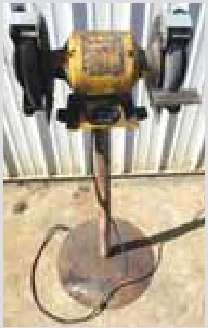
“Old disk blades make great pedestal mount bases for shop tools. For example, I made a bench grinder stand by welding a 3-ft. long pipe onto a 20-in. broken disk blade, then welding a scrap steel bracket on top of the pipe and bolting the bench grinder to it. The disk blade had a crack in it, which I welded shut. Now I can access the bench grinder from anywhere in my shop. Commercial floor pedestals for shop tools are available, but they’re not free.”

From the archive · Full text
Reader shop tip

Doug McAlexander

Doug McAlexander, Cedar Grove, Tenn.

“Two-stroke engines require a special tool to adjust the carburetor needle, but you don’t need the tool. Take the needle out and use a hacksaw to cut a slot in the top of it. Then put the needle back in and use a screw driver to adjust.”

From the archive · Full text
Reader shop tip

Roy Phlipot

Roy Phlipot, Scott, Ohio

“When applying caulk or silicone, coat your rubber gloves with liquid hand soap. You can use your finger to smooth the caulk, and it won’t stick to the gloves.”

From the archive · Full text
Reader shop tip 1 of 2

Bob Payne

Individual tip 1 of 2 from this reader’s published contribution.
Bob Payne, Coldwater, Miss.

“Due to uneven ground, our woven wire fencing needs a lot of little Z bends to tighten it up. Making the bends with pliers wears out your hands fast. So I used an angle grinder to cut notches in one socket of a 4-way lug wrench. Makes tweaking with Z bends really easy.

From the archive · Full text
Reader shop tip 2 of 2

Bob Payne

Individual tip 2 of 2 from this reader’s published contribution.
Bob Payne, Coldwater, Miss.

“I use a small fridge that my daughter once had in her dorm room to hold welding rods. It is not plugged in and serves only as a storage cabinet. A droplight inside provides the heat, controlled by a dimmer switch outside. I check the temperature inside with a multimeter equipped with a thermocouple. Welding rods keep nicely with no humidity damage to the coating. I keep it at 98 degrees which is cool enough to keep from damaging the plastic interior.”

From the archive · Full text
Reader shop tip

Don Raucstadt

Don Raucstadt, Seligman, Mo.

“I used a brake drum off a semi truck axle to make a solid base for a free-standing vise. I welded steel plates to both ends of channel iron uprights and bolted the bottom plate to the brake drum. It’s heavy and stable but I can easily roll it around to move it.”

From the archive · Full text
Reader shop tip

Bob Payne

Bob Payne, Coldwater, Miss.

“I got tired of dragging my tire changing tools out onto the driveway when I needed them. So I mounted all the tools on a piece of 3/4-in. plywood bolted to a wood pallet. It lets me easily move all the tools at once with a pallet fork and I can use my forklift to put it up on a shelf when I’m done with it. In the past, I always had trouble using the bead breaker because it was supported poorly. So I flanked it with a couple deck boards that hold it solidly in place. I have a 5-ft. pipe extension I can slip over the bead breaker handle when I need more leverage.”

From the archive · Full text
Reader shop tip

Karl Scheibengraber

Karl Scheibengraber, Lisbon, Wis.

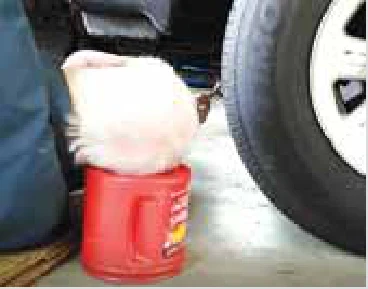
“Whenever I would lay down a piece of cardboard and lay down on my side to service or repair vehicles, I would get a sore neck if I didn’t support my head somehow. Old pillows or a folded cloth worked but quickly got too dirty to use. I had a ‘eureka’ moment when I realized an empty plastic Folgers coffee container placed upside down on the concrete would make an ideal headrest because the bottom is soft and rounded. It’s also stable, easy to keep clean, and won’t slide around. It even has molded finger grips for easy handling. Now I keep several empty containers around my shop so I have one handy whenever I need it.”

From the archive · Full text
Reader shop tip

Gary Swensen

Gary Swensen, Yankton, S.Dak.

“I bought two extra mounting brackets for the jack on my old trailer and mounted one on each side of the trailer. Now, if I have a flat while pulling the trailer, I just attach the jack to the side that is flat. No more wondering, ‘Do I have a jack in the toolbox, or did I leave it in the shop or somplace else?’”

From the archive · Full text
Reader shop tip

Rick Croll

Rick Croll, East Stroudsburg, Penn.

“The gas mixture screws on my chainsaws can be difficult to adjust. They have knurled heads and I can’t seem to find a tool that makes it easy to reach and turn them. Instead of breaking the plastic guards off my new saw and trying to get a needlenose in there, I used a small piece of small diameter plastic tubing. Snake the tubing through the guard and onto the screw head, then adjust it and pull the tubing off. It works great.”

From the archive · Full text
Reader shop tip

Craig Nelson

Craig Nelson, Heron, Mont.

“When spring rolls around and it’s time to take off the hydraulic oil tank that supplies my snowblower, it can be a difficult task getting it off and into storage.

“I decided to build a dolly that would allow me to remove the tank and roll it away. I made it from scrap 4 by 4’s and some plywood, buying large pneumatic swivel caster wheels from Harbor Freight that let me move it over gravel. The handles came off the frame of an old trampoline. I added a box on front to hold the pump that I pull off the pto.”

From the archive · Full text
Reader shop tip

Rick Bohl

Rick Bohl, Cedaredge, Colo.

“Instead of carrying around a trouble light with a long cord, it’s much easier to equip the light with a short stub cord and bring an extension cord over to it.”

From the archive · Full text
Reader shop tip 1 of 2

Lauren Rasmussen

Individual tip 1 of 2 from this reader’s published contribution.
Lauren Rasmussen, Kokomo, Ind.

“Small pieces of a plastic shopping bag can be used as a thread locker on bolts or as a sealant on pipe threads.

From the archive · Full text
Reader shop tip 2 of 2

Lauren Rasmussen

Individual tip 2 of 2 from this reader’s published contribution.
Lauren Rasmussen, Kokomo, Ind.

“I use a light chain hanging from the ceiling of my shop to help support long items on the drill press.”

From the archive · Full text
Reader shop tip

Mel Hauck

Mel Hauck, Sauk Rapids, Minn.

“I protect hydraulic hoses by attaching a 4-in. pvc pipe to the implement tongue and then running the hoses through it.”

From the archive · Full text
Reader shop tip

Harvey Gillispie

Harvey Gillispie, Glasgow, Ky.

“After dealing with mower issues every spring, I converted my self-propelled lawn boy mower to E-85. I set my automatic choke to open no more than 1/3 while running and placed a fuel shut off so the carb runs out all the E-85 after each use to prevent any possible corrosion. With those minor modifications my mower runs better than on regular gas with no loss of power. With gasoline prices on the rise, E-85 is less expensive with the added benefit that the exhaust smells like popcorn.”

From the archive · Full text
Reader shop tip

Ken Henderson

Ken Henderson, Woodland, Calif.

“Whenever I crack a wooden garden tool handle, I put a couple of screws in to repair it, but it always seemed I would get a big sliver from the sharp end of the break. I’ve found that ‘shrink tube’ works great to cover the slivers and doesn’t come unraveled like duct tape.”

Shop feature stories

From the archive · Full text
Feature story

Drum Crusher Flattens Steel Barrels

Featured source: Miles Brett

Miles Brett was hired for maintenance and trouble shooting at a Calgary, Alberta, business with a yard filled with thousands of steel 55-gal. drums which used to hold rubberized asphalt crack filler. Brett had to come up with a solution to get rid of them.

“I had previously built a log splitter for personal use,” Brett says.

“I decided to build a barrel crusher using the same concept, except it’s vertical and larger in scale. It’s equipped with a 5-in. dia. hydraulic cylinder that exerts more than 44,000 lbs. of downward pressure.” That’s enough to crush even the thickest steel drums made in the 1920s. Brett built the crusher using materials he had on hand plus purchased parts including an 8-hp. gas motor for the hydraulic fluid. Early on he realized he needed a strong base that wouldn’t bow, and the professional welder he hired beefed it up with 3/4 by 4-in. steel plate on the front and back with 1 1/2-in. square steel bars across. When finished, the crusher could flatten a barrel in under a minute. Brett stacked about 50 of them on pallets and hauled them to a metal recycler that picked them up with a magnet and paid about $100/pickup load. Getting paid for the metal was a bonus, preferable to paying drum recyclers to take them. A video of it can be seen on YouTube: Miles Brett Crushing Drums.

Contact: FARM SHOW Followup, Miles Brett, Calgary, Alberta, Canada ([email protected]).

From the archive · Full text
Feature story

Work Table Lifted By Hydraulic Jack

Featured source: Bob Payne

To work on mowers, pressure washers, and other equipment that’s too heavy to lift, Bob Payne, Coldwater, Miss., bolted a lift table to the lift plate on a large hydraulic jack.

The 3/4-in. plywood deck has hinged 2 by 4 sides that can be latched shut. Car ramps make it easy to roll equipment onto the platform when it’s down. Then you close the sides and crank it up with the jack.

Once the lift table is at working height, Payne puts a sawhorse under each end and lowers the table onto them.

“I can use the lift table wherever I need it and it stores under a workbench. It’s easy to unbolt the table from the lift jack if you need the jack for other uses,” he says.

Contact: FARM SHOW Followup, Bob Payne, 65 Wallace Road, Coldwater, Miss. 38618.

From the archive · Full text
Feature story

Antique Tractor Seat Shop Stool

Featured source: Dave Dam

Dave Dam, Eau Claire, Wis., mounted an antique metal tractor seat on the base of an old IH cream separator, using a pair of elevator bolts that go through existing holes in the seat and base.

“The holes just happened to match up perfectly,” says Dam.

“I bolted the bottom of the base onto a pair of 5 by 5-in. wooden blocks to make the seat just the right height. I painted the seat red and the separator’s base black for contrast. It makes a nice looking little stool.”

Contact: FARM SHOW Followup, Dave Dam, 111 N. Buena Vista Rd., Eau Claire, Wis. 54703 (ph 715 450-2943; [email protected]). Please call after 6 p.m.

From the archive · Full text
Feature story

“Splash Bib” Keeps Gas Off Your Vehicle

Featured source: Marty Heilman

Ever filled up your car with gas, but had the gas splash back and dribble down the side of your vehicle? To keep that from happening, a few years ago Marty Heilman, Andover, Minn., designed a rubber bib that safely drains the gas away.

His “Gas Splash” measures 6 in. long by 4 in. wide and has a gas-cap size hole near the top. The rubber is very flexible, making it easy to put on and take off.

To install, you remove the vehicle’s gas cap and stretch the bib around the filler tube, then replace the cap and fold the bib up over it. The next time you open the door, just grab the bib and fold it down so it hangs outside the door.

“I got the idea one day while watching our baby girl eat while sitting in a high chair, and getting food all over her bib,” says Heilman.

“I made a pattern and cut out part of an old truck tire tube, then tried it out on my friends’ cars. They loved them.

“A local business called Car World made about 1,000 bibs for me, in two different sizes, and I gave most of them away to local car dealers who gave them to customers. We even printed the dealer’s name on the bib. But for various reasons the marketing effort soon fizzled out, and no more bibs were ever made. Now I only have a couple left.”

He says the bib works on vehicles with locking gas caps, and on vehicles without a gas cap as you can just stretch the bib over the filler tube. Another advantage is the bib protects the vehicle if you accidentally bang a gas pump nozzle against the car.

“Over the years I’ve used it on my lawn tractor, 4-wheeler, and snowmobile. It’s really handy when I have to use a 5-gal. gas can, because it’s hard to keep a big can like that steady as you pour.”

Heilman is looking for a manufacturer.

“I think the Gas Splash could be sold for under $5,” he says.

Contact: FARM SHOW Followup, Marty Heilman, 148th Lane N.W., Andover, Minn. 55304 (ph 763 434-7301; [email protected]).

From the archive · Full text
Feature story

Shop Engine Hoist Mounts On Pickup

Featured source: Michael Veatch

Michael Veatch, Republic, Mo., modified a jack-operated shop engine hoist so that it can be quickly attached to the receiver hitch on his pickup.

“At farm auctions I often buy something that requires a couple of extra men to help me lift it into my pickup bed,” says Veatch.

“I hate to impose on people to help me load, so I decided to build something that could take the place of 3 or 4 people. It works great and is safer to use than several people loading by hand. No part of the hoist support I made weighs more than 30 lbs., so the entire unit can be assembled in only about 5 min.”

He bought the hoist for $15. The main alteration was to add a “pipe-in-pipe” rotating joint at the base, which allows the crane to rotate 360 degrees.

“I used the hoist’s existing slip joints, along with adjustable stands that keep the hoist steady on uneven surfaces,” says Veatch.

He made a bracket and bolted a bumper jack to the hoist’s base to aid in setting the adjustable stands to the correct height.

“The entire assembly can be left on the pickup by removing the adjustable stands and hooking the boom onto the pickup bed,” says Veatch.

Contact: FARM SHOW Followup, Michael Veatch, Republic, Mo. ([email protected]).

From the archive · Full text
Feature story

Tool Straightens Warped Posts

Featured source: Joseph Stearns

Joseph Stearns didn’t listen to neighbors who said he needed to replace a bunch of 4 by 4’s he was using to build a garage. They’d been set in concrete the year before but had warped because he and his son weren’t able to finish the project right away.

“I came up with a design for a tool to straighten them out,” says the Champlain, Va., resident. He had a welder make two of the tools, which have 4-ft. pipe handles. A 3 by 9-in. piece of 1/2-in. steel plate is welded flat across the end. Another piece of 1/2-in. steel plate is welded perpendicular to the flat piece, and is held in place by adjustable 12-in. long, 1/2-in. dia. bolts that tighten the 2 plates together against the 4 by 4.

“Just tighten it on the post by hand,” Stearns says.

“With that 4-ft. handle you can almost twist a 4 by 4 in half.” He had the stud walls ready to place between the 4 by 4s, which are 8 ft. apart. So, as soon as he twisted the 4 by 4s straight, the wall could be nailed in place with 16-penny galvanized nails and then bolted.

“If the 8-ft. center was bowed out too far I put a tool on each of the 4 by 4s and used a come-along or ratchet strap to pull them together,” Stearns says. He drilled 7/8-in. holes in the tops of the tools to hold clevises to hook into. The tools worked well, and Stearns and his son were able to put up straight walls for the 20 by 32-ft. garage. Contact: FARM SHOW Followup, Joseph Stearns, 364 Farmers Hall Rd., Champlain, Va. 22438 (ph 804 445-1249).

From the archive · Full text
Feature story

“Propane Bottle” Engine Coolant Heater

Featured source: Charles Kunau

“I needed an engine coolant heater for a hard-to-start diesel tractor. After looking at prices for the size heater I needed, I decided to make my own,” says Charles Kunau, Bellevue, Iowa He cut a hole big enough to accept a 1-in. pipe bushing in the bottom of an empty 1-lb. propane tank, then used JB Weld to seal the pipe in place and screwed in a 120-volt, 2,000-watt water heater element. He wired a heavy-duty extension cord onto the element and covered the connections with a plastic cap for safety reasons. Then he drilled two holes in the tank, one near the bottom and one in the top, to accept 5/8-in. hose barbs and used JB Weld to secure them.

“The cold coolant flows into the bottom of the propane tank as the warmed coolant flows out the top of the tank,” says Kunau.

“Within 20 min. I have a warm, easy-to-start diesel tractor. I didn’t install a thermostat, but one could probably be added.

“I used an empty propane tank because it’s able to hold up to the pressure of water heating and expanding without blowing a seam.” Contact: FARM SHOW Followup, Charles Kunau, 32909 320th St., Bellevue, Iowa 52031 ([email protected]).

From the archive · Full text
Feature story

“Zerk Zapper” Opens Clogged Grease Fittings

Featured source: Horizon Products

The newest tool to clean out dried grease behind zerks is the Zerk Zapper from Horizon Products, Hot Springs Village, Ark.

According to the company, the Zerk Zapper is the largest grease fitting tool on the market and holds the most solvent, making it more efficient at cleaning clogged fittings. It also has a larger and stronger piston, with 2 O-rings to deliver higher and more consistent pressure.

To free up a frozen fitting, you fill the cylinder with an oil solvent, then use a hammer to tap the knob on the piston shaft to force solvent into the fitting. The Zerk Zapper comes with a check valve that holds pressure, allowing you to leave the tool on the clogged zerk so it can continue to work for up to 8 hrs. A pressure release valve allows removal of the tool from the fitting without damage.

The Zerk Zapper comes with a 20-year warranty. Sells for $45 plus S&H. A heavier-duty shop-size model that holds twice as much fluid and has a bigger piston head sells for $50 plus S&H.

Contact: FARM SHOW Followup, Horizon Products, 1 East Andalusia Way, Hot Springs Village, Ark. 71909 (ph 501 606-6353; www.zerkzapper.com).

From the archive · Full text
Feature story

Tractor “Rack” Saves Space

Featured source: Gerald Suurdt

Gerald Suurdt, Frankford, Ontario needed to find room on his shop floor for his 6 Massey Ferguson tractors.

“I built a shop with tall 17-ft. sidewalls so I decided to build a tractor rack to save space. A good friend, Ed Jackson, did all the welding,” says Suurdt.

Each tractor sits on 12 in. I-beams. He cut notches in the beams and welded in 2 by 6-in. square tubing to fit the forks on his 5,000-lb. forklift to place and move the tractors.

Suurdt estimates the tractors to weigh between 4,000 and 5,000 lbs. each depending on the model.

“The bottom one is the heavy one. I had to put a cement counterweight on my forklift for balance. It’s a lot for the forklift but that tractor is only 16 in. off the ground.”

Some of the I-beams came from a carport that was torn down at a local church.

“I had to buy more, and the square tubing. In the end, I would guess I have $2,000 in it,” says Suurdt.

The project was completed on Saturdays over a month.

Contact: FARM SHOW Followup, Gerald Suurdt, 255 Huffman Road, RR3, Frankford, Ontario Canada K0K 2C0 ([email protected]).

From the archive · Full text
Feature story

Hinged Shelf Brackets Save Space

Featured source: Tom Hohl

“Permanent shelving is a great idea for some areas, but in others I like the idea of having a flat wall when the shelves aren’t needed,” says handyman Tom Hohl. To achieve that he came up with a space-saving idea that he uses in his main shop, as well as on the side of his woodshed and in his sugar shack. Hohl’s simple approach was to build heavy-duty L brackets and mount them on sturdy door hinges that are screwed into studs on his shop wall. When he needs the brackets to hold a temporary work shelf, he folds the 3 brackets out and places a 4-ft. plank on the horizontal surface.

“I make the brackets in the shop with 2 by 4’s that extend out 16 in. with an 18-in. vertical support that bolts to the hinge. A single 2 by 4 provides diagonal support at a 45 degree angle.” Inside his sugar shack, two brackets on one wall are installed to hold his sap boiling tank after it’s removed from the firebox.

“After the sap is boiled down we empty the tank and have to remove it from the firebox so it doesn’t overheat,” Hohl says.

“Because the tank is very hot when we take it off the fire, I covered the horizontal arms of the brackets with 1/8-in. steel to protect the wood.”

When the tank is returned to the firebox, the hinged brackets fold flat against the wall. This allows about 2 1/2 ft. of walk space beside the firebox and tank to tend the sap fill and pre-heating tank.

“The brackets didn’t take long to build, didn’t cost anything except for the hinges, and they sure are handy,” Hohl says.

Contact: FARM SHOW Followup, Tom Hohl, Duluth, Minn.

From the archive · Full text
Feature story

State-Of-The-Art Toolbox

Featured source: James Perkins

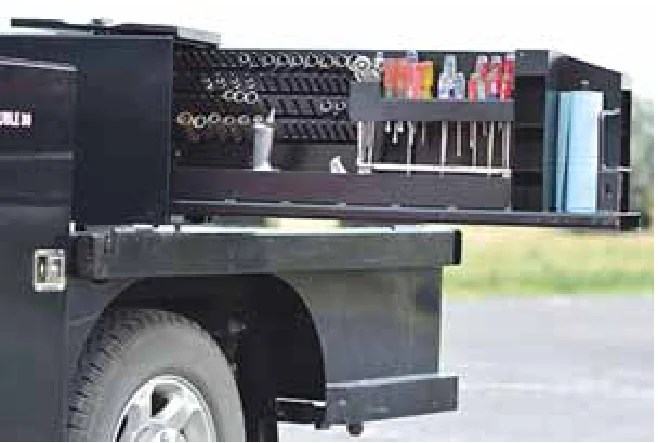
“Our new JP Elite 40 toolbox keeps all your tools organized and easy to access. It opens like a fisherman’s tackle box, making most tools easily visible,” says James Perkins, inventor of the Shop-N-Box toolbox.

The JP Elite 40 toolbox is made from 14-ga. diamond plate steel except for a 10-ga. steel top. It measures 40 in. wide by 10 in. high and 24 in. deep and comes with a small fold-up front door that lifts out of the way, allowing you to easily access small tools like combination wrenches and screwdrivers. Once you’ve opened the front door, you can also access a roll-out tray designed to hold small tools such as pliers, meters, miscellaneous wrenches, and so forth.

You also can lift the top of the toolbox to access bigger and heavier tools such as sockets, wrenches, hammers, bars and more. The top of the toolbox is fitted with rows of metal pegs for storing sockets, and a series of holes for storing screwdrivers.

“Each tool sets on its own peg and everything lays down flat. As the toolbox is closed, a bar goes across the top of the pegs so nothing can get loose,” says Perkins.

A storage drawer can be set up under the JP Elite 40 to store cordless drills, bolts, spare parts, and more.

“I came up with the idea for the Elite 40 because most truck tool boxes take up too much space, and are too tall,” says Perkins.

“The Elite 40 is just 10 in. high so it’s easy to see over, and doesn’t compromise your visibility while driving.”

The toolbox’s hard top can support a lot of weight.

“By lifting the front door you can throw ladders or feed bags on it, or even stand on it, and still have access to your tools,” says Perkins.

He developed his first toolbox, the I-80, in 2011. It’s designed to set on a flatbed pickup or truck and measures 80 in. wide by 18 in. high and 1 ft. deep. It comes with an 80-in. long insert that holds all your tools and can be rolled out from either end of the toolbox.

“All the rollout drawers on our toolboxes come with a patented roller system that’s designed to hold up to heavy use,” notes Perkins.

The JP Elite 40 sells for $800 plus S&H; the 1-80 for $1,500 plu S&H. The company will soon introduce a Super 40 toolbox with built-in storage for big tools.

You can watch videos of all Shop-N-Box toolboxes on the company website and on YouTube.

Contact: FARM SHOW Followup, James Perkins, Shop-N-Box, 152 Perkins Rd., Sedan, New Mexico 88436 (ph 844 502-9361; [email protected]; www.shopnbox.com).

From the archive · Full text
Feature story

Tire-Changing Cart Built For Bigger Tires

Featured source: Cleason Hoover

is a whole lot easier with Cleason Hoover’s tire cart. The big cart, with its 6 by 6-in. steel tubing for the main frame and 2 by 6-in. uprights, can handle the weight. The design makes it easy to raise, secure, and reposition wheels safely and quickly for “We needed a new tire cart because tires are getting larger and our old cart couldn’t handle them,” says Hoover, shop foreman at Binkley & Hurst.

When he looked for alternatives, attachments for skid steers were most of what he found. With no room for a skid steer in the shop, Hoover needed another cart, but one that was more efficient, larger and safer. He realized they needed to build their own to get the features they wanted.

“The old cart placed the tires on a fork,” says Hoover.

“We wanted rollers so we can more easily adjust the wheel when returning it. With its larger size and the rollers, we can take the entire axle assembly away with the wheels and easily line it up with the gears when putting the assembly back on. It also makes it easy to do tractor brakes.”

The old cart was used to remove wheels and then a forklift moved the assembly. The design of the new cart lets shop workers lift, lower and adjust wheels, whether by themselves or with an assembly. This saves time, notes Hoover.

The cart is designed to handle duals up to 710 70R42. However, even with its 4-ft. long rollers, it can be too narrow for a set of large duals. Thanks to the safety strap, tire edges can extend past the rollers without a problem. While the old cart used a come-along, the new cart uses ratchet straps like those that secure loads on semis.

“Recently we had duals with each tire holding 1,000 lbs. of weight, and the cart comfortably picked it up,” says Hoover.

“The straps easily adjusted to the size, and we strapped the duals in safe and secure.”

Hoover says feedback on the cart’s design has been very positive. Based on current steel prices, he estimates he could build one for around $7,500.

“I would be interested in building them for sale,” says Hoover.

“However, if FARM SHOW readers wanted to build their own, I can provide CAD drawings for $100.”

Contact: FARM SHOW Followup, Cleason Hoover, 140 Furnace Hills Rd., Denver, Penn. 17517 (ph 717 625-4764; [email protected]).

From the archive · Full text
Feature story

Shop Uses For Old Golf Equipment

Featured source: Bill Shipman

Bill Shipman, Elwood, Ind., found several uses for old golf equipment around his shop.

“I needed some anchor stakes for my portable satellite dish, so I made stakes out of old golf irons by cutting them down and sticking them into the ground,” says Shipman.

From there he has found several uses for clubs such as making garden tools from old clubs by replacing the heads with small garden tools like hoes, scratchers and drip cans. He also uses the heads from irons as hooks and hangars in his shop.

“I made a grinder holder from an old pitching wedge. It already had a groove in the club that fit my hand held grinder.” Shipman also uses old club heads as different hangars.

“I just cut a small piece of metal and either drill a couple holes or weld the club head directly to the plate with the head on where I want it mounted.”

He also uses old clubs cut down as ground markers for underground pipes or cables.

Even old golf balls are used in his shop.

“I drill a small hole in the golf ball and drive the file’s pointed end into the ball. No glue neeeded, they stay on fine. The golf ball really fits your hand better than normal file handles,” says Shipman. He notes that some balls have liquid in them and may squirt a bit when drilling.

Contact: FARM SHOW Followup, Bill Shipman, 6809 West State Road 28, Elwood, Ind. 46036 ([email protected]).