Practical ideas from FARM SHOW MagazineSubscribe · Free issue · Send us your shop tip
Subscribe to FARM SHOW
Issues / Vol. 46, No. 1 (2022)

Vol. 46, No. 1 (2022)

Money-Saving Repairs & Maintenance Shortcuts · Printed section pp. 32–35

29 selected entries · Complete text of selected entries

This issue’s section includes reader tips and feature-length shop stories. Held items and editorial notices are not reproduced.

Archive text: prices, coupons, availability and contact details reflect the original publication, not current offers. Reader methods are not universal instructions; follow manufacturer guidance and proper safety practices.

Reader shop tips

From the archive · Full text
Reader shop tip

Steve Coley

Steve Coley, Meeker, Colo.

“Here’s a trick for finding all of the pinholes in a rusty fuel tank. First, get the tank ‘boiled out’ at a radiator shop. Then get a magic marker and a flashlight or light bulb that will fit inside the tank.

“In a dark area, put the light in the tank and mark all the pinholes with the magic marker. Then patch all of the holes with JB Weld before coating the inside of the tank with a sealant.

“I came up with this trick when restoring an old Mercedes diesel. A replacement tank would have been very expensive. The upper part of the tank was badly corroded but after patching and coating, it worked perfectly.”

From the archive · Full text
Reader shop tip

Rick Bohl

Rick Bohl, Cedaredge, Colo.

“We had a problem in our carport with chalky drip lines off the underside of the metal roof, which is starting to deteriorate. When condensation collects on the metal, it drips from the raised ribs and leaves nasty white lines on your vehicles.

“To solve the problem without replacing the carport, we fastened a couple tarps to the 2 by 2 metal tubing using 1 by 2 boards and self tapping screws. It worked well for us at a cost of only about $50 and our labor.”

From the archive · Full text
Reader shop tip

Nancy Sundin

Nancy Sundin, Pine Bluffs, Wyo.

“To remove metal fragments and other pieces of metal from a magnet, first put the magnet into a plastic bag. Then pick up the fragments, nails, or whatever your picking up with the magnet so that the metal pieces stick to the outside of the bag. When you’re done, just turn the bag inside out, bagging up the metal and leaving the magnet free. Works great.”

From the archive · Full text
Reader shop tip

Bill Ridgway

Bill Ridgway, Salem, Ind.

“If you use old shirts and other clothing for rags, borrow your wife’s rolling fabric cutting tool. It’s unbelievable how fast you can get the job done with one of these.

“However, be advised to treat the tool with kid gloves and return it after you’re done, or you can expect burnt toast, cold coffee and a cold shoulder for an extended period of time.”

From the archive · Full text
Reader shop tip

Gusto Lehmann

Gusto Lehmann, Canada

“You had an article a few years ago about a guy who replaced the power steering pump on a Case 1190 tractor with a pump from a 2000 Nissan Exterra. He did it because it’s almost impossible to find a Case pump for that 30-year-old tractor. I wanted to confirm that the information in your article was 100 percent correct. I did it and it worked great. Very simple. Thank you.” (Volume 37, No. 3).

From the archive · Full text
Reader shop tip

Richard Church

Richard Church, McCleary, Wash.

“Sometimes during cold weather when I grab a can of WD-40 or another pressurized can, nothing will come out even though there’s still liquid in the can. So I put about 2 in. of water in a tin can that’s larger than the spray can and heat it up on the stove. Once the water is hot, I take it off the stove and put the spray can in the hot water for a few minutes. Works nearly every time.”

From the archive · Full text
Reader shop tip

Matthew Hempel

Matthew Hempel, Edridge, Mo.

“I added a drain cock to my grease gun to make it easier to pull the grease gun tip off a grease fitting when it won’t take grease. It releases pressure on the grease tip. It even helps when greasing in cold weather. Stops me from breaking off grease fittings and saves time. Also cuts down on the need for those newer $35 grease gun tips that are too clumsy to use on many grease fittings.”

From the archive · Full text
Reader shop tip

David Simpler

David Simpler, Elkton, Md.

“It’s hard to put jumper cables or battery charger clips on side-mount battery posts, and they’re poor conductors of electricity. The solution is to install top post adaptors so you can use regular battery post clamps. You can buy them at Walmart, Amazon and other places. Just cut away enough of the rubber on the side mount post so you can get the bolt out and screw in the top post adaptor. Problem solved!”

From the archive · Full text
Reader shop tip

Bob R.

Bob R., Chandler, N.C.

“I read with interest the comment by a reader in your last issue that he wasn’t able to return his Craftsman tools anymore because he originally bought them at Sears. I wanted to tell him that I recently watched a man return 8 ratchets at our local Ace hardware store.”

From the archive · Full text
Reader shop tip

Karl Spees

Karl Spees, Port Angeles, Wash.

“I came up with an idea while working on an unusual project. It might help out on many projects in the shop.

“I was mounting a mule deer skull on the wall and wanted it to be sturdy enough to hang hats or rifles. I decided to reinforce the weak spots with dowel sticks and Bondo but getting Bondo into the small cavities was going to be tricky.

“I hit on the idea of putting two golf-ball-size blobs of the Bondo resin and hardener into a tightly sealed zip bag. Hold the sealed edge in one hand and squeeze the bag and roll it around until the hardener and filler are thoroughly mixed. Then snip off a bottom corner of the plastic bag and squirt the mixture out through the hole into the nicks and crannies of the project. Makes it much easier to be precise with Bondo and other epoxy products.”

From the archive · Full text
Reader shop tip

James Edstam

James Edstam, Olympia, Wash.

“I recently bought a 20-volt lithium-ion battery adapter for my older 18-volt DeWalt tools when the NiCad batteries started dying. Now I never run out of juice. The brand name is Swidan, and it cost less than $20 on Amazon.com.”

From the archive · Full text
Reader shop tip

Gary Lee Meeks

Gary Lee Meeks, Augusta County, Va.

“When old-style shed door rollers jump off the track, I have found that the see-saw tool used to lift the bottom edge of wallboard works well. Just slip it under the door, pry it up with your foot, and work the roller back onto the track. On taller barn doors, I pry them up and then put a wedge under the door. Then I go up a ladder and put the roller back onto the track.”

From the archive · Full text
Reader shop tip

John Matthews

John Matthews, Chapin, S.C.

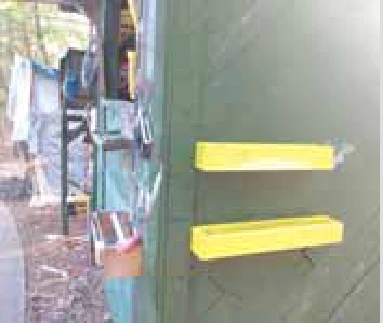
“I have a zero-turn mower and several push mowers, so it was sometimes tough to tell which blades went on which mower when I needed a set of sharpened blades. So, I built two simple wood boxes that fit under the eves of my storage shed. Each box holds 6 or 7 of the same size blades. The boxes are sized to fit the blades, so I don’t have to guess which is which.”

From the archive · Full text
Reader shop tip 1 of 2

Don Klassen

Individual tip 1 of 2 from this reader’s published contribution.
Don Klassen, Harrisburg, S. Dak.

I was frustrated by anchors on small steel electric fenceposts that would bend, keeping me from pushing them into hard soil with my foot. So, I made a lightweight post driver with a length of 1/2-in. dia. pipe that does not reach all the way down to the anchors. I put a 1/2-in. ‘T’ at the top along with two short nipples to hold onto when driving a post. No more frustration even when the soil is hard.”

From the archive · Full text
Reader shop tip 2 of 2

Don Klassen

Individual tip 2 of 2 from this reader’s published contribution.
Don Klassen, Harrisburg, S. Dak.

His other idea is electric.

“Every time you plug in an appliance that doesn’t have an on-off switch, a spark burns the ends of the plug and the inside of the receptacle, making them useless after a while. To avoid the problem, I fastened a heavy appliance cord to a double-wide plastic electric box with a switch and a 15-amp GFCI breaker outlet. Now when plugging in or unplugging a small air compressor or tractor battery charger or engine heater, there’s no more arcing because I flip the switch on after the appliance is plugged in and flip the switch off before unplugging the appliance.”

Shop feature stories

From the archive · Full text
Feature story

Simple Tip For Hard Starting Deere

Featured source: Ted Lacey, Trent, S. Dak.

If you have a Deere 4-WD diesel tractor that is hard to start, Ted Lacey has a simple tip.

“Pull the fuel stop lever out 1/2 to 3/4 in.,” says the South Dakota rancher and inventor of the Hay Manager (FARM SHOW Vol. 36, No. 3) and other equipment.

He learned the method after purchasing a hard starting 8640 Deere and paying a mechanic $800 to check out the injectors and add new tips. When Lacey took it home, the tractor did the same thing - spew white smoke. Only by pumping lots of ether could he get it started in even the warmest weather.

When he called the mechanic back, Lacey learned that for a while Deere beefed up its tractors with “full rack advance” which added more fuel, heat and combustion in the engine. With some tractors that creates problems with the rpm’s and can even break crankshafts.

Pulling the fuel stop lever reduces the amount of fuel to start the tractor without stressing tractor parts.

So, if you have issues with starting an older Deere 4-WD diesel tractor, Lacey suggests adjusting the fuel stop lever before trying other expensive options.

Contact: FARM SHOW Followup, The Hay Manager, 47802 240th St., Trent, S. Dak. 57065 (ph 605-633-0038; [email protected]; www.thehaymanager.com).

From the archive · Full text
Feature story

How To Pull With A Pipe And Chain

Featured source: Eric Grutzmacher, Sisters, Ore.

Eric Grutzmacher keeps a chain and short piece of pipe in his pickup. It’s come in handy often to move a fallen tree across the road or rip out invasive shrubs on his Sisters, Ore., property.

How to use it is an old trick he shared in the Home & Shop Companion, a free weekly email newsletter he puts out from Small Farmer’s Journal, a quarterly periodical published and family-owned since 1976.

“I called it a chain lasso, but it’s probably more accurately described as a choker chain,” Grutzmacher says.

“It acts like a slip knot.”

Instead of wrapping the chain around itself or making a couple of wraps, the hook slips into the pipe. With the hook safely secured, the other end of the chain can be hooked up to a pickup, tractor, etc.

“It’s not an original idea by any means,” he notes, but he recognized its usefulness and simplicity and shared it recently with readers.

He also tested its pulling power when he needed to demolish an old single-wide trailer. He linked a few chains end to end through a door and window, using the “chain lasso.” It worked well to tear the trailer wall in half, he says.

Contact: FARM SHOW Followup, Eric Grutzmacher, Small Farmer’s Journal, ([email protected]; www.smallfarmersjournal.com).

From the archive · Full text
Feature story

Low-Cost Hydraulic Chain Drive Retrofit

Featured source: David Nolt, Kutztown, Penn.

David Nolt is making manure spreading easier with his hydraulic chain drive for older New Holland and Gehl spreaders. His farm-shop manufactured drive system does the job better and costs less than OEM rope-controlled gearboxes.

“With the hydraulic chain drive, you simply toggle the control to stop the apron or increase or decrease apron speed to match the amount of manure left in the box,” says Nolt.

“It gives you infinite speeds, from very slow to high speed versus changing gears one at a time with the rope control.”

The valve control box is equipped with a magnet so it can quickly attach to any metallic surface in a cab or on a tractor.

“No more reaching around to tug on a rope,” says Nolt.

The control box with its toggle switch activates an electric actuator on the assembly mounted to the front of the spreader. It controls the valve to the hydraulic motor powering the apron drive.

Nolt developed the hydraulic chain drive as an economic alternative to replacing a worn-out OEM gearbox.

“You can get a new rope-controlled gearbox for $3,500 from New Holland or buy mine with everything needed for $2,200,” he says.

Contact: FARM SHOW Followup, David Nolt, 307 Eagle Rd., Kutztown, Penn. 19530 (ph 610-914-1248).

From the archive · Full text
Feature story

Quick-Stop Patch For Leaks & Other Tough Repairs

Featured source: Tech-Bond Solutions, Newark, Ohio

Tech-Bond Solutions sells a polymer patch that works on pvc, galvanized, and copper pipes, and any kind of water tank except for stainless. Designed to quickly seal up cracks or holes, the patent-pending patch is made with flourosilicone and creates a chemical reaction with heat once applied, to create a permanent bond that’s impervious to gas, water, oil, weather, dirt, grease and salt.

Patches come in standard, XT for up to 120 psi and MX patches with copper foil for over 120 psi.

The company reports a permanent Tech-Patch costs about 20 percent of installing replacement pipe. They offer a money-back guarantee for the life of the patch. Their kits have a 2-year shelf life.

Tech-Patches will seal holes up to 3-in. dia. and cracks up to 5-in. long and 1-in. wide.

“This product really works. My Tahoe had a big crack on the side of the dash and nothing could hold it together. I tried Tech-Bond and presto, it was strong as new. I also tried it on some clay tiles I had broken and I got the same results. It’s a very strong bond. It works just like they say and the price is fair,” says Tech-Patch user Barry Finkle on the Tech-Bond website.

Kits are available online starting at $15 and go up to $160 based on the kit and patches ordered from the company website. We also found these on Amazon at $27 for a standard 3 in. by 6 in. or $43 for a 6 by 6-in. patch. The company notes a basic poly kit is also required ($32 on Amazon) which includes surface prep, activator, and adhesive. Heat from a hairdryer or heat gun is required to finish the sealing process. Shipping costs are additional. The single patches and poly kits listed on Amazon had limited but good reviews.

A few patches and a kit may be worth putting in the work truck or shop for when a fast repair is needed.

Contact: FARM SHOW Followup, Tech-Bond Solutions, 384 Old Ballard Ave., Newark, Ohio 43055 (ph 877-565-7225; www.tbbonding.com).

From the archive · Full text
Feature story

Full Pull Ropes Offer Easier Towing

Featured source: Nick Gebhardt, Black River Falls, Wis.

For one cranberry farmer, a passion for helping others has turned into a profitable business. Nick Gebhardt is a fourth-generation farmer who works with his brother to manage close to 300 acres of cranberries grown for Ocean Spray.

But today you’re just as likely to find him managing his side business - Search and Recovery Engineering, LLC. The company offers a complete lineup of search and recovery (SAR) equipment that includes “full pull” tow ropes for anyone who works with heavy equipment.

Gebhardt and his family honed their manufacturing skills in their cranberry bogs. His dad manufactured his own equipment and built a machine shop in the 1990’s to produce specialty products for others in the cranberry industry.

“I discovered high-strength synthetic winch lines while diving about 15 years ago and since have used them on our cranberry marshes,” shares Gebhardt.

“The capabilities and versatility of these ropes make them ideal for heavy recovery operations where high strength lightweight tow ropes are needed.”

Once Gebhardt realized that other farmers could benefit from the marine industry tools he was using, he started selling the “full pull ropes”. Today the ropes are bought by specialty markets such as agriculture, construction, mining, utilities, and landfills.

For these customers, having rescue equipment available to quickly and efficiently recover a stuck machine can pay dividends during busy seasons. The company currently specializes in the heavier side of recovery, offering tow lines and shackles with up to 1.54 million pounds of breaking strength.

These specialty ropes and towing equipment offer many advantages compared to traditional rescue equipment. Gebhardt is especially proud of the brand’s Amsteel-Blue Recovery Tow Ropes.

“Samson rope designed Amsteel-Blue in 1996 and is currently the most trusted brand in the Maritime industry and also crossing over into heavy tow recovery,” he explained.

“Amsteel-Blue is a lightweight, low-stretch rope with the same characteristics as steel cable at 1/7th the weight.”

A 20-ft. 9/16-in. Amsteel-Blue recovery rope with chafe guard and 45,000-lb. average strength sells for $125 plus shipping. Bulk pricing depends on thickness and strength.

Contact: FARM SHOW Followup, Search and Recovery Engineering, LLC, 800 Oasis Rd., Black River Falls, Wis. 54615 (ph 833-392-3589; www.sregear.com).

From the archive · Full text
Feature story

Robot Welder Delivers Precision Welds Every Time

Featured source: Central McGowan, St. Cloud, Minn.

The Cobot welding package wows attendees at farm shows and industrial shows alike. It lets any trained operator produce professional-quality welds. Central McGowan combined a Lincoln Power Wave welder with an automation unit to create the mobile robotic welder.

“This is a product partnership we put together to make a portable, programmable welding system,” says Julie Berling, Central McGowan.

“It can easily be moved around the production or shop floor.”

What makes the Cobot shine is the ease of programming. The operator shows it what to do with arm movements and drag and drop programming. Move the arm to the starting point on the weld and punch in the position on the control device. Move it to the end position and punch in that position. Welding speed is 39 in. per second.

“It is such an easy teaching application,” says Berling.

“It’s not for repetitive welds. However, it fits a multitude of different welding applications and types of welds.”

The Cobot can be programmed to make a single pass or multiple passes and is easily repositioned. Clamp the piece to be welded to the integrated tabletop and start welding.

“The resulting weld is beautiful, very clean, the perfect weld,” says Berling.

The automation unit can be ordered with the 49-in. standard arm or the 56-in. long arm.

Berling suggests interested readers call the company to discuss needs and price.

“Every customer has unique needs, and the arm and welding setup is equally unique,” says Berling.

“We don’t have a standard base price.”

Contact: FARM SHOW Followup, Central McGowan Automation & Robotic Center, 2820 1st St. S, St. Cloud, Minn. 56301 (ph 320-257-4800 or 800-569-1322; [email protected]; www.centralmcgowan.com).

From the archive · Full text
Feature story

Trailer Ramp Lift Assist

Featured source: Kenny Vandeventer, Ottawa, KS

“Recently I borrowed my grandson’s mower trailer and while I had it I decided to repair the fold-down ramp. The problem was that after I finished the repairs it was so heavy I could hardly lift it,” says Kenny Vandeventer, “I decided to add a spring-loaded lift assist to one side of the ramp. I know you can buy them but since I’m a cheapskate, I wanted to use things I already had on hand. I ended up using the arrangement you see in the pics with a cable and three pulleys hooked up to a really strong implement spring. It’s very simple but really came together nicely.

“Now I can easily lift the ramp when it’s down. I plan to put a protective guard over the lift assist.”

Contact: FARM SHOW Followup, Kenny Vandeventer, 3139 Indiana Rd. Ottawa, KS 66067 (ph 785-241-0613).

From the archive · Full text
Feature story

Hydraulic Hand Pumps Provide Big Power

Featured source: Bosch Automotive Service Solutions, Warren, Mich.

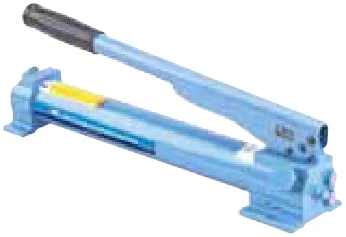
Two-speed hydraulic hand pumps from Bosch offer a versatile alternative to power hydraulics or bottle jacks for many shop uses. The OTC 4004 hydraulic hand pump can produce 10,000 psi, compatible with rams between 10 and 100 tons.

“The OTC 4004 is ideal for any job involving bending or straightening strong metals with a ram, extracting or installing bushings on equipment, lifting heavy materials or shop press operations,” says Denny Hanson, Bosch.

The U.S.-made hand pump has a reservoir capacity of 24.4 cu. in. Dimensions are 7.2 by 7.7 by 20 in. It has a shipping weight of only 9.95 lbs.

The rugged, all-metal construction is built to handle all conditions. It has a maximum handle effort of 90 lbs. and is an economical power source when 20 cu. in. or less of useable oil is adequate.

The OTC division of Bosch Automotive Service Solutions offers several hand-powered alternatives of lesser and larger power. Prices vary significantly by dealer.

The suggested retail price for the OTC 4004 is $999, but it can be found online from several suppliers in the $530 to $550 price range.

Contact: FARM SHOW Followup, Bosch Automotive Service Solutions, 28635 Mound Rd., Warren, Mich. 48092 (ph 800-533-6127; [email protected]; www.otctools.com).

From the archive · Full text
Feature story

Ways To Reuse Radiator Cores

Featured source: Roger Podoll, Wautoma, Wis.

Roger Podoll has found multiple uses for old radiator cores. He sticks them in front of the OEM radiator core on skid steers and tractors as a pre-cleaner and also uses them as filters in his shop.

“I cut out sections to fit gas and diesel fuel funnels,” says Podoll.

“They make great strainers.”

He has also used them to strain out old paint and set them over rain barrels to strain out debris from rain gutters.

He keeps one with his parts washer. It’s a great place to set parts to dry. When he wants to elevate a painted part to dry, he simply drives in a few screws. The radiator cores are also great for drying gloves as they allow plenty of air movement.

Contact: FARM SHOW Followup, Roger Podoll, W8772 State Rd. 21, Wautoma, Wis. 54982 (ph 920-295-2357).

From the archive · Full text
Feature story

“Tie Boss” Secures Loads & Hoists Them Up

Featured source: Tie Boss, LLC, Piqua, Ohio

U.S.-made. Easy to use. Lifetime warranty. Those are things customers appreciate about the Tie Boss. It’s a handy tool for tying down or hoisting up loads.

“About 80 percent of people with trucks don’t need ratchet straps,” says Rich Meissner, product manager for Tie Boss. It’s more than they need to strap down an appliance or occasional load, plus using ratchets can be challenging.

“Tie Boss works similar to a Venetian blind,” Meissner says. Just pull the rope to tighten or hoist up something. Tuck the rope behind a safety tab to secure it for hauling. To release, just pull the rope at an angle to release. Tie Boss was invented about 12 years ago, with outdoorsmen in mind, to secure ATVs, snowmobiles and hunting and fishing gear. The 3/8-in. Tie Boss ($22) has a 300-lb. load limit, so four of them secure equipment up to 1,200 lbs. As part of the block and tackle package ($70), hunters use it to hoist up wild game or items 300 lbs. or less. As the product was introduced at trade shows, new markets realized its value and specific uses were developed. Jeep owners appreciate the jeep top sling to lift the tops off their Jeeps. Slings for kayaks and ladders create garage storage solutions using the 1/4-in. Tie Boss ($16) with a 150-lb. weight capacity. At the Oshkosh, Wis., air show, Meissner notes he sells Tie Boss slings to store plane wings out of the way. Tie Boss is built to last, made of glass-filled nylon polymer that is boiled to fuse water into plastic to increase its strength by 10 percent. The Tie Boss hardware has a limited lifetime warranty, and it comes with 10 ft. of solid braid, polypropylene rope.

“Once people purchase and use it, they find so many uses for it,” Meissner says. Farmers use it to secure square hay bales. Campers and hunters hoist up coolers in bear country. Bird lovers use it to raise and lower bird feeders. Tie Boss can be found at NAPA Auto Parts and online. Contact: FARM SHOW Followup, Tie Boss, LLC, 1711 Commerce Dr., Piqua, Ohio 45335 (ph 937-570-4529; 877-900-2677 Canada; [email protected]; www.tieboss.com).

From the archive · Full text
Feature story

Draft Eliminator Reduces Workshop Heating Costs

Featured source: Tony Bunniss, Webster, Minn.

Tony Bunniss built an extension on his tuck-under garage to expand it to a 4-car garage, which Bunniss heated and air-conditioned. The original garage section then became a machine shop.

Preventing cold winds from blowing through became a challenge, and Bunniss knew that merely caulking the cracks wasn’t going to cut it.

Bunniss first installed insulated doors.

“Then, I installed a vinyl flexible seal that is mounted into a doorstop type, wood trim. It can only be installed lightly touching the door, or it puts too much of a drag on the opener,” he shares.

This system worked well through the summer, but winter winds posed a problem. As Bunniss explains, “While the seal would initially touch the door, blowing winds would bounce the door and push it away. Being that the material was cold and stiff, it would not follow the edge of the door to maintain a seal.”

As a result, snow tended to accumulate inside the door, making his furnace run nearly full time.

The solution was to build four devices (two for each door) to hold each door joint against the vinyl strip.

“This draft eliminator is initially set by just closing the door, which spring-loads the hook,” he explains.

“As the door comes down, the hook latches into the slot, which happens during the last inch or so of door travel. It then pulls down on the rod that is connected to the three roller housing’s levers.”

The rod compresses the unlatching spring, located on the top of the rod, which pulls the rod up upon opening the door, pivoting the latches away so that the door hinge below it clears each of the latches as the door moves upwards.

With this system, wind becomes an advantage.

“As the wind rocks the door back and forth, the latching spring will pivot the latches tighter, eventually, holding the door against the vinyl strip/door jam, tight enough so that the wind can’t vibrate it.”

Contact: FARM SHOW Followup, Tony Bunniss, Webster, Minn. ([email protected]).

From the archive · Full text
Feature story

Skirted Flatbeds Make Great Tool Carriers

Featured source: Besler Industries, Inc., Cambridge, Neb.

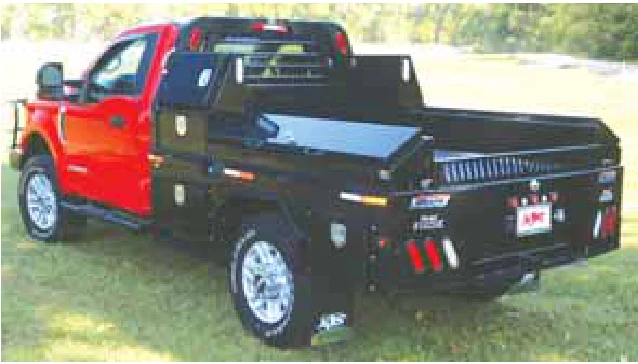
“Our company builds two series of skirted flatbeds that safely and efficiently organize field worker’s tools,” says Cliff Kester of Besler Industries, Inc. in Neb.

“The 9000 series has four toolboxes under the deck and hinged side rails that fold down. The 8000 series has four toolboxes under the deck along with stake pockets and a rub rail. Toolboxes can also be added on the deck of an 8000 series bed.” Kester says all of the toolboxes are completely modular so a customer can arrange boxes on the deck of the bed to fit their needs.

Besler also builds 6000 and 7000 series basic flatbeds. The 6000 is a base bed with stake pockets and a rub rail and the 7000 is a base bed with a hinged side rail that folds down. Options include drawers for the front mount toolboxes, dividers for the top taper boxes, ladder racks and a shovel box.

Kester says Besler flatbeds are made using tough 11-ga. deck plate with 4-in. channel stringers and 3/16-in. cross member channels. Standard equipment includes a bolt-in 30,000 lb. ball for gooseneck trailers and woven harnesses for lights. Four pin and seven blade trailer connectors are integral on the back. There’s also an option for a B & W flush mount or a Ball & Puck flush mount gooseneck assembly instead of the standard recessed 30,000 lb. gooseneck ball. Kester says beds can also be configured with a formed end gate, removable side rails and steps that bolt under the toolboxes.

“These options and others can be found on the Besler Industries website in the ‘Build Your Own Flatbed’ section of the home page,” Kester says.

Contact: FARM SHOW Followup, Besler Industries, Inc., 40855 West Hwy 6/34, Cambridge, Neb. 69022 (ph 308-697-4698; www.beslerindustries.com).

From the archive · Full text
Feature story

Cordless Tools Converted To Run On Car Battery

Featured source: Charles Kunau, Bellevue, Iowa

“The batteries on my Hitachi 18-volt drill and my 12-volt sawzall would no longer take a charge, even though I hadn’t used either tool very much. After checking out the cost of replacement batteries, I decided to convert both tools to operate off the 12-volt battery on any vehicle,” says Charles Kunau, Bellevue, Iowa.

“I got rid of the batteries, then cut off both ends of a 20-ft. long extension cord. I attached a pair of female spade connectors to one end and then hooked up to the male connectors on the tool battery.”

At the other end of the extension cord, he attached battery clamps that hook up to the vehicle’s battery.

“Now I have power wherever I go, and I don’t have to worry about rechargeable batteries going dead,” says Kunau.

“People are often surprised that a 12-volt car battery has enough power to operate an 18-volt tool, but it does. That’s because the 12-volt battery on a vehicle has much higher amperage than an 18-volt battery on a cordless tool, and therefore produces more power per volt,” notes Kunau.

Contact: FARM SHOW Followup, Charles Kunau, 32909 320th St., Bellevue, Iowa 52031 ([email protected]).

From the archive · Full text
Feature story

Handy Fence Wire Unroller

Featured source: Lynn Thomas, Salmon, Idaho

Idaho rancher Lynn Thomas needed to build several miles of fence with limited help. At 78 years old, he needed to come up with a new way to get the job done. Wire unrollers he’d seen either unrolled too fast or easily got tangled up. So he made a simple one using a 13-in. tire off a small car still mounted on the rim with a 3/8-in. round metal plate on top of it. A metal rod is driven down through the plate and tire into the ground.

“It works well because the friction between the metal plate and the roll of wire creates a little drag that acts like a brake. The wire won’t start spinning out of control,” says Thomas, who used the method to unroll 4 miles of 5-strand barbed wire fence. The device stays in place even when pulling some long runs - even up to 1/4 mile. Even in brushy, uneven terrain, two people can readily pull the wire with one at the end of the wire and the other back 75 to 100 ft.

“I’ve never had anything that worked as well as this and we’ve built more than 25 miles off fence over the past 55 years on this ranch,” says Thomas. Contact: FARM SHOW Followup, Lynn Thomas, Box 215, Salmon, Idaho 83467 (ph 208-756-2841).