Practical ideas from FARM SHOW MagazineSubscribe · Free issue · Send us your shop tip
Subscribe to FARM SHOW
Issues / Vol. 47, No. 1 (2023)

Vol. 47, No. 1 (2023)

Money-Saving Repairs & Maintenance Shortcuts · Printed section pp. 32–35

33 selected entries · Complete text of selected entries

This issue’s section includes reader tips and feature-length shop stories. Held items and editorial notices are not reproduced.

Archive text: prices, coupons, availability and contact details reflect the original publication, not current offers. Reader methods are not universal instructions; follow manufacturer guidance and proper safety practices.

Reader shop tips

From the archive · Full text
Reader shop tip

Garnet Powers

Garnet Powers, Marsden, Sask.

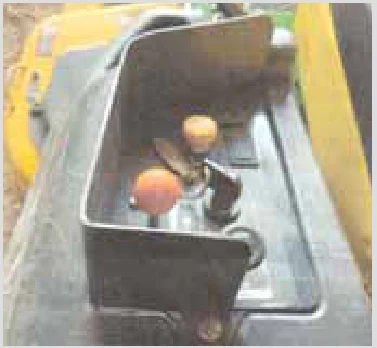
“After breaking two keys off and bending the choke cable while mowing around trees, I installed a shield around the engine controls on my zero-turn mower. Now those low branches just slide up and over the top, doing no damage.”

From the archive · Full text
Reader shop tip

Gerald Ripps

Gerald Ripps, San Antonio, Texas

“I attach magnets to the inside of oil pan drain plugs on equipment. I buy rare earth magnets from Harbor Freight at $3 for 10 magnets. Works great to pull metal filings out of the oil. Each time I pull the plug, I clean off the magnet.”

From the archive · Full text
Reader shop tip

Tim Barndon Jr.

Tim Barndon Jr., Kulin West, Australia

“I made an extension bar for box end wrenches. It has tabs that wrap around the wrench so it’s much safer to use than a pipe or other methods. No more skinned knuckles or slips.”

From the archive · Full text
Reader shop tip

March Coover

March Coover, Dallas, Texas

When adding new electric junction boxes in his shop, barn or attic where the walls are not finished, Coover writes the number of the electrical circuit on the metal cover of the box. That way, the next time that circuit needs servicing or expanding, he doesn’t waste time making several trips back and forth to the panel trying to figure out which breaker to turn off.

From the archive · Full text
Reader shop tip

Richard Bader

Richard Bader, Middletown, N.Y.

“I got this idea to keep starting fluid aerosol cans from accidentally spraying liquids inside my truck and tractor cabs. In the past, covers would come off cans and fluid would spray all over. By storing it inside a Pringles can, the top is protected. No more leaks. Works for paint cans too. In fact, a friend of mine bought a new truck and stopped at NAPA to buy black spray paint to paint the inside of the fender walls. His son jumped in the truck, knocked off the cap, and sprayed black paint all over the inside of the new truck. My friend started using my Pringles can idea right away.”

From the archive · Full text
Reader shop tip

Richard Mountcastle

Richard Mountcastle, Indianapolis, Ind.

“I have a Stihl weed trimmer and the string release button wore out on the head. I tried to buy a new head for it, but they wanted over $40, and it would take a few days to get. So, I just used a hole saw to make a button out of wood and glued it where the old one was worn. I’ve been using it for over a year now and it’s still working great.”

From the archive · Full text
Reader shop tip 1 of 2

Keith Fisher

Individual tip 1 of 2 from this reader’s published contribution.
Keith Fisher, New Palestine, Ind.

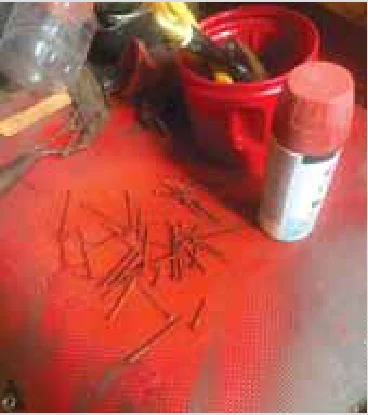
“We use a lot of wood screws, sorted and reclaimed from various projects. We throw them into a catch-all box but to eliminate the headache of confusing a Torx drive with a Phillips screw, we spray paint the Torx screws red.

From the archive · Full text
Reader shop tip 2 of 2

Keith Fisher

Individual tip 2 of 2 from this reader’s published contribution.
Keith Fisher, New Palestine, Ind.

“My high lift jack always seemed to be in the way out in the shop. So, I made a little shelf for it that’s sized to fit the base of the jack and put a spring clip on the wall that grabs onto the handle of the jack. It’s easily accessible but out of the way.”

From the archive · Full text
Reader shop tip

Eric Petrevich

Eric Petrevich, Glen Gardner, N.J.

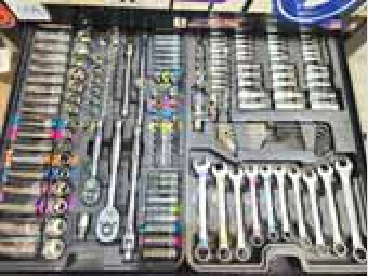
Eric sent in pictures showing how he keeps the tools in his portable tool case straight. When putting back sockets or wrenches, instead of having to read the sizes on the tools and the inside of the tool case, he spray paints the most common sizes so both the tools and the slots they fit into are marked. That way, he can tell at a glance where they go when putting things back.

From the archive · Full text
Reader shop tip

Gary Swensen

Gary Swensen, Yankton, S.D.

“After decades of use and handling millions of gallons of oil, the suction hose on my hydraulic loader pump broke off, and I lost the oil. It broke at the point where the hose bends and rubs. I went into town to buy hydraulic oil and stopped to fuel up my pickup. When I grabbed the fuel pump handle, I realized that if I used a swivel like they have on gas pump handles, it would lessen the wear and tear on the new hose I was going to install. So, I bought one, installed it, and it works great.”

From the archive · Full text
Reader shop tip

Clarence Maupin

Clarence Maupin, Scottsbluff, Neb.

“I’m 89 years old and I’ve been welding since I was 14 when the REA brought electricity to our farm. I don’t know what took me so long, but I recently discovered a handy hint that helps a lot. I fastened two pieces of heavy plastic pipe to the side of my welding table. Now I don’t have to look for a suitable place to lay down the rod holder so as not to spark. I just stick the rod in one of the pipes, and it’s real handy to pick it up again.”

From the archive · Full text
Reader shop tip

Karl Spees, MD

Karl Spees, MD, Port Angeles, Wash.

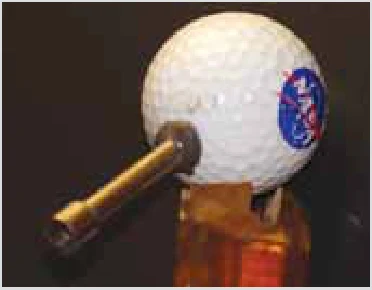
“Recently, our 40-year-old Maytag dryer quit working. I needed to replace the thermostat, which required using a 1/4-in. wrench in a very tight space. I had several 1/4-in. nut drivers, but they were all too long to fit into the area. I solved the problem by taking the oldest nut driver and cutting the shaft off, then inserting it into a drilled golf ball. I applied JB Weld to the hole and the nut driver shaft and let it cure overnight. It made a dandy tool, and I got the screws removed. Installation after the part arrived was a snap. Our dependable old dryer is back in action.”

From the archive · Full text
Reader shop tip

David L. Kimmel

David L. Kimmel, Rochester, Ind.

“If you ever find that your welding cables are too short on a stationary welder, you can temporarily extend them with a set of good battery cables.”

From the archive · Full text
Reader shop tip

Don Rakosnik

Don Rakosnik, Lombard, Ill.

“I installed a 3,000-lb. capacity 44 by 52-in. scissor lift in my shop. It raises to 36 in. high. Many things I work on in the shop can be raised to make repairs easier. It retracts down to the floor when not in use. Very handy.”

From the archive · Full text
Reader shop tip

Mark S. Yax

Mark S. Yax, Solon, Ohio

“My Simplicity bandsaw mill uses tires for the drive wheels on the mill. Sometimes when cutting through knots or hard dense spots on logs, the band blade will tend to pull down, causing wavy cuts. To help eliminate this, I added some small roller bearings to support the blade under the existing bearings. The bearings are mounted so that they don’t turn with the blade all the time. But when the cut tends to cause the blade to travel down, the bearings will hold the blade straight in the cut. The small size lets me cut boards down to 3/4 of an inch thick over the bunks.”

From the archive · Full text
Reader shop tip

Don Burt

Don Burt, Anchor Point, Alaska.

“I needed more windows in my shop to lighten it up, so I went to a local recycling center and got some used sliding glass doors. I just framed them into the walls. Works great, and it was cheap.”

From the archive · Full text
Reader shop tip

Steve Lane

Steve Lane, Springville, Iowa

“I replace the hand grips on 5-gal. buckets with pieces of split rubber gas line hose that’s taped in place. Much easier on your hands.”

From the archive · Full text
Reader shop tip

Vern Platt

Vern Platt, Prior Lake, Minn.

“I had a rotted round fence post that broke off at ground level. I wanted to put a new post in the same spot, so I screwed an 8-in. long, 1/2-in. lag bolt into the top of it and pulled it out with my loader.”

Shop feature stories

From the archive · Full text
Feature story

Jib Crane Added To Walk-Behind Forklift

By Bruce Derksen, Contributing Editor
Featured source: Randy Boyce, Marshalltown, Iowa

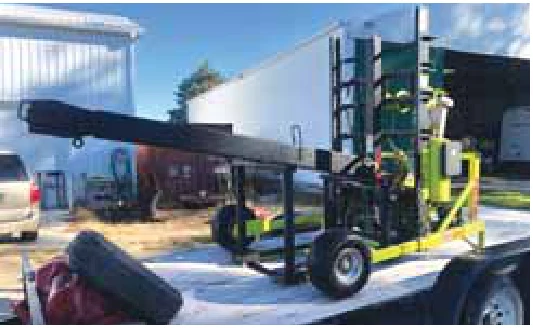
When Randy Boyce needed something to lift heavy parts for his restoration business, he thought adding a boom and jib crane to his walk-behind Burro 6162 forklift might be exactly what he was looking for.

He left the Burro standard, with its 14-hp. Honda motor and 3-lever hydraulic system that controlled the boom, forks, 24-in. reach extension plus the electric winch.

To support his extended boom, Boyce welded a framework of 1/2-in. thick by 3-in. boiler pipe for upright legs and upper horizontal supports. He added metal pockets for the forklift tines to slide into to lift the unit.

The exterior boom is 8-in. square tubing with the interior telescoping beam slightly smaller. He welded a handle on the end for manual positioning, using a 1-in. pin to secure it every 2 ft. A large pivot pin supports the boom at the forklift mast with four U-bolts added for extra stability.

“When fully extended, I can lift the tail end of my van with it,” says Boyce.

“The winch is also great for lifting. I just run the cable around the end through a pulley.”

With the forks lowered, the boom reaches out to an 8 ft. height. In the raised position, it extends up to 16 ft. when fully telescoped.

“If I were to build it again, I’d make the main pivot pin fit a bit better,” Boyce says.

“It’s a little tight, so I need to use a hammer to slip it in and out.”

He built and welded the jib crane from scratch and estimates he put slightly less than $1,000 into the project.

Contact: FARM SHOW Followup, Randall Boyce, Quality Auto Repair, 1755 Oaks Avenue, Marshalltown, Iowa 50158 (ph 641-753-9468; [email protected]; www.qualityauto56.com).

From the archive · Full text
Feature story

They Made An Electrical Pole From Spare Parts

Featured source: Reid Allaway, Les Cedres, Quebec, Canada

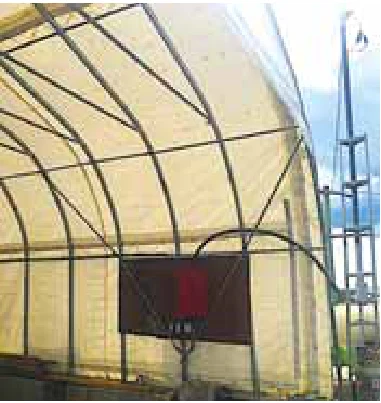
“We made an inexpensive and simple aerial electrical mast for our fabric equipment shelter using parts from an old TV antenna tower, some extra black pipe, and various conduit pieces and fittings,” says Reid Allaway of Tourne sol Farm in Quebec.

“The mast uses random pieces of 2-in. threaded pipe that’s welded into the top section of a truss-type antenna tower. We welded gussets to spread the load through several truss layers,” Allaway says.

“It’s completed with a 2-in. PVC weather head at the top and a 2-in. LB elbow into weathertight conduit at the base. This allowed us to set up a sub panel supplied with 60A 240VAC that we use to run fans for our onion dryer. We can also plug in tractor block heaters and battery chargers for electric vehicles and tools.”

Allaway says the cooperative always wanted power in the shelter but couldn’t justify having an expensive installation done using a new pole and new electrical equipment.

“Once I realized we had a used breaker panel on hand and could build a quick and simple mast to span the driveway, the project became a lot more affordable.”

The TV mast is bolted securely to a concrete footing and anchored to the outside arch of the hoop building. With an overall height of 15 ft., the mast is tall enough to elevate wires above the roadway and secure enough to hold electrical wire extending to another building across the driveway.

Contact: FARM SHOW Followup, Reid Allaway, Tourne-Sol Co-operative Farm, 1025 Chemin St Dominique, les Cedres, Quebec, Canada J7T 1P5 (ph 450-452-4271; [email protected]; www.fermetournesol.qc.ca).

From the archive · Full text
Feature story

Draper Belt Repaired With Zip Ties

Featured source: Jerod Schmidt

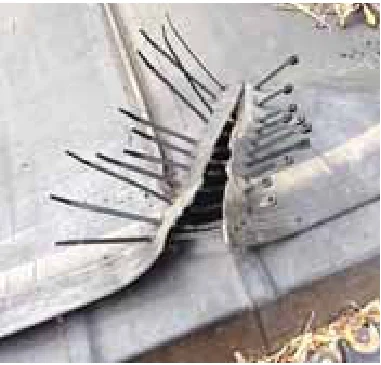
“My farmer engineer degree came in handy today,” proclaimed Jerod Schmidt after executing a creative solution for fixing a broken draper belt on a combine head. He drilled holes along the side and used 11 zip ties to create sutures across the tear to hold the sides together. It held up until he could get a replacement.

Contact: FARM SHOW Followup, Jerod Schmidt (www.twitter.com/SchmidtJerod).

From the archive · Full text
Feature story

Easy-To-Store Collapsible Trailer

Featured source: Christophe Goffoz, Saint-Roch-de-l’Achigan, Quebec, Canada

“When you think about it, what people do most with their trailers is store them,” says Christophe Goffoz, owner and co-founder of Apogee Trailers.

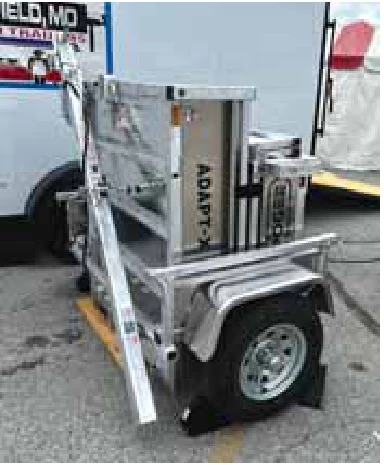
Apogee created their Adapt-X folding trailer in five sizes from 4 by 8 ft. up to 6 by 12 ft. Each model is built to be easily and quickly folded into a compact unit by a single person.

The trailers are built completely from aluminum except for stainless steel hardware and connections. Standard features include 13-in. wheels, anti-skid floor surfaces, and internal wiring.

Options include a storage cover, a spare wheel with covering, high-side kit, canoe racks, front deflectors, jack, Spyder ramps, floor liner and side steps.

“Our challenge was to build it strong and still be able to fold it,” says Goffoz, noting that the Adapt-X is rated for 2,990 lbs. GVWR.

“Our customers mainly use them to carry ATVs, UTVs, motorcycles, golf carts, firewood and snowmobiles. But they can be used to haul sand and gravel and for many other chores on the farm.”

The most unique feature is the lateral transport wheel kit which can be added to maneuver the closed-up trailer through gates or into tight storage spaces.

“When the trailer is collapsed, you can easily push it around, even sideways. If a gate or a corner is at least 42 in., it will fit.”

The Adapt-X trailers are manufactured in Canada and are available throughout North America via a network of distributors.

MSRP costs range from $4,000 to $6,900 (CAD) plus S&H depending on sizes.

Contact: FARM SHOW Followup, Christophe Goffoz, Apogee Trailers, 565 Rue J. Oswald Forest #201, Saint-Roch-de-l’Achigan, Quebec, Canada J0K 3H0 (ph 833-360-3845; [email protected]; www.apogeetrailers.com).

From the archive · Full text
Feature story

“Stitching” Process Repairs Cracked Cast Iron

Featured source: Metalock Engineering

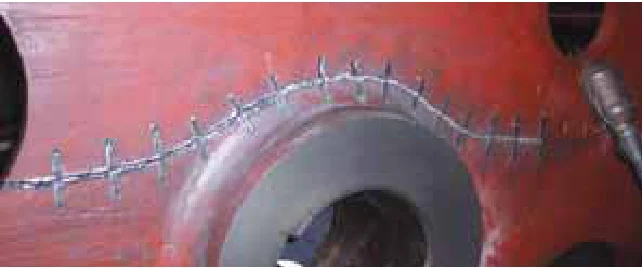
A “metal stitching” technique invented in the 1930’s to successfully repair cracked or broken cast metals without welding has been widely used in many industries for over 90 years. Metalock Engineering in the U.S. and Herculock in Canada use the technique to repair old steam engines, commercial boilers, industrial equipment, ships, and oil field equipment. Gerald Cyr at Herculock says the cold cast technique known as metal locking repairs a crack without adding extra stress to the part. Cyr says the process has been used effectively to repair broken crankcases and other parts on century-old engines. The cracked area is thoroughly cleaned, and the repair design is determined by magna flux or dye penetrant testing. The stitching process requires drilling small holes and adjoining shoulders along the fractured area. Metal dowel key strips and lacing bolts are inserted into the holes and peened (driven) into place with pneumatic tools. Peening expands the surface of the cold metal into the area of the fissure and relieves tensile stresses to strain-harden the surface metal. The process adds rigidity to the repaired area and creates an extremely strong joint. The exposed metal pieces are then ground smooth to the surface revealing only the stitch lines extending into the solid metal adjacent to the crack. Cyr says repaired areas have excellent shear load resistance and hydraulic pressure levels of up to 10,000 psi can be achieved. The native metal isn’t damaged or distorted because heat isn’t used in the repair. Metal locking is an ideal alternative to welding on metals where using heat isn’t possible or recommended. Search Google.com for “metal stitching cast iron” for more information on the technique. Contact: FARM SHOW Followup, Metalock Engineering (www.metalockengineering.us) or Herculock Ltd. ([email protected]).

From the archive · Full text
Feature story

Emergency Storage Made Permanent

Featured source: John Krueger, Blanchard, Okla.

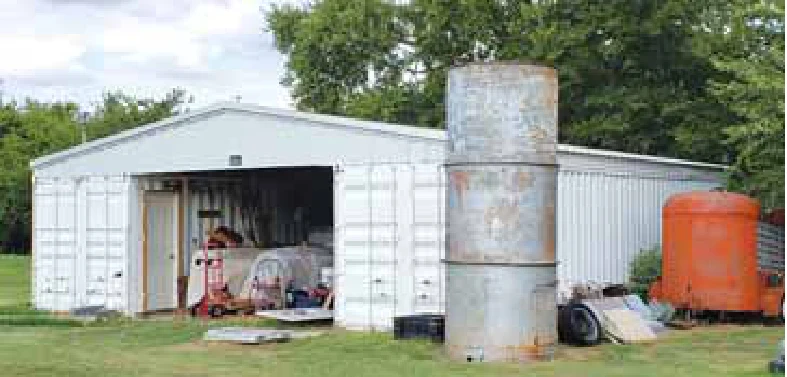
When a tornado damaged his barn, John Krueger needed a place for tools and other equipment, and he needed it fast. An 8 by 8 by 40-ft. shipping container did the job. In short order, he added a second and then covered them both with a set of trusses and metal roofing. His short-term emergency storage became a workshop, storage unit, and a tractor shed.

“I set the two containers 12 ft. apart on railroad ties,” says Krueger.

“Then I purchased Red Iron 30-ft. trusses and covered them with 26-ga. sheathing for roof and gable ends. The roof gets tractors and other equipment under cover while securing tools and supplies in the containers.”

Krueger set the shed next to 1940’s era shipping containers that he had stacked years ago and used as a silo for cattle feed. With the shed in place, he repurposed them.

“They were originally used for shipping radial engines,” he says.

“Now I use them for fuel container storage. Stacking them was easy. I just bolted the flanged ends together. Being all steel, it’s a safe place to store fuel and other flammable fluids.”

The more modern shipping containers came equipped with double swinging doors at one end. Container floors are treated plywood and teak tongue and groove. Krueger added a walk-through door to one of the shipping containers for more convenient access. He outfitted it for a welding shop with 220 current. He also added a bathroom and wash station.

“My main shop near the house is over capacity,” says Krueger.

“My son is a welder by trade but disabled. I hope he’ll be able to use it.”

Krueger also put the space above the containers and between the trusses to use.

“It provides extra storage,” he says.

“You never have enough room.”

Contact: FARM SHOW Followup, John Krueger, 1112 County St. 2984, Blanchard, Okla. 73010 (ph 405-392-4796).

From the archive · Full text
Feature story

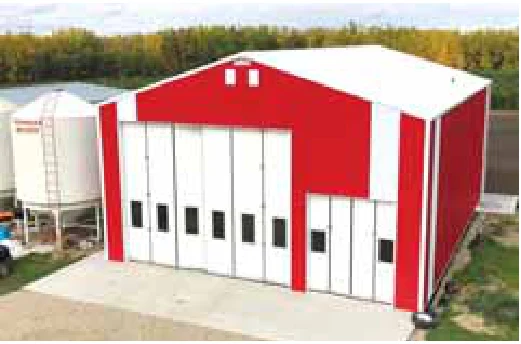
Finnish Doors Fold Vertically, Seal Tight

Featured source: Findoor Industrial Inc., Westerose, Alberta, Canada

No springs, cables, rails or drums. No maintenance besides occasionally oiling the hinges. Those features of the Findoor garage door are catching the attention of North American builders. The doors fold open vertically instead of horizontally like overhead doors. While the Finnish doors have been around for 30 years, they were recently introduced to Canada, where a factory to make them was built four years ago in Alberta.

Contractors who see them for the first time appreciate that the doors require less headroom (5 in. for doors up to 18 ft. and 16 in. maximum for the largest doors).

“It’s a very innovative design,” says Richelle Black, who works in sales for Findoor. The doors seal tightly with compression seals on all four sides and are well insulated.

In addition to commercial uses such as warehouses and car washes, they’re popular with rural customers for machine sheds, dairy and livestock barns, and warehouses for potatoes, for example.

The doors can be opened manually, or remote-control electric operators can be added. The lifting steel hinges ensure that weather stripping doesn’t rub on the ground.

The larger doors are competitively priced with overhead doors, Black notes. The custom doors can be as tall as 35 ft. or as wide as 50 ft. And they can swing in (for snowy areas) or out (for buildings that need to be scraped out such as hog and dairy facilities.) A heavy-duty steel floor plate reinforces the door against wind and intruders.

The doors come in six standard colors and can have windows and access doors. Findoor is building a dealer network throughout North America, including U.S. dealers in the North, Midwest and the West Coast.

Check out the website for more information. Contact: FARM SHOW Followup, Findoor Industrial Inc., Site 8, Box 12, RR 1, Westerose, Alberta, Canada T0C 2V0 (ph 866-338-8308; [email protected]; www.findoor.ca).

From the archive · Full text
Feature story

Small LED Floods Work Area With Light

Featured source: Matco Tools

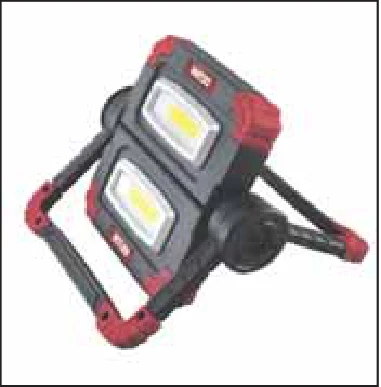
Hang the rechargeable, collapsible MCFL800 floodlight (about $100) from Matco from the hood or slip it under the car. It’s ideal for emergencies, like changing a tire, jumping a battery, or anytime you need more light. With its 8 by 5 1/2-in. footprint, you can use it anywhere.

The 360-degree ratcheting stand directs light where you want it. Two adjustable position, 20-lb. magnets can be used to attach the floodlight to metal surfaces. The floodlight folds up flat for storage.

The LED strips adjust for just the light needed where it is needed. The floodlight produces 800 lumens on high and 400 lumens on low from its two LED strips. That’s roughly equivalent to a 60-watt bulb, shining at close range. Need light over a broader area? The LED strips can be rotated into the desired position.

The lithium rechargeable battery provides up to 7 hrs. of use. The Micro USB can recharge in 6 hrs. The port lets the battery serve as a power bank for other electronic devices.

The floodlight is one of more than 60 work lights available online at Matco Tools and through Matco franchisees. The company has been selling automotive tools and products for more than 75 years.

Contact: FARM SHOW Followup, Matco Tools, (ph 866-289-8665; www.matcotools.com).

From the archive · Full text
Feature story

Simple Lock Protects Trailers

Featured source: Arden and Salley Vernon, Turon, Kan.

Arden and Salley Vernon of Turon, Kan., have an easy fix to keep your trailer safe.

“It’s called the EZE-LOC,” says Vernon.

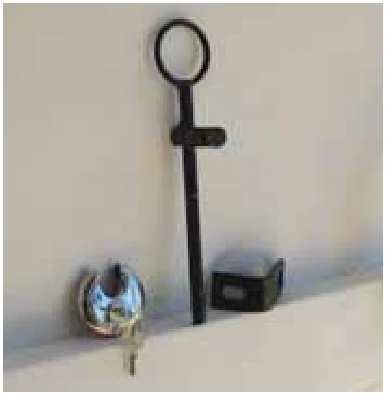
“It’s a trailer lock that goes on the hand-crank jack of gooseneck trailers or implement trailers. Once it’s locked in, it disables the hand-crank jack on your trailer.”

You’ll have to drill a hole through the pipe that turns the jack up and down. The EZE-LOC goes through the hole, and then you attach a padlock to keep it safe. The hand-crank jack will not move once it’s locked.

The lock itself is 12 in. long, made of solid steel, powder-coated, and difficult to cut off. While anything can eventually be cut off, Vernon points out that most thieves don’t want to work that hard and draw attention to themselves.

The diameter of the lock is 1/2 in., so he says the hole should be drilled at 17/32 in. dia.

“We sell the padlocks separately,” Vernon says.

“They’re solid, round padlocks built to be very awkward for a bolt cutter to bite through. People who’ve lost their keys say the only way they could get the lock off was to use a cutting torch.”

The birth of the EZE-LOC began when Vernon spent some time talking to an Oklahoma detective whose primary job was investigating trailer thefts.

“Areas around Tulsa and Oklahoma City are probably the trailer-theft capitals of the world,” he says.

“Trailers are easy targets because they have an equine event in both cities almost every week.”

Trailers with hand-cranked jacks are the easiest trailers to make off with when electric jacks because the jacks are disabled when the towing vehicle shuts off.

“But the hand-crank jack is just sitting there and waiting to get turned by anyone,” he says.

“All thieves need to do is hook it up to their trucks and take off with it.”

“It’s simple and convenient to use,” he says.

They retail for $30 each, plus S&H.

“If you have a trailer worth $25,000, then $30 isn’t much to protect that investment,” Vernon says.

Contact: FARM SHOW Followup, Arden and Salley Vernon, EZE-LATCH for Trailers, P.O. Box 356, Turon, Kan. 67583 (ph 866-231-8589; www.eze-latch.com).

From the archive · Full text
Feature story

Rolling Shop Tables

Featured source: Arlo Slack, St. Marie’s, Idaho

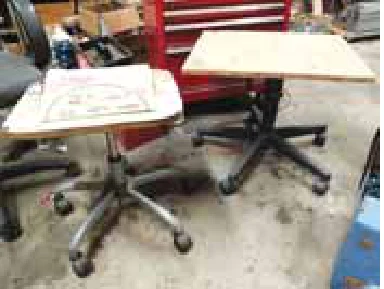
“I took a couple of old office chairs and made handy rolling tables for use around the shop,” says Arlo Slack, St. Marie’s, Idaho.

He takes the seat off, leaving the bracket that holds it on at the top of the chair stem. Then he attaches a square piece of plywood to that bracket. No welding is needed.

One table is 18 in. square and the other 24 in. Contact: FARM SHOW Followup, Arlo Slack, St. Marie’s, Idaho (ph 208-245-2448).

From the archive · Full text
Feature story

Add-On Makes Hydraulic Connections A Snap

Featured source: Westendorf

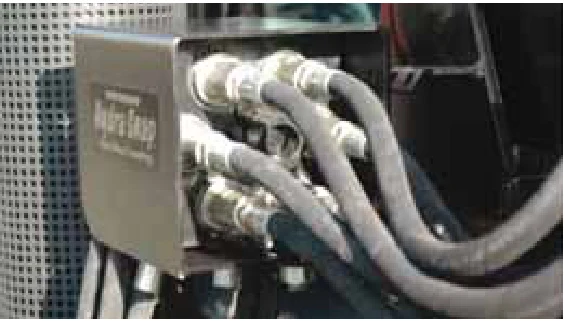
Westendorf, a manufacturer of front-end loaders for over 80 years, says their patented Hydra-Snap™ add-on lets you quickly couple multiple hydraulic hose configurations in a single motion.

It’s a metal box with remote outlets that mounts ahead of the cab. Each hose is fastened to a self-aligning keyed plate, so the hoses stay organized. You can add it to an existing loader or upgrade your Westendorf loader package at purchase to include it.

The device’s one-lever manifold ensures a spill-free connection point, and the patented spiral lock technology makes it hassle-free to put into place. It’s easy to install, simple to use, and best of all, the device’s space-saving design makes it useful for different locations and applications.

By design, all hoses connected to the Hydra-Snap will merge into a keyed, multi-coupling unit that keeps them aligned and organized with minimal risk of mixing them up. The unit is self-storing and comes with a dust cover to keep the hydraulic connections clean when not in use. An integrated electronic connection is also available.

To disconnect the hydraulics, you rotate a lever on the back of the box 90 degrees. Reconnecting again requires inserting the hose assembly plate and rotating the lever back to its prior position.

Thanks to its universal design, the Hydra-Snap can work with almost all loader models and other implements with hydraulic hoses, including balers, planters, snow blowers, and disc blows.

At publication, the Hydra-Snap comes in four and six-line models. Contact Westendorf directly for current pricing information.

Contact: FARM SHOW Followup, Westendorf Online Parts Store, (ph 877-423-0070); [email protected]; www.store.loaders.com/Accessories/Manifold/Hydra-Snap).

From the archive · Full text
Feature story

Portable Bandsaw Stand

Featured source: Ron Rawls, Lufkin, Texas

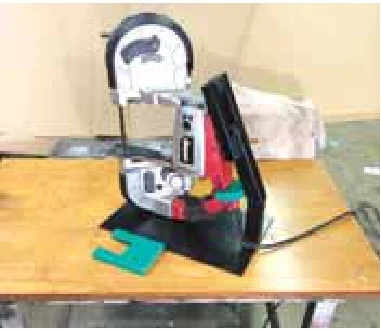
Cutting small shapes with his portable bandsaw is easy since Ron Rawls built a stand. Stands available commercially were too expensive, too complicated, and often limited to certain bandsaws. They required clamping the bandsaw to the stand or even unbolting the handle.

“I looked at what was out there and came up with a simple alternative that didn’t require clamping or unbolting handles,” says Rawls.

“I use my portable bandsaw a lot, but sometimes I want it to be stationary. With my stand, it takes less than 5 sec. to go from stationary to portable.”

Rawls eyeballed the design of the bandsaw and began by cutting two pieces of 1 1/2-in. square tubing for an upright. He welded them together at an angle to match the shape of the bandsaw when held vertically. He added 1-in. tubing with slotted ends to either side of the upright. He knew the space between the slots would match the width of the bandsaw handle. A piece of U-shaped plastic attached near the bottom of the angled upright centers the bandsaw.

“I slide the handle into the slot, and the weight helps keep it in place,” says Rawls.

Satisfied with the vertical, Rawls butt-welded it to a 10 by 16-in. steel base. He admits he would have liked a larger base. However, very much larger and he knows it would’ve been in the way when using the stand.

“If I need more stability, I can always clamp the base plate to a work surface,” says Rawls.

With the bandsaw held in place, the only remaining challenge was switching it on and off. His model didn’t have a lock-on trigger.

“I used a piece of high-density polyethylene to center the bandsaw on the stand,” says Rawls.

“I cut out a second piece designed to slip over the trigger and hold it in the running position. When I want to shut the saw off, it’s easy to pull out.”

Rawls has used the stand to make several items for himself and others.

“It makes it easy to cut out small pieces or shapes where I need two hands on the piece,” says Rawls.

Contact: FARM SHOW Followup, Ron Rawls, 4432 Benton Dr., Lufkin, Texas 75901 (ph 936-676-0052; [email protected]).

From the archive · Full text
Feature story

How To Organize Nut Drivers, Sockets

Featured source: Phil Tilley, Aragon, Ga.

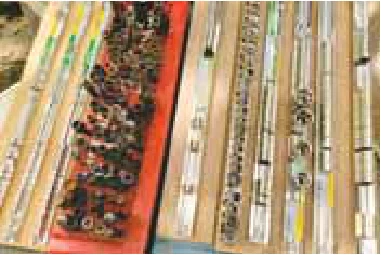
FARM SHOW reader Phil Tilley grew tired of never finding the right-sized nut driver or sockets. Digging through his toolboxes for the correct piece proved too tedious, so he came up with an idea for organizing them. He purchased a safe deposit box from Harbor Freight and modified it by drilling holes through the top and mounting socket rails on it. This made it possible to keep each nut driver in one spot while organizing the sockets by size on the sliders, one section for 1/2 in. and another for 1/4 in. The safe deposit box still works to keep larger tools stored underneath. Now he can find what he wants at a glance.

“This organizing system has saved me hours of searching around,” he says.

Contact: FARM SHOW Followup, Phil Tilley, 366 N Bellview Rd, Aragon, Ga. 30104 (ph 770-316-8000).

From the archive · Full text
Feature story

LED Combine Lights Sold In Kits

Featured source: K&M Manufacturing

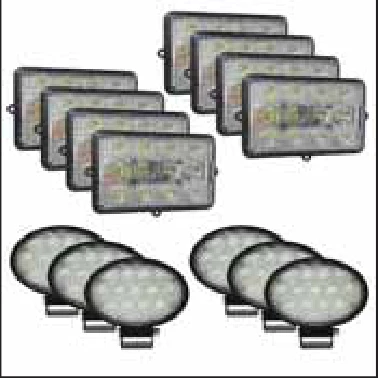
K&M Manufacturing sells Tiger Lights LED light kits for Deere and Case IH combines. Each lighting kit makes it possible to fully outfit your combine with LED lights.

One example is the JDKIT4, priced at $1,461. This kit is meant for Deere combines with rectangular lights on top of the cab (buy oval lights with the JDKIT5). Included in the kit are eight TL9000 headlights and six TL5655 field lights.

Purchased individually from Tiger Lights, the TL9000 lights are priced at $111 each, while the TL5655 field lights are $107. This brings the light set’s total value to $1,530, for a savings of approximately $70 when purchasing the kit compared to buying them individually.

These LED lights illuminate up to 330 percent brighter than halogen bulbs. They are IP68 rated, meaning that the lights are impervious to dust and water resistant to a maximum depth of 1.5 meters for 30 mins. They include stainless steel hardware for durable mounting and streamlined assembly.

Each has built-in filters that will eliminate unwanted radio and electromagnetic frequencies, and their die-cast aluminum housing offers long-term durability even through rugged use. Better yet, the LEDs emit light at a frequency near the color spectrum of the mid-day sun to optimize conditions for the human eye. This improves comfort and makes it easier to stay focused while on the job.

The lights are made with a durable polycarbonate lens. Since aluminum works to dissipate heat away from the light’s internal electronics, the lights will provide excellent light output and consistent performance over time.

Contact: FARM SHOW Followup, K&M Manufacturing (ph 800-328-1752; www.tractorseats.com).

From the archive · Full text
Feature story

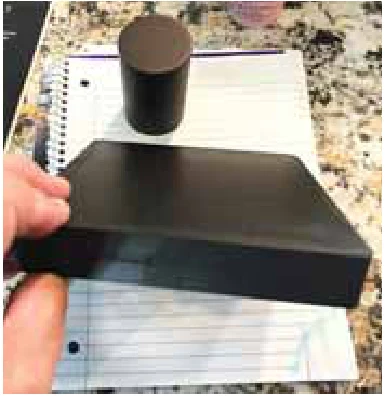
Carburetor Floats Made With Nitrophyl

Featured source: Wendell Kelch, Bethel, Ohio

If you need a new float for a carburetor repair or restoration, try Nitrophyl. It’s easy to drill, mill or carve, and it’s impervious to all fluids.

“It’s a state-of-the-art material; nothing phases it,” says Wendell Kelch, Kelch Restoration Services.

Kelch should know. He’s restored hundreds of old tractors, some for himself, but most for customers, with his five to six full-time employees. He buys Nitrophyl for use in his shop but has to buy in quantities beyond his needs from his supplier.

“It’s so good, we decided to sell the extra,” says Kelch.

Nitrophyl is a nitrile rubber ebonite formulation that has been used for floats for more than 60 years. It’s resistant to gasoline, diesel, LP and automotive oils, such as power steering fluid, motor oil and various chemicals and solvents. Different companies make their own proprietary versions.

Kelch’s source makes a proprietary Nitrophyl for their own line of products for the aviation industry and other markets. Like Kelch, they sell the excess.

He offers rectangular and round blocks of the material. He has priced 3 by 3 by 1-in. thick blocks and 2-in. diameter by 3-in. long round blocks at $20. A 6 by 6 by 1-in. thick block costs $65.

“I’ve used this material for years with no issues whatever,” says Kelch.

“We also sell an adhesive for bonding multiple layers.”

Contact: FARM SHOW Followup, Kelch Restoration Service, 3727 Starling Rd., Bethel, Ohio 45106 (ph 513-543-9477; [email protected]).