
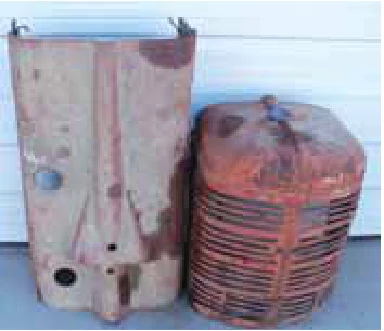
Chlor*Rid soluble salt remover from Chlor Rid International makes repainting metal surfaces easier and more effective. Jim Deardorff, paint contractor, author and industry consultant, recommends an application of Chlor*Rid after the first sand blasting.
“Normally, if you sandblast and wait overnight before priming, you get more rust,” says Deardorff.
“I apply a coat of Chlor*Rid, and it reacts with remaining iron oxide (rust) and dissolves it, separating it from the metal. The entire surface turns dark. I can wait and sandblast again in the morning for a virtually paint-free surface.”
Better yet, Deardorff says the second sandblast doesn’t remove sound metal, and the Chlor*Rid works on stains other than rust. He uses the Chlor*Rid as one step in his Classic Blast restoration process. The process also uses a fine, dense mix of aluminum oxide, trace minerals and graded walnut shells for a blast medium.
“I believe I am the only person who can remove rust from 10-gauge metal without affecting the metal,” says Deardorff.
“And I can remove a stain off any surface.”
Deardorff has coined the term Lifetime Coating to describe his resurfacing that equals the 5 to 7-step coating process used by the automotive industry.
“Chlor*Rid not only dissolves the rust, but also cuts salt content on the metal to less than 5 ppm,” explains Deardorff.
“Any chloride over 10 ppm will produce rust.”
Deardorff recommends mixing Chlor*Rid at 1 part to 200 parts water. He then applies 10 gal. of the solution through his sandblaster.
“The industry doesn’t want paint to last,” says Deardorff.
“With my system and Chlor*Rid, you stabilize the substrate, so the resurfacing will last longer.”
Contact: FARM SHOW Followup, Superior Coatings Co., 205 McCormick St., Chillicothe, Mo. 64601 (ph 660 646-6355; [email protected]; www.classicblast.com).
Reproduced from the published FARM SHOW entry. Prices, coupons, availability and contact details are historical, not current offers. Reader methods are not universal instructions: follow manufacturer guidance, proper supports and safety practices, and consult a qualified professional when needed.
Comments and votes
Have you tried this idea? Mark it helpful and share how it worked in your shop.