Practical ideas from FARM SHOW MagazineSubscribe · Free issue · Send us your shop tip
Subscribe to FARM SHOW
Issues / Vol. 30, No. 5 (2006)

Vol. 30, No. 5 (2006)

Money-Saving Repairs & Maintenance Shortcuts · Printed section pp. 36–39

35 selected entries · Complete text of selected entries

This issue’s section includes reader tips and feature-length shop stories. Held items and editorial notices are not reproduced.

Archive text: prices, coupons, availability and contact details reflect the original publication, not current offers. Reader methods are not universal instructions; follow manufacturer guidance and proper safety practices.

Reader shop tips

From the archive · Full text
Reader shop tip 1 of 2

Bob Bugger

Individual tip 1 of 2 from this reader’s published contribution.
Bob Bugger, Effingham, Ill.

Bob reduced wire changing time on his mig welder by installing an extra spool dispenser that he designed himself.

In the past, he had to wind wire from larger wheels onto the smaller wheel that comes with the welder. To eliminate that step, he mounted a bracket in the unused space below the welder. The bracket is simply a piece of flat angle iron with a short shaft to allow the commercial spool to slip on. In the bottom of the upper compartment, he installed a small brass fitting to allow the wire to slip through smoothly without jamming.

From the archive · Full text
Reader shop tip 2 of 2

Bob Bugger

Individual tip 2 of 2 from this reader’s published contribution.
Bob Bugger, Effingham, Ill.

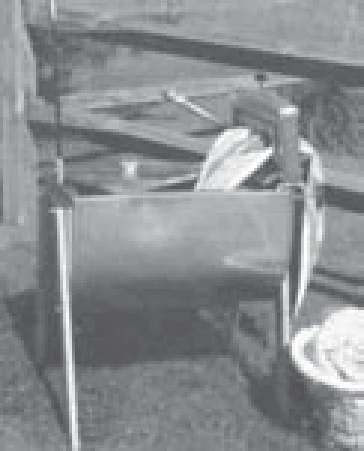
Bob also made a parts washer that he says works as well as anything he could have bought. He used a salvaged kitchen sink from a school cafeteria with a flip down cover made from a sheet of stainless steel. The hinged lid drops down quickly in case of a flash fire. Bugger had experience with such a fire when a magneto he was working on emitted a spark and set off a fire. Washing solvent is stored in a barrel below. To circulate it, he uses a car power steering pump. It’s belt-driven by an electric motor. The washing nozzle is made from thin gauge copper tubing.

From the archive · Full text
Reader shop tip

Neil Marshall

Neil Marshall, Bethany, Ill.

Neil likes to use his chop saw a lot but he doesn’t like the dust that settles all over his shop. So he mounted it on a pivoting bracket attached just inside the garage door. When not in use, it pivots inside for storage. When he has to cut something, it swings easily to the outside.

From the archive · Full text
Reader shop tip 1 of 2

John Needham

Individual tip 1 of 2 from this reader’s published contribution.
John Needham, Nipissing, Ont.

“Anyone who uses a splitting axe for chopping firewood knows how easy it is to break the handle. By welding a 6-in. length of 1-in. angle iron to the axe head, with the apex facing down, the handle will be protected. Run a couple steel straps from the angle iron to the head for reinforcement. I have split several hundred cords of wood with the same handle so the idea really works.

From the archive · Full text
Reader shop tip 2 of 2

John Needham

Individual tip 2 of 2 from this reader’s published contribution.
John Needham, Nipissing, Ont.

“Here’s another tip. If you need to tighten a wooden handle, soak it in antifreeze instead of water because water will rot the wood.”

From the archive · Full text
Reader shop tip

Arco Rosenow

Arco Rosenow, Chillicothe, Ill.

“It seems battery-powered shop tools always go dead whenever I’m away from home. To solve the problem I carry spare batteries in my tool and tackle boxes using this idea. I cut a length of PVC tubing into 6-in. lengths and glue on one end cap. Then I push in a small wad of paper, stack several batteries, insert another wad of paper and push on another cap.”

From the archive · Full text
Reader shop tip

C.F. Marley

C.F. Marley, Nokomis, Ill.

“When the starter motor in my old 1948 IHC M went bad I went looking for a replacement. I discovered a company in my own back yard that works on starters, generators and alternators from all over the country.

“K&W Auto Electric (103 N. Automotive St., Teutopolis, Ill. 62467 ph 217 857-1717) provided me with a rebuilt starter for $88. What I like about their service is that you can wait for your part to be rebuilt or you can pick up a rebuilt part and trade yours in.

“Owners Karl Wendt and Rick Kreke started out in 1987 in an old chicken house rewiring starters and alternators. In 1991 they also started selling batteries. In 1994 they added a second store in Shelbyville, Ill., and started selling used golf carts.

“You can ship parts to them from anywhere by UPS.”

From the archive · Full text
Reader shop tip

Bill Reeks

Bill Reeks, Cromwell, Ky.

“I install a shut-off switch and also an extra outlet along the length of extension cords to make them more useful. Works great.”

From the archive · Full text
Reader shop tip

Mike Miller

Mike Miller, Athens, Ill.

Mike’s moveable workbench has a split-level top which offers several benefits. One is that it makes it easy to hold flat pieces of steel while sawing or grinding because you can slip them under the top level. A second advantage is that when working on a motor, all motor parts can be kept on the upper level while the tools are on the lower level.

The all-steel table mounts on casters and can be moved about the shop and taken to repair jobs. The table is fitted with a vise.

From the archive · Full text
Reader shop tip

Jeff Kumpf

Jeff Kumpf, Hopedale, Ill.

“In building a new shop, I needed a place to store miscellaneous metal pieces. I had some 4-in. pipe straps so I decided to mount them on a couple 8-ft. 2 by 4’s. I mounted the straps end to end along the length of the board. Then I mounted the boards, one above the other, along the wall of the shop. I just slip the pieces of iron, rod or pipe, through the straps.”

From the archive · Full text
Reader shop tip

Dwight Michener

Dwight Michener, Waynesville, Ohio

“I use body putty to make small repairs and patches to all kinds of wood and metal parts. It’s easy to mix up and lasts longer than other repair materials.”

From the archive · Full text
Reader shop tip

Danny Bowes

Danny Bowes, 3467 Queens Line, RR1, Foresters Falls, Ontario K0J1V0 Canada ph 613 646-2672; www.importtractorparts.net

“I run a small business and website called Import Tractor Parts, specializing in parts for Fiat-built and Universal (UTB) or Long tractors. We carry a large stock of parts. Parts from the dealers are either not available or prohibitively expensive to keep these older tractors up and running. But ITP tries to alleviate that for its customers by providing quality, aftermarket parts for these models.”

From the archive · Full text
Reader shop tip

Joe Hinchman

Joe Hinchman, Rochester, N.Y.

“I needed to replace the lower ball joint and control arm on one of my Honda Accords but I couldn’t get the strut rod out of the bushing. I tried heat, penetrating oil, gear pullers, pickle forks, etc. I actually broke my gear puller. Then I remembered a trick an old master plumber told me about. Soak the part in household ammonia for at least 24 hours. So I wrapped the part in a rag, soaked it with ammonia, then wrapped everything with cling wrap to seal it. I waited 48 hours, and tapped the strut out with three blows of a hammer and chisel.”

From the archive · Full text
Reader shop tip 1 of 2

Mike Hoy

Individual tip 1 of 2 from this reader’s published contribution.
Mike Hoy, Hedrick, Iowa

“My 1949 WD tractor has a low volume hydraulic system (6 qts.). I added a 3 gal. hydraulic reservoir mounted to the frame to give me all the fluid volume I need.

From the archive · Full text
Reader shop tip 2 of 2

Mike Hoy

Individual tip 2 of 2 from this reader’s published contribution.
Mike Hoy, Hedrick, Iowa

“I use Sea Foam fuel additive in all my small engines. It keeps fuel fresh and engines running smooth. I dump a few ounces in the gas tanks in the fall and, come next spring, they start right up.”

From the archive · Full text
Reader shop tip

Mike Clabaugh

Mike Clabaugh, Grinnell, Iowa

To keep mudflaps from tearing on grain trucks, wagons, trailers, semis, and other equipment, I cut them in half horizontally and attach a hinge to the front side. That way, if I hit an object when backing up, the lower half of the flap will flex forward rather than tearing off. But when you drive forward, they’ll hold firm.”

From the archive · Full text
Reader shop tip

R.E. Charlton

R.E. Charlton, Dillwyn, Va.

“I patched a hydraulic cylinder rod using an aluminum welding rod of the type you see at fairs where the salesman will use it to patch a hole in a soda pop can. It works great. Electric rods leave a small groove in the side of the bead and bronze rods require too much heat. These aluminum weld rods work just right.

From the archive · Full text
Reader shop tip

Dieselcraft Fluid Engineering

Dieselcraft Fluid Engineering, P.O. Box 7670, Auburn, Calif. 95604 ph 877 823- 7075; [email protected]; www.dieselcraft.com)

This company has developed a compact Fuel Purifier that it says removes more than 99 percent of water and more than 95 percent of the natural contaminants in diesel fuel. The two-stage fuel treatment system results in increased power and up to 5 percent better mileage. Decreased smoke and no more clogged fuel filters are other benefits, says the company.

It has no replaceable, changeable or cleanable filter elements. Clean fuel is drawn out of the unit and into the primary fuel filter. Water and contamination is drained from the bottom of the unit.

From the archive · Full text
Reader shop tip

Byron Bremer

Byron Bremer, Imperial, Neb.

“When the 6-volt battery on my Sears Craftsman 6-volt cordless screwdriver went out, I discovered that a replacement battery was no longer available. The company said they don’t make these batteries any more.

“I bought a new 6-volt dry cell flashlight battery and ran a 3-ft. long cord from the drill to it, using clips to clamp the wire to the battery terminals as shown in the photo. The original design was to clamp the flashlight’s bulb assembly onto the top of the battery using a couple of thumb screws. The same idea would work using a cigarette plug outlet in any vehicle equipped with a 6-volt battery.”

From the archive · Full text
Reader shop tip

SolarSun

SolarSun, Inc., 15 Blueberry Ridge Rd., Setauket, N.Y. 11733 (ph 877 276-5277; [email protected]; www.vinylclear.com)

This company makes a product called VinylClear that’s designed to keep your home’s siding clean for years.

VinylClear comes in a spray bottle you attach to your garden hose. It takes only about 15 minutes to apply VinylClear to an average size home. The product is non toxic and won’t harm plants. Works on vinyl, aluminum, painted siding and other nonporous surfaces. The spray-on coating also slows the growth of mildew and algae.

One package contains two bottles and one garden hose spray head, which is enough to cover 2,500 sq. ft. Sells for $56.90 plus S&H.

From the archive · Full text
Reader shop tip

Stuart Gunness

Stuart Gunness, 6220 165 th Ave. S.E., Walcott, N. Dak. 58077 (ph 701 372-3761)

“I overhauled the pivot arms that hold the double disc seed openers on my 1992 Deere 9300 40-ft. drill. I used bolts and bushings instead of replacing the original rivets. The problem is that when the rivets wear out, the piece the arm pivots on also wears out. Replacing the rivets and this piece costs about $16 per arm.

“I removed the rivets and drilled out the piece that the arm pivots on to 3/4 inch. Then I moved the pivot arms from outside the disc opener to the inside. Then I installed two bushings (JD part no. A41207), a 3 1/2-in. length of 1/2-in. pipe as a spacer, and a 7/16-in. bolt to reassemble it. The pipe keeps the bushings from twisting as they wear.

“I made the conversion four years ago and installed new discs at the same time. It was a big job, but I saved a lot of money. I paid $1 apiece for the bushings. My total cost was only about $3 per set of disc openers. The same idea would also work on older Deere LLA drills.”

From the archive · Full text
Reader shop tip

Hubert Smith

Hubert Smith, Altamont, Ill.

“I came up with the idea of rigging an electric-operated air hammer with a shingle-removing blade for taking up linoleum or anything else that’s glued down to a floor. It both reduces labor and speeds up the job.

“I unbolted the 10-in. wide serrated metal blade from a s h i n g l e remover that I already had. Then I bought a long-handled, air-operated chisel from Harbor Freight for $99 and attached it to the chisel.

“I use a control box at the top of the handle to operate the chisel. It works great on a lot of types of flooring.”

Shop feature stories

From the archive · Full text
Feature story

“Nuts & Bolts” Sand Blaster

Featured source: Taylor Taylor

We got a phone call the other day from a fellow in Texas with the unusual name of Taylor Taylor. He’s the president of Worthy Manufacturing, a direct-from-the-factory manufacturer of sand blasters.

“We’ve been making the Texas Blaster for 38 years so it’s been proven over time,” says Taylor.

“Because we sell direct, we can sell it for just $349. That might be a little more than some cheap knock-offs you can buy from China, but it’s two to three times cheaper than comparable domestic-built machines.”

The Texas Blaster holds 140 lbs. of blast media and runs on 7 cfm @80 psi. It’ll clean 1 sq. ft. per minute and blast for an hour and a half on a tank of sand. It has a 14-gal. tank and an easy-pour funnel for fast loading.

“It’s plumbed with heavy galvanized pipe and powder-coated to last a long time. It comes with 10 ft. of Dayton sandblast hose and two different blasting tips. It’s fitted with 10-in. dia. hard rubber tires.” In most cases the blasters are shipped the day they’re ordered. The company also makes the Worthy Strainer, which is used to strain paint when spray painting.

Contact: FARM SHOW Followup, Taylor Taylor, Worthy Mfg. Co., P.O. Box 279, Martindale, Texas 78655 (ph 877 380-5829; www.texasblaster.com).

From the archive · Full text
Feature story

See-Through Propane Tanks

Featured source: The Lite Cylinder Co.

You can tell at a glance how much propane is left in these new see-through propane tanks from the Lite Cylinder Company.

They’re made from a translucent composite material that lets you visibly check the propane level. In addition to knowing your exact fuel level, the tanks are about 30 percent lighter than conventional steel cylinders. Another benefit is that they won’t rust and can be cleaned with soap and water.

The tanks have passed DOT fire tests. They sell for $85 to $95.

Contact: FARM SHOW Followup, The Lite Cylinder Co., 139 Southeast Parkway Ct., Franklin, Tenn. 37064 (ph 866 412 5483; www.litecylinder.com).

From the archive · Full text
Feature story

Hand-Cranked Washer, Wringer

Featured source: Lehman’s

If you live or have a cabin in a remote location off the power grid – or if you just want to wash out rags or coveralls in the shop without bringing them into the house – you’ll like this old fashioned hand-cranked washing machine from Lehman’s.

The James Hand Washer is actually a new design with a double pivot action that reduces the effort needed to crank it and shortens the wash time to about 7 min. per load. A triangle-shaped agitator keeps clothes fully submerged so they never float to the surface or get stuck in the corners.

Tub and agitator are stainless steel. It mounts on wood legs and has a galvanized lid. Holds about 15 gal. of water.

A wringer roller can be mounted on one end that the company says takes out twice as much water as a spin dryer. Even if you don’t have the washing machine, it can be used to squeeze water out of rags, chamois, sheets and blankets.

The washing machine sells for $459 and the wringer for $179. You can buy them both together for $599.

Contact: FARM SHOW Followup, Lehman’s, 289 Kurzen Road North, Dalton, Ohio 44618 (ph 877 438-5346; www.lehmans.com).

From the archive · Full text
Feature story

Kit Solves No-Till Drill Seal Problem

Featured source: Pollock Retrofix, Inc.

After a two years of use, a farmer-designed seal kit appears to be a good fix for a problem which has plagued owners of Deere 1850 Air Seeders produced from 1996 to 1998 and the Deere 750 No-Till Drills produced from 1991 to 1998. Quentin Larson of Pollock, S. Dak., invented the seal kit to use on the drills’ closing wheels. Larson had become frustrated by having to replace seals and bearings on the closing wheels every 1,500 acres.

By working with a local machinist, he created a prototype seal, then he field-tested it himself for over a year on more than 8,000 acres.

The prototype held up perfectly, so Larson formed a partnership with neighbors Ken and Arlene Odde called “Pollock Retrofix, Inc.” They began marketing the preassembled seal kits last year.

The partners say feedback from customers over the past year has been excellent. It has also allowed them to learn that really worn spindles will result in the seals not fitting as tight as they should.

“We tell drill owners they should first have the spindles built back up for best results,” Larson says.

“Most of our sales have been to customers in North Dakota, South Dakota and Montana.”

The kit (which includes a seal and a bushing) sells for $30, including shipping and handling. Replacement seals for the kits are $6.50 each.

Contact: FARM SHOW Followup, Pollock Retrofix, Inc., 11157 S. Dak., Hwy. 1804, Pollock, S. Dak. 57648 (ph 605 889-2827; [email protected]).

From the archive · Full text
Feature story

Horse Trailer Converted To “Shop On Wheels”

Featured source:

“From the outside, it still looks like a horse trailer. But inside are all the shop tools I need,” says a Kansas inventor who converted a used 10 1/2-ft. horse trailer into a “shop on wheels.”

He has a custom business filling in center pivot wheel ruts on alfalfa and grass fields (Vol. 27, No. 3). He takes his shop tool trailer with him wherever he goes.

“It’s my support vehicle for whenever a machine breaks down or for when I need to do routine jobs like changing a tire,” he says.

“I often work up to 50 miles from the nearest town with any re-pair services, so it’s important that I’m able to do my own repair work.”

With double doors at the back of the trailer, a side door on front, and an aisle down the middle, all tools are easy to get at. Often, he doesn’t even have to go inside the trailer to get what he needs. For example, the toolbox is in back of the trailer so he can grab a tool without having to climb inside.

He paid $2,200 for the trailer and then spent a lot of time planning where to place each tool.

“I knew I wanted my 250-amp Miller Bobcat welder at the back so I wouldn’t have to go inside to start it or to adjust the dials and so the exhaust could be vented outside. I also built a metal frame on both sides of the trailer and fit all the big stuff into it, like toolboxes and welders, so they wouldn’t vibrate too much and fall over.”

The toolbox is on one side of the trailer and has a pair of hinged fold-out working tables on it. The welder is on the other side and has a torch hose reel mounted above it.

Several “pull-out” features are built into the trailer. By removing a pin, he can slide a 3 1/2-ft. long metal arm out of a hollow tube next to the welder and use the arm to support a vise. A telescoping crane slides out just below the trailer’s roof. A Halogen light bar mounted on a hinged center post at the back of the trailer can be swung outside the back end of the trailer and raised 12 1/2 ft. high.

The front part of the trailer contains a 25 cfm, gas-powered air compressor.

“The compressor powers a 1-in. impact wrench that I use to change flat tires on trucks,” he says. The front part of the trailer is also used as storage for extra air hoses, lights, extension cords, chop saws, sawzalls, etc. Brackets along both sides of the trailer are used to hang air hoses, etc.

Other tools inside the trailer include a generator, battery charger, gas engine-powered chop saw, band saw, impact wrenches, electric drills and grinders, end wrenches, socket wrenches.

From the archive · Full text
Feature story

Ignition Module Helps Start Older Engines

Featured source: Charley Marley

If you have some older small engines that aren’t getting much use because the points or condensor are corroded, making them hard to start, here’s a quick, easy and inexpensive way to give the machine new life.

It’s a “transistorized ignition module” that’s designed to eliminate the need for points and condensers in older magneto-type engines. The add-on device gets high praise from Charley Marley of Nokomis, Ill. It works on older engines that have one magnet in the flywheel (but not on engines with more than one magnet).

Marley has used an ignition module on both an older garden rototiller equipped with a single cylinder Briggs & Stratton engine, and also an older Simplicity 16 hp riding mower.

“It made the difference between getting use out of these pieces of equipment or having to get rid of them,” he says.

“You can find transistorized ignition modules at any good auto supply store, and the cost is less than $20.”

The module kit comes complete with instructions and a diagram. Basically, you wire it in and attach it to the engine.

“When people first hear about this idea, many of them say it sounds crazy. But it works,” says Marley.

The modules sell for $18.50 apiece. Contact: FARM SHOW Followup, Charley Marley, 27147 Oconee Ave., Nokomis, Ill. 62075 (ph 217 563-2007).

From the archive · Full text
Feature story

Old Grain Bin Makes Low-Cost Shop

Featured source: Roy L. Gray Jr.

“I spent less than $50 to build my shop,” says Roy Gray Jr., Newsoms, Va., who converted an old 18-ft. dia. drying bin by laying it over on its side.

The shop measures 20 ft. long by 15 ft. wide and is 9 1/2 ft. high at the peak. The south side has a 9-ft. wide opening, with a homemade metal lean-to attached to it. There’s a 7-ft. wide opening with homemade folding doors on the west end of the building. The other two sides of the building are closed.

He got the bin for free from an acquaintenance after a storm blew the roof off the bin. He used an impact wrench to un-bolt half the panels from the bin and then laid the half that remained over on its side. The metal lining out of an old swimming pool was used to close up the bin’s open top and bottom ends. A tin snips was used to cut out the two door openings, as well as a small window on one end of the building. He built a wooden frame in each of the door openings for support. He made the double folding doors out of an old roll-up garage door, unbolting the door into two halves and then laying them on their sides and adding hinges.

“I keep my shop tools in it, as well as my Cub Cadet riding mower,” says Gray.

“I stood on an 8-ft. ladder and unbolted the bin all by myself, then brought it home and put it back up. I built the lean-to out of an old utility shed that someone gave me.”

Contact: FARM SHOW Followup, Roy L. Gray Jr., 22382 Cross Keys Rd., Newsoms, Va. 23874 (ph 757 653-7362).

From the archive · Full text
Feature story

Fuel “Refiner” Heats, Filters Diesel

Featured source: Allen McKay

I got a call the other day from Allen McKay, president and CEO of Ramco Performance Manufacturing in Fargo, N.Dak. Ramco specializes in aftermarket filter systems and has had products on the market for mostly industrial and over-the-road trucking – for more than 20 years.

Allen says he has been getting interest from the farm market and wondered if he could tell our readers about his TurboFyner™ filter for diesels.

“This is a filter and a water separator that also heats the diesel before it enters the engine. It’s a very compact product that simply plumbs in ahead of the existing filter. Fuel is heated by plumbing in a line from the engine coolant or transmission fluid. Heat helps prevent fuel waxing or gelling in cold weather. In fact, it’ll let you use #2 diesel in winter instead of #1, which costs more money and doesn’t do as good a job of lubricating.

“Our filtering media is what makes us unique. It filters down to 5 microns but does it with the flow restriction of a 25-micron filter. It’ll extend the life of your existing OEM filter indefinitely. This filter traps moisture and harmful particles before they can get to the injectors, pumps and internal engine components. The heat in the filter keeps ice from forming in the filter media before the separated water can be drained away.

“The self-contained filter element is eas-ily replaced. There are no seals or gaskets on the filter to leak.

“We’ve had customers install it on small diesel generators up to big 2,000 hp models. It’s also ideal for biodiesel applications, especially because of the way it heats the fuel.”

The TurboFyner is sized to fit pickups, trucks, tractors, combines and other farm-sized equipment. It sells for $189.95. The company also makes a variety of other smaller and larger filters.

Contact: FARM SHOW Followup, Allen McKay, Ramco Performance Mfg. LLC, 2710 33rd St. SW, Fargo, N.Dak. 58103 (ph 701 476-1320; www.ramcoperformance.com).

From the archive · Full text
Feature story

Where To Buy Sprockets, Hubs

Featured source: Linn Gear Co.

If you’re looking for a sprocket or hub for an older piece of equipment or to complete a “made it myself” project, you might want to check out Linn Gear Co., Lebanon, Oregon.

The company has been making sprockets, hubs and gears for more than 30 years. They stock virtually all types, sizes, and pitch with hundreds of models in stock. They can also do custom runs of non-stock items.

Linn makes sprockets and gears out of .35 to .45 carbon steel and they can be hardened as needed, more than doubling life expect-ancy.

Contact: FARAM SHOW Followup, Linn Gear Company, P.O. Box 297, 100 N. 8th St., Lebanon, Oregon 97355 (ph 541 259-1211; www.linngear.com).

From the archive · Full text
Feature story

They Specialize In Parts For Moldboard Plows

Featured source: Elmer Bearinger

If you need parts for a moldboard plow, there’s a good chance Elmer Bearinger has what you need.

“We can save you a lot of money,” says Bearinger, Moorefield, Ontario.

He has been buying and selling new and used moldboard plows for years.

“When we get one in that we can’t repair, we part it out. We also have new and reconditioned parts,” he says.

Parts include coulters, moldboards, stems, castings, hubs, wheels, and more.

He sells new moldboards and shares for domestic and European plows including Kverneland, Overum and KKK.

While they don’t stock parts for every make and model of moldboard plow ever produced, Bearinger says it would have to be an extremely rare part if they didn’t have it.

“We have most of the hard-to-find parts, either used, new or after market.”

He even has antique plows for sale.

“Farmers come to us because sometimes they can’t get parts from their dealer, or the parts are very expensive. We ship mainly to Canada but can also ship to the U.S.”

Contact: FARM SHOW Followup, E. Bearinger, 8494 Concession 12, RR 1, Moorefield, Ontario, Canada N0G 2K0 (ph 519 638-3538; fax 519 638-3353).

From the archive · Full text
Feature story

Module Boosts Diesel Power In A New Way

Featured source: Southcoast Performance Solutions

“Don’t chip your truck and run the risk of destroying your engine by overfueling. Get safe power increases and fuel savings with the new Workhorse.”

That’s the ad FARM SHOW spotted in a recent farm publication for the “Workhorse” computer module that simply plugs into your engine’s wiring harness with factory-style connectors. It’s not a conventional power chip, says Adam Hochstetler, Southcoast Performance Solutions, Eugene, Oregon.

He says the Workhorse is the only diesel performance product that guarantees a 15 percent or greater mpg increase; provides 160 more lbs. of torque and 80 more usable horsepower; doesn’t require gauges or exhaust modifications; and requires no changes to factory computer settings.

“Power Chips are designed to get more power from a diesel engine by overfueling it. Instead of adding more fuel to the engine, the Workhorse increases the combustion efficiency of the engine through improved atomization of the injected fuel,” says Hochstetler.

“Another key difference is that the Workhorse saves fuel and also boosts power while power chips do one or the other but not both.”

The unit manages the fuel delivery based upon the rpm’s and load you’re putting on the engine.

“It changes your engine’s peak efficiency, so you can start accessing your engine’s power curve at a lower rpm range,” says Hochstetler.

“It breaks down the diesel into smaller particles, mixing in more oxygen. This causes the diesel to burn faster in the combustion chamber, releasing more thermal energy and producing more power.

“Every power chip that I know of produces more power by adding fuel and changing the timing of the injection pulse,” says Hochstetler.

“Overfueling does produce more power, but it also produces high exhaust gas temperatures, cylinder washdown, and a lot of black smoke. If you add more fuel without adding more air to your engine, you get an unbalanced air/fuel ratio. The unburned fuel ignites as it exits through the exhaust manifold and turbo, causing excessive gas temperatures, which can literally melt parts of your engine. Because of the high temperatures, diesel owners often have to spend a lot more money on a larger air intake and exhaust system, and expensive gauges, just to make sure they don’t burn up the engine.”

He says customers tell him they’re getting up to 100 more miles out of a tank of fuel with the Workhorse installed.

“Normally they would get 14 to 15 mpg, but with the Workhorse installed, they’re now getting 19 to 20 mpg. Even when towing they’re still gaining several miles per gallon,” he says.

“The average driver will save $1,400 in fuel costs the first year alone. You can expect a 15 to 20 percent increase in fuel economy.” The module doesn’t interfere with or change your truck’s computer so it won’t void the engine warranty, he says.

Sells for $695. Contact: FARM SHOW Followup, Southcoast Performance Solutions, 14761 Cool Valley Ranch Road, Valley Center, Calif. 92082 (ph 888 223-2396; www.more powerlessfuel.com).


From the archive · Full text
Feature story

Air-Powered Oil Transfer Pump

Featured source: Norm Batson

Norm Batson, Clay Springs, Ariz., converted an old power steering pump and a 1-in. pneumatic air gun into a simple, low-cost bulk oil transfer pump.

“It works reliably and cost very little to build,” says Batson.

“Commercial diaphragm pumps with comparable capacity sell for $800 to $900, and are much more likely to break down.”

The 4-in. sq. power steering pump is shaft-driven by the air gun, which has its hammer removed and its trigger taped open. An air compressor hose hooks up to the air gun. An air valve is used to turn the pump on and off.

The power steering pump came off a Cummins diesel engine and was originally attached to the engine’s oil pump by a 2-bolt flange and a small collar spline. He made a bracket to attach the pump to a shaft coming out of the air motor. He welded a short 3/4-in. dia. shaft from the collar to the air motor. Then he unbolted the hammer from an old Chicago pneumatic 1-in. air gun and taped the trigger open, then bolted the air gun to a homemade metal bracket.

“It’s quite noisy because of the air gun, but it’ll pump three times faster than most oil transfer pumps you can buy. We built our first one 15 years ago, and the only maintenance it has ever needed was to replace some O-rings inside the air gun. The pump still works as good as ever,” says Batson.

“It takes less than an hour to assemble.

“My brother and I have a general purpose hauling business and use the pump a lot in our shop, where we change the oil on up to 35 trucks and bulldozers. Most of the time we pump 15-40 motor oil. We put a lot of miles on these trucks and change the oil on them at least once a month, so we pump a lot of oil. We also built a portable model that we use to pump from barrel to barrel, including hydraulic oil and diesel fuel.

“We already had the air gun. Used air guns are pretty easy to come by. Usually the hammer wears out but the motor is still good.

“Any shop that works on Cummins engines will have used power steering pumps around because internal seals on them tend to go bad. The power steering pump doesn’t leak, but often it’s more economical to replace the pump than to replace the shaft or seal.

“If you’re going to use this system you need a 2-stage air compressor and a 1-in. air gun to operate the pump - a 3/4-in. air gun won’t handle it,” he notes.

Contact: FARM SHOW Followup, Norm Batson, P.O. Box 881, Clay Springs, Ariz. 85923 (ph 928 739-4336).