Practical ideas from FARM SHOW MagazineSubscribe · Free issue · Send us your shop tip
Subscribe to FARM SHOW
Issues / Vol. 34, No. 6 (2010)

Vol. 34, No. 6 (2010)

Money-Saving Repairs & Maintenance Shortcuts · Printed section pp. 36–39

43 selected entries · Complete text of selected entries

This issue’s section includes reader tips and feature-length shop stories. Held items and editorial notices are not reproduced.

Archive text: prices, coupons, availability and contact details reflect the original publication, not current offers. Reader methods are not universal instructions; follow manufacturer guidance and proper safety practices.

Reader shop tips

From the archive · Full text
Reader shop tip

Lytle Schwarzrock

Lytle Schwarzrock, Poplar, Mont.

“To change sickle sections on my hay swather, I put the sickle on a 2 by 6 board with a groove cut in it for the bar to rest in. Makes a sturdy place to remove sections. The 2 by 6 is the same length as the sickle and I set it across the top of two 30-gal. drums.”

From the archive · Full text
Reader shop tip

Henry Smith

Henry Smith, Hay River, Northwest Territories

“Many people don’t realize that corrosion on battery posts and cables is water soluble. You don’t need baking soda or any other additive, which just makes a mess. And don’t put pennies on top of the battery unless you believe in leprechauns. Here’s the best way to clean off corrosion: “Use a stiff brush and a pitcher of hot water. The corrosion will dissolve when you pour on the hot water and start working it with the brush. Use an air hose to blow the post and cables completely dry and then spray-paint the assembled cables and posts with aerosol spray paint to seal them from the air. This will prevent corrosion for a long time as long as the connections are not disturbed.”

From the archive · Full text
Reader shop tip

Fenton McAvoy II

Fenton McAvoy II, [email protected]

“It really does pay dividends to have a subscription to FARM SHOW. Last year I traded 20 lbs. of hamburger for a 1970’s front tine rototiller that supposedly ran great. It did, but only for short periods of time before it would shut down. I replaced the points, plug, cleaned the fuel tank, rebuilt the carb and still had the same problem. I had this problem for three years and was just about ready to look for a new tiller when I read the comment from Glenn Hatfield about a similar problem. He said the problem was that the gas cap vent was plugged up. I cleaned my gas cap. Problem solved!”

From the archive · Full text
Reader shop tip

Gary Alford

Gary Alford, Edwardsburg, Mich.

“I repair the worn ends of mower blades using my Lincoln 180c mig welder with .030 wire. I put a copper bar behind the blade because the weld won’t stick to it and then build the worn blade back up, grinding the ends down to original specs. A lot cheaper than buying new blades.”

From the archive · Full text
Reader shop tip

Bob Kohrs

Bob Kohrs, Frontenac, Minn.

“To make my own penetrating oil, I mix 2/3 paint thinner with 1/3 light oil. I let whatever part I’m trying to ‘unstuck’ soak overnight. Works well.”

From the archive · Full text
Reader shop tip

Gary E. Havens

Gary E. Havens, Frankfort, Ohio

“One of my best money-savers over the years has been the use of JB Weld to repair engine blocks, radiators, oil pans and much more. Very good success with whatever I use it on.”

From the archive · Full text
Reader shop tip

Noah Wehrspann

Noah Wehrspann, Long Prairie, Minn.

“The kicker on my father-in-law’s baler was wearing on the main bolt. Essentially the bolt hole became bigger and oblong. To fix it, we drilled the hole out large enough to fit 3 washers in the hole like bushings and had ourselves a nice tight fit again. Should work on any machine with a similar problem.”

From the archive · Full text
Reader shop tip

David Chapman

David Chapman, Henderson, Texas

“Here in East Texas we have what we call ‘dirt daubers’, which are moist clods of dirt that plug up equipment. I recently got my pressure washer out to do some cleanup work. It hadn’t been used for a while and I found that the pressure hose hookup was plugged by a dauber. It had dried so hard I had to drill it out and flush the pipe before I could hook up. When I finished the job I put some tape over the end but it wouldn’t stay in place. A few days later, I was in a local farm store and spotted rubber dust covers that you use to cover hydraulic couplers on tractors. I bought one for $3 and it was a perfect fit for the pipe on my pressure washer. The retaining ring fit over the pipe so I don’t have to worry about losing the cap. A simple solution that works.”

From the archive · Full text
Reader shop tip

Larry Lang

Larry Lang, Pekin, Ind.

“Put unsalted hog lard on the threads of anything that you might someday have to take apart. It’ll prevent rust and easily unscrew years into the future.”

From the archive · Full text
Reader shop tip

John Coleman

John Coleman, Mt. Pleasant, Penn.

“A friend of mine worked for a tree service for many years. When he has to sharpen a saw with a file, he makes a simple handle out of a corn cob to make it easier to hang onto the handle. He just drills a shallow hole in one of the cob – minus the kernels – and then hammers the file in until it’s good and solid. Makes a great handle.”

From the archive · Full text
Reader shop tip

Chester Rukat

Chester Rukat, Altamont, N.Y.

“I have arthritis in my hands and I felt there had to be an easier way to shake aerosol paint cans. I hit on the idea of shaking them with a Sawzall. All I do is cover the blade with duct tape, use a large hose clamp to attach the aerosol can to the blade, and then run the saw. Works like a charm and is easy on the hands.”

From the archive · Full text
Reader shop tip

John Eilers

John Eilers, Pana, Ill.

John found a way to make changing high-up light bulbs easy. He started with a length of pvc pipe and the duct-taped a plastic bottle to the end that firmly grips the intended bulb. Lets him change high-up bulbs without a ladder or cherry picker.

From the archive · Full text
Reader shop tip

Brian Johnson

Brian Johnson, Clearwater, Minn.

“I made a pedal-operated foot torch using a fuel saver valve block that I bought at a welding supply store. The torch has a pilot light that’s match-flame size. When you step on the pedal, it provides a controlled even heat.

For some applications – such as making tight bends in rebar – it can’t be beat.”

From the archive · Full text
Reader shop tip 1 of 3

Milan Hochstetler

Individual tip 1 of 3 from this reader’s published contribution.
Milan Hochstetler, Cumberland, Va.

“I mounted castor wheels on several pieces of equipment in my shop. They let me move things around easily and I can lock the equipment in place by stepping on the wheel locks.

From the archive · Full text
Reader shop tip 2 of 3

Milan Hochstetler

Individual tip 2 of 3 from this reader’s published contribution.
Milan Hochstetler, Cumberland, Va.

“Carrying a step ladder can be a little awkward. I made it a lot easier by mounting a simple handle on the side of the ladder at the balance point.

From the archive · Full text
Reader shop tip 3 of 3

Milan Hochstetler

Individual tip 3 of 3 from this reader’s published contribution.
Milan Hochstetler, Cumberland, Va.

“I have a 1946 Clark forklift with a worn-out engine. I mounted a 4-cyl. Wisconson engine on back, belted it to the old crankshaft pulley, and removed the pistons from the old engine. Works great.”

From the archive · Full text
Reader shop tip

Ronald N. Miller

Ronald N. Miller, Bonner Springs, Kan.

“The air bag that’s used to release bales went bad on my New Holland 853 round baler. The company wanted $429 for a new one. So I went to a local truck parts dealer and found one that would fit for only $119. It works fine and fit perfectly.”

From the archive · Full text
Reader shop tip

SmartGate

SmartGate, P.O. Box 185, Michigan, N. Dak. 58259 ph 701 388-8548; www.thedblaster.com

The DBlaster is a 5-in. long device that uses carbon dioxide cartridges to deliver a blast of air to clean sprayer nozzles, in-line filters and screens. It eliminates the risk of getting chemicals in your mouth by blowing out spray nozzles. One canister will clean up to 8 nozzles. The DBlaster can also be used for cleaning electronic devices such as computers and keyboards, and for woodworking, drilling, dusting and sensor cleaning. Sells for $40 plus S&H. Replacement cartridges sell for $1.50 apiece.

From the archive · Full text
Reader shop tip 1 of 2

Michael Bradley

Individual tip 1 of 2 from this reader’s published contribution.
Michael Bradley, Auburn, Ill.

“I use a pull-type mower with my riding mower, and the hole in the drawbar hitch wore out and broke the bar. I solved the problem by bolting a 1/4-in. thick steel piece over the hole and then drilling the hole out again.

From the archive · Full text
Reader shop tip 2 of 2

Michael Bradley

Individual tip 2 of 2 from this reader’s published contribution.
Michael Bradley, Auburn, Ill.

“The square umbrella on my Sears Craftsman riding mower swayed around quite a bit. To stabilize the umbrella I ran some electric fence wire from the umbrella to the machine’s front foot rests.”

From the archive · Full text
Reader shop tip

David Ferek

David Ferek, Osteen, Fla.

“My utility trailer sits outside unused most of the time. I noticed the sidewalls on the trailer’s tires were cracking due to exposure to ultraviolet rays. Instead of spending the money for new tire covers, I bought some inexpensive sun-block SPF 30 and 50 from Walmart and started applying heavy coats of it to the tires once or twice a month. It really seems to help. I figure that if sun-block protects a person’s skin from ultraviolet rays, why not tires?”

From the archive · Full text
Reader shop tip 1 of 2

Kim Jones

Individual tip 1 of 2 from this reader’s published contribution.
Kim Jones, Pearce, Arizona

“The inside door handles on our two Chevies broke. No aftermarket parts were available, so my son made door handles in our welding shop. They work great.

From the archive · Full text
Reader shop tip 2 of 2

Kim Jones

Individual tip 2 of 2 from this reader’s published contribution.
Kim Jones, Pearce, Arizona

“Our home is off-grid solar-powered, but after a cloudy day the system has no power. So we married a 38-amp alternator from a semi truck to a gas engine and wired the alternator into our battery bank. After running it for 30 min. we have plenty of power.”

From the archive · Full text
Reader shop tip 1 of 2

Scott Hunn

Individual tip 1 of 2 from this reader’s published contribution.
Scott Hunn, Wright City, Mo.

“The battery went bad on my 12-volt cordless drill so I put an extension cord with battery clips on it. Now I can hook up the drill to the battery on my truck or tractor without worrying about it ever going dead.

From the archive · Full text
Reader shop tip 2 of 2

Scott Hunn

Individual tip 2 of 2 from this reader’s published contribution.
Scott Hunn, Wright City, Mo.

“I’ve had a couple of fan motors lock up on air conditioning units and furnaces due to lack of lubrication. To solve the problem, I drill a small hole in the bearing cover and then put a few drops of penetrating oil in the hole. Then I turn the motor with an electric drill to free it up. The motors then keep working for years, as long as I put a few drops of oil in the hole once a year.”

From the archive · Full text
Reader shop tip

John T. Gresham

John T. Gresham, Centerville, Texas

“I had a problem with front wheel wobble on early model IH tractors. To fix them I used the power steering pump off a 1975 GM pickup, a Char-Lynn steering valve that I bought at a surplus center, and a 2 by 12-in. hydraulic cylinder.

“I used the original steering wheel and steering shaft to come up with power steering for my IH 300 tractor. Works great. No more wheel wobble.”

From the archive · Full text
Reader shop tip

David Klemme

David Klemme, Oklahoma City, Okla.

“I made my own ‘redneck air ride seat’ by folding up two wheelbarrow inner tubes like hot dog buns and then duct taping them side by side. After adding just a little air, I’m ready to go mow rough hay fields. If I want, I can even add a third inner tube to provide back support.”

From the archive · Full text
Reader shop tip 1 of 3

Alex Thomson

Individual tip 1 of 3 from this reader’s published contribution.
Alex Thomson, Woodbury, Conn.

“I recently bought a used tire changing machine from a local garage that was upgrading to a larger size. I should have bought one years ago because changing wagon and other implement tires is so much faster and easier. No more pinched fingers or trips to find a garage that’s open.

From the archive · Full text
Reader shop tip 2 of 3

Alex Thomson

Individual tip 2 of 3 from this reader’s published contribution.
Alex Thomson, Woodbury, Conn.

“Numerous overhead hoists mounted on trollies are a big help in moving heavy items around our shop. They work great for splitting tractors and for doing any other job that requires lifting.

From the archive · Full text
Reader shop tip 3 of 3

Alex Thomson

Individual tip 3 of 3 from this reader’s published contribution.
Alex Thomson, Woodbury, Conn.

“If you’re building a new shop or remodeling an existing one, don’t skimp when installing the lighting. Because as you get older, you appreciate good light.”

From the archive · Full text
Reader shop tip

Loren Smith

Loren Smith, Spring Valley, Minn.

“I made a portable battery charger and 110-volt generator by using a 5 hp gas engine to belt-drive an automotive alternator. The alternator is used to charge a 12-volt battery that’s hooked to a DC-to-AC converter. The converter provides 110-volt power, which I use to operate a skil saw and other tools when I’m away from home with no other power source.

“The unit mounts on a 4-wheeled cart which makes it easy to move around. I can go out in the woods and use it to operate an electric chainsaw, and still have 110-volt or 12-volt power for charging a car battery. I keep jumper cables and an extension cord on the cart at all times. It’s much more useful than commercial gas-powered generators because it can do both jobs.”

From the archive · Full text
Reader shop tip

Milwaukee Electric Tool Corp.

Milwaukee Electric Tool Corp., Brookfield, Wis. ph 800 729-3878; www.milwaukeetool.com

This company’s new cordless nailer uses a magnet to hold each nail as it pounds, allowing you to use it with one hand. The battery-powered M12 Palm Nailer works almost as fast as an air-powered model, but doesn’t require use of an air compressor or hose. It weighs just 3.4 lbs. As you hold the tool over a nail, a 3.2-ounce steel ram moves up and down 2,700 times a minute, alternately compressing a spring and then bouncing back forcefully to hit a steel post in the tip that strikes the nail. The unit can drive a common 2-in. nail in one second and a 3 1/2-in. nail in less than two; it can even sink 5-in. pole barn spikes.

Shop feature stories

From the archive · Full text
Feature story

Funnel Twists Into Any Shape

Featured source:

Draining oil from some tractors and trucks – and adding new oil – can be almost impossible when a loader or engine components get in the way. That’s where the new Form-A-Funnel comes in. When it’s not in use, it lies flat. To use it, you just curl it up into whatever shape you need. If you’re taking off a filter that’s in an awkward spot, you can make a trough to direct oil out away from the engine. And if you’re putting oil into a regular opening, you can simply curl it into a regular funnel shape. Form-A-Funnel consists of a piece of lead sheeting encased in a flexible rubber cover that’s impervious to oil and gas. Even brake fluid and battery acid won’t harm it and it’ll handle temperatures up to 450°. The lead sheet has no “memory” so you can continually bend and twist the 6 1/2 by 14 1⁄2 in. funnel into virtually any shape. It’s available at NAPA Auto Parts and other auto and farm stores. Contact: FARM SHOW Followup, Form-A-Funnel Tool, One Pork Ave., Tipton, Penn. 16684 (ph 800 328-2464 ext. 4098; www.formafunnel.com).

From the archive · Full text
Feature story

Stainless Steel Exhaust Pipes, Mufflers

Featured source:

You can dress up an older tractor, truck or car exhaust system with stainless steel pipes from Stainless Specialties. The company has been supplying custom pipes for nearly 30 years.

“We make mufflers and pipes, straight or angled, to customer specifications,” says Lou Burger, Stainless Specialties.

“We’ve made them as big as 8-in. diameter for large trucks, but handle tubing as small as 5/16-in. as well.

“We make tractor exhaust components to the customer’s order,” says Burger.

“We need accurate dimensions and, if possible, a sketch. We have done projects based on information over the phone, but we need more than the make and model. We need length, diameter and any angles, such as 45 degrees or 90 degrees, as well as polished or plain steel.” Stainless Specialties sells plain or polished straight tubing by the foot. They also offer a full line of stainless header collector adapters, muffler clamps, flanges and hangers, all fabricated from long-lasting 304 stainless steel.

The bulk of the company’s business is car related, with special products like Cobra Side Pipes for the original Cobra and most Cobra kits. It’s a fully chambered muffler inside the pipes, handcrafted from 304 stainless steel. Other specialties include a muffler that installs at the end of the system and various tube ends, including baloney tubes ranging from 2 1/2 to 4-in. diameters. Burger says prices change weekly, so it’s best to call for prices on a particular project or part.

Contact: FARM SHOW Followup, Stainless Specialties, P.O. Box 5126, Cleveland, Tenn. 37320 (ph 423 728-3011; [email protected]; www.stainless-specialties.com).

From the archive · Full text
Feature story

Nifty New Toolbox Design

Featured source:

Why didn’t anyone think of this before: Toolbox drawers that pivot out on a front corner to expose every square inch of space. They’re also built tough. At the show where we saw them the salesman stood in a drawer as it pivoted.

“The Swivel Pro Series was designed by our parent company for use in their factory,” says Mike Stuart, director, Swivel Storage Solutions.

“These cabinets are the result of years of trial and error.”

The all-steel tool cabinets come in a variety of sizes and styles. All share common features like tamper-proof central locking, durable powder-coated paint, one hand operation, no-bind closing, and anti-skid drawer mats. All drawers are equipped with magnets to hold them shut. Each pivoting drawer has its own grease zerk for lubricating as needed.

The 39 1/4-in. high, 24 1/4-in. deep and 32-in. wide Pro 30 and the 60-in. wide Pro 60 double as workbenches. Heavy-duty, 14-ga. steel drawers and frame with 1/4-in. steel tops weigh in at 415 lbs. for the Pro 30 and 660 lbs. for the Pro 60. Legs adjust for uneven floors, and a foot pedal lowers casters into place to easily move the loaded tool cabinet/workbench to another spot.

Pro 20 units are designed to fit on top of Pro 30 and Pro 60 workbenches. The 30-in. wide, 13 1/2-in. deep and 21-in. high units feature 16-ga. drawers, a 14-ga. frame and weigh 130 lbs.

“We will soon be introducing a new cabinet similar in size to the Pro 20 that can be mounted on a truck or trailer bed for mobile shop work,” says Stuart.

“A bottom hinged front cover will lower to reveal the drawers. The cover will provide a weather tight seal and will be lockable. When open, the unit will have a fully functional work surface.”

Stuart says the new unit is a direct result of interest expressed by visitors to the Swivel Pro display at the recent National Farm Machinery Show in Louisville, Ky.

“Many people told us their traditional slider drawers don’t hold up well to vibration and shifting tools when used in a mobile application,” says Stuart.

The Pro 20 is priced at $950. The Pro 30 sells for $2,150, and the Pro 60 for $3,450. Corner units, and other configurations are also available.

Contact: FARM SHOW Followup, Swivel Storage Solutions, 1831 E. 71st St., Tulsa, Okla. 74136 (ph 888 979-4835; [email protected]; www.Swivel.pro) or Swivel Storage Solutions, P.O. Box 992, Arborg, Man., Canada R0C 0A0.

From the archive · Full text
Feature story

Reworked Deere Carburetor Burns Cleaner

Featured source:

Gary Hoefling says he can clean up the black smoke and fouled spark plugs common to Deere 3010/3020 and 4010/4020 tractors with his modified Zenith carburetor. He says his carburetor also makes the gas-fueled tractors more attractive to collectors.

“Diesels in those models can’t be found,” he says.

“They’ve all been grabbed by collectors. If we can make the gas models burn cleaner and burn less fuel, we can add value to them, too.”

Hoefling reworks the original Zenith cast iron carburetors. After seeing his improvements, Zenith agreed to make the changes and let him sell them.

“I’ve sold about 30 of them, and the customers can’t believe their tractors run so well,” says Hoefling.

“If the spark plugs foul in two years, I’ll replace them.”

Hoefling and Zenith do some additional machining of the original carburetor and add Viton fuel seals. In addition to the new Zenith carburetors, Hoefling is also reworking original, existing carburetors for owners of the 3010/3020, 4010/4020 and other tractors.

“I also get a lot of people sending in non-Deere carburetors,” he says.

“If it’s made out of cast or brass and burns gas, I can fix it.”

Hoefling uses a local machine shop to make 5 or 6 replacement parts at a time. If one person needs one, he knows others will too.

The new replacement Zenith carburetor is currently priced at $795. Hoefling says the price will increase by $50 in 2011. Old carburetor repair is priced at a flat rate plus parts. Depending on the work required, repairs could take up to 8 weeks, though Hoefling says most average four weeks.

Contact: FARM SHOW Followup, Robert’s Carburetor Repair, 1601 35th Ave. W., P.O. Box 624, Spencer, Iowa 51301 (ph 712 262-5311; [email protected]; www.robertscarbrepair.com).

From the archive · Full text
Feature story

Truck Wheel Forge Fitted With Antique Blower

Featured source:

Alvin Oien remembers watching his uncle make knives on a forge in his blacksmith shop. That memory inspired him to make his own forge recently out of a truck wheel rim and an antique hand-cranked blower he picked up at an auction sale that was manufactured by Champion Bower & Forge in Lancaster, Penn.

“It was challenging just planning how to put it together,” says Oien, a retired Bagley, Minn., farmer and road construction worker. He figured out a way to install the blower on the side and get the air to blow in from the bottom of the rim. He used a torch to cut a hole in the rim for a pipe to connect the blower. The air blows up through a layer of sand to burning briquettes. Oien notes regular barbecue briquettes work, but says there are briquettes designed for forges that burn hotter and longer. He built the forge on a wheeled cart so it’s portable. He plans to use it to make knives and parts for farm repairs. His wife has ideas for decorative door handles and plant hangers. But Oien admits he really built it for another reason.

“I built it mostly to show off the old blower,” he says. Contact: FARM SHOW Followup, Alvin Oien, P.O. Box 21407 340th St., Bagley, Minn. 56621 (ph 218 785-2319).

From the archive · Full text
Feature story

“Notcher” Helps Make Precise Pipe Welds

Featured source:

“Fish mouthing” the end of a pipe in preparation for welding it to another pipe can be tricky and time consuming. The Tube Notcher gets the job done fast, easy and relatively inexpensively. Best of all, it prepares the tubing in a way that makes for a better weld than fancier, more expensive tools do.

“You can notch two sides of a pipe in about five seconds,” says Dave Williams of Williams Lowbuck Tools.

“A good weld is one that has been ‘V’d’ out to a slight gap and then filled in with weld. My notcher produces a proper V-gap in the notch.”

Williams is a hands-on hot rod builder and fabricator. Over the years, he’s developed a number of impressive tools that do jobs in simple ways, replacing more expensive and complicated equipment.

He came up with the Tube Notcher to build roll cages but it has many other uses. It will notch 0.134-wall mild steel, 0.095-wall 4130 (chromoly) and schedule 40 pipe. Angles can be easily adjusted by the size of the “bite” removed. A full bite to each side of a pipe creates a perfect 90° fit. A smaller bite to one side and a larger bite to the other create an angled fit.

The notcher is simplicity at its best, rugged and easy to install and adjust. Williams ships the notcher with male and female cutters. Angle iron supports that can be bolted down to a workbench are $20 extra. When FARM SHOW received one to photograph and try, we bolted the irons through a steel plate to a wooden workbench.

The "shearing/punch" style notcher consists of a steel plate that is bolted to the supports and held vertical to the work surface. A male cutter is mounted to a drive mechanism, while a female cutter serves as a rest for tubing being cut.

The male cutters consist of rounded cutting edges, case hardened to 62 Rockwell. They are available in four sizes to cut tubing from 1 in. to 2 1/2 in. diameter. Set #1 does 1 in. to 1 1/4 in. O.D. tubing. Set #2 does 1 1/4 in. to 1 7/8 in. O.D. tubing. Set # 3 does 2 in. to 2 1/2 in. O.D tubing or fence pipe, and set #4 does 1 3/8 in., 1 5/8 in., and 1 7/8 in. fence pipe, including schedule 40. Male cutters also can be milled down for smaller sizes.

To use the unit, a cutter head to match the pipe diameter is threaded in place with a lock nut securing it. The female cutter is adjusted to leave a gap of .050 to .060 thousandths of an inch and secured.

A lever action assembly provides down pressure to the driver mechanism. With the aid of a 4-ft. pipe extender to the driver lever, the operator can quickly punch through steel pipe to create a perfect fish mouth notch. The simple “extended” lever action does the work with arm muscle. A competitive punch style notcher requires a 4-ton press to do the same job.

Trying it out on steel pipe proved as easy as Williams promised. Adjusting the gap solved initial problems. The notcher was quick and decisive, leaving a smooth cut behind. Changing male cutter heads and adjusting the female cutter also lived up to claims.

“Just jam the pipe against the male cutter head and pull down on the lever pipe,” he advises.

“You don’t have to hold the pipe being cut. The action holds it in place.”

Williams says male and female cutter heads can be used thousands of times. The tube notcher with the buyer’s choice of male and female cutter size is priced at $335. Additional cutter sets consisting of a male and female cutter are priced at $130 each.

Contact: FARM SHOW Followup, Williams Lowbuck Tools, Inc., 4175 California Ave., Norco, Calif. 92860 (ph 951 735-7848; toll free 800 735-7844; [email protected]; www.lowbucktools.com).

From the archive · Full text
Feature story

How To Remove Spot Welds Fast

Featured source:

You can quickly remove spotwelds on sheet metal or steel up to 1/4 in. thick with this attachment for handheld drills. The Blair Premium spotweld cutter consists of an arbor with a pilot on it that helps line up the hole, and a cutter that screws onto the arbor. The cutters look somewhat like a drill bit except they’re hollow and have teeth with multiple angles on them. Both the pilot and cutter are replaceable, and different size cutters and pilots are available.

“It works somewhat like a hole saw, only it works much better. It’s almost like having a hole saw on steroids,” says Greg Londrigan, Blair Equipment Co., Flint, Mich.

“It works great for car restoration or auto body repair work, where you want to remove spotwelds from body panels. You can also use it to drill plug holes, where you drill a hole through one piece of sheet metal and then lay another piece on top of it and then weld in that hole.” Premium spotweld cutters are available individually ($27.95 plus S&H) or in kits with 3 cutters ($46.35 plus S&H) or 7 different sizes of cutters from 5/16 to 3/4 in. in dia. ($84 plus S&H). Contact: FARM SHOW Followup, Blair Equipment Co., P.O. Box 2005, Flint, Mich. 48501 (ph 810 635-7111; info@ blairequipment.com; www.blairequipment.com).

From the archive · Full text
Feature story

Salvage Yard Specializes In Grain Drill Parts

Featured source: Burrell Implement Co.

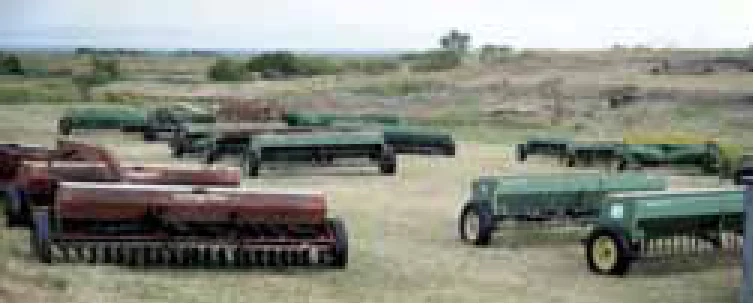
Burrell Drill Salvage carries everything needed from horse-drawn grain drill parts to parts for a newer Deere 8000 series drill. The Fairview, Okla. salvage yard claims more than 9,000 tons of used and new drill parts, as well as acres of used Deere and Case IH grain drills.

“We have new parts as well as rare antique parts,” says Mark Burrell.

“We carry high activity/high wear parts like bearings, press wheel tires and disks, but also specialty kits like added press wheels or double disks and agitators. We can help a drill owner upgrade to features that weren’t available on their drill originally.”

Burrell’s is a family farming operation that expanded into farm equipment sales and service nearly 50 years ago. Today the family continues to farm, while the equipment business has evolved into parts for drills and other equipment. The farming experience shapes how Burrell says they approach the parts business.

“We’re farmers, so we know if you’re broken down and need a part, you need it right away,” he says.

“Often by the time people call me, they’ve tried 10 other yards and someone gave them my number.”

Burrell says the business has changed over the years from supplying local farmers to shipping nationally. What hasn’t changed is that their business runs on farmer hours. Local farmers know they can stop by for a part any time of the day or evening. Burrell’s extends the same service to farmers in New Jersey or New York via phone. Not many business owners answer after 5 p.m., much less posting home numbers on their website or in ads like the Burrell’s do.

“The phone rings at the shop and at home,” says Burrell.

“We get more orders evenings and weekends than during the day. In fact, it really helps me if people call in the evening rather than waiting until the next morning, because I can start working on filling their order right away.

“ To order a part, simply check the castings number on the problem part. Make and model information are also helpful.

“Often times people don’t know what the model is, but every part has a number on it,” says Burrell.

“If you send a picture, we can look at it and know what you need.”

In addition to common drill parts, Burrell’s carries drill hitches, manual and hydraulic markers, and sheet metal for drills. The parts business also carries new and obsolete parts for other implements, as well as belts, laces and repair tools for big round balers.

“Everybody sells belts, but we have the tools needed for all brands of balers,” says Burrell.

“People can buy the tools and supplies and repair their own.”

Contact: FARM SHOW Followup, Burrell Implement Co., HC 60, Box 8, Fairview, Okla. 73737 (ph 580 227-4494 or 580 227-3200; www.burrells.net).

From the archive · Full text
Feature story

Where To Buy Horse-Drawn Plow Parts, And More

Featured source: Norman Macknair

Norman Macknair is known as the guy to go to for parts for horse-drawn plows. With thousands of cast iron parts on hand, he’s probably the largest cast iron plow part supplier in the country. However, the plow business is only part of what he does. Living in the heart of “old order” Amish country, Macknair, and his father before him, built a business based on supply and repair of old equipment. Today, his customers range as far as Europe.

“I recently shipped two manure spreaders to Ireland and two more to France,” he says.

“I have guys in Europe who give me a list of stuff they want and 6 to 10 months to locate it.”

He sells and restores spreaders, plows, binders, mowers and other equipment. He estimates he has rebuilt 40 to 50 spreaders alone in the past 30 years.

“With manure spreaders, it’s often best to strip them down to the frame and start fresh,” says Macknair.

Macknair has 14 acres of equipment for re-sale and salvage, as well as new and salvaged parts for ground driven equipment.

“I stock McCormick-Deering and Deere grain binder canvas at $140 to $175 per set, as well as reprints of old manuals,” says Macknair.

“I have a huge selection of detachable chain as well as old cast iron links. I also carry pitmans for mowers and grain binders and make replacement parts for two-way plow hitches.”

While Macknair carries many plow parts, the hardest to find, he says, are plow bottoms. He notes that many plow bottoms were regionally adapted.

“What worked for one type of soil in Pennsylvania didn’t work in Minnesota,” he explains.

“At the same time, Oliver and Deere two-way plows were common throughout the country and used the same bottoms.”

Macknair ships parts throughout the country and overseas. He leaves the shipping of rebuilt, repaired and “as-is” equipment to the buyer. He does ask that customers be patient when contacting him.

“I am just a one-man show here,” he says.

“If you’re in a hurry, call me. Otherwise send an e-mail or letter.”

Contact: FARM SHOW Followup, B.W. Macknair & Son, 3055 U.S. Hwy. 522 N., Lewistown, Penn. 17044 (ph 717 543-5136; [email protected]; www.macknair.com).

From the archive · Full text
Feature story

Tractor Mechanic Takes His Skills On The Road

Featured source: Ted Kalvitis

An old black truck drives in the yard. A tall man wearing baggy bibbed overalls and a big straw hat slips out of the seat and reaches for a toolbox. Traveling Tractor Mechanic Ted Kalvitis is on the scene. He’s ready to change the oil on a new Kubota tractor or head out to the woods to see if he can start an old Oliver tractor.

“This is my 21st year doing this,” says Kalvitis, who started out working as an indoor mechanic.

“I wanted to work outside so I developed this occupation.” A stint as a mechanic at a Massey-Ferguson dealership, along with his farm upbringing, gave him the skills he needed. Field mechanics are not new, he notes, but he carved out a unique market for himself after he put an ad in a newspaper for the Shenandoah Valley of Virginia. The affluent area netted a wide range of clients ranging from folks who wanted to keep their old tractors running to farmers with new tractors who wanted to maintain them well. Jobs cover the gamut. Doctoring a Zetor on a mountain; performing a transmission repair on a 1939 Ford 9N behind a barn; axle seal replacement on a Farmall C – precariously close to a shelf of ceramics. Kalvitis credits his Lithuanian genes for his fortitude in all types of weather. And unless the tractor has a serious design flaw, he always comes through with a fix – with the help of his extensive library of repair books and manuals and common sense advice from old-timers. He’s well known in the 50-mile radius he serves — not just for his mechanic skills, but also his personality. He even writes off-beat articles for magazines such as Antique Power.

“He’s an amazing character,” says Chuck Kleine, a documentary producer with West Virginia Public Broadcasting. He’s currently filming Kalvitis with some of his customers to tell the stories of why people love their tractors. The film is expected to air by mid-2011.

“He’s creative with his business and has lots of knowledge of local history.” Kalvitis’s interest in history and mechanical skills merged when he was recently asked to remove a crankshaft from an 1850 Faber steam engine so it could be taken out of the American History Museum of the Smithsonian Institution. Kalvitis reassembled it at a Smithsonian storage site in Maryland. But jobs such as fixing a 1950 Oliver Super 77 so it could be started for a man whose father parked it before he died, are the most rewarding. His successful career has been part luck and part skill.

“It helped getting into the right population and having a certain tenacity to keep at it,” he says. While he continues to take his mechanic work on the road — in his second old black truck — he has also set up a shop two days a week in North River Mills, W. Va. Contact: FARM SHOW Followup, Ted Kalvitis, HC 78 Box 86AA, Augusta, W. Va. 26704 (ph, 304-496-8067; www.oldblacktruck.com).