Practical ideas from FARM SHOW MagazineSubscribe · Free issue · Send us your shop tip
Subscribe to FARM SHOW
Issues / Vol. 37, No. 5 (2013)

Vol. 37, No. 5 (2013)

Money-Saving Repairs & Maintenance Shortcuts · Printed section pp. 36–39

34 selected entries · Complete text of selected entries

This issue’s section includes reader tips and feature-length shop stories. Held items and editorial notices are not reproduced.

Archive text: prices, coupons, availability and contact details reflect the original publication, not current offers. Reader methods are not universal instructions; follow manufacturer guidance and proper safety practices.

Reader shop tips

From the archive · Full text
Reader shop tip 1 of 2

Tom Ashby

Individual tip 1 of 2 from this reader’s published contribution.
Tom Ashby, Abbeville, S.C.

“The best solution I’ve found to all my electrical corrosion problems is CorrosionX, a great corrosion preventative. Works on any and all electrical connections, cleaning and restoring electrical continuity. It works great! (www.corrosionx.com).

From the archive · Full text
Reader shop tip 2 of 2

Tom Ashby

Individual tip 2 of 2 from this reader’s published contribution.
Tom Ashby, Abbeville, S.C.

“Another great product is Clenzoil, a cleaner and rust preventative. The best product I’ve found for all my gun maintenance and cleaning. It actually wipes surface rust off parts.”

From the archive · Full text
Reader shop tip

Neil Ohler

Neil Ohler, Stavely, Alta.

“If I’ve got an air-cooled motor that hasn’t been started recently, I just squirt a bit of WD-40 into the air intake, crank it once, and let it sit for a couple hours. Then ‘voila!’, it starts right up – even 2-cycles.”

From the archive · Full text
Reader shop tip

Dale Jarvis

Dale Jarvis, Thodosia, Mo.

“My yard cart needed new tires. I had 2 older tires off the front of junked garden tractors so I decided to try them. To my surprise, they fit fine. Saved some money and they’re more durable than the ones that came on the cart originally.”

From the archive · Full text
Reader shop tip

Daniel Alderfer

Daniel Alderfer, Basalt, Colo.

“My Sears 2,500 psi pressure washer stopped pumping. It has the 5 hp Honda vertical shaft motor, which runs well. It turns out the problem was simply a very fine sand that had caused each of the 6 check valves to stick open. The tiny valves were difficult to remove and clean, but now the pump works fine. The problem was water from a well with fine sand in it.”

From the archive · Full text
Reader shop tip

Joseph Syczylo

Joseph Syczylo, North Fork, Idaho

“When filling fluids in tight places – like power steering fluid, brake fluid, and even engine oil – I’ve found that the pop-up top on many dish soap bottles will screw right onto an oil or fluid bottle. Or you can pour the fluid into the old dish soap bottle. No need for funnels and it’s easy to control the flow so there’s no mess.”

From the archive · Full text
Reader shop tip

James J. Keem

James J. Keem, Arcade, N.Y.

“I depend on hired help to maintain and lube equipment, so I change the color of grease we use at regular intervals. That way I can tell at a glance if the machine has been lubed.”

From the archive · Full text
Reader shop tip

Weaver’s Compact Tractor

Weaver’s Compact Tractor, Shippensburg, Penn. (ph 866 950- 1050)

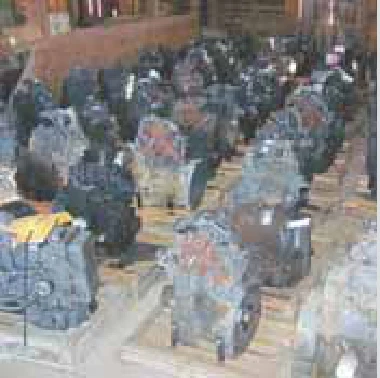
Weaver’s has a large inventory of reconditioned and new aftermarket parts for Japanese New Holland engines, often called JSM or Shibaura engines. They’re found in compact Ford New Holland tractors and skid loaders. Weavers sells new aftermarket piston rings, bearings, and gaskets for these engines and also sells used and/or reconditioned blocks, cranks, rods, heads, etc. They also have new overhaul kits starting at $595 complete, as well as rebuilt engines.

From the archive · Full text
Reader shop tip

Joe Williams

Joe Williams, Maple Grove, Minn.

“If you drop a ring, a bolt, or other small part down a sink drain, you can get it out easily without having to get out your plumbing tools. Just stretch a nylon stocking over the nozzle of a shop vac and stick it over the drain. Whatever it pulls up will stick to the nylon for easy retrieval.”

From the archive · Full text
Reader shop tip

Brendon Schaufelberg

Brendon Schaufelberg, Amsterdam, N.Y.

“I recently bought a Claas Uniwrap 375 baler and found myself with lots of black plastic tubes left over from the bale wrap. They are too good to throw out so I mount the tubes on the wall to hold shovels, brooms, and other long-handled tools.”

From the archive · Full text
Reader shop tip

O.J. Hanson

O.J. Hanson, Kaycee, Wyo.

“I used to have frequent battery problems with my PA-18 Super Cub airplane. About 20 years ago I installed an Optima gel cell car battery and I’m still using that battery today with no problems. I had to remove the original battery box and bolt down the gel cell using holes in the battery casing.”

From the archive · Full text
Reader shop tip 1 of 2

Michael A. Smith

Individual tip 1 of 2 from this reader’s published contribution.
Michael A. Smith, Elkton, Md.

“Many guys are of the opinion that older Kubota fuel injectors are too sophisticated for the average mechanic to mess with. They’re not. Just put them in a vise and carefully unscrew the body and use emery cloth to polish up the needle and spring. That will unstick them.”

From the archive · Full text
Reader shop tip 2 of 2

Michael A. Smith

Individual tip 2 of 2 from this reader’s published contribution.
Michael A. Smith, Elkton, Md.

Here’s another idea: “I had to compress the spring washers in a Deere 455G’s powershift clutch pack. Mimicking the Deere service manual picture, I cut a wide notch out of an old 18-in. long cylinder tube with a 4-in. bore and used a press. They came out nice while allowing me room to release the snap ring.”

From the archive · Full text
Reader shop tip

Harold Fratzke

Harold Fratzke, Cottonwood, Minn.

“I made a portable hydraulic press that can be used with any hydraulic jack.

“The portable press measures 12 in. wide by 8 in. deep and about 2 ft. high. The base is made from 1/2-in. thick railroad iron and has four legs made from 2 1/2 by 2-in. sq. tubing welded onto it at each corner. A 1/2-in. thick flat railroad plate is welded on top of the legs and has a 2-in. dia. hole drilled into it at the center.

“It’s built strong and works great with standard 10 to 20-ton hydraulic jacks. It weighs only about 20 lbs. so I can easily lift it in back of my pickup if I need to take it somewhere. Works great for punching shafts out of sprockets and gears, for punching out holes in metal, and for bending iron. However, if I built another one I’d use telescoping legs that could be adjusted up or down to make room for longer shafts.”

From the archive · Full text
Reader shop tip

Fred Thompson

Fred Thompson, Ferndale, Wash.

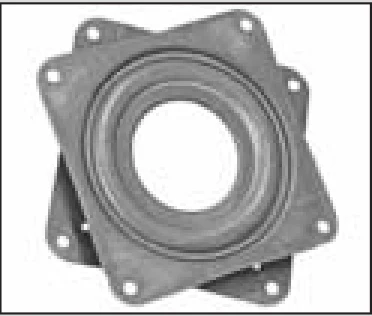
“I keep my Bucket Boss tool bucket on a lazy susan on my work bench. It keeps all my tools just a spin away.”

The Bucket Boss is a heavy-duty nylon tool holder designed to fit over a 5-gal. bucket (ph 888 797-7855; bucketboss.com). It has 16 pockets around the outside and 11 additional pockets that hug the inside of the bucket, leaving the entire interior open to hold larger tools, extension cords, etc. Thompson, a cabinet maker, commonly installs 9-in. dia. lazy susans designed for use in kitchen cabinets.

“One day I set my Bucket Boss on a lazy susan and it worked great. I could spin the bucket and grab whatever tool I needed instantly without even thinking.” So, he decided to build a lazy susan just for a 5-gal. bucket. He placed the lazy susan between 2 pieces of plywood, with the lazy susan riding on a pair of 6-in. dia. flat bearings. There was a small ring on the bottom side of the bucket, so he used a hole saw to cut a corresponding circular groove into the plywood.

“The groove keeps the bucket stable,” says Thompson. He says he also plans to make a portable lazy susan.

“It will attach permanently to the bucket so I can take it anywhere with me.”

From the archive · Full text
Reader shop tip

Lowell Hayes

Lowell Hayes, Columbia, S.C.

When Lowell broke his thumb he was impressed with the gauze the doctor wrapped around his thumb. After wetting it, the wrap became hard within 5 min. As a restorer of wrecked autos, Hayes immediately recognized the hardening gauze’s potential for other uses. After some research, he was able to buy the product at Uline, a shipping supply company (www.uline.com). 3MScotchcast Plus casting tape contains fiberglass, and with a water-active resin it hardens with the handling ease of plaster and is water-resistant. It comes in a variety of widths and colors. Hayes purchased 2-in. wide black rolls for restoration work. For example, the wrecked cars he works with often have broken tabs that mount the headlight assembly to the car. Instead of replacing them with a whole new assembly, he creates new tabs with the casting tape.

“I fix cracks with it, too,” Hayes adds.

“I’m thinking you could use it on a lot of things you build. It could be used on a cracked distributor cap to keep out water, on the inside of a cracked taillight – all kinds of places.” Prices vary, but the 2-in. size rolls start at around $62/per box of 10 rolls.

“It’s great stuff,” Hayes says.

“I think people could use it for a lot of different things.”

From the archive · Full text
Reader shop tip

Vincent Gwaltney

Vincent Gwaltney, Poseyville, Ind.

Vincent came up with a low-cost way to keep the front wheels on his 1952 Farmall SM tractor from wobbling and shimmying when moving rapidly down a smooth road.

“Most older tractors have loose steering mechanisms. On my older tractors with wide front ends, I solved this problem by using two heavy-duty tarp straps. I fasten one strap onto each side of the tractor. I attach one end to the inboard steering ball shank and the other end to a hole in the axle, and then secure it with a heavy wire tie. It lets me travel along a smooth blacktop road at full throttle while the tires and steering wheel remain smooth and steady. I’ve used this setup on the tractor for many years.”

From the archive · Full text
Reader shop tip

Dick Clevenger

Dick Clevenger, Letts, Iowa

“The gearbox and shaft wore out on my Aeromotor windmill. To get the windmill running again I ‘repurposed’ the front wheel, spindle, and kingpin assembly off a 1961 GM 1 1/2-ton pickup. I welded them to a length of 1 5/8-in. dia. shaft that I installed in the top of the tower. I spent a lot of time balancing the entire assembly, and now the windmill works fine.”

From the archive · Full text
Reader shop tip

Scott Testory

Scott Testory, Farmer City, Ill.

“The secondhand scaffolding I bought to paint my house uses wing nuts to fasten the cross braces. I realized the nuts needed to be tighter when I walked around the scaffolding and saw the braces had become loose. I tried using a hammer to tap the wing nuts around, but the wings kept breaking off the nuts. So I developed this wrench to apply equal pressure to both wings on the nut as it’s tightened. It works great.

“I started with a 1 by 8-in. flat plate that was 3/16 in. thick. I drilled a 1/2-in. dia. hole about 1 1/4 in. from one end and then reamed it out one size larger. Then I put it in a vice fixture on my lathe and chucked up a 1/4-in. mill bit. I centered it in the previous hole and ran it out 1 in. in both directions. The last step was to round the corners and clean up the burrs.”

From the archive · Full text
Reader shop tip

Bill Hettler

Bill Hettler, Federalsburg, Md.

“I used a metal-clad door, a wheelbarrow wheel, and table leg to make this portable workbench.

I keep it outside most of the time and use it to work on various projects. The big wheelbarrow wheel makes it easy to move from work area to work area as needed, and if I want I can also use it as a scaffold to paint buildings.

“I welded up a metal frame that’s attached to both ends of a short axle on both sides of the wheelbarrow wheel, and used self-tapping screws to attach the frame to the door. All-thread rod bracing runs from the frame to the door. The table leg bolts onto the other end of the door and has a 4-legged stand that makes the door very stable.”

From the archive · Full text
Reader shop tip 1 of 3

Milan Hochstetler

Individual tip 1 of 3 from this reader’s published contribution.
Milan Hochstetler, Cumberland, Va.

“I mounted a car radiator fan on front of my riding mower to keep cool. I connected it to the original headlight switch.

From the archive · Full text
Reader shop tip 2 of 3

Milan Hochstetler

Individual tip 2 of 3 from this reader’s published contribution.
Milan Hochstetler, Cumberland, Va.

“The rope on my overhead shop door was too small to get a good grip, so I drilled holes through some golf balls and slid them onto the rope for a better grip. I tied a knot under each ball and wrapped copper wire above the balls to hold them in place. The balls are spaced 12 in. apart.

From the archive · Full text
Reader shop tip 3 of 3

Milan Hochstetler

Individual tip 3 of 3 from this reader’s published contribution.
Milan Hochstetler, Cumberland, Va.

“To reach the window crank on the passenger side of my pickup, I attached a short length of pvc pipe to a broom handle.”

Shop feature stories

From the archive · Full text
Feature story

“Easy Up” Shop Ladder

Featured source: Paul Tierney

Paul Tierney needed a ladder to get up to the loft above his shop but he didn’t want to take up valuable floor space. So he made this “easy up” ladder that’s easy to raise and lower when needed. He simply hinged the upper end of the ladder to one side of the opening into the loft. Then he attached two steel cables to one side of the ladder and ran them up through the floor of the loft, over a couple of small pulleys, and attached each cable to a bundle of old window weights. The weights are balanced so the ladder floats up or down easily with one hand.

“The only tricky part was positioning the cables and the weights to match the weight of the ladder,” says Tierney. In the “up” position, the ladder is flat against the ceiling. Contact: FARM SHOW Followup, Paul Tierney, 10020 Pleasant Ave. S., Bloomington, Minn. 55420 (ph 952 888-8526).

From the archive · Full text
Feature story

They Make Custom Rims For Any Size Tire

Featured source: Ron Barlow

Need a wider or narrower wheel rim? FTC Enterprises can build any rim to specs whether it’s for agriculture, forestry, mining or any other off road tires. Purchased in 2012 by Ron and Jennifer Barlow of Francesville, Ind., the business was founded in 1969 to meet the demand for wide rims for floatation tires. That continues to be a big part of the business, Barlow says. He works with rubber tire companies that need custom rims as well as individuals who want tractor tires widened or narrowed. Creating quality products requires skill and attention to detail.

“When we expand wheels we use the submerged arc process to get 100 percent penetration on the welding so there are no air leaks,” Barlow explains, noting that most tires they make rims for are tubeless.

“The most challenging part is to get the wheel to spin true. We spin them here to make sure they spin true up to 35 mph.” FTC Enterprises carries steel in various thicknesses to meet rim specs and has bolt-hole patterns for every need. They also offer custom rim painting. Typical ag-related orders include rims for Swamp Buggies and Terra-Gators for fertilizer applicators. But Barlow notes his biggest area of sales is for the petroleum industry, including rims for sonic vibrator equipment. The rims are 25 in. wide by 36 in. tall, and fitted with 6-ft. tall tires. Besides fabricating wheel assemblies, the company makes and sells sub-assemblies including lock rings, flanges, side rings, bead bands, center flat disks, dual plates and valve protectors. FTC Enterprises is ready to custom make or fabricate original spec rims for any off-road use, Barlow says. Call for an estimate. Contact: FARM SHOW Followup, Ron Barlow, 4455 S., U.S. Hwy. 421, Francesville, Ind. 47946 (ph 219 567-2441; [email protected]; www.ftcenterprisesinc.com).

From the archive · Full text
Feature story

Do-It-Yourself Airbag Kit For Pickups

Featured source: Firestone

If you do a lot of hauling or towing, Firestone’s Ride-Rite Air Helper Springs can make the job safer and the ride smoother. The airbag kit levels and balances loads as needed, reduces “bottoming out” and increases stability.

“Anyone who has added weight to a truck recognizes the need,” says Todd Green, Ride-Rite.

“Keeping a heavily loaded vehicle level is essential for maintaining proper steering control and braking effectiveness, reducing tire wear and keeping headlight beams on the road.” He notes that OEM suspension is always a compromise between suspension under full load and ride quality. The Ride-Rite kit is designed to not affect ride when unloaded. However, adding air to the airbags brings the truck back up to the appropriate height while absorbing road shocks. The basic kit consists of mounting brackets, hardware, air lines and airbags. Green says most pickups 1999 and newer can be outfitted with the kits using existing holes. The airbags mount between the frame and existing leaf-spring packs.

“If you can change oil and rotate tires, you should have no problem installing a Ride-Rite kit,” says Green.

“It can usually be installed in 2 hrs. or less. If it’s maintained at around 5 psi, it won’t affect ride quality.” Prices for the basic kit usually run between $340 and $360. The airbags are inflated using any available compressor and standard air valves. Optional accessories include different size air tanks, on-board compressors and an on-board monitoring system. Systems can be as simple as a tank and manual switch or compressors with automatic switches and tank charging.

“With the basic system, most people add air once the load has been added,” says Green.

“The on-board systems give infinite adjustability from the cab while travelling down the road. Once you have the compressor and tanks, you can add air hoses for inflating truck tires or other uses around the farm.” The Ride-Rite Air Helper Springs kit adds from 3,200 to 5,000 lbs. of load leveling capacity. The company cautions that they do not increase load carrying capacity. Contact: FARM SHOW Followup, Firestone Industrial Products, 250 W. 96th St., Indianapolis, Ind. 46260 (ph 317 818-8600; toll free 800 247-4337; www.firestoneip.com).

From the archive · Full text
Feature story

PTO Wrench Speeds Equipment Hook-Ups

Featured source: Roy Noel

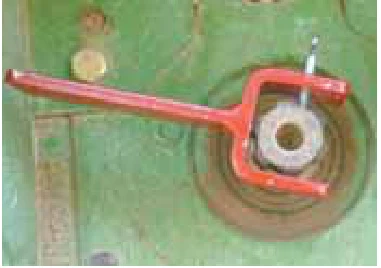
When Roy Noel traded an older tractor for a new 6230 Deere five years ago, he found out he also got a hard-to-turn pto shaft. When hooking the tractor up to the mower/conditioner, baler or Bush Hog mower, it could take half an hour to line up the splines.

“I designed a wrench that gives me the leverage I need to turn the tractor’s pto shaft,” says Noel. The wrench has a clevis-shaped mouth with a set screw that adjusts to grab a spline. Once the implement shaft is lined up with the splines on the pto shaft, Noel turns the set screw to remove the wrench.

“The wrench lets me line up the splines in a few seconds,” he says. Noel has a patent pending on the device. He has had 30 of them made and has given 3 away for testing. He also sent one to FARM SHOW to review. It worked as described on a late model Deere utility tractor. It slipped on easily and provided plenty of leverage for turning the shaft.

“I sold 22 of them through a local equipment dealer for $24.95 each,” says Noel.

“If you have a free moving pto shaft, you won’t need it. But if yours is hard to turn, this gives just the leverage needed.” Noel isn’t interested in manufacturing the wrench and doesn’t plan to make more. He is interested in selling the patent and all manufacturing rights. Contact: FARM SHOW Followup, Roy Noel, 14 Dutch Run Rd., Piketon, Ohio 45661 (ph 740 289-2851).

From the archive · Full text
Feature story

“Safety Lift” For High Clearance Sprayers

Featured source: Joey Waldner

“Our new lift for high-clearance sprayers works great for changing tires and doing other maintenance work. It’s the safest jack system on the market for sprayers,” says Dan Waldner, RockPort Welding, Magrath, Alta. The sprayer lift is designed to operate off tractor hydraulics and is equipped with slots for a forklift or front-end loader. Or, optional wheels can be attached to roll the unit around your shop floor. It has a lift capacity of 36,000 lbs. Hydraulic cylinders are used to raise or lower a pair of telescoping tubes that lift the entire front end or back end of the sprayer, allowing you to change 2 tires at a time. Once the sprayer is fully raised you install a steel pin through each tube.

“Changing the tires on a high clearance sprayer can be a dangerous job,” says Waldner.

“With bottle jacks and blocks you’re lifting only one side of the sprayer, and changing only one tire at a time. Our sprayer lift is much more stable and it lets you change two tires.” A bolt-on kit is available for Deere 4940 high clearance sprayers. It fits the sprayer’s front end and provides 4 lift points. Also optional is an air bag kit that attaches to the sprayer’s air bag cylinders. The sprayer lift can be ordered in any color, and custom designs are available for most sprayer brands. It sells for $2,000 to $2,300 depending on options. Contact: FARM SHOW Followup, Dan Waldner, RockPort Welding, P.O. Box 871, Magrath, Alta., Canada T0K 1J0 (ph 403 758-3077, ext. 604).

From the archive · Full text
Feature story

Gas-Powered Battery Charger

Featured source: Robert Hanke

With his home-built gas-powered battery charger, Robert Hanke can charge a dead battery anywhere – quickly and inexpensively. The Amsterdam, N.Y., welder built his first prototypes out of lawn mower engines and car alternators to charge batteries for his camper. But they were heavy and gas-guzzlers. His latest version only weighs 15 to 20 lbs. and charges a 12-volt battery in less than 20 min. on about half a weed whacker tank of gas.

“It works great,” says Hanke.

“It’s like a rapid charge.” He started with the 31cc engine from a broken weed whacker. He removed the shaft and head and fabricated an aluminum plate to bolt on a magneto from a 1973 Honda CB350 motorcycle.

“The biggest challenge was the magneto part that spins had to be perfectly lined up and couldn’t wobble,” Hanke says.

“I used feeler gauges to shim it.” Once the magneto was mounted, he fabricated more mounts for the voltage regulator and rectifier from a 1986 GM alternator. He created a shroud by wrapping it with aluminum tape, which pulls air through to keep the engine cool. Hanke says he hooks up the battery and starts up the weed whacker engine. He added a throttle that can be set at different speeds and runs it at full throttle at first, then slows it down. He isn’t certain if it would overcharge the battery, so he keeps an eye on it. After about 15 min., he checks the battery with a pocket voltage meter. Contact: FARM SHOW Followup, Robert Hanke, 97 Hewitt St., Amsterdam, N.Y. 12010.

From the archive · Full text
Feature story

Stainless Steel Oil Filters Improve Engine Performance

Featured source: Kelly Tidwell

Kelly Tidwell is a world champion drag racer who’s been working on engines for more than 50 years. Today he’s head of research and development for Pure Power!, the company he co-founded in the late 1980’s to produce premium quality filtration and lubrication products. He holds multiple mechanical and liquid process patents. The Pure Power! Filter stainless steel oil filter is a lifetime product for passenger vehicles, trucks, stationary engines, industrial and agricultural equipment, including over-the-road semis. It’s a spin-on style filter with a removeable and cleanable stainless steel filter element. The billet-aluminum housing is burstproof up to 1,000 psi and virtually leakproof because of the Viton seals. Tidwell says a Pure Power! oil filter improves engine performance by reducing the drag created by poor oil flow. The filter has deep-pleated, 2-ply stainless steel filter media.

“Using stainless shows a 90 percent improvement in debris removal compared to other media,” Kelly says.

“Those numbers aren’t just a sales pitch on my part. They’ve been authenticated by several independent tests.

“All of our filters are cleanable and reusable, so they’re not ending up in the garbage every few thousand miles,” Kelly says. More important to consumers, however, are the performance advantages gained from the stainless filters.

“They maintain high oil flow through 2-ply, 45-micron stainless steel media,” Tidwell says.

“They even attract ferrous particle matter with the proprietary Neodymium magnets inside the media.” The filters provide maximum filtered oil flow to the engine at all times and incorporate a patent pending full-flow bypass for emergency oil requirement.

“Clean oil improves engine performance, improves fuel economy, improves torque and horsepower,” Tidwell says.

“We’ve been involved in many independent tests that show a 10 to 15 percent gain in torque and horsepower with Pure Power! filters.” Pure Power! filters are easy to clean with hot soapy water and don’t require any modifications for installation. They just screw on in place of the existing filters. They sell for $200 to $259, depending on the engine. Check website for dealers. Contact: FARM SHOW Followup, Pure Power! Inc., 17731 Sampson Lane, Hunting-ton Beach, Calif. 92647 (ph 714 894-2994; www.gopurepower.com).

From the archive · Full text
Feature story

“Tyler The Plow Guy” Can Fix Your Old Moldboards

Featured source: Tyler Buchheit

Ask Tyler Buchheit any question about a vintage Deere moldboard plow and chances are he’ll have an answer. Even though Buchheit is only in his mid 30’s, he knows exactly what he’s talking about.

“I got started in the plow parts business a couple years ago because I couldn’t find the parts I needed to restore an old moldboard plow,” says Tyler.

“I’d gone to shows, friends, dealers, and the internet but there just didn’t seem to be any one place that had what I needed.” That seemed like an opportunity for the energetic Buchheit, who launched “The Plow Guy” website, aimed at providing assistance and parts for people restoring vintage Deere plows. His focus is on Deere plows mainly because he has become an expert on that brand, although he admits to learning new information every day. Tyler says it’s possible to get some parts from Deere dealers, but finding a parts counter guy who knows vintage plows is rare.

“I’ve had several people tell me they sought help from their dealer, only to get that ‘deer in the headlights’ look when asking about shares and landsides.

“This started as a hobby and has turned into something much larger. There’s just a huge number of people who search to find parts on the internet.” Buchheit’s site features a good assortment of original and reproduction parts, along with a large collection of vintage pictures to help people identify the plow they own. Buchheit launched the website initially by offering a 17-in. notched coulter blade that fits nearly every Deere plow made from 1936 through the 1970’s. His reproduction blade will fit a 3 or 6-hole bolt pattern and sells for $35. Other items include a notched trash board, moldboard extensions that fit most Deere plows from the mid-1930’s through the 1970’s, and conventional plow bottom parts, commonly known as Blacksmith Bottoms.

“I get requests for new moldboards and shares for conventional plows very often,” Tyler says.

“I have some new old stock and some reproduction parts, but mostly I suggest that people switch their plow over to newer style HS or NU series plow bottoms if function is their main priority. That way they’ll always be able to find replacement parts.” A few other products he lists include an optional landside root cutter for $30; reproduction cast “tear drop” landsides; a rolling landside mudscraper that fits a 52 series, a 4 through 4A and 4B series, and the M/MT plows with a small rear wheel; 15-in. plain edge blades and transport pins for hydraulic lift trailer plows. Shares, trash/weed hooks, clutch assemblies and some operator’s manuals are also available.

“From the calls I get it seems like people have restored one or two tractors and now they want something else to do with them besides drive in fairs and shows,” Tyler says. Contact: FARM SHOW Followup, Tyler Buchheit, The Plow Guy, Ellis Grove, Ill. (ph 573 768-4092; [email protected]; www.mrbtractors.com).

From the archive · Full text
Feature story

“Do Everything” Welding Helmet

Featured source: Michael Buckman

Michael Buckman’s WindMaker is a welding helmet that keeps you cool, lights up your work area, and even blows away dust and smoke. It may look like something out of a Star Wars movie, but Buckman says it would also be at home in a hog barn, grain bin or woodworking shop.

“I had a lot of jobs welding in very contaminated, enclosed areas like the holds of ships,” recalls Buckman.

“Sometimes I would have to have someone holding a flashlight so I could see to weld.” Buckman designed the WindMaker to make welding and other dirty jobs safer and easier. The concept is simple. The WindMaker pulls air from the rear through a HEPA-rated (high-efficiency particulate air) filter and directs it forward for breathing. As it moves, it cools the skin and prevents the breath from fogging the faceplate. A second fan near the chin pushes out stale air. He teamed up with Salient Technologies, a product design firm, to make a prototype from his plans. Salient helps companies and inventors with concept development, prototypes, and production design. The team engineered a virtual prototype using computer imaging and design. Using what they learned, they constructed a fully functional proof-of-concept prototype, complete with battery-powered filtered ventilation, auto-dimming screen, LED illumination and an exhaust system that the user can direct at the workspace, keeping fumes and smoke out of their field of view. Buckman says the WindMaker is very adaptable.

“We have designed it to use interchangeable lenses so it could be used when mowing lawns, working in a wood shop or cleaning out a grain bin or silo,” he says.

“We can use Bluetooth to connect with your cell phone. Just open the cell phone to activate and talk. It’s also video camera capable with its own data storage.” Buckman says the U.S. Navy is interested in the WindMaker for the ability to capture video of welds for later reference. He suggests that future adaptations could include computer screen-like lenses that let the welder see the plans for the weld on his lens as he works. Other plans include using photovoltaic cells to capture light from welding flashes to increase battery life. The helmet is now in prototype stage and Buckman is deciding whether to license the WindMaker or sell the patent outright to a manufacturer. Contact: FARM SHOW Followup, Michael Buckman, Universal Healthier Helmets ([email protected]); or Salient Technologies, Inc., 3701 Trakker Trail, Unit 2A, Bozeman, Mont. 59718 (ph 406 585-7275; www.salient-tech.com).

From the archive · Full text
Feature story

“Rubber Paint” Seals, Repairs And Protects

Featured source: Paul Citoli

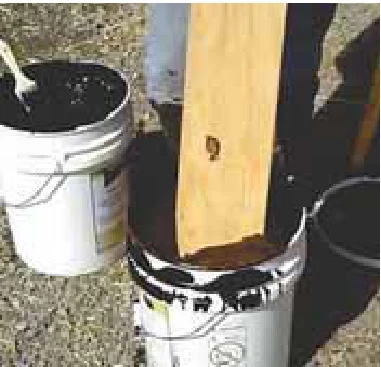
Paul Citoli likes to think of RubberizeItΤΜ as duct tape in a can. There seems to be no end to the uses customers come up with for the coating that repairs leaks, prevents rotting and corrosion, and adheres to most construction materials. It’s durable enough to prevent leaking in the cooling towers of Japanese nuclear power plants, yet non-toxic for use on fish ponds and horse tanks. It’s unlike other coatings on the market because of two characteristics.

“It has an emulsion base and neoprene that makes it highly elastic,” Citoli says.

“It’s also UV-stable and will hold up for 20 years.” He initially worked with the Canadian company that developed and manufactured RubberizeIt for industrial uses to protect steel from corrosion. Citoli recognized broader applications and started RubberizeIt LLC, in Hood River, Ore., to sell it in 1 and 5-gal. containers.

“It’s a product that is especially useful on a farm,” he says.

“I have a 55-gal. drum in the barn and have used it to fix a metal roof and duck pond liner. I used it to patch an old steel water tank to make a raised bed veggie garden. And I used it to coat the inside of a horse stall.” The black coating is the consistency of yogurt and can be painted on with a brush or roller to about the thickness of a credit card. It dries enough in about half an hour to be protected from rain and takes about 4 days to vulcanize. For some uses 2 or 3 coats build up a membrane.

“The key is to make sure the surface is clean and to let it dry,” Citoli says.

Use it to coat the bottom of fence posts and on raised garden beds to protect the wood from rotting. Patch small to large holes in water troughs by painting RubberizeIt over reinforced fabric or galvanized steel mesh. Apply it to metal joints on tractors and equipment to protect them from corrosion if the paint chips off. Including shipping, the cost of RubberizeIt is $75 for a 1-gal. can and $250 for a 5-gal. can (up to 140 sq. ft coverage on a smooth surface). The products can be purchased through the website and dealers. Check out the user-friendly website, Citoli says, to find the wide variety of uses. Contact: FARM SHOW Followup, RubberizeIt LLC, P.O. Box 642, Mosier, Ore. 97040 (ph 855 782-2374; www.rubberizeit.com).

From the archive · Full text
Feature story

Underpowered Bobcat Powered Up With Honda

Featured source: Leonard Wulf

Leonard Wulf’s 1973 Model 371 Bobcat looks like new and runs better than new since he converted it to a 20 hp Honda V-Twin engine. The old 13 hp Kohler engine was underpowered to begin with and about shot by the time Wulf bought it. More than 30 years old, the Bobcat looked pretty rough, too.

“I know I paid too much for it when I bought it about 5 years ago,” says Wulf.

“The carburetor was shot. It had a burned piston, and the valve case fuel pump was going out.” With parts for old Kohlers difficult – if not impossible – to find, a new motor seemed like a good investment. Wulf uses the little skid steer on a daily basis since he swapped out engines.

“I use it in the woods, to haul rock and when I built a new building,” says Wulf.

“It works well with the new engine. With the Honda in there, you can’t stop it.” Converting was relatively easy, he says. The V-Twin fit well, though Wulf did have to raise it up about an inch and a half so the belly of the engine had clearance. Unlike the Kohler, the Honda has its fuel tank under the belly of the engine. He also had to modify the 3 drive pulleys needed to match the 2-speed drive on the Bobcat. The Honda driveshaft required narrower hubs than were commonly available on drive pulleys. Wulf had to find pulley blanks and hubs he could modify. They were hard to find.

“Everybody had cast iron pulleys, but I finally found some blanks that I could weld at Tractor Supply,” recalls Wulf.

“I narrowed the hubs and welded the pulleys on. The hubs fit perfectly and matched up with the Bobcat drive pulleys.”

While he had the Bobcat apart, Wulf made some other changes.

“I stripped it down completely, sandblasted it and repainted,” he says.

“It was so old that it had no safety features. The first thing I did was add seat belts.” The Honda required that he mount the key/start module in the operator compartment. He also connected the throttle linkage and choke levers, both off the shelf parts. Contact: FARM SHOW Followup, Leonard Wulf, 53 E. Big Rock Rd., Waterloo, Iowa 50703 (ph 319 232-3919).