From the archive · Full text
Reader shop tip
Steve Taphorn
“A metal 30-gal. barrel makes a good chop saw stand. Just bend the top edge of the open end to mount the saw. Works good because small cut-off pieces of scrap fall right into the barrel.”
Money-Saving Repairs & Maintenance Shortcuts · Printed section pp. 36–39
39 selected entries · Complete text of selected entries
This issue’s section includes reader tips and feature-length shop stories. Held items and editorial notices are not reproduced.
“A metal 30-gal. barrel makes a good chop saw stand. Just bend the top edge of the open end to mount the saw. Works good because small cut-off pieces of scrap fall right into the barrel.”
“In your last issue, a reader complained about problems with her Mighty Mule gate opener. I also had issues with mine but I found a solution and now it works flawlessly.
“The problem was the motor kept shorting out so I sealed it with RTV silicone adhesive to keep moisture out. And I replaced the little 12-volt batteries with a larger lawn mower battery. I also sealed up the solar panel with silicone. Now everything works great. On cloudy days, the larger battery holds plenty of power. No other gate opener comes close to this one when it’s working right.”
“I do a lot of welding and repair work and often find myself welding grapple forks on loaders. Most of them break on the grapple arms that squeeze the bales tight. In my opinion, most of the problems could be avoided by sharpening the grapple fork teeth. When grapples come from the factory, the teeth are usually pretty blunt. It takes a lot of hydraulic force to push the tines into dense bales, putting stress on the arms and tines themselves. Any grapple fork that I work on in my shop gets the sharpening treatment. It’s just like a pitch fork. If the tines aren’t sharp, you can’t slide them into the hay or straw.
“I’m sure manufacturers make them blunt for safety reasons because if you bump into a sharp tine, there will be blood. But you’ll never do it again. Sharp tines slip into bales like a hot knife through butter. You can sharpen the tines with either a grinder or a cutting wheel.”
“I mounted a vise on a small metal table fitted with 10-in. wheels on two of the legs so it’s easy to move it around the shop wherever I need it. Very handy.”
“I agree with the reader in your last issue who thinks Deere gouges farmers for replacement parts. Here are some recent examples: “1. There are 4 linear bearings on the hydracushion seat on my Deere 4440 tractor. The seat rides on them to move back and forth. Deere wanted almost $80 per bearing. We found the same ones at www.grainger.com for $22 each.
“2. The 30 and 40 Series Deere tractors use the same AC compressor as General Motors vehicles did during that time period. This spring a Deere dealer quoted me $550 for a new one. My local NAPA store sold me a new one for $215.
“3. Finally, my 3020 Deere had a short piece of 1/4-in. hydraulic hose that split. The dealer wanted $63 for a kit to fix it. We bought the same piece of hose at O’Reilly auto parts for $1.35.
“I think Deere makes great long-lasting equipment, but I sometimes feel they increase parts prices to force us into buying newer equipment.”
“Two air bags gave out on my New Holland 855 round baler. The dealer wanted $1,100 plus labor to replace them. I went on the internet and bought 2 air bags for $650 and installed them myself.”
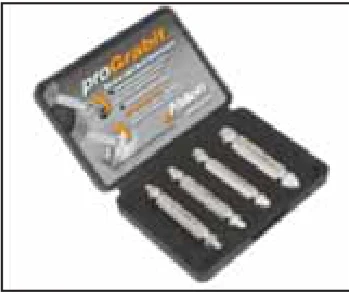
“During a recent building project I was using my impact drill to drive lag screws into 4 by 4 lumber when I accidentally snapped off the socket adapter. It twisted and snapped off flush with the end of the drill chuck. There was no way to extract it, so I thought my drill was finished. Fortunately, I had just bought a set of high quality drill bits from Winters Drill Bit City (ph 800 950-3938; www.wintersdrillbitcity.com) and a set of Grabit extractors (ph 765 247-2248; www.thegrabitstore.com).
“I drilled a hole in the broken socket adapter and was amazed at how easily the Winter’s drill bits worked. They cut into the socket adapter like it was butter.
“Next, I used the Grabit extractor to get a firm grip on the broken piece and it was out in a flash. The entire job took less than 10 min.
“I’ve used various extractors in the past without much success. I’m highly impressed with both the Winters drill bits and the Grabit extractors. They may be more expensive than other brands, but they’re well worth the money. As the saying goes, you get what you pay for. And, they’re made in the U.S.”
“I hang a small vacuum cleaner from a rope directly above my work bench. The rope runs through pulleys to a counter balancing weight along one wall. I pull the vacuum down to vacuum up debris on my work bench. When I’m done I just lift it back up out of the way.
“The rechargeable battery on my 12-volt cordless drill went bad, so I attached 2 wires to the end of a wooden block that installs in place of the battery to make contact with the drill’s power plugs. I then attached a regular house plug to the wires. I can then plug that into an extension cord with alligator clips on the other end. They hook up to the battery on my pickup. Works great.
“I soak rusty parts in Coca-Cola overnight to clean them. Works good.
And believe it or not, Coca-Cola is a great marinade for cooking meat. I use it for roasts and make gravy from the Coke and meat drippings.”
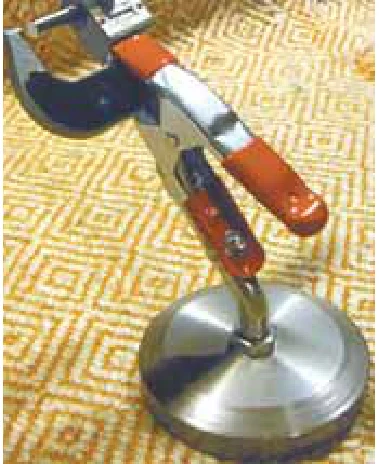
“I came up with a handy multi-purpose micrometer stand for my shop. It’s a simple way for machinists to take precision measurements and costs much less than commercial micrometer stands.
“The stand uses a spring-loaded clamp to hold the micrometer. It works like a third hand. I riveted one side of the clamp to a curved 1/2-in. dia. bolt, which screws into a nut welded on top of a 4-in. dia., 3/4-in. thick round metal base.” Seltzer is willing to make plans available for a fee.
If you don’t like the new-style gas and water can spouts with automatic shutoff, you’ll be interested in this new EZ-Pour replacement spout kit. It lets you pour fluid from your gas and water cans without spilling gas on the ground. The kit includes spout and cap, a second cap for the vent on older Rubbermaid cans, a 1/2-in. r e p l a c e m e n t push-in vent t o k e e p g a s flowing fast and prevent it from splashing out, a second base cap to fit additional cans, and a flame arrester. The kit is only designed for use on portable fuel containers manufactured prior to Jan.
1, 2009. It’s compatible with Eagle, Gott, Briggs-Stratton, Rubbermaid, Midwest Can, Essence, Blitz, Koplin, Wedco, and Scepter cans. It’s not for use with metal cans.
“In the last issue, a fellow with a differential seal leak said he solved the problem by filling it with grease instead of replacing the seal and filling it with gear oil like you should. I just want to say that he will be sorry. Maybe not this week or this year but eventually he will have damaged gears.”
“The control cables for the loader on my New Holland TV140 bi-directional tractor take on moisture somehow. During winter they freeze up so we can’t use the loader. It’s a bad problem because the cables run beneath the cab, which has to be removed to replace them. Cost? Probably a couple thousand dollars.
“I came up with a method to solve the problem at almost no cost. First, free up one end of a cable by removing the yoke and clamp a short length of rubber hose over the end. Then pour an ounce or so of antifreeze into the hose before inserting an air valve stem in the open end and clamping that in place. Then use a couple short bursts of air pressure while a second person sits in the cab and works the loader controls. Muddy colored water will exit the other end of the cable housing. You can stop when you see green antifreeze come out. It both lubricates and freeze-proofs the cable.”
“I bought a 12-volt impact driver with a lithium ion battery. The manual states that you shouldn’t charge the battery for more than 1 hr. or it will be harmful to the battery. I didn’t want to have to remember to unplug it so I made a timed receptacle by wiring an electrical box to a timer and then running a plug from the timer to another outlet. I simply plug the battery charger into the timed outlet and set it for an hour.”
“The flywheel studs came loose on my 1946 Case VA row crop tractor. I solved the problem by cleaning them well and then reinstalling them with Blue Loctite. They’ve never come loose again.
“The front axle broke on that ’46 Case so we put a piece of 2-in. angle iron (1/4 in. thick) along the bottom of it. We welded it all together and it worked just fine.
“I built my own pitman arm puller out of a piece of scrap square tubing. I cut a notch out of one end, welded a 1/4-in. nut on top, and inserted a bolt. It works perfect. I’ve used it on my Dodge Dakota and Ram pickups.”
“I’ve had trouble over the years with the fuel pump on my 1984 Suburban. I solved the problem by switching to an electric fuel pump. Worked great. This idea can help many older vehicles.”
“I designed a new kind of push-off 2-wheeler that makes it a lot easier to handle heavy loads. I started with a regular 2-wheeler and used 1/2-in. steel rod and scrap flat iron. You just pull back on the handle to push off the load at the bottom. It hinges on the lower bar and locks in place when not needed. It’s simple but if you use one a lot you’ll really appreciate it.”
“Over my 83 years I’ve developed a profound distrust of alternators. The first thing I do on all my fuel-powered equipment (generator, lawn mower, tractors, Vespa scooter, etc.) is to wire on a trickle charger so they can be plugged in any time you’re not using them. Works very well and makes equipment much more enjoyable to use when you know they’ll always have power.”
“One of our 4 by 6-in. fence posts broke off in frozen ground. To repair it, we drilled a 1-in. dia. hole 12 in. deep into the piece in the ground and drilled the same size hole in the piece that broke off. We put a steel rod in between the two and used a tractor to seat them back together. After 6 years, that repair is still holding strong.”
“Instead of using a chunk of wood to remove mower deck blades, I slip a piece of pvc pipe over one half of the blade to hold it in place while I remove the nut.”
“The drive mechanism on an old sickle mower was rusted tight. I used the rust-buster recipe that I’ve read about in FARM SHOW (a 50-50 mix of automatic transmission fluid and acetone) and it loosened right up.”
“After years of struggling to remove pto units from IH 06-88 series tractors so the clutch can be rebuilt, I decided to make the job easier. I designed a hanger that bolts onto the pto unit, allowing one man to use an engine hoist to lift the unit off the tractor. The hanger balances the pto unit perfectly and makes the removal and installation an easy, one-person job,” says Robert Grenzow, Sumas, Wash. Grenzow operates a custom fabrication shop and specializes in repairing older IH tractors.
“I’d rather see these old tractors go back into the field than go to the scrap yard,” he says. He explains that IH 06-86 series tractors are equipped with an external pto unit that bolts onto the tractor’s differential, so to rebuild the pto clutch you have to unbolt the pto unit from the differential and then remove it.
“You don’t have to split the tractor like you do on many other tractor brands. However, the pto unit weighs several hundred pounds so removing it isn’t easy. The hanger helps by balancing the pto unit perfectly as you lift it out,” says Grenzow. The hanger is designed to be used after you remove the cover from the top link on the tractor’s 3-pt. hitch, exposing a big hole. It’s made from 1/4-in. thick steel and attaches at 2 places to the back of the tractor using a welded-on pin and a bolt. The engine hoist chain attaches to a big 2-in. dia. hole near the top of the hanger. After the pto unit has been rebuilt and bolted back onto the tractor, Grenzow uses a 5-gal. bucket and a homemade trough to fill the differential with oil.
“It lets me add oil fast and without making a mess,” he says.
“The trough is made from light sheet metal and measures 18 in. long by 8 in. wide at one end, tapering down to 5 in. The way I built the trough it’ll stay in place by itself.” The hanger works so well that Grenzow says he has already sold several to other mechanics. It sells for $35 plus S&H. Contact: FARM SHOW Followup, Robert Grenzow, 3047 Halversitck Rd., Sumas, Wash. 98295 (ph 360 988-2401; [email protected]).
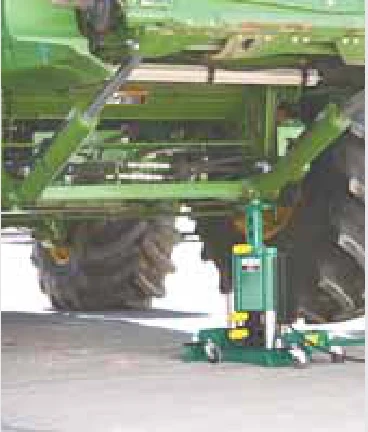
Farm equipment keeps getting bigger and so do Emerson Jacks. The company’s new 60,000-lb. twin cylinder air-over-hydraulic lift is a far cry from the car bumper jacks the company first made in 1960, says founder Fran Voss.
“We went entirely to heavy jacks because tractors, combines and other equipment were getting so much bigger,” says Voss.
“The new SC-60, with its 16 1/4-in. starting height, is designed for farm tractors, combines and sprayers. With a combination of the optional lift bars and the 8-in. stroke, the lift pad can reach a maximum height of 90 1/2 in.” The company makes a wide variety of wheel jacks, bottle jacks, ramps and more, much of it for tire shops. The farm service jacks are specially designed for challenging conditions. Hydraulic cylinders are completely enclosed, and air-over-hydraulic pressure ensures maximum load with a smooth lift. Air-powered jacks require high-pressure compressors. With air-over-hydraulic, only 110 lbs. of pressure is required to achieve 10,000 psi. The air-powered motor drives a hydraulic piston back and forth to provide hydraulic pressure for the lift. The model 15 has a lift capacity of 30,000 lbs., and the model 25 has a capacity of 50,000 lbs. Both are powered by Emerson’s own air-over-hydraulic pump with turn-valve control.
“When we went to the SC-60, we went with a different pump in order to add a foot control valve option,” says Voss.
“The foot control and pump can be removed from the base, allowing the operator to raise and lower the jack without being under the machine.” The SC-60 comes with a single height adjustable lift bar. Two optional lift bars are available, one that can also be used by itself and the other to be used in combination with the first two for even greater heights.
“The Lift Bars are made from high stress steel,” says Voss.
“With the heights they extend to and the weight they carry, regular steel would bend like a pretzel.” In addition to high stress steel, the SC-60 is designed for stability. Steel tubes 1/4 in. thick ride over the cylinders to guide them and shield them from the elements. The lift pad/bars are centered between the cylinders for optimal load balance. The SC-60 with a single lift bar is priced at $2,195. Contact: FARM SHOW Followup, Emerson Mfg., P.O. Box 10, Pender, Neb. 68047 (ph 402 385-2459 or 800 633-5124; [email protected]; www.emersonjacks.com).
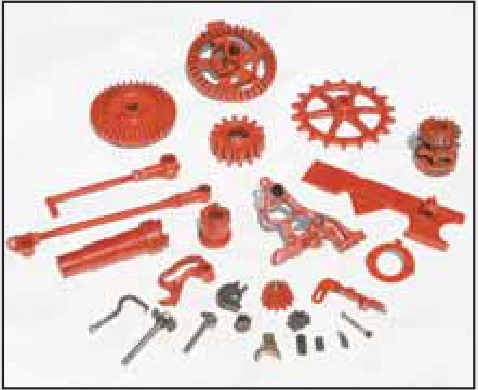
Whether you need a part or a total rebuild of a McCormick binder, General Repair is the place to go. John Fischer says the company has been repairing the old binders since it started as a farm repair shop in 1964.
“Back then, a local International implement dealer still carried most, if not all, parts for the McCormick binder,” says Fischer.
“At the time you could still get binders in good shape. Over the years as parts were discontinued, we began making them or finding those who could.” Today, General Repair has a complete list of parts available for the McCormick pto version, and most parts for the ground drive version. If they don’t have a part, Fischer knows where to get them. Some parts are used, but most of the more than 100 new parts are made by General Repair. That includes the entire knotter assembly with knotter frame, drive clutch for the ground drive, cutting knives, needle pitman and more.
“The knotter is probably the piece we work on the most,” says Fischer.
“We also make all the shields and binder boards.” In addition to making and selling parts, Fischer repairs binders. Increasingly, he gets asked to do a complete restoration. Pricing either a repair or a restoration is tricky without seeing the shape it is in, he says.
“Photos help along with the history of the binder,” says Fischer.
“If you find one that sat in a fence row for 25 years and the board is rotted off, very likely the gear parts will still be solid. Restoring it will take a lot of elbow grease and new boards.” Fischer has shipped parts as far south as Texas. While he doesn’t advertise much beyond the state of Pennsylvania, customers are spreading the word on the internet and person to person. FARM SHOW reader LeRoy Baumgardner wanted other readers to know about the service provided.
“They completely rebuilt my binder with new sprockets, chains, cutter sections and other parts that were worn out,” he says. Contact: FARM SHOW Followup, General Repair Shop, 63 Old Leacock Rd., Ronks, Penn. 17572 (ph 717 768-3902; voicemail 717 656-1967).
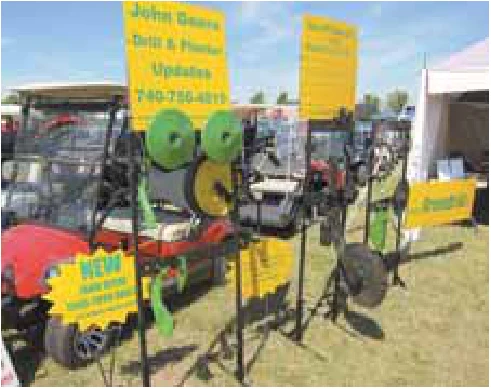
Hizey Farm Service makes replacements for parts that don’t work like they should, makes them better, and makes them for less than OEM manufacturers. Owner Bob Hizey knows they’re better because he uses many of them in his farming operation. He sees no reason to pay $735 for a Deere no-till drill seed boot arm when he can repair it for $12.
“The first machine shop job we did was to bore out a no-till coulter pivot and install a hardened steel bushing in a Great Plains drill,” recalls Hizey.
“We started advertising it and soon added a similar service for Case IH drills and other brands. We would get calls from people about a problem, wondering if we could do something about it.” Today, 80 percent of the company’s business is with Deere equipment. The remaining business is spread across a wide variety of brands. In addition to a full line of aftermarket replacement parts, they also machine many of their own.
Upgrades include replacing bushings on parallel linkage for Deere/Kinze and other brand corn planters. Cast seed closing wheels for Deere/Kinze planters and Deere no-till drills are reconditioned for only $10 each, a quarter of the replacement part cost. The list goes on, with reconditioning of worn parts with superior after-market components and fabrication. The key is to be able to do it at a lower cost than OEM replacement.
“We look for opportunities where we can improve on the original part and update it for 25 to 30 percent of the OEM replacement,” says Hizey.
“As long as the companies keep making their equipment the way they do, we’ll have business.” Currently, Hizey Farm Service is experimenting with transforming worn out, cast iron closing wheels into spiked closing wheels. Hizey notes that manufacturers are charging as much as $130 for a spiked closing wheel.
“We can make them out of the cast iron wheels for as little as $25,” says Hizey. In the case of the $735 seed boot arms, Hizey sends customers a repair kit that includes 24 of the $12 parts.
“Because we farm, we can relate to the customer service we like to receive,” says Hizey.
“We don’t take credit cards. We ship on a guy’s word. We just shipped $8,000 in parts to a customer in Texas. We had spoken with him by phone twice.” Contact: FARM SHOW Followup, Hizey Farm Service LLC, 3755 Stringtown Rd., Lancaster, Ohio 43130 (ph 740 756-4810; [email protected]; www.hizeyfarmservicellc.com or www.greendrills.com).
Jerome Webb keeps his riding mower in great working condition, thanks to his home-built, 3-pt. mounted service lift. It lets him access the blades and change the belts or motor oil without having to remove the deck. He used steel tubing to build a frame that pins onto the 3-pt. hitch on his compact tractor. A pair of square lift frames support the mower’s front wheels. Webb simply drives the riding mower’s front wheels onto the lift and then raises the tractor’s 3-pt. hitch. Contact: FARM SHOW Followup, Jerome Webb, 8756 N. 1550th Rd., Effingham, Ill. 62401.
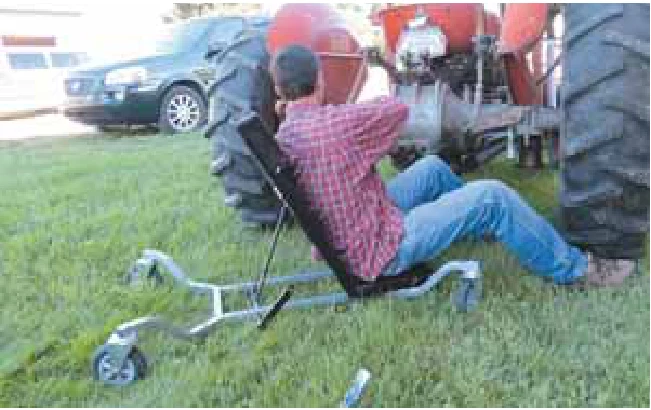
“The All-terrain Mobile Creeper is necessary for a person with a disability and convenient for the rest of us,” says Ned Stoller of Disability Work Tools. He designs and manufactures the creepers along with other adaptive tools.
“I work with the AgrAbility Project. For people who have hip, knee or leg impairments, there was a need for a creeper with large enough wheels to serve as a crawling mechanism. But it’s ideal for anyone who wants to work on rough terrain. It has larger pneumatic wheels and a reclining seat to go at different angles. It has higher ground clearance (2 1/2 in.) to go across obstacles,” he explains. A wide wheelbase and 1-in. steel tubing frame make the creeper stable and strong enough to support 350 lbs. A lever on the side controls the angle of the foam padded vinyl bench. The all-terrain creeper sells for $419 (plus shipping) and is available on the Disability Work Tools website. Contact: FARM SHOW Followup, Ned Stoller, Disability Work Tools, 12152 Cascade Rd., Lowell, Mich. 49331 (ph 888 354-3289; [email protected]; www.disabilityworktools.com).
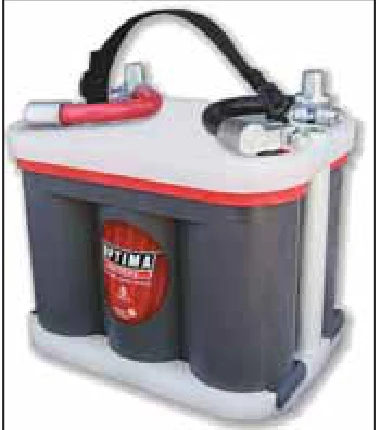
Kevin Lehnert’s frustration with starting older 6-volt machines led him to a better idea and his own business. He supplies custom CNC-machined battery packs that include a pair of Optima 6-volt AGM Red Top batteries harnessed together in parallel to provide 2,000 cranking amps (1,600 CCA) of 6-volt power.
“Any vehicle or machine with a 6-volt system can benefit from our battery packs,” says Lehnert.
“Optima AGM batteries are ideal for older cars and equipment because they’re more vibration resistant, are spill-proof, and last up to 3 times longer than conventional batteries.” The battery pack includes a base plate, top plate, 2 stanchions, removable carry strap, custom positive and negative parallel cables, and assembly hardware. Two models are available – one with the batteries mounted side by side and the other end to end – depending on the size and shape of your battery box.
“Harnessing 6-volt Optima batteries together in parallel doubles the amperage, which results in a lot more cranking power without changing the voltage,” says Lehnert.
“It’s less expensive than converting from 6 to 12 volts because you don’t have to replace the original 6-volt equipment.” He says you need to determine if his battery pack will fit in your battery box.
“Measure your battery box/compartment and compare to the measurements listed on our website,” he says. The harness is machined to fit only Optima batteries.
“I also sell kits without the batteries,” says Lehnert, “but if you only have one Optima battery, you can’t buy another one and use the 2 batteries together because the older battery will draw the new one down.”
The side by side model sells for $409 plus S&H, and the end to end model for $429 plus S&H. He ships the battery packs throughout the continental U.S. and Canada from his machine shop in Henderson, Minn. Lenhert also sells Optima batteries and made-to-order cables, and plans to offer custom built battery boxes and trays.
“We recommend using 2/0 gauge cable because it can handle the higher amperage. Most 6-volt systems have a fairly heavy cable, but if the cable is worn we recommend replacing it,” he notes. Contact: FARM SHOW Followup, Kevin Lehnert, Henderson Machine, 302 Main Street, P.O. Box 352, Henderson, Minn. 56044 (ph 507 868-0070; [email protected]; www.HenMach.com).
“Our DieselFlex injection system blends measured amounts of CNG or LPG into diesel engines using state-of-the-art fuel management technology,” says Lance Hartman, branch manager of Maxquip, in Saskatoon, Sask.
“Power can be increased by 20 to 25 percent and fuel intake can be reduced by 10 to 15 percent using this system, especially when engines are under heavy load conditions.” The DieselFlex system works by injecting gas vapor into the engine’s fresh air stream behind the air cleaner and in front of the turbo air intake. Hartman says the gas vapor combines with diesel to help fuel burn more efficiently, which creates more power and uses less fuel.
“Molecules in propane gas are smaller than those in diesel fuel,” says Hartman, “so by blending the two fuels, the combined product burns cleaner. Another added benefit is lower particulate emmissions, so the exhaust is actually cleaner.” Hartman says cleaner burning fuel should also help reduce engine maintenance and possibly lengthen the oil change interval because fewer impurities are collected by the engine oil.
“Farmers using the DieselFlex system on combines and tractors pulling heavy tillage equipment tell us they don’t see any black smoke from the exhausts,” says Hartman.
“That means the engine is working efficiently and producing maximum power.” One operator reported saving about 25 percent on his fuel bill during 2 seasons of planting and harvesting. The fully-computerized DieselFlex system mounts above the turbo air intake and precisely injects gas vapor proportional to the turbocharge intake pressure, up to 70 psi. The kit has self-diagnostic safeguards built into its operating system to ensure optimal operation and automatic de-activation when decelerating and engine braking.
“Gas vapor can only be injected into the air stream at exact ratios because the ignition point is very precise,” says Hartman.
“The gas vapor is injected into the air stream on the intake stroke, but it ignites slightly after the diesel fuel. The propane can’t be injected in a pressurized system because then it would turn into a liquid, which wouldn’t work.” It takes about 2 days to install a DieselFlex kit on a combine or high-horsepower tractor. The electronic control unit mounts on the firewall or body of the engine, a wiring harness feeds into the cab to switches and the controller, and the injector taps into the air intake. A 42 to 60-gal. propane tank is needed for the system, depending on the size of the engine being configured.
“A mechanically minded person who can follow a manual should be able to handle the process,” says Hartman.
“We also install the systems from the factory and help the operator program it exactly to their needs.” Current DieselFlex kits are designed for engines running without DEF fuel, but Hartman says the company is researching how the kits operate with the new Tier 4 technology. Prices for DieselFlex kits in the ag sector start around $3,000, and are slightly higher for over-the-road trucks. Those systems need to put in by certified installers. The DieselFlex system complies with rigorous CSA and UL fuel standards for safety and performance. Contact: FARM SHOW Followup, Maxquip, 6235A-86th Ave. S.E., Calgary, Alta., Canada T2C 2S4 (ph 866 629-7847 or 800 667-5886; [email protected]).
If you need a pto shaft fast, PaulB Parts has them. If your equipment takes a German, Italian or North American driveline or a conventional or constant velocity driveline, they have it. If you don’t know what kind it takes, they can help.
“All pto shafts are not created equal,” says Gerald Martin, PaulB Parts.
“While having a heavier shaft doesn’t hurt, having too light a shaft can be a problem. It can cause a bearing to burn out or even twist and ruin a shaft.” If you’re unsure which shaft is right for your equipment, Martin suggests you give them a call. How much horsepower is moved through the shaft is a key factor. Other facts needed to identify the proper shaft include the size and style bore on the end yoke of the equipment and the tractor. The length of shaft and how much telescoping is also important.
“If the shaft is too long, when it tries to flex, it can come together too far,” explains Martin.
“It can bottom out and ruin equipment components on either end.” If the shaft is too short, that can be as much of a problem and more dangerous. Flexing can pull the telescopic shafts apart.
“The shaft under power can spin uncontrollably and be a danger to bystanders,” explains Martin. The wide variety of shafts available can provide options for using lower cost alternatives, suggests Martin. One of the strengths of the company, he adds, is being able to custom build drivelines from scratch. Whether for a one-off design or repeat parts, the company can help.
“If a customer comes in, we often can sit down at the drawing board and design a shaft that will work,” says Martin.
“We have a shop that can fabricate the new design. Our wholesale division provides a similar service for small manufacturers.” PaulB offers multiple resources on the company website for pto shaft customers. That includes diagrams for identifying shaft styles, the series of the shaft, and a video on measuring and cutting a pto shaft. The company also carries a wide variety of parts for sprayers and other equipment. Contact: FARM SHOW Followup, PaulB Parts, 50 Wood Corner Rd., Lititz, Penn. 17543 (ph 717 738 7355, ext. 280; www.paulbparts.com).
With more than 1,000 different makes and models of bearings on hand, Georgetown Hydraulics likely has the bearing you need. The company offers 4 different lines of bearings, 2 imported and 2 made in the U.S.
“We match the right bearing to the application at a reasonable price,” says Menno Beiler, Georgetown Hydraulics. It makes sense that a high speed, high vibration shaft that gets heavy use requires a different bearing quality than one that operates at low speed under light use. Why pay a premium for a quality bearing you don’t need?
“We may have 4 bearings that look the same, but vary in price and quality,” says Beiler.
“For example, our KML bearings are a premium line of imported bearings. Our premium domestic bearings are very high quality, but they’re often 4 times the cost of an equivalent KML bearing.” Beiler says the company’s recent addition of the KML line of bearings came only after a lot of testing.
“They have excellent quality control,” says Beiler.
“In some cases they have a superior design as well. Their pillow block bearings have reinforcing ears on them. We would recommend them in applications where greater strength is needed.” Beiler says Georgetown can match up just about any bearing.
“Call us with the bore, shaft size, mounting pattern and shaft height of the old bearing,” he says.
“Be sure to include the application as well.” Contact: FARM SHOW Followup, Georgetown Hydraulics, 343 Christiana Pike, Christiana, Penn. 17509 (ph 610 593-2753).
Tony Haney needed portable power more than he needed an old golf cart, so he turned it into a towable cart. A ramp for loading his emergency generator and clamps for tools make it easy to use.
“I wanted to be able to use the generator for emergency power when necessary,” says Haney.
“With the cart, I can roll the generator into place and strap it down, and move it more easily when I want power away from the buildings.” Haney stripped the E-Z Go electric golf cart down to its frame and axles. He removed the front running gear and fabricated a hitch in its place. He used 3/4-in. scrap plywood he had on hand to fashion a deck. Steel and other parts also came from a scrap pile.
“I left the steering assembly and front wheels on at first,” recalls Haney.
“I quickly found it difficult to back up. It would jackknife rapidly.” Haney says the extra deck space leaves lots of room for tools like his electric chain saw and pole saw. With the now-portable generator, he gets added use of these corded power tools. Contact: FARM SHOW Followup, Tony Haney, 2138 Redwood Rd., Irwin, Iowa 51446 (ph 712 782-3378).
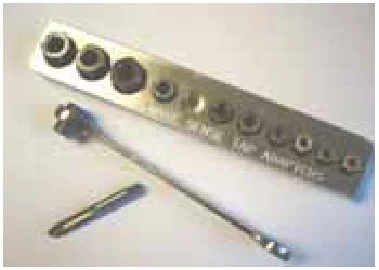
“I came up with this adapter because it’s always a pain to use a Vise-Grip or a crescent wrench to turn a conventional tap,” says Iowa farmer and machinist Eliot Evans.
“Standard wrenches don’t fit conventional taps, so my tap adapter, which has a pattern like a bolt head, just fits over the top of the tap so common wrenches can be used to turn it.” Evans worked on his invention almost 3 years before finalizing and patenting the product, which he calls Make Sense Tap Adapters. They fit all common fractional taps up to 3/4-in. standard and 22 mm metric. He sells the adapters as a set that includes a stand, set screws and an allen wrench for $60.
“The adapters are fully-machined CNC parts made from 4140 heat-treated steel,” Evans says. Evans’ adapters made quite a splash nationally when he was invited out to California to show them to Jay Leno. He got to visit Leno’s famous garage where he stores his collection of more than 200 cars and motorcycles. Make Sense Tap Adapters are simple and unique.
“You might not need them every day, but they’re very handy to have around.”
Contact: FARM SHOW Followup, Eliot Evans, 505 410th Street, Joice, Iowa 50446 (ph 641 588-3546; [email protected]; www.eliotinc.com).