
Practical ideas from FARM SHOW MagazineSubscribe · Free issue · Send us your shop tip
Subscribe to FARM SHOW
Issues / Vol. 21, No. 4 (1997)

Vol. 21, No. 4 (1997)

Money-Saving Repairs & Maintenance Shortcuts · Printed section pp. 32–34

33 selected entries · Complete text of selected entries

This issue’s section includes reader tips and feature-length shop stories. Held items and editorial notices are not reproduced.

Archive text: prices, coupons, availability and contact details reflect the original publication, not current offers. Reader methods are not universal instructions; follow manufacturer guidance and proper safety practices.

Reader shop tips

From the archive · Full text
Reader shop tip

Walter Ray

Walter Ray, Warsaw, Ontario

“After we heard about problems farmers have had with Ford-Versatile 276 bi-directional tractors burning up, we inspected our own 276 which has front and rear hydraulics and 3-pt. hitches. I’m convinced that the problem farmers have had is that there are too many electrical and hydraulic lines running through the center articulation joint. The hydraulic lines wear through and then an electrical spark starts a fire. We think we’ve eliminated the problem permanently by wrapping a piece of thin plastic sheeting around the hydraulic lines. We simply used a snow sled that people up here call a “lazy carpet”. There’s a 5/16-in. steel loop in the articulation joint that rubs on the line. The plastic goes between that and the line. We just wrapped it around the line several times. Provides peace of mind.”
From the archive · Full text
Reader shop tip

R.E. Charlton, Jr.

R.E. Charlton, Jr., Dillwyn, Va.

“Here’s a tip that works well for me when lacing together replacement baler belts. I first melt the cords then press the cut ends together. It keeps the laces from pulling out later.”

From the archive · Full text
Reader shop tip 1 of 2

Ken Turbett

Individual tip 1 of 2 from this reader’s published contribution.
Ken Turbett, Winnipeg, Manitoba

“I have a 20-ft. wide solid frame cultivator. Somehow, the rockshaft got twisted so there was a 4 to 5 in. difference in cultivating depth from one side to the other. To solve the problem, we mounted 14-in. car tires on the high end. The diameter difference between the car tires and the regular implement tires is just right to fix the problem. I saved about $2,500 over the cost of making a repair or switching cultivators. To fine tune tillage depth, now I adjust air pressure in the tires.

From the archive · Full text
Reader shop tip 2 of 2

Ken Turbett

Individual tip 2 of 2 from this reader’s published contribution.
Ken Turbett, Winnipeg, Manitoba

“To make spin-on oil filter changes less messy, I use a nail to make air and drain holes in the filters before taking them off. The drawing shows where I make the two holes.”

From the archive · Full text
Reader shop tip

Sam Lambert

Sam Lambert, Pontiac, Ill.

“A small problem with our White 160 tractor was the round holes in the cab steps. They weren’t large enough for dirt thrown up by the wheels to fall through. The dirt would build up and make a round, slippery mess. To solve the problem, we cut out the perforated part of the steps and welded two 1/2-in. dia. rods across the hole so dirt can fall through. Makes a good solid, non-skid step.”

From the archive · Full text
Reader shop tip 1 of 2

Bill Short

Individual tip 1 of 2 from this reader’s published contribution.
Bill Short, Hamilton, Mo

“Hacksaw-ing a groove in the side of grease fittings to relieve pressure as you fill bearings with grease is an easy way to prevent damage to grease seals. You just cut a groove along one side of the threads. This lets air out as you pump in grease. When grease starts to come out, you stop. It keeps grease from pushing out on the bearing seals.

From the archive · Full text
Reader shop tip 2 of 2

Bill Short

Individual tip 2 of 2 from this reader’s published contribution.
Bill Short, Hamilton, Mo

“I make many of my own replacement parts in my shop. They say inflation is low but it seems the cost of parts goes up 50 to 100 percent a year. Parts which were $4 to $5 three or four years ago now cost $35. One part I recently made cost $75 at the dealer yet cost me only $3.50 to make.

“To do work like this, I’ve outfitted my shop with lots of metal working equipment. My latest acquisition is a forge, since I need heat for various parts. The forge saves money over using acetylene.”

From the archive · Full text
Reader shop tip

Marlon Steinwand

Marlon Steinwand, Edgeley, N. Dak.

“I have only one gripe with my late 1980’s Hesston 5580 round baler. The pickup and throat are positioned so close together hay has a tendency to wrap and plug around the squeeze roller, resulting in excessive clutch wear and frequent broken chains.

“To solve the problem, I bolted a 6-in. dia. piece of pipe right above the pickup to keep even the longest stemmed hay moving through with ease. It runs the length of the entire squeeze roller.

“I made the modification at the beginning of baling season last year. I made more than 1,000 bales, many of them sweet clover and long-stemmed ditch hay. Didn’t slip the clutch or break a chain once.”

From the archive · Full text
Reader shop tip

Marion L. McGee

Marion L. McGee, Columbia, Mo.

“I built an ‘equalizer hitch’ to make my 1984 Ford F-150 steadier under load by allowing weight to be transferred back onto the trailer. It consists of half a leaf spring off a 3/4-ton International truck. It extends out the back of the pickup and connects to the trailer neck.

“The spring U-clamps in a box, made from 1/2 by 3-in. flat stock, that pivots on a 1-in. dia. pin centered directly under the ball hitch. A recessed spacer under the ball nut provides clearance between the pin and hitch for a roll or cotter pin that secures the 1-in. pin. A 3/4-in. dia. Grade 8 bolt secures the front straps to your receiver tube whilea chain provides vertical adjustment. A 3-in. channel cleat works on V-neck trailers; a U-clamp works on tubing tongues. To unhook a trailer, you simply loosen the 3/4-in. bolt. One caution: the trailer neck must be able to handle the added loading, so you may need to reinforce it.”

From the archive · Full text
Reader shop tip

Randy Henson

Randy Henson, Rt. 1, Box 195, Wheeler, Texas 79096 (ph 806 826-5665)

“You don’t throw away a pocket knife just because the blade gets dull, so why throw away sickle sections when they get dull?” says Randy, a custom harvester who’s come up with a unique method of sharpening sick-les.

“In our area, we cut a lot of short dryland wheat and a sharp sickle bar is a must or you have to slow your ground speed way down. I use a small hand-held Dremmel grinder that you can buy at most hardware stores to sharpen blades on my Deere 24-ft. sickle. I fit it with a wafer thin cutting disk about 3 in. in dia. You can buy them for about $3 apiece at a machine shop. To fit the disks to the grinder’s shaft, you’ll have to get a machine shop to custom-fabricate an adapter mandrel, which shouldn’t cost more than $10 or $15.

“To use, you simply make 1/8-in. deep cuts into the sides of the dull blade, skipping two or three of the original serrations between cuts. It takes only a minute or two per blade and two cutting disks should take care of a 24-ft. sickle bar. The easiest way to sharpen the blades is to remove the sickle bar from the header. However, you can leave the sickle bar in place to do the job. You can cut into two blades at a time. No need to unbolt the blades.

“The tool costs only about $70, including the adapter mandrel, which is a drop in the bucket compared to what you’d spend routinely replacing dull sickle blades. Inci-dentally, I’ve never completely worn out a sickle blade in the many years I’ve been using this method.”

From the archive · Full text
Reader shop tip

Eldon Knox

Eldon Knox, Ponteix, Sask.

“I farm some pretty rough country and one side or the other of the 30-ft. straight-cut header I run on my 1992 Case-IH 1688 combine always seems to be hitting the ground.

“So I made an inexpensive sensor that lets me know right away if my header’s about to dig dirt. It consists of two automotive door light switches and two dash lights out of an old car wired to sensors made out of curved rods on each side of the header. The 3/8-in.

dia. rods are 16 in. long and are curved down under the header. They pivot on a 1-in. long piece of pipe that bolts to the side of the header. A spring holds the rod tight against the door switch mounted underneath. The header normally runs 3 to 4 in. off the ground and when one side or the other dips below that, the rods pivot up and off the door switch, opening the circuit and activating the corresponding green dash light mounted on the steering column in my cab. Then I simply raise the header according to which light goes on.

“An extension cord running through a pipe frame connects the switches to the plug. All you do is pull the plug if you change headers.”

From the archive · Full text
Reader shop tip

Jack L. Docken

Jack L. Docken, Winner, S. Dak.

Jack built a stand to sharpen the 9-ft. sickles on his International mower.

“I used an 8-ft. length of 1 in. angle iron. I welded a pair of 3/8-in. hex nuts to it every 24 in. to hold the sickle in place. The angle iron welds across the top of an old wool sack holder that’s about 30 in. high. Angled braces support each end of the sickle holder.

“To use, you simply set the sickle in the angle iron and sharpen with a #60 or #80 sanding disk with your sander running on low rpm’s.”

From the archive · Full text
Reader shop tip

J.W. “Mike” Thomas

J.W. “Mike” Thomas, Prescott, Wash.

“I installed control levers for the hydraulics on my 1996 Cat Challenger 65D tractor that I can reach from the ground. Makes it a lot easier to hook up implements - no need for climbing in and out of the cab.

“I removed two bolts from the cover on the differential and mounted a control base on it, replacing the two original bolts with ones that were 1/4-in. longer. I made four 9-in. levers out of 1/4 by 2-in. flat iron. They have four positions - neutral, open, close, float - to exactly simulate the positions of the controls in the cab. I made 15-in. long linkages out of 7/16-in. dia. rod that run from the control levers to the controls in the cab. The linkages have 90 degree bends in them.”

From the archive · Full text
Reader shop tip

Bob Wooding

Bob Wooding, E. Greenbush, N.Y.

Bob says a farmer friend of his thinks the chain saw filing guide he made to clamp in his vise is the best thing since sliced bread.

“It’s for ‘freehand’ filing and accommodates all sizes of chains and filing angle,” he says.

“You need two pieces of hardwood (the ones I used are 1-in. thick, 13-in. long and 3 and 1 3/4-in. wide), two 1/2 by 3-in. machine bolts, two 1/2-in. washers, and two 1/2-in. wing nuts. After clamping the pieces of wood together as one unit, drill holes as shown. Assemble both pieces and place masking tape on top as shown. Back off wing nuts enough to insert drive of chain in slot. Adjust the chain so cutters are spaced evenly across the bar. Make a pencil mark at cutter gullets, re-move chain and mark filing angles on masking tape (magic marker works fine). To use for different size chains or different filing angles, just put a clean piece of tape on and mark the new angle.”

From the archive · Full text
Reader shop tip

Leo Dillman

Leo Dillman, Mandan, N.Dak.

“My portable roller table stands make it a lot easier to use a metal cutting saw or even certain kinds of wood saws. With one or more of the roller stands, you can make straight cuts on material of virtually any length. A set screw makes it easy to adjust height. The 6 in. long roller feeds material smoothly into the saw. I’ve never seen anything like these in any tool catalog. So far, I’ve only built them for my own use.”

From the archive · Full text
Reader shop tip

Gilbert O. Miller

Gilbert O. Miller, Mitchell, S.Dak.

“To loosen frozen nuts on manifolds and rusted equipment, here’s a method I learned from an old mechanic years ago. Just heat the nuts until they’re red hot and then apply a piece of bees wax. It will flame a little so be careful. You might have to repeat the process but keep applying till the wax no longer melts. Leave it set till it cools and the nut will then turn off easily. I’ve found that the wax pen-etrates the entire length of the bolt and acts as a lubricant, making it easy to turn off even badly rusted bolts.”

From the archive · Full text
Reader shop tip

George “Bing” Ribble

George “Bing” Ribble, Hettick, Ill.

George has a large lathe in his farm shop and needed a way to change the chucks, which are heavy and awkward. What he did was to install a section of roller door track above the lathe. He then mounted a block and tackle on the door track to raise and lower the chucks. He lifts the chucks and moves them to a storage area.

From the archive · Full text
Reader shop tip

Charles Henderson

Charles Henderson, Burt, N.Y.

“I made my own paint shaker by cutting the crankshaft and connecting rod off a lawn mower engine and mounting them on a wooden frame that sits on top of my workshop bench. A 1/4 hp electric motor belt-drives the connecting rod which turns the crankshaft to give the paint can an oscillating, back-and-forth motion. The paint can mounts on a steel bracket that’s connected to the crankshaft. The top and bottom of the bracket can be slid up or down via a series of holes, allowing it to hold 1-gal., 1/ 2-gal., or quart cans. By mounting an artificial hand on it I can even use it to shake spray cans. Friends and neighbors come over to have me shake their paint. My total cost was about $5.00.”

From the archive · Full text
Reader shop tip

Bob Haddon

Bob Haddon, Belvidere, Tenn.

“I’ve found that pouring a little beer on a dull drill bit, before it starts smoking, will make it cut much faster. I have no idea why it works, but it does work, even when using beer from a can that’s been open for several weeks.”

From the archive · Full text
Reader shop tip

Jerry Witzig

Jerry Witzig, Tremont, Ill.

“I modified a pair of locking pliers so that it’s easier to install the master link on any roller chain where you can’t make an adjustment between the rollers. I welded half of a No. 80 master link onto one side of the plier jaws and ground the other half down so that it will fit between the chain links. When I squeeze the pliers the master link will slip right in place.”

From the archive · Full text
Reader shop tip 1 of 3

Floyd E. Ver Ploeg

Individual tip 1 of 3 from this reader’s published contribution.
Floyd E. Ver Ploeg, Lovila, Iowa

“I retired from Maytag as a journeyman machine repairman 12 years ago and now operate a welding and machine shop for local farmers. Over the years I’ve picked up a few ideas that may help others.

“If a nut, bolt, or pulley gets frozen by rust, just heat it real hot, then pour water on it until it’s cool and it’ll come loose. However, don’t pour water on a cast iron part as the fast cooling will cause the cast iron to explode. Just heat it.

From the archive · Full text
Reader shop tip 2 of 3

Floyd E. Ver Ploeg

Individual tip 2 of 3 from this reader’s published contribution.
Floyd E. Ver Ploeg, Lovila, Iowa

“I save quart oil bottles to make small parts bins. Most of the bottles are rectangular-shaped. I cut out one side of the bottle and put the cap back on, then after I have 50 or 60 bottles I use 1/4-in. thick wood to build a shelf box, leaving a little more space between the shelves than the bottle is thick. The bottle bins will hold bolts up to 5 in. long. If I need several bolts of the same size I can just take a bottle of bolts to the job.

From the archive · Full text
Reader shop tip 3 of 3

Floyd E. Ver Ploeg

Individual tip 3 of 3 from this reader’s published contribution.
Floyd E. Ver Ploeg, Lovila, Iowa

“I save used oil and mix a quart or two of it 50-50 with gas to make the best penetrating oil anyone could ask for. I also use it as a cutting oil. Works great and costs little.”

From the archive · Full text
Reader shop tip 1 of 3

Landis Shelton

Individual tip 1 of 3 from this reader’s published contribution.
Landis Shelton, Webbers Falls, Okla.

“I read about the ‘Weed Eater’ line trimmer guide that lets Dennis Lenart of Waco, Texas, trim along fences or buildings (Vol. 21, No. 3). I made my own version by bending a length of 1/2-in. dia. conduit pipe into a semi-circle to form a guard and welding it to the Weed Eater shaft. The guard is offset so I can trim weeds a full 6 in. from the fence or right up to it. A pair of hose clamps connect an arm on the guard to the Weed Eater shaft. I move the clamps up or down depending on the height I want to cut.

From the archive · Full text
Reader shop tip 2 of 3

Landis Shelton

Individual tip 2 of 3 from this reader’s published contribution.
Landis Shelton, Webbers Falls, Okla.

“When the bolt and bushing on the front spindle of my riding mower wore down, causing the spindle to flop around, I decided to fix the problem myself. I removed the bolt and bushing and used a 7/64-in. dia. drill bit to enlarge the bolt hole, then tapped it out and screwed in a 5/16-in. dia. bolt. Tightening up the bolt takes the slack out of the bushing and spindle. I also set a jamb nut on the bolt to keep it in place. It’s a simple but effective idea that I’ve since used on 1/2-ton, 1-ton, and 2-ton trucks. I think the same idea could be used on almost any vehicle. It’s not a permanent solution to the problem but it’ll keep a vehicle going for quite a while.

From the archive · Full text
Reader shop tip 3 of 3

Landis Shelton

Individual tip 3 of 3 from this reader’s published contribution.
Landis Shelton, Webbers Falls, Okla.

I mounted a bolt on a bell crank equipped with a worn-out woodruff key. I drilled a hole on the opposite side of the key and screwed in a bolt to take the play out of the key.”

Shop feature stories

From the archive · Full text
Feature story

Electric Cord Reel Stays “Hot” As You Roll It

Featured source:

Slip rings built into the shaft of this new electric cord reel maintain constant electrical contact, allowing you to roll out additional cord at any time without having to unplug the “pigtail” from the wall outlet, says Briggs Mfg., Minneapolis, Kan.

“As long as the pigtail is plugged in, the cord is always ‘hot’ and ready for use,” says president Stanley Briggs.

“With other electric cord reels you have to unplug the pig-tail before you can roll out more cord and then plug the pigtail back in. A built-in re-ceptacle on the reel allows you to easily replace the cord. The reel mounts on a specially designed wall bracket that can also be used as a free-standing portable unit. An adjustable drag on the reel eliminates excessive unrolling of cord.”

Contact: FARM SHOW Followup, Briggs Mfg., Inc., 446 Meadowlark Drive, Minneapolis, Kan. 67467 (ph 913 392-3520).

From the archive · Full text
Feature story

Military Surplus Dual Wheel Dolly Jack

Featured source:

This military surplus dual wheel dolly jack is more economical and better-built than anything you can buy on the commercial civilian market, according to Army Surplus of Dodge City, Kan.

Designed for bearing, seal and brake work for both single and dual wheels on military vehicles, it has a 1,500-lb. capacity mechanical jack system on front. It has 30-in. long lift rollers with roller bearings that allow wheels to quickly be lined up to one another and the vehicle. Either side of the unit can be tilted to achieve proper alignment with the axle. It rolls easily on four heavy-duty 4-in. dia. casters.

It handles all truck tires, floater tires and most tractor tires, the company says.

Sells for $295. Contact: FARM SHOW Followup, Army Surplus of Dodge City, 3121 Fort Dodge Road, Dodge City, Kan. 67801 (ph 316 227-7441).

From the archive · Full text
Feature story

‘Caddie’ Makes It Easy To Change Big Wheels

Featured source:

One man can easily handle big truck tires and most tractor tires with this new-style “wheel caddie” that slides easily under a tire to take it off or put it on.

The Clever Lever is made of high tensile-strength tubular steel. Each arm of the U-shaped unit is fitted with side-mount rollers that allow you to rotate the tire to line up studs.

To use, you simply roll the tool under the tire, then lift and pull out the tire.

Lets you lift tires up to 285 lbs. with ease.

Comes in two models - one for 24 to 36-in. dia. tires, the other for 36 to 48-in. dia. tires.

Sells for $149.95 plus $10 S&H. Contact: FARM SHOW Followup, Safe Shop Tools, P.O. Box 4206, Missoula, Mont. 59806 (ph 800 327-7639; fax 406 721-3545).

From the archive · Full text
Feature story

Garden Tractor Equipped With Welder

Featured source:

Jacob Martin, Waterloo, Ontario, replaced the original gas engine on his Massey Ferguson 16 hp tractor with a diesel engine and mounted a welder-generator on back of the tractor so he can make welding repairs on equipment right in the field and run power tools.

“It’s a very handy rig, especially when a machine breaks down in the field. The engine came off a Kubota B 850 diesel tractor. I used the Kubota’s hood, gauges, and muffler. The engine belt-drives a steel shaft that powers the welder-generator. I mounted a wooden rack on top of the generator which I use to store tools, jacks, chains, torches, and other equipment.”

Contact: FARM SHOW Followup, Jacob Martin, RR 3, Waterloo, Ontario, Canada N2J 3Z4.

From the archive · Full text
Feature story

Gauge Tells When To Change Fuel Filters

Featured source:

If you’ve ever experienced a loss of power in a diesel tractor or truck due to a bad fuel filter, you’ll be interested in this new gauge that monitors the filter and tells you when it needs changing.

The “Fuel Filter Minder” monitors the suction side fuel filter and indicates at a glance how much filter capacity has been used and how much remains. It’s installed in-line at the filter outlet or, on Cummins engines, at the Compucheck port of the fuel pump. The gauge measures restriction through the fuel filter when the engine is operating at maximum rpm’s and locks up at that point, so the remaining filter capacity can be read even after the engine is shut down.

As the filter becomes plugged, a bright yellow indicator rises inside a clear plastic sight gauge. When the indicator reaches the red zone, the filter is plugged and should be replaced. The company also makes an air filter gauge that measures air flow re-striction. It installs on everything from larger truck and tractor engines to light duty cars and pickups.

“They take the guesswork out of knowing when to change the filters. Helps re-duce costs by only replacing filters when it’s really necessary,” says Ron Kelderman, Engineered Products Co., Waterloo, Iowa.

Sells for $34.95 not including fitting hardware. Air filter gauges sell for $24.95.

Contact: FARM SHOW Followup, Engineered Products Co., 2940 Airport Blvd., Box 598, Waterloo, Iowa 50704 (ph 319 234-0231; fax 8922).

From the archive · Full text
Feature story

“Welding Spoon” Makes Filling Cracks Easy

Featured source:

New “welding spoon” provides a bridge for the weld, making it easier to weld cracks and holes in metal or to weld two pieces of metal that don’t fit well together, says Tahenh Machining & Fabricating, Delmont, S. Dak.

The “welding spoon” consists of a 1/8-in. thick, 2-in. wide by 3 1/2 in. long copper plate mounted on an aluminum handle with a rubber grip. You hold the plate behind the crack or gap as you weld. The plate pulls the heat away from the molten material and supports the weld so that a steady bead can be laid down along the length of the crack. The molten material doesn’t adhere to the plate. After making one pass with the plate you can pull it away and further build up the bead.

“It eliminates having to always start and stop, waiting for the bead to cool off, as you build up the gap,” says Steve Gundrum, spokesman for Tahenh Machining, manufacturer.

“The spoon pulls the heat away and keeps the arc from burning through or warp-ing light sheet metal behind the gap. It works a lot better than using a hunk of copper because the handle makes it much easier to use. It works on all types of welders - stick or wire-feed, and on coated or non-coated wire.”

Sells for $14.95 plus S&H. The company also offers welding spoons in other shapes and sizes for use in hard-to-reach areas and for use when welding thicker steel. A kit that includes three different spoons sells for $21.95 plus S&H.

Contact: FARM SHOW Followup, Tahenh Machining & Fabricating, Box 216, Delmont, S. Dak. 57330 (ph 605 779-2121; fax 3321).

From the archive · Full text
Feature story

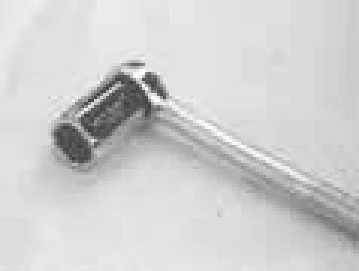
Adjustable Socket Fits Any Size Nut

Featured source:

This is the last socket tool you’ll ever need, according to American International Tool Industries, Cranston, R.I.

The Multi-Socket is a one-size-fits-all socket. It handles all standard and metric nuts and bolts, stripped nuts and bolts, square nuts and bolts, thumb screws, eye bolts and wing nuts, the company says. The socket is filled with spring loaded square pins that fit tightly around any shape.

It fits a 3/8-in. dia. drive. Sells for $19.95 plus $4.95 S&H. An 8-in. ratchet is also available. Contact: FARM SHOW Followup, American International Tool Industries Inc., 1140 Reservoir Ave., Suite L01, Cranston, R.I. 02920 (ph 800 932-5872 or 401 942-7855; fax 6120).