Practical ideas from FARM SHOW MagazineSubscribe · Free issue · Send us your shop tip
Subscribe to FARM SHOW
Issues / Vol. 25, No. 5 (2001)

Vol. 25, No. 5 (2001)

Money-Saving Repairs & Maintenance Shortcuts · Printed section pp. 38–41

35 selected entries · Complete text of selected entries

This issue’s section includes reader tips and feature-length shop stories. Held items and editorial notices are not reproduced.

Archive text: prices, coupons, availability and contact details reflect the original publication, not current offers. Reader methods are not universal instructions; follow manufacturer guidance and proper safety practices.

Reader shop tips

From the archive · Full text
Reader shop tip

Alfred Wilson

Alfred Wilson, Annville, Ky.

“I read a blurb in a recent issue about a guy who re-moved a broken stud by welding a nut to it. I had a similar experience that I solved a different way. My car had a broken hydraulic brake cylinder bleeder screw. It broke off level with the surface. That might have meant installing a new brake cylinder. The guy who was repairing it welded a flat washer of the right size to the broken off screw, then he welded a nut to the flat washer and turned it out with a wrench. After putting in a new screw, I was on my way.”

From the archive · Full text
Reader shop tip 1 of 2

Glen Gettemeyer

Individual tip 1 of 2 from this reader’s published contribution.
Glen Gettemeyer, Saint Peters, Mo.

“I spray WD-40 on dirty grease fittings that are hard to work. Lots of times it helps. I often spray it on the night before and grease in the morning.

From the archive · Full text
Reader shop tip 2 of 2

Glen Gettemeyer

Individual tip 2 of 2 from this reader’s published contribution.
Glen Gettemeyer, Saint Peters, Mo.

“One simple idea I use in my shop is keeping a 1-gal. can sitting on the workbench. I put screwdrivers in the can and hang pliers on the sides with one handle in and one out. Makes the tools easily visible and easy to grab. And you can take the whole can to wherever you’re working.”

From the archive · Full text
Reader shop tip

Lyle Bruns

Lyle Bruns, Ly-Mar Mfg., Tower Hill, Ill. 62571 (ph 217 567-3675)

Lyle came up with a method of cutting perfectly round holes in box steel or flat plate. He made an attachment for his cutting torch that has a pin under it to center in the proposed hole. Distance between the pin and the end of the torch is the radius of the hole.

The work table mounts on a old car wheel, fitted with a hub that attaches to a pedestal made from a pipe.

To cut a hole, he first drills a small hole in the center of the proposed hole into which he inserts the radius pin. He then simply rotates the wheel to cut out the circle.

From the archive · Full text
Reader shop tip 1 of 2

Pete Peters

Individual tip 1 of 2 from this reader’s published contribution.
Pete Peters, Osler, Sask.

“I made a ramp for servicing garden tractors out of 4 by 4 treated posts set into the ground. I fastened old rubber belting onto the ramps for better traction. This permanent installation makes it easy to make all kinds of routine repairs.

From the archive · Full text
Reader shop tip 2 of 2

Pete Peters

Individual tip 2 of 2 from this reader’s published contribution.
Pete Peters, Osler, Sask.

“Another idea I had was making a fence tool caddy out of old elevator leg buckets bolted together back to back. The buckets were bolted to each side of a piece of 3/8-in. plywood with a hole cut in the top for a carrying handle.”

From the archive · Full text
Reader shop tip

John Adams

John Adams, Cross Plains, Tex.

“If you lose the grease retainer cap on the end of an axle, you can replace it with a beer can cut in half. Just shove it onto the end of the axle and it will stay on.”

From the archive · Full text
Reader shop tip

Stan McDonald

Stan McDonald, Foxboro, Ont.

“Like other FARM SHOW readers, I like to build the things I need. That often means cutting flat bars, channel iron, and so on. So I bought a powered bandsaw. The problem I ran into is that the blade on the small imported saw did not last long due to the lack of coolant. Also, the stand was flimsy. I guess you get what you pay for.

“So I built my own stand from square tubing which allows me to add coolant as I cut. The stand cost $125, not including the expense of a coolant pump. I figure the investment will pay for itself by extending the life of blades about 5 times. I’ve also noted that using bi-metal blades also increases blade life, when compared with dry cutting.”

From the archive · Full text
Reader shop tip 1 of 3

Don Lasee

Individual tip 1 of 3 from this reader’s published contribution.
Don Lasee, Don’s Welding & Repair, 2486 Hwy. 32, Krakow, Wis. 54137 ph 920 899-3690

“To remove an outer bearing race from a blind hole, simply weld a bead inside the race where the balls ride, wait 30 seconds, and it will come free.

From the archive · Full text
Reader shop tip 2 of 3

Don Lasee

Individual tip 2 of 3 from this reader’s published contribution.
Don Lasee, Don’s Welding & Repair, 2486 Hwy. 32, Krakow, Wis. 54137 ph 920 899-3690

“Several lengths of 3/8-in. rerod, driven into holes drilled in mortar joints in a block wall, make quick shelf supports. Drill under the web of the block above.

From the archive · Full text
Reader shop tip 3 of 3

Don Lasee

Individual tip 3 of 3 from this reader’s published contribution.
Don Lasee, Don’s Welding & Repair, 2486 Hwy. 32, Krakow, Wis. 54137 ph 920 899-3690

“I use a product called Sportsman Goop to repair the rubber steering wheel on an old tractor. After years of exposure to the sun, the rubber had dried out and cracked. Big pieces of rubber fell off, making the wheel hard to hold.

“I started with a piece of 1 1/2-in. dia. pre-formed radiator hose with a curve that matched the curvature of the steering wheel. I slit the hose in half and filled it with plaster of paris, then placed a piece of Saran Wrap around an undamaged portion of the wheel and taped the hose on tight around it. The shape of the rubber grips was molded into the plaster of paris. After the plaster of paris dried, I pulled the mold off, lined the plaster of paris with Saran Wrap, moved it to a bad spot on the wheel, and poured it full of goop. It takes a couple of days for the goop to dry when it’s totally enclosed like this. Then I dropped the mold off, peeled off the Saran Wrap, and sanded and painted the goop black to match the rest of the wheel. I made the repair four years ago and it has held up great.

“Sportsman Goop is normally used for patching waders and boots, but we use it on all kinds of things. For example, I used it to fill a hole in a casting on a tractor to keep dirt and water out. A neighbor used the product to patch a hole in a tire on a garden tractor. Two years ago I stepped on a hot piece of iron in my welding shop and burned a hole through the sole of a new pair of shoes. I filled the hole with goop and it’s still there. The product comes in a tube about the size of a toothpaste tube and sells for about $3. It’s available at many hardware stores.”

From the archive · Full text
Reader shop tip

G.A. Henderson

G.A. Henderson, Rt. 1, Box 264, Williamstown, W. Va. 26187 ph 304 464- 4579; E-mail: [email protected])

“I came up with a nifty tool-mounting system that makes it easy to move bench-mounted tools around the shop and also take them around the farm. This includes my drill press, chop saw, pipe vice, and regular shop vice. I bolt each tool to the top of a 1/4-in. thick metal plate and welded a short length of 1 1/ 2-in. dia. pipe to the bottom of the plate. I also drilled a series of holes into my steel work bench and welded 4-in. long, 2-in. dia. pipes into them, flush with the top of the bench. The 1 1/2-in. dia. pipes at the bottom of the tool-holding plate fit into the 2-in. dia.

pipe tool. I use a set screw to lock the two pipes together to hold the tool rigid.

“I also welded a 40-in. length of 2-in. dia. pipe into the hub of a car tire. I can turn the tire on its side and roll it around anywhere I want, then lay the tire flat and mount a tool on the pipe. I also fastened a 2-in. dia. pipe to the side of a wagon that I use to haul 20-ft. lengths of plastic irrigation pipe. I carry my portable generator and chop saw on the wagon. Once I get to the field I mount the chop saw on the side of the wagon, hook it up to the generator, and cut pipe right in the field.

“I also welded a 2-in. dia. pipe to one end of a 28-in. length of box tubing that fits into the receiver hitch on my pickup. The box tubing extends beyond the pickup tailgate when it’s in the down position. The tool mounts on top of the pipe at the same level as the pickup bed.”

From the archive · Full text
Reader shop tip

Bruce’s Welding

Bruce’s Welding, 302 A 3 rd , Girard, Ill. 62640 ph 217 627-2241

An Asian timber known as Apitong has become a favorite building material at Bruce’s Welding whenever there’s a call for extremely tough wood that will be slow to rot. Apitong was used for the deck of this trailer which is intended for a concrete contractor. Bruce says it’s a situation demanding the ultimate in tough.

According to importer Bill Schaffer, Mobile, Ala., Apitong is produced in such places as Melanesia and Indonesia, as well as in some other south Asian nations. He says Apitong has become the standard for flatbeds in North America simply because it’s such a dense hardwood and is relatively free of defects. It is expensive, though. The deck for this trailer will cost about $600. But it is cheaper in the long run because it performs so well.

From the archive · Full text
Reader shop tip

Jim Kopriva

Jim Kopriva, Raymond, S. Dak.

“Those little scissors jacks that come in small cars work slick with an air impact wrench. They jack up light implements in a jiffy or spread bent iron better than expensive hydraulic jacks.”

From the archive · Full text
Reader shop tip

Vic Stratman

Vic Stratman, Argyle, Mo.

“The tie rod ends on my Deere 2440 tractor are built in Continued from previous page three sections. The outside section slides into a sleeve and clamps on. When they get worn, they’re very hard to get out. The inner end screws on over the center sleeve so I took a chop saw and cut that end off and welded a 5/8-in. nut onto it. Then I screwed a 5/8-in. threaded rod through the nut and to push out the outside tie rod end. It worked great and saved a lot of time.”

From the archive · Full text
Reader shop tip

Denis Seewald

Denis Seewald, Mustang, Okla.

“I’ve come up with a cheap way to hang tools in my shop. I hang a 4 by 8-ft. sheet of plywood on the wall, then drill holes as desired and glue in 5/16 or 3/8-in. dowel rods to hang tools on. It’s much less expensive than buying hangers at hardware stores. If you’re creative you can hang almost any object in just a few minutes.”

From the archive · Full text
Reader shop tip 1 of 2

Tom Carey

Individual tip 1 of 2 from this reader’s published contribution.
Tom Carey, Jr., Boulder, Mont.

“I’ve found that I can replace 6 and 12-volt generator-equipped engines with 12-volt alternators. Some minor modifications to the ignition on 6-volt systems are necessary, but everything else is simple.

From the archive · Full text
Reader shop tip 2 of 2

Tom Carey

Individual tip 2 of 2 from this reader’s published contribution.
Tom Carey, Jr., Boulder, Mont.

“I built a drive-over pit in my shop for changing oil, greasing, and doing other service work under equipment. I built steps down into it and I have a cover when not in use. This makes routine chores much easier and saves countless hours.”

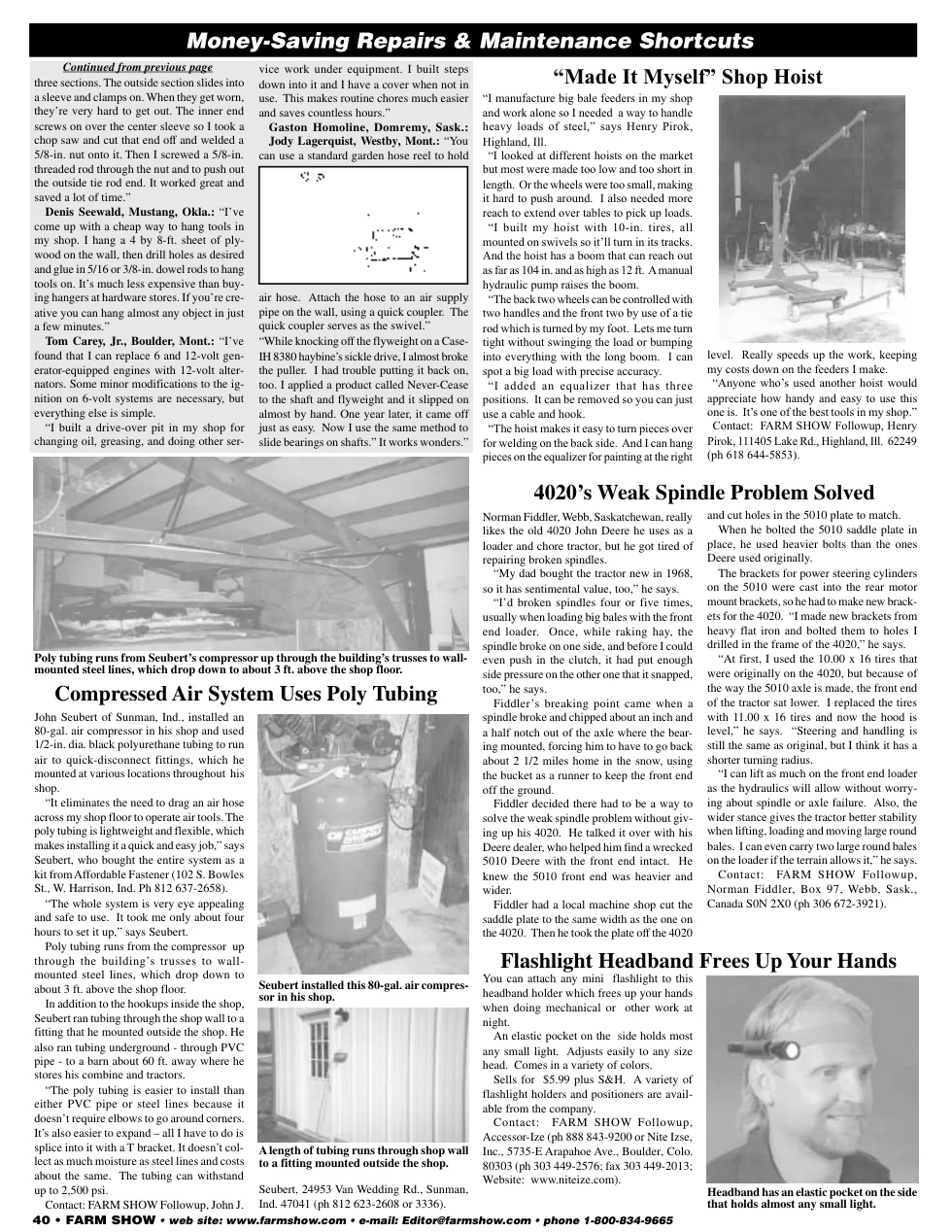
From the archive · Printed page image
Reader shop tip

Gaston Homoline

Gaston Homoline, Domremy, Sask.

Text from the original printed page; see page image. Its wording is shown on the printed page below.

Printed FARM SHOW page 40, Vol. 25, No. 5 (2001)
Original printed page: Vol. 25, No. 5 (2001) · p. 40 · tap to enlarge
From the archive · Full text
Reader shop tip 1 of 2

Jody Lagerquist

Individual tip 1 of 2 from this reader’s published contribution.
Jody Lagerquist, Westby, Mont.

“You can use a standard garden hose reel to hold air hose. Attach the hose to an air supply pipe on the wall, using a quick coupler. The quick coupler serves as the swivel.”

From the archive · Full text
Reader shop tip 2 of 2

Jody Lagerquist

Individual tip 2 of 2 from this reader’s published contribution.
Jody Lagerquist, Westby, Mont.

“While knocking off the flyweight on a Case-IH 8380 haybine’s sickle drive, I almost broke the puller. I had trouble putting it back on, too. I applied a product called Never-Cease to the shaft and flyweight and it slipped on almost by hand. One year later, it came off just as easy. Now I use the same method to slide bearings on shafts.” It works wonders.”

Shop feature stories

From the archive · Full text
Feature story

“Power Caulker” Runs Off Electric Drill

Featured source:

New Power Caulker adapts to virtually any electric drill, eliminating the need for an air compressor or bulky, heavy air lines.

The unit is made from heavy duty aluminum and steel. Power caulking saves time, reduces waste, and makes it easier to work in cold weather, says the company. Also, the ability to make a continuous bead improves the bead’s appearance. According to the company, the unit can easily handle high viscosity materials.

Two models are available - one with a 10-11 oz. (1/10-gal.) tube and the other with a 32 oz. (1 quart) tube. Both models weigh less than 3 lbs. and can be operated by either a handheld 3/8-in. cordless drill or a 110-volt corded electric drill. Both models come with a universal mounting bracket for the drill.

The 10-11 oz. model sells for $79.95 plus S&H. The 32-oz. model sells for $89.95 plus S&H.

Contact: FARM SHOW Followup, Delta Industries, 9550 Gateway Drive, Reno, Nevada 89511 (ph 800 238-3333 or 775 853-5335; fax 775 853-3670; E-mail: [email protected]; Website: www.powercaulker.com).

From the archive · Full text
Feature story

Simple Device Converts AC Welder To DC

Featured source:

“A friend asked me to do some DC welding on rather thin steel. He thought I could arc weld the material. I knew I could do it but I wanted to do the neatest job possible so I wanted a way to TIG weld the material rather than arc weld,” says Stan McDonald, Foxboro, Ontario.

“The problem was that I only had an AC arc welder at the time and therefore needed to modify my current welder to allow me to do DC welding. I couldn’t justify buying a new machine for a one-time job.

“So I made a converter that allows me to do DC tig work in my shop. Total cost of the converter was $165. It worked so well I now sell the converter for $230 Canadian (about $150 U.S.).

“DC welding gives you better penetration, better out-of-position welding (vertical and overhead welds), and it’s better for hard-sur-face cladding. It also gives you a more stable arc and, once established, the arc won’t ex-tinguish as easily as an AC arc. You’ll get better looking and more consistent weld beads. It will also let you weld thinner metals and you can stick weld automotive sheet metal with a little practice. You can also weld stainless steel and aluminum, and use a greater selection of electrodes.

“My DC converter was designed for small shops or hobbyists who already have an AC welder. It’s an economical way to add DC capability to your shop. It has a 200 amp rating and is rugged and simple. It rectifies the output of your AC welding machine to provide full wave DC output unlike manufactured units, which use single diodes and only produce a 1/2-wave rectifier which give you 1/2 the rated output of the AC.

“It’s easy to connect to your welder. Just cut the cables and add cable lugs to each of the cut ends. Depending on how you hook the cables to the converter, you can switch easily from AC to DC, and back again.

Contact: FARM SHOW Followup, Stan McDonald, 402 Rosedale Ave., Foxboro, Ontario, Canada K0K 2B0 (ph 613 968-9516; E-mail: [email protected]).

From the archive · Full text
Feature story

Easy Way To Sharpen Bush Hog Blades

Featured source:

“I got behind with my mowing so a friend of mine, Tommy Floyd, came over to help me get caught up. Tommy’s mower had a good sized hole in the back of the deck, where it had rusted and then busted out,” says William Liles, Jr.

“He told me he was in no hurry to fix the hole because it made the blades so easy to sharpen. He said he would just stick a 4 1/2-in. grinder under the back of the deck and then look through the hole to sharpen the blades.

“I thought it was a pretty good idea so I promptly cut a hole in my 6-ft. Rhino cutter. I cut a hole about 8 by 10 in. on the back of the deck, and then welded pieces of L-iron around the edges of the hole to form a track. I put a handle on the piece I cut out of the deck, and then welded four pieces of 1-in. flat iron around the edge of the hole to hold the cover up when it’s closed. I put a 1/2-in. bolt on one piece of the track to act as a set screw.

“This makes sharpening blades much easier. Many thanks to my friend and his rusted out mower.”

Contact: FARM SHOW Followup, Billy Liles, 1069 Collins Rd., Natchitoches, La. 71457 (E-mail: [email protected]).

From the archive · Full text
Feature story

Vacu Drill Can Save Project Clean-Up Time

Featured source:

Hate cleaning up after drilling holes to install wall anchors or ceiling fixtures?

Vacu Drill™ can save you a lot of time chasing drill dust around the floor or trying to get it out of carpeting. If done right, you won’t need to put down a drop cloth.

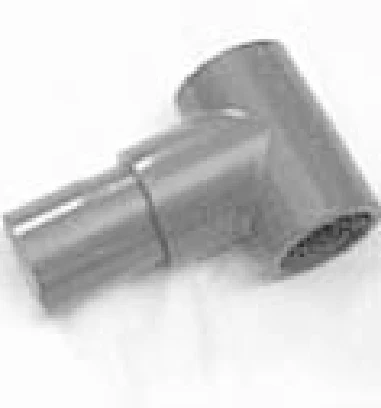
Vacu Drill, the brainchild of Ron Baker, Baker Innovations, Alva Oklahoma, is a short T-shaped sleeve that fits over a drill chuck. It allows you to hook up a shop vac hose.

“You just fasten the hose to the Vacu Drill and drill away,” Baker says.

“There’s no need to move or cover furniture and no mess when you’re finished.”

Besides walls and ceilings, you can use Vacu Drill on floors or on items being drilled in a drill press, too. Baker says Vacu Drill is available for under $10. He’s hoping it will soon show up in retail stores and home centers.

Contact: FARM SHOW Followup, Ron Baker, Baker Innovations, 612 4th Street, Alva, Okla. 73717 (ph/fax 580 327-3097; E-mail: [email protected]).

From the archive · Full text
Feature story

“Made It Myself” Shop Hoist

Featured source:

“I manufacture big bale feeders in my shop and work alone so I needed a way to handle heavy loads of steel,” says Henry Pirok, Highland, Ill.

“I looked at different hoists on the market but most were made too low and too short in length. Or the wheels were too small, making it hard to push around. I also needed more reach to extend over tables to pick up loads.

“I built my hoist with 10-in. tires, all mounted on swivels so it’ll turn in its tracks. And the hoist has a boom that can reach out as far as 104 in. and as high as 12 ft. A manual hydraulic pump raises the boom.

“The back two wheels can be controlled with two handles and the front two by use of a tie rod which is turned by my foot. Lets me turn tight without swinging the load or bumping into everything with the long boom. I can spot a big load with precise accuracy.

“I added an equalizer that has three positions. It can be removed so you can just use a cable and hook.

“The hoist makes it easy to turn pieces over for welding on the back side. And I can hang pieces on the equalizer for painting at the right level. Really speeds up the work, keeping my costs down on the feeders I make.

“Anyone who’s used another hoist would appreciate how handy and easy to use this one is. It’s one of the best tools in my shop.”

Contact: FARM SHOW Followup, Henry Pirok, 111405 Lake Rd., Highland, Ill. 62249 (ph 618 644-5853).

From the archive · Full text
Feature story

4020’s Weak Spindle Problem Solved

Featured source:

Norman Fiddler, Webb, Saskatchewan, really likes the old 4020 John Deere he uses as a loader and chore tractor, but he got tired of repairing broken spindles.

“My dad bought the tractor new in 1968, so it has sentimental value, too,” he says.

“I’d broken spindles four or five times, usually when loading big bales with the front end loader. Once, while raking hay, the spindle broke on one side, and before I could even push in the clutch, it had put enough side pressure on the other one that it snapped, too,” he says.

Fiddler’s breaking point came when a spindle broke and chipped about an inch and a half notch out of the axle where the bearing mounted, forcing him to have to go back about 2 1/2 miles home in the snow, using the bucket as a runner to keep the front end off the ground.

Fiddler decided there had to be a way to solve the weak spindle problem without giving up his 4020. He talked it over with his Deere dealer, who helped him find a wrecked 5010 Deere with the front end intact. He knew the 5010 front end was heavier and wider.

Fiddler had a local machine shop cut the saddle plate to the same width as the one on the 4020. Then he took the plate off the 4020 and cut holes in the 5010 plate to match.

When he bolted the 5010 saddle plate in place, he used heavier bolts than the ones Deere used originally.

The brackets for power steering cylinders on the 5010 were cast into the rear motor mount brackets, so he had to make new brackets for the 4020.

“I made new brackets from heavy flat iron and bolted them to holes I drilled in the frame of the 4020,” he says.

“At first, I used the 10.00 x 16 tires that were originally on the 4020, but because of the way the 5010 axle is made, the front end of the tractor sat lower. I replaced the tires with 11.00 x 16 tires and now the hood is level,” he says.

“Steering and handling is still the same as original, but I think it has a shorter turning radius.

“I can lift as much on the front end loader as the hydraulics will allow without worrying about spindle or axle failure. Also, the wider stance gives the tractor better stability when lifting, loading and moving large round bales. I can even carry two large round bales on the loader if the terrain allows it,” he says.

Contact: FARM SHOW Followup, Norman Fiddler, Box 97, Webb, Sask., Canada S0N 2X0 (ph 306 672-3921).

From the archive · Full text
Feature story

Compressed Air System Uses Poly Tubing

Featured source:

John Seubert of Sunman, Ind., installed an 80-gal. air compressor in his shop and used 1/2-in. dia. black polyurethane tubing to run air to quick-disconnect fittings, which he mounted at various locations throughout his shop.

“It eliminates the need to drag an air hose across my shop floor to operate air tools. The poly tubing is lightweight and flexible, which makes installing it a quick and easy job,” says Seubert, who bought the entire system as a kit from Affordable Fastener (102 S. Bowles St., W. Harrison, Ind. Ph 812 637-2658).

“The whole system is very eye appealing and safe to use. It took me only about four hours to set it up,” says Seubert.

Poly tubing runs from the compressor up through the building’s trusses to wall-mounted steel lines, which drop down to about 3 ft. above the shop floor.

In addition to the hookups inside the shop, Seubert ran tubing through the shop wall to a fitting that he mounted outside the shop. He also ran tubing underground - through PVC pipe - to a barn about 60 ft. away where he stores his combine and tractors.

“The poly tubing is easier to install than either PVC pipe or steel lines because it doesn’t require elbows to go around corners. It’s also easier to expand – all I have to do is splice into it with a T bracket. It doesn’t collect as much moisture as steel lines and costs about the same. The tubing can withstand up to 2,500 psi.

Contact: FARM SHOW Followup, John J.

Seubert, 24953 Van Wedding Rd., Sunman, Ind. 47041 (ph 812 623-2608 or 3336).

From the archive · Full text
Feature story

Flashlight Headband Frees Up Your Hands

Featured source:

You can attach any mini flashlight to this headband holder which frees up your hands when doing mechanical or other work at night.

An elastic pocket on the side holds most any small light. Adjusts easily to any size head. Comes in a variety of colors.

Sells for $5.99 plus S&H. A variety of flashlight holders and positioners are available from the company.

Contact: FARM SHOW Followup, Accessor-Ize (ph 888 843-9200 or Nite Izse, Inc., 5735-E Arapahoe Ave., Boulder, Colo. 80303 (ph 303 449-2576; fax 303 449-2013; Website: www.niteize.com).

From the archive · Full text
Feature story

Roll-up Shop Curtains Protect Machinery, Tools

Featured source:

John Imhoff, Swiss Bell Farms, Roanoke, Illinois, and employee Dave Kindig use the farm shop for a variety of wet, dirty and messy tasks like pressure washing, painting and sandblasting.

“Whenever we used the pressure washer to clean machinery before, our tools and equipment would end up wet. And we couldn’t use the sand blaster because the sand would have pelted everything,” Imhoff says.

The men decided there had to be a way to partition off part of the shop to contain the water, sand and paint. Solid walls wouldn’t work. Curtains made the most sense but Imhoff didn’t want anything that was going to be a lot of work to put up and take down.

“We decided what we needed was a cur-tain we could roll up or down automatically and store neatly up near the rafters out of the way when we didn’t need it,” he says.

“Our first version rolled up on a pipe mounted near the shop roof. We found we needed carrier bearings every 15 to 20 ft. to keep the pipe from sagging in the middle. That meant we had to have cuts in our cur-tain, so it didn’t protect as well as we wanted,” he says.

After a little more thought, Imhoff and Kindig came up with a design that rolls up from the bottom, using a DC motor with a special-built gear reduction system.”There’s no sagging. We control the motor with a toggle switch. It takes just a few seconds for the 15-ft. high curtain to roll up or down,” he says. It works so well that he applied for and received a patent on the design.

Other farmers have looked at Imhoff’s cur-tains and encouraged him to make them for sale. He’s gearing up to do that.

“We’re hoping to be able to make curtains any width for farm shops and other applications, too,” he says.

“They hold heat in the work area on cold days and can be used as sound barriers as well.”

He says the standard material for his automatic roll-up curtains is 13 oz. vinyl laminate.

“They’re available in a variety of colors, and are durable and fire retardant,” he says. Heavier and lighter vinyl is also available.

He envisions his rollup curtains being used in shops, livestock buildings, auditoriums and maybe churches.

Imhoff plans to put together the pipe roller, the application, so prices will be determined by the height and length of span of the cur-tains.

He anticipates that most buyers will install their own curtains.

“Hanging the curtains is Imhoff, Swiss Bell Farms, Inc., RR2, Box 52, Roanoke, Ill. 61561 (ph toll-free 888 817-5646; fax: 309 923-7845; E-mail: [email protected]).

From the archive · Full text
Feature story

Swing-Out Vise Attaches To Pickup Bed

Featured source:

“My pickup is my portable workshop and I had just about every piece of equipment in there I needed except a vise,” says Jerry Hessman, a custom hay contractor from Dodge City, Kansas.

He hit on the idea of mounting the vise on a swinging arm inside the pickup bed. That way, he could pull it out and use it either in the pickup bed or out on the tailgate. And when he was through, he could stow it away along the side of the bed behind the wheel well.

Hessman started with a 5-in. shop vise. He built a base to mount it on from two pieces of 2-1/2 in. angle iron that is 3/16 in. thick, welded together to make a channel.

By putting the two pieces of angle iron together, Hessman made a base wide enough that he could mount his vise without having to drill new holes in the base of the vise.

He says the base is long enough to reach out onto the tailgate, but short enough to let it slide up against the side of the bed behind the wheel well.

He found an old 2 in. Chevy tailgate hinge and welded one side of the hinge vertically inside the pickup bed next to the tailgate opening. He welded the other side of the tailgate hinge to the base of the vise.

The hinge allows the arm to swing out freely. He welded a piece of 1/8-in. flat iron, turned up 22 degrees on each end, to the bottom of the base to act as a runner to make it easier to slide in and out.

For quick, light work, he just swings it out to the center of the pickup bed. He can leave the vise in that position and still close the tailgate if he wants to.

When he needs a more solid base, he swings the vise out onto a piece of 1 by 2-in. tubing that he welded to the tailgate.

Besides a vise, Hessman’s portable shop pickup bed features an air compressor powered by a gasoline engine, tool boxes to store air and hand tools, gear pullers, extra chain, a chain breaker, spare parts, bolts and nuts for his haying equipment.

Contact: FARM SHOW Followup, Jerry Hessman, 10948 104 Rd., Dodge City, Kansas 67801 (ph 620 227-3688).

From the archive · Full text
Feature story

Rechargeable Powered Grease Gun

Featured source:

“We think it’s probably the most advanced grease gun ever created,” says Lincoln Century about the company’s new rechargeable powered grease gun which has a 12-volt motor that delivers grease at up to 6,000 psi.

It’s powered by a 12-volt NiCad battery with a planetary gear drive and a machined and hardened piston. Comes in a custom carrying case with a recharger.

Sells for $174.55 plus S&H. Two smaller models – 7.6 and 3.6 volt – are also available.

Contact: FARM SHOW Followup, Lincoln Industrial, One Lincoln Way, St. Louis, Mo. 63120 314 679-4200; Web site: www.lincolnindustrial.com).

From the archive · Full text
Feature story

Rolling Fenders Make Nifty Hose Reel

Featured source:

Glenn McCrea, Lincoln, Ill., needed a reel to hold 100 ft. of pressure hose. He didn’t want to spend the money for a commercial reel, so he made one himself using a pair of rolling fenders off an old field cultivator.

The fender discs were originally 4 in. apart and connected at the center by a bolt. He welded a short length of pipe onto the bolt to lengthen it by 1 in. Then he attached a length of redi rod to the bracket that originally held the discs to the cultivator and bolted it to the shop wall. He welded a nut onto another short length of 3/8-in. dia. redi rod to make a crank.

“To unroll the hose we just drag the hose out. To roll the hose up, we turn the crank. A good commercial reel sells for about $100 so I saved a lot of money,” says McCrea.

Contact: FARM SHOW Followup, Glenn McCrea, Rt. 3, Lincoln, Ill. 62656 (ph 217 732-4519).

From the archive · Full text
Feature story

Lava Towels Great For Shop Cleanup

Featured source:

For cleanup in the shop or field, you might want to try these new Lava towels, which are much tougher than a normal moist towelette.

You can throw a 10-pack into a toolbox or glovebox. They’re also available in a 50-count tub.

Sold by the WD-40 Company, manufacturer of the famous lubricant, they’re available at discount stores everywhere.

Contact: FARM SHOW Followup, WD-40 Company, Box 80607, San Diego, Calif. 92138-0607 (ph 800 448-9340; Website: www.wd40.com).