Practical ideas from FARM SHOW MagazineSubscribe · Free issue · Send us your shop tip
Subscribe to FARM SHOW
Issues / Vol. 39, No. 2 (2015)

Vol. 39, No. 2 (2015)

Money-Saving Repairs & Maintenance Shortcuts · Printed section pp. 36–39

42 selected entries · Complete text of selected entries

This issue’s section includes reader tips and feature-length shop stories. Held items and editorial notices are not reproduced.

Archive text: prices, coupons, availability and contact details reflect the original publication, not current offers. Reader methods are not universal instructions; follow manufacturer guidance and proper safety practices.

Reader shop tips

From the archive · Full text
Reader shop tip

Arnold Anderson

Arnold Anderson, Aragon, N. Mex.

“Here’s another tip for securing hammer handles for young Cameron Messinger who was in your last issue. I remove the metal wedge in the hammer handle and replace it with a tight wooden shim. Then I stand the hammer in a container with about 1⁄2 in. of anti-freeze in it with the handle extending straight up. Let it soak for a week or so and the handle will absorb the anti-freeze and swell up. The anti-freeze won’t evaporate so the handle will stay tight. I’ve never had one come loose.”

From the archive · Full text
Reader shop tip

Joe Ciarlette

Joe Ciarlette, Joliet, Ill.

“I recently read a tip about using hockey pucks to minimize vibration on large shop compressors. Just put a puck between the floor and each leg. They cost only a couple bucks each and you can lag bolt them to the floor so they stay in place.”

From the archive · Full text
Reader shop tip 1 of 2

Al Keehn

Individual tip 1 of 2 from this reader’s published contribution.
Al Keehn, Buckeye, Ariz.

“Like a reader in your last issue, I’ve found that nail polish works well to color code parts that need to fit together. Just put a dot of the same color on each corresponding part. I also use it to write my phone number on equipment.

From the archive · Full text
Reader shop tip 2 of 2

Al Keehn

Individual tip 2 of 2 from this reader’s published contribution.
Al Keehn, Buckeye, Ariz.

“Another idea that has saved me a lot of water in recent years is using the alarm feature on my cell phone to remind me to turn off hoses. It’s handy because it’s always with you.”

From the archive · Full text
Reader shop tip

David Simpler

David Simpler, Elkton, Md.

“Ever wonder how you can use those heavy rubber wristbands they give out at County Fair booths or schools? Well, I use one on my grease gun to keep the handle closed. How many times do you pick up your gun and the handle is cocked. When you close it, you lose a shot of grease. I just slide the wrist band up over the handle and tube body. Saves grease and holds your gun neatly.”

From the archive · Full text
Reader shop tip

Isaac Yoder

Isaac Yoder, Burkewsville, Ky.

“I bought a used Deere 4420 combine and noticed from the beginning that the feederhouse variable control valve would only operate the hydraulic cylinder one way. I couldn’t get it to go the other way. If I switched the hoses, the cylinder would go the other way but not back.

“I had a hydraulic specialist go over the valve but he couldn’t find anything wrong. After a further period of frustration, I decided to take the entire valve apart. It was a 3-spool valve which controlled the header height and ground speed. Inside were 2 poppet valves less than 1/8-in. dia. with little plastic grommets at one end. I looked at them closely and, sure enough, one of the grommets was broken and would not release for the return. There was my problem. I replaced it and the valve was fine.

“My first thought after that was ‘What could I do to save other guys all the hassle?’ The answer: Send it to FARM SHOW!”

From the archive · Full text
Reader shop tip

Spike Bruggeman

Spike Bruggeman, Larchwood, Iowa

“If you live on a gravel road, put a canister-style vacuum bag over the EVAP vent valve on your vehicle’s fuel tank. This will prevent the valve and canister from getting full of dirt and triggering the ‘check engine light’. A plugged EVAP vent can also make it difficult to fill up with gas.”

From the archive · Full text
Reader shop tip

John Hayne

John Hayne, Wadsworth, Ohio

“My 45-year-old Farmall 656D was turning over slowly this winter. Even with the block heater and auxiliary charger in place, it wouldn’t turn over fast enough to start. Time for new batteries, I figured at first. But instead, I took the starter to Automotive Electric in Akron, Ohio, where they rebuilt it with new brushes, worked on the armature, new bushings, and a solenoid. When I got it back, the tractor turned over just fine and started right up. I won’t need batteries for a while.”

From the archive · Full text
Reader shop tip

Vic Elmore

Vic Elmore, Oronville, Wash.

“I use old plastic political advertising signs as ground sheets under machinery. I cut them to 2 by 3 ft. and keep them in my truck. They are very slick, making them easy to slide under and easy to clean. They also take up very little space.”

From the archive · Full text
Reader shop tip

Randy Zimmer

Randy Zimmer, Mercer, Maine

“My 25-year-old 12 hp. Wheelhorse tractor needed a new fuel pump. The cost of an exact replacement would have been $135 plus labor. I was able to install an automotive fuel pump for less than $50 with a separate switch. Works great.”

From the archive · Full text
Reader shop tip

Roger Gutschmidt

Roger Gutschmidt, Gackle, N. Dak.

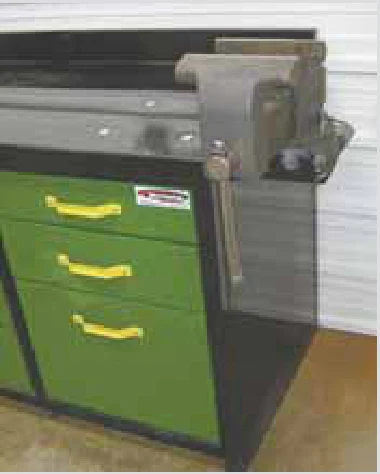
“I mounted a big vise on the end of my workbench using a receiver hitch-type mount. A heavy plate mounts under the top of the workbench to anchor it. What I like about this is that the vice can be removed and used elsewhere, if needed.”

From the archive · Full text
Reader shop tip

Jim Howe

Jim Howe, Jr., Rutledge, Ala.

“In a recent issue a reader complained about the oiler on his 455 Husqvarna chainsaw. He needs to use either 10 or 20 weight oil instead of the usual 30 weight. The bad oiler was the company’s response to government complaints about too much oil on the ground. If he is brave enough to modify the machine, there is an oiler cam inside that he can file down slightly to allow more flow of 30 weight oil. Hope this helps.”

From the archive · Full text
Reader shop tip 1 of 2

Sam Long

Individual tip 1 of 2 from this reader’s published contribution.
Sam Long, Salvisa, Ky.

“We had a 1983 Chevy farm truck with a 350 engine. The rear bolt on the starter stripped out. A helicoil wouldn’t hold it due to the high pressure so I welded a grade 8 nut inside the hole, put a piece of 3/8-in. dia. steel threaded rod through it, and put a 3/8-in. nut on the other end to hold the starter. Worked great.

From the archive · Full text
Reader shop tip 2 of 2

Sam Long

Individual tip 2 of 2 from this reader’s published contribution.
Sam Long, Salvisa, Ky.

“To seal blown head gaskets, we pour a bottle of K&W Fiberlock into the radiator. Just get the vehicle up to operating temperatures and you’re good for several months. I’ve tried several similar products but none works as good as Fiberlock, which you can buy at Amazon and most parts stores.”

From the archive · Full text
Reader shop tip

Delbert Hayes

Delbert Hayes, Norwalk, Iowa

“I bought an 8-ft. tall rolling ladder for our shop. It’s very handy for all kinds of things but especially for working on combines and tractors, and changing light bulbs.”

From the archive · Full text
Reader shop tip

Jeffrey M. Heiser

Jeffrey M. Heiser, Vesper, Wis.

“In addition to writing down maintenance info in a log book in my shop, I write the date of oil changes on the outside of oil filters using a paint pen. Helps to notice at a glance when oil was changed and the number of hours.”

From the archive · Full text
Reader shop tip 1 of 2

Paul Peyton

Individual tip 1 of 2 from this reader’s published contribution.
Paul Peyton, Ava, Mo.

“More than 2 years ago, you wrote a story about how I converted a Farmall Cub to run on a chainsaw carburetor. I have lost track of the number of phone calls and emails I have received from people wanting to make the same modification. Some have used the idea on other tractors. One even modified a stationary power unit that had previously been unusable.

From the archive · Full text
Reader shop tip 2 of 2

Paul Peyton

Individual tip 2 of 2 from this reader’s published contribution.
Paul Peyton, Ava, Mo.

“I recently had a Jet 15-in. planer that would not start up. The motor turned slowly but could not reach full rpm’s. The starter capacitor was good. The problem was that the internal switch that turns the starter capacitor on and off had failed. I disassembled the motor, removed the bad switch, and ran wires to an external push-button switch. Now I just hold the push button until the motor reaches full rpm’s and then release. I saved about $250 that I would have spent on a new motor.”

From the archive · Full text
Reader shop tip

Fred Nardi

Fred Nardi, Sault Ste. Marie, Ont.

“Small radiator leaks may be easily stopped with black pepper. It’s an old trick someone showed me years ago. I’ve used it many times and it usually works very well. Put about a teaspoon of ground black pepper into the coolant and run the engine. The small grains of pepper lodge into any holes. The rest of the pepper remains suspended in the coolant for any future leaks and doesn’t affect cooling efficiency like some commercial products do. It’s also cheap and always available.”

From the archive · Full text
Reader shop tip

Harley Gillett

Harley Gillett, Battle Creek, Mich.

“I have a 1949 Ford 8N. Last summer I noticed my hands and gloves were turning black every time I used the tractor. I discovered the hard surface on the steering wheel had worn off and the rubber underneath was deteriorating. I sprayed the wheel with truck bed liner. It solved the problem and gave me a better grip.”

From the archive · Full text
Reader shop tip

Mike Mitchell

Mike Mitchell, Fairbanks, Ak.

“If you have a truck that won’t start, there’s a fast and easy way to find out if it’s a fuel system problem or an electrical problem. Just take the air cleaner off and run propane into the intake with a weed burner or other propane torch. If the engine starts when you crank it, you’ve got a fuel system problem.”

From the archive · Full text
Reader shop tip

Mark Yax

Mark Yax, Solon, Ohio

“I came up with a fast way to spray paint bushings. I cut a strip of cardboard slightly wider than the bushings’ inside diameter and then space the bushings out, leaving room between the bearings.

“This method lets me spray all sides of the bushings and their ends in one shot, and then hang them up to dry. It works a lot better than painting the bushings on a flat surface and having to wait for them to dry, and then having to flip them over on their other side.”

From the archive · Full text
Reader shop tip

Glenn Buxengard

Glenn Buxengard, Spring Grove, Minn.

“Here’s an absolutely foolproof way to make a handle for your file that won’t come out. Grind a couple of notches into the file’s tail, and also drill matching holes into a short length of 3/4 or 1-in. dia. pvc pipe. Fill the pipe with auto body putty and then stick the file’s tail inside it. Some of the putty will ooze out of the pipe through the holes, which you can wipe off. The rest of the putty will harden and stay locked inside the pipe. It won’t be able to slide out and neither will the notched file. The result is an absolutely indestructible file handle.”

From the archive · Full text
Reader shop tip

Kenny Fasnacht

Kenny Fasnacht, Janesville, Minn.

“I have 2 artificial hips so I needed a step that would stay put whenever I lean over while working on trucks, farm machinery and construction equipment. I couldn’t find what I wanted on the market so I built my own ‘slip resistant’ step.

“It’s 12 in. wide, 16 to 24 in. long, and 9 to 18 in. high and stands on legs made from 1-in. tubing. The legs set on 3 1/2-in. sq. metal pads with diamond-shaped, rubber baler belting pop-riveted onto them. The rubber pads stick to the floor and won’t slip when I lean over to work under the hood of a vehicle.

“The top of the step is made from anti-skid serrated plank grating, which comes in different widths. It doesn’t matter if my shoes are dirty or oily, the grating will dig into the soles and clean everything off.”

From the archive · Full text
Reader shop tip

Jim Westcott

Jim Westcott, Orillia, Ontario

“To keep fluid from migrating front to back on my Case 430 tractor, I run a hydraulic hose from the front drain hole to the back one. This way they self level, so I don’t have to take it all apart and remove the seal in the transmission and rear end.”

From the archive · Full text
Reader shop tip

Raymond Nanney

Raymond Nanney, Union Mills, N.C.

“The pto shield on my bush hog wore out, and a new one would have cost several hundred dollars. Instead, I used a piece of 4-in. dia. sewer pipe to make an inexpensive replacement. I cut off a length of pipe and drilled 2 holes into it. Then I slipped the pipe over the pto shaft and wired the pipe to the lower lift arms on my tractor’s 3-pt. hitch, in order to keep the shield from turning. To grease the pto shaft’s universal joints, I just loosen the wire and move the shield either forward or backward.”

From the archive · Full text
Reader shop tip

Robert O. Wallrath

Robert O. Wallrath, Houston, Texas

“I recently retired but still operate a business that services engines. I needed an inexpensive hoist so I built one that sets outside my shop, but can pivot all the way around to set objects inside the shop through the doors. I just grab a chain and swing the hoist in either direction. The 12-ft. long I-beam on top of the hoist pivots on 3/8-in. bearings and can lift up to 2,000 lbs.

“The hoist is supported by a 6-in. dia. steel pipe that goes 4 ft. deep into the ground. The top of the chain is covered by a modified plastic bucket to keep the chain dry. I cut a 2 1/2-gal. sq. plastic bucket in half, keeping the bottom half. I cut a small hole in the bottom, slipped the chain hook through it, and attached it to the trolley. Then I sawed the cutout round plug in half, put the 2 halves back into the hole, and used Liquid Nail to seal it.

“It really comes in handy. I recently used the hoist to lift 30-ft. long steel beams off a trailer and then swing them inside the shop. It cost less than $1,000 to build. I’m willing to sell plans.”

From the archive · Full text
Reader shop tip 2 of 2

Michael Meyers

Individual tip 2 of 2 from this reader’s published contribution.
Michael Meyers, Kirbyville, Texas

Another idea: I put all my saw and tables on wheels, which makes shop cleaning a lot easier.”

From the archive · Full text
Reader shop tip

Leland Nadig

Leland Nadig, Evart, Mich.

“I took a stainless steel fire extinguisher, cut off the end of the hose, and installed an air chuck to make an inexpensive air carrier. It’s important to stay under the extinguisher’s limit of 190 lbs. air pressure; I usually don’t go above 120 lbs. Works great for pumping up tires on riding mowers and small cars.”

Shop feature stories

From the archive · Full text
Feature story

Thread Repair Made Easy

Featured source: Shilo Technologies

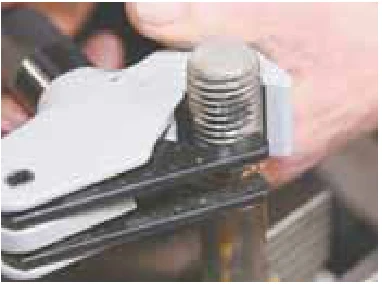
Damaged threads on nuts, bolts and pipe are no problem for the new Nes Thread Restorer Tool, says manufacturer Shilo Technologies of Jerusalem, Israel. The company says the tool works better than a tap and die set because it has the same form cutting ability due to the existing thread, whereas a tap can’t pick up the original path of the initial cutting tool. NES maintains the original centerline of the internal thread by following the existing groove. To use, insert the tool’s cutting blades into the thread groove, adjust the knob to the diameter of the thread, and rotate. No calibration is required; it self-adjusts to any pitch and size within range including inch, metric, right-hand, left-hand, and even shafts with a keyway slot. Cutting fluid isn’t necessary because the reduced cutting forces and the small amount of material being removed don’t generate heat or distortion. The high speed steel blades on the tool have no problem removing rust, burrs or any other obstruction. Replacement blades are available. Prices range from $37 for the external repair tool (which will do 5/32 to 1/2 in.) up to $570 for a full set that will repair up to 6-in. I.D. and O.D. pipe threads.

Contact: FARM SHOW Followup, Anglo American Tools, 403 Kennedy Blvd., Somerdale, N.J. 08083 (ph 856 784-8600; [email protected]).

From the archive · Full text
Feature story

4010 Gets Hydraulic Power Boost

Featured source: Larry McPhail

Larry McPhail loves his 4010 Deere with its 248 loader. However, he didn’t love the slow hydraulics – until he added a booster pump.

“The 4010 hydraulic system is underpowered for everything it has to do,” says McPhail.

“The tractor is equipped with a belly 1,000 rpm pto facing forward from the transmission. A friend suggested I mount an auxiliary pto-driven hydraulic pump there.” Mc Phail got a pump from Prince Manufacturing (ph 605 235-1220; www.princehyd.com). He fabricated a bracket for the pump and secured it to 4 existing holes on front of the transmission.

“The holes are for mounting a belly sickle mower on the tractor,” explains McPhail. With the pump in place, McPhail ran the pump’s intake hose to the drain plug on the transmission case. He found a cheap fix for mating the hose end’s hydraulic fitting to the drain’s 1-in. fine thread bolt.

“Deere has a fitting with fine thread on one end and hydraulic pipe on the other with a swivel in between,” says McPhail.

“It’s called a Seal Lock, and it cost just $2.78.” Once he mounted control valves on a bracket on the loader frame and ran hoses to the loader, he had the speed he was missing.

“It works great,” says McPhail. Contact: FARM SHOW Followup, Larry McPhail, 2855 H Street Rd., Blaine, Wash. 98230 (ph 360 366-5548; [email protected]).

From the archive · Full text
Feature story

Parts Gurus Help Restore Old Ford Cars, Trucks

Featured source: Mark Sullivan and Tom Roberts

Mark Sullivan is a car enthusiast who loves to rebuild, refurbish and restore old Ford vehicles. Models range from the early 1930’s to late ’70’s. During projects involving 12 cars of his own in the late ’90’s and early 2000’s, Sullivan bought, bartered and sold hundreds of parts to get exactly what he needed. In 2005 he recognized that many other Ford enthusiasts were calling him for parts, so he started a business called Sullivans Garage. The business quickly gained traction and in the past 9 years the company has shipped parts to more than 45,000 customers worldwide. He adds several thousand new parts every year.

“I only sell parts I use in my own restorations,” Mark says, “which means customers are getting the best parts available for the vehicle they’re working on.” Sullivan stocks parts from about 20 different suppliers and sells primarily online. For older vehicles he carries gas tanks, spreader bars, headlamps, running boards, grill shells and firewalls. Gauges, script bumpers, lights and interior accessories are also available. Some parts are originals, others are rebuilt, others are replicas. In 9 years the business has sold more than 1,500 sets of Model A brake floaters, hundreds of running boards and grills, along with countless others parts. Mark says, “If you’re building a ’32 Ford, send him a list of all the parts you need and I’ll come up with a ‘package’ deal that’s tough to beat. Sullivan also sells operators manuals and parts lists for many old vehicles. Sullivan says he’s continually on the lookout for cars to restore or to acquire, then inventory and re-sell. He tries to maintain at least a dozen vehicles for sale at all times and is usually working on 3 to 4 cars of his own at any given time.

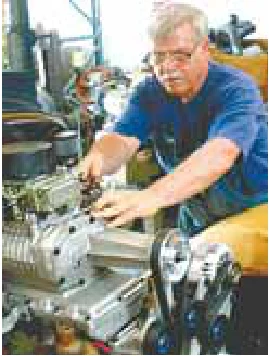
“I started doing this for fun and it quickly grew into a business which has done extremely well,” says Mark. Contact: FARM SHOW Followup, Sullivan’s Garage, 30 Hazelnut Lane, Londonderry, N.H. 03053 (ph 855 785-5988; www.Sullivansgarage.com). Tom Roberts is another car enthusiast who built a business out of his passion for old Fords. He started building hotrods as a teenager and eventually built heads, gearboxes and blocks for dragsters, Indy cars, off-shore racing boats and even experimental aircraft. His well known Roberts/Magnuson Supercharger Kit is a true bolt-on modification for flathead Fords. It delivers complete driveability together with neck-snapping performance at an affordable price. TR Designs also has flathead manifold systems configured for a single 4-barrel carburetor, 4 Stromberg carburetors, and a Supercharger with two Strombergs. All of Tom’s parts are created using CAD technology, cast in aluminum and machined to exact specs. Contact: FARM SHOW Followup, Tom Roberts, TR Designs, 1646 Morse Ave. no. 6, Ventura, Calif. 93001 (ph 805 644-8899; www.tr-designs.com).

From the archive · Full text
Feature story

“No Mess” Bulk Oil Dispensing Rack

Featured source: B.J. Gingerich

One of the handiest systems we’ve seen for storing and dispensing bulk lubricants is this one set up by B.J. Gingerich of Tremont, Ill.

“It’s convenient because we don’t have drums sitting all over our shop floor and making a mess,” says Gingerich, who is the shop manager for a small, family-owned company in the crane rental business.

“We rent out about 50 cranes of different brands and models and use a lot of different oils, solvents, and antifreezes which we buy in 55-gal. drums,” he says.

“I came up with the idea because I was tired of the constant mess caused by all the drums and pumps.” So he set up a big gravity-fed, bulk oil dispensing pallet rack system. Several 55-gal. drums set on the top 3 racks, each with a different type of oil, while 14 rectangular 30-gal. clear plastic tanks set on the lower 2 racks in a staggered fashion. Oil gravity flows from the drums into the tanks, and from there through hoses fitted with ball valves. A big 250-gal. overflow containment tank on the floor under the tanks catches any spillage and has a metal screen on top of it to place buckets and drain pans. Once a 55-gal. drum goes empty, Gingerich uses a forklift to replace it with a full one. If a full drum isn’t immediately available, he can use the 30-gal. tanks as a reserve and continue dispensing oil out of them.

“It lets us continue to bulk purchase oil and lubricants in 55-gal. drums, but also provides a ‘reserve’ system of 30-gal. barrels whenever the drums go empty,” says Gingerich.

“Using the forklift I can replace an empty drum in just 10 min. The bulk oil dispensing racks I found on the market were expensive and required a lot of pumping to refill the drums, which is a messy job. With my gravity-flow system there’s no need to pump anything.” The clear plastic tanks were originally designed for use as water tanks in RV’s, and because they’re rectangular they can be stacked next to each other without taking up much space.

“The tanks are made of thin plastic, so whenever they’re filled with liquid they tend to expand,” says Gingerich. To keep the tanks from bulging out too much, he sets each tank inside a home-built, 3-sided plywood enclosure. A 1-in. thick by 12-in. wide plywood strip is bolted onto the racks in front of the 2 rows of tanks, with adhesive labels marking the contents of each tank. Gingerich also cut long, narrow slots into the plywood next to each tank to serve as sight gauges. He made the overflow tank by cutting up a 500-gal. fuel tank.

“When the overflow tank gets full, we pump the waste oil into a big 275-gal. plastic tank that’s used to heat our shop,” notes Gingerich. Contact: FARM SHOW Followup, B.J. Gingerich, 26770 Allentown Rd., Tremont, Ill. 61568 (ph 309 208-8882; [email protected]).

From the archive · Full text
Feature story

Fast Fix For Cracked Blocks

Featured source: Jeff Hoard

Jeff Hoard won’t be junking any more cracked engine blocks after learning about a quick and easy fix. Not only did he get a cracked engine block working, he sold the engine to a fellow who says it still runs fine.

“I bought an old Ferguson with a cracked block very cheap, intending to replace the engine,” recalls Hoard.

“I had no luck finding an engine. One day I asked a mechanic who had a lot of old equipment on his place. He said he didn’t have an engine but then he grinned and told me how to fix the crack for about $20.” He advised Hoard to get 3, grade 8, 5/16-in. bolts that were an inch longer than the width of the cracked block. Staying high on the block, but below the bottom of the head bolts, Hoard was to drill 5/16-in. holes horizontally between each of the four cylinders.

“On the Ferguson there was a clear shot between each cylinder,” says Hoard.

“If you can’t tell where the head bolts are, pull off the rocker arm cover and check to see if spacing will be an issue.”

Once the holes were drilled, Hoard inserted the bolts with washers and caulking at each end and turned the nuts down tight. He explains that the grade 8 bolts (tensile strength of 150,000 lbs./sq. in.) were needed because of the tremendous torque.

“I then added antifreeze and my secret ingredient...3 cans of Stop Leak,” says Hoard.

“The tractor sat for years, but I fixed it in a couple of hours. It ran great the whole time I had it, and I never had to add coolant.” Hoard suspects there are hundreds of tractors and other engines in the same condition around the country.

“They could be put back in use tomorrow morning,” he suggests.

“Why not try it? What do you have to lose?” Hoard shares his creative scrounging ideas and projects on his DVD titled Hillbilly Heaven available at his website. Contact: FARM SHOW Followup, HM Ranch, HC 61, Box 6108, Austin, Nevada 89310 ( [email protected]; www.hmranch-hoardmfg.com).

From the archive · Full text
Feature story

He Specializes In Obsolete Deere Parts

Featured source: Greg Stephen

If you’re looking for old or even not-so-old Deere parts, a good place to start is The Old Tractor Company. Greg Stephen started running parts while in high school when his dad Dean bought a Deere dealership in 1975. He jokes that he memorized parts numbers because he was too lazy to look them up. The dealership closed in 2006, but the parts business continues. Stephen admits he may not have all his parts numbers memorized, but he does have a good idea where to find them.

“We have well over 100,000 line items, perhaps as many as 150,000 to 200,000,” says Stephen.

“I don’t know for sure because we have pallets of parts yet to be inventoried.” Stephen and his dad began buying up parts inventories as other Deere dealerships went out of business around the country. In addition to original equipment, they also handle many reproduction parts.

“I liked the old stuff and started concentrating on that, ran some ads and started promoting it and writing articles for Green Magazine,” says Stephen.

“I have long-time product knowledge. I may be weaker on the newer stuff, but I know the old Deere stuff, including anything available after market.” While tractor parts continue to be the core of his business, he sells “everything Deere” from bikes to garden equipment to barbeque grills. Stephen cites a growing demand for antique combine and implement parts.

“People with tractors want to do something with them,” he says.

“An old B with a plow or sickle mower is kind of neat.” Stephen advises people thinking of restoring an implement to first buy the parts and service documentation for it, as they are often hard to find. He also suggests paying more for a complete implement or picking up a second for parts.

“Implement parts are often hard to find because many weren’t kept when the model was discontinued,” says Stephen.

“Spend the money on the parts book for the implement you want to collect. You’ll need it. Always look for tractors or implements that are in good shape. A $100 price may be attractive, but all the parts needed can get costly.” Stephen carries a wide variety of implement parts such as roller chain, but also specialty parts no longer made by Deere or others. In some cases, such as lift handle latch plates for spike tooth harrows, the Old Tractor Company has had them reproduced. Stephen advises people looking for parts to have the model number and year handy if they have it. If a casting number is available, have that as well. He suggests talking to your local Deere dealer about being sponsored to get access to JDParts.com, Deere’s parts website.

“They have all the parts catalogs online, and you may be able to figure out the part you need,” he says.

“Then we don’t have to play a guessing game over the phone.” He warns people to be persistent and patient if calling. His Joe’s Tractor website has a parts search link, but the parts number is needed. Contacting him by email is a good option.

“I’ve kept the old parts boxes, and now they are becoming collectibles, too,” he adds.

“It is fun looking over the old boxes with their ivory and green stickers, some of them from the 1930’s and 1940’s.” Sometimes what he finds looking through old boxes surprises even him.

“I pulled a box apart one day, and the parts were packed in newspapers,” he recalls.

“A headline read ‘President Hoover Visits His Mother’.” Contact: FARM SHOW Followup, The Old Tractor Co., P.O. Box 709, 7460 E. Hwy. 86, Franktown, Colo. 80116 (ph 303 663-5246; [email protected]; www.theoldtractorcompany.com; www.joetraktor.com).

From the archive · Full text
Feature story

“Poor Man’s” Service Rack Made From PVC Tubing

Featured source: Robert Wallrath

Using pvc pipe, Robert Wallrath of Houston, Texas, built his own “service rack” for walk-behind mowers.

“It gives me easy access to sharpen blades and change belts or motor oil,” says Wallrath.

“Once the mower is on the service rack I can pull up a chair and do all my work from a sitting position.” The 4-legged service rack measures about 3 ft. sq. and is built mostly from 2-in. dia. pvc tubing. The mower’s wheels ride inside a pair of troughs made by cutting a pvc pipe in half. Wallrath tilts the mower’s front wheels up onto the rack, then lifts the mower’s rear end and slides the mower forward. A pair of long pipes, which swivel 360 degrees and also pivot up or down, are used to prop the mower up from the side or front. The rack’s legs pin into a series of holes in the tubing and can be adjusted narrower or wider depending on the mower. A short pvc “T” clamped onto one side of the rack serves as a funnel holder, or as an umbrella holder if Wallrath is working outside.

“The funnel always stays clean because it’s off the ground,” says Wallrath, who says he’s willing to sell plans for the rack. Contact: FARM SHOW Followup, Robert O. Wallrath, 7422 Nodding Pines Lane, Houston, Texas 77044 (ph 713 614-5538).

From the archive · Full text
Feature story

A Tractor Jack You Can Drive On

By Andy Sewell
Featured source: PFE TrakJak

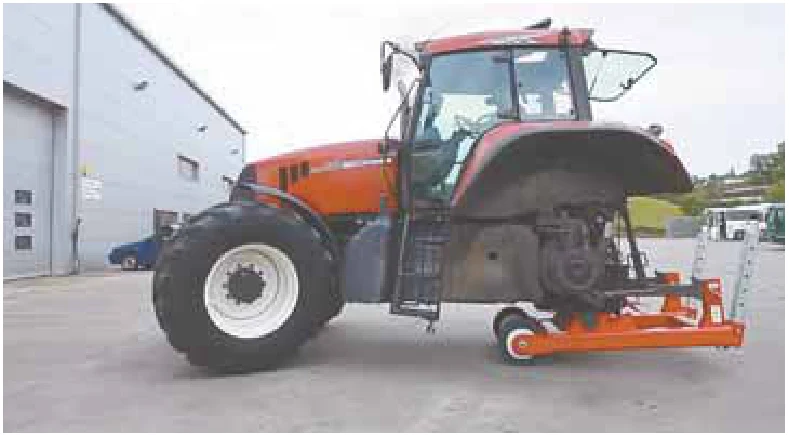
Our British correspondent Andy Sewell recently spotted a new-style tractor jack from an Irish company. The new jack is designed to make it easier to service rear brakes which, he says, go bad too often because so much equipment is trailered on narrow roads. And the trailers often either have poor brakes, or none at all. So the tractors do all the work. The new TrakJak from PFE farm equipment slips under the rear end and fastens securely to the tractor’s 3-pt. hitch. Tractor hydraulics are used to raise the rear end off the ground so the rear wheels can be removed. Once the brakes, or rear end, have been repaired, the tractor can be driven around on hard ground with the jack in place to test the repair before replacing the tires (you can see a video of a tractor moving with jack in place at farmshow.com). Contact: FARM SHOW Followup, PFE TrakJak;[email protected]; ph 011 353 872678902).

From the archive · Full text
Feature story

Handy Ties Made From Cat. 5 Electrical Wire

Featured source: Jim Rist

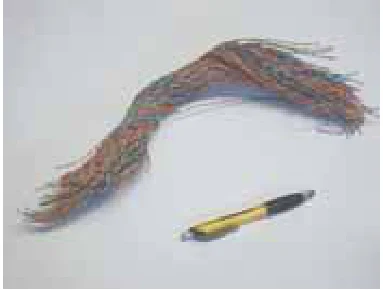
Cat. 5 wire can be used to make handy, inexpensive multi-purpose ties, says Jim Rist of Granbury, Texas. He recently sent FARM SHOW samples of the ties he makes by pulling wires out of damaged sheathing and then cutting it into the desired length.

“It’s easier to use than baling wire or zip ties and makes a great substitute. It’s also reusable,” says Rist.

“After using it once, you’ll never again throw away a scrap piece of Cat. 5 wire.” He uses a stainless steel linesman’s scissors, often used by the phone industry, to score the sheathing. Then he pulls the sheathing off by hand to expose the wires, which come out loose and twisted in pairs.

“You can cut the wires to any length, and you don’t need a special cutters like you do with zip ties,” says Rist.

“I use the wires to tie garden hoses and extension cords together and to hang different kinds of stuff in my garage. The wires don’t take up much space so you can keep them in your truck or toolbox, or at work in your desk drawer.” Rist says the wire is commonly available from local construction sites and cable companies.

“Go to a construction project and it’s likely an electrician will have tons of this stuff on hand. Cable companies often give the stuff away, even if it just gets nicked a little, because it doesn’t meet their standards. Of course, you can also buy Cat. 5 wire at computer and hardware stores, but it’s more fun to repurpose it.” Contact: FARM SHOW Followup, Jim Rist, 2708 E. Hwy. 377, Granbury, Texas 76049 (ph 817 573-1150; [email protected]).

From the archive · Full text
Feature story

New Link Belts Offer Long-Lasting Fix

Featured source: Barry Hershey

Urethane link-V-belts from BDH make it easy to replace worn or broken endless rubber belts. They are quick to install like other link-V-belts, but last longer.

“The new urethanes make our belts way stronger than previous link-V-belts while maintaining a link belt’s main design approach -– adjust the belt, not the drive,” says Barry Hershey, BDH, Inc.

“Our DuroDrive belts can be used almost anywhere an industrial grade V-belt is used.” All DuroDrive belts feature the exclusive modular link fabrication. The link-V-belts have a wider operating temperature, from 40°F to 200°F. Hershey says the new polymers are resistant to water, oils, grease, dust, dirt and most common chemicals and solvents. The DuroDrive belt absorbs vibration and is abrasion and shock load resistant. It can even handle misaligned drives and 1/4 turns. Hershey says the link-V-belts are ideal for use with modified or newly designed equipment. "A lot of times when building or modifying a piece of equipment, the last thing you think about is a belt to fit the pulleys," says Hershey. "The beauty of our belts is that you can make them the length you need. You always have the size belt you need." DuroDrive belts are available in 6 1/2-ft. sleeves or in rolls 25, 50, 100 and 500 ft. long. Pricing for the sleeves is in the $30 range with bulk lengths costing $4 to $5 per foot. "Our belts are more expensive than the standard V -belt because of the way they are made," says Hershey. "They are worth more because of their longevity and how quick they are to install." Adjustable length belts means no need for maintaining a supply of replacement belts of various sizes. They also eliminate the need to disassemble most drive components to replace belts. "DuroDrive offers standard industry power ratings and operates on standard pulley grooves," says Hershey. "They offer a smooth transition from sheave to sheave." Contact: FARM SHOW Followup, BDH, Inc., 6975A River Rd., Conestoga, Penn. 17516 (ph 717 871-0994; www.bdhbelt.com).

From the archive · Full text
Feature story

“No Leak” Pivoting Hose Reel

Featured source: Roger Gutschmidt

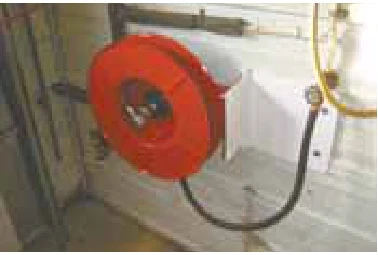
“I bought a retractable hose reel that holds 50 ft. of 1/2-in. hose. I made a hinged bracket that makes it a lot more convenient to have a hose inside the shop,” says Roger Gutschmidt, Gackle, N.Dak.

“It folds up against the wall when I’m not using it so we don’t keep bumping into it. Also, by making it pivot, the hose pulls out much easier. When a hose reel is rigid, you have to pull direct or it will bind up. I paid $400 for this unit and it’s far superior to the cheap plastic hose reels you find at Walmart. It doesn’t leak a drop of water and, because it’s retractable, the hose is easy to store.

“One downside is that it only uses 1/2-in. hose instead of 5/8 or 3/4-in., like most garden hose. I didn’t have room for a unit that would work with larger hose. This one is fine inside the shop. Outside the shop I have a 3/4-in. hose for filling sprayer tanks and I don’t care if that one drips a little.” Contact: FARM SHOW Followup, Roger Gutschmidt, 6651 Hwy. 56, Gackle, N. Dak. 58842 (ph 701 698-2310; [email protected]).