Practical ideas from FARM SHOW MagazineSubscribe · Free issue · Send us your shop tip
Subscribe to FARM SHOW
Issues / Vol. 41, No. 2 (2017)

Vol. 41, No. 2 (2017)

Money-Saving Repairs & Maintenance Shortcuts · Printed section pp. 32–35

38 selected entries · Complete text of selected entries

This issue’s section includes reader tips and feature-length shop stories. Held items and editorial notices are not reproduced.

Archive text: prices, coupons, availability and contact details reflect the original publication, not current offers. Reader methods are not universal instructions; follow manufacturer guidance and proper safety practices.

Reader shop tips

From the archive · Full text
Reader shop tip

John Handeen

John Handeen, Montevideo, Minn.

“We use a clothes iron to start engines in sub-zero weather. I just use tarp straps to secure it to the underside of the oil pan. It’s more effective than other heaters because the amount of heat is fully adjustable and it uses less electricity than block heaters. They’re cheap, too, if you look for old ones at farm auctions.”

From the archive · Full text
Reader shop tip

Eric Sagan

Eric Sagan, Melville, Sask.

“In your last issue a reader said he uses WD-40 as starting fluid. That might work okay but the best starting fluid I’ve found is Johnsen’s Starting Fluid, which is a 50 percent blend of ether and propane. Very effective (www.johnsens.com; ph 817-556-0983).”

From the archive · Full text
Reader shop tip

Earl Caron

Earl Caron, Oxford, Mich.

“The clutch linkage on my Kubota 3600 GST tractor was froze up right where it goes through the bell housing. When I pressed the clutch in, the pedal would stick all the way down to the floorboard. I tried all the penetrating oils but nothing would help. The dealer wanted $1,800 to fix it because they would have to remove the loader and break the tractor in half to get to the problem.

“Then I remembered the article in FARM SHOW about making penetrating oil from a 50-50 mix of transmission fluid and acetone. After mixing the two, I applied some and let it soak in. A couple hours later I added more and started working the clutch pedal in and out. I added more as I worked the pedal and, in no time, the pedal was back to normal.

“I was so happy with not having to spend the money on a repair, I renewed my subscription to FARM SHOW for 3 more years!”

From the archive · Full text
Reader shop tip

T.W. Ojala

T.W. Ojala, New Ipswich, N.H.

“When banding a pallet full of lumber or other material, shove a piece of pvc or steel pipe in under the material and feed the band through the pipe, then pull the pipe out and tighten down the band. Works nifty.”

From the archive · Full text
Reader shop tip

Daniel Williamson

Daniel Williamson, Fort Necessity, La.

“Sometimes when using a chainsaw, the blade and chain get caught in a cut. You can spend a lot of time trying to free it up. My solution is to keep an old bar and chain nearby so if I get stuck, I can remove the powerhead, install the spare bar and chain, and resume cutting.”

From the archive · Full text
Reader shop tip

Tony Ryba

Tony Ryba, Johnstown, Penn.

“When my 2016 Ford F150 XL went back to the dealer for its first free oil change, I had them troubleshoot a starter problem. With the key in the start position, there were numerous times when there would be a split second delay before starting, and sometimes it wouldn’t start at all. A few months after they worked on it, at about 5,800 miles, the problem came back. Lacking a wiring diagram, I just did basic maintenance. The ground straps and ground wire connections were cleaned to bare metal on the firewall, starter stud, and on the inner fenders. A coating of electrical grease was applied over the tightened connections. Since I did that, starter action is immediate with the turn of the key.”

From the archive · Full text
Reader shop tip

Tom Lass

Tom Lass, Cromwell, Minn.

“A reader in a recent issue related how he had trouble starting a Sears rototiller. He finally replaced the Champion spark plug with a Delco, and after that the machine started on the first pull. I’m a retired auto mechanic and I’ve had the same problem with Champion spark plugs in small engines. Now I strictly use NGK plugs and my starting problems have been solved, too.”

From the archive · Full text
Reader shop tip

Ready Davis

Ready Davis, Willow Creek, Calif.

“I run a small engine repair shop and sell Husqvarna chainsaws. I love them so I was concerned to read about Paul Peyton’s experience with purchasing a replacement fuel hose for his trusty Model 66 chainsaw. The replacement hose was too short and he said the dealer and company were unhelpful.

“I suggest Mr. Peyton consider using a Husqvarna fuel filter, a couple inches of extra fuel tubing, and a small brass nipple to install where the current fuel filter is. Small zip ties or wire could be used to improve the seal. Should only cost about $12 and will allow him to continue using his trusty ol’ Husky.”

From the archive · Full text
Reader shop tip

Steve Nichols

Steve Nichols, Galesburg, Ill.

“In your last issue one of your contributors shared his money-saving idea of using a shop-vac filter in place of a factory-approved Toro filter for his mower. Paying $37 for an air filter is outrageous but I don’t know if it’s a good idea to use a vac filter. I would find out if the filtration capability is equal to the original filter in terms of microns of particles. The $27 saved could pale in comparison to the cost of replacing your engine.”

From the archive · Full text
Reader shop tip

Wallace Browning

Wallace Browning, Buckingham, Va.

“I use metal bed frames to make repairs and build projects around the farm instead of buying angle iron. You can get them for free in any college town when students move out in May. I usually pick up 10 sets or so for myself and to give away. It’s great for many projects.”

From the archive · Full text
Reader shop tip 1 of 2

Kenneth Vincent

Individual tip 1 of 2 from this reader’s published contribution.
Kenneth Vincent, Kimball, Neb.

“I use medicine dropper bottles to apply oil by the drop. So many things on the farm only need a drop or two of oil and that’s easy to do with a medicine dropper. I like to use 90 weight oil for this kind of stuff because it’s heavy enough to stay put. For example, I use 3 or 4 drops to drill a hole through 3/8-in. metal. Easy to do with the dropper and saves wear and tear on drill bits.

From the archive · Full text
Reader shop tip 2 of 2

Kenneth Vincent

Individual tip 2 of 2 from this reader’s published contribution.
Kenneth Vincent, Kimball, Neb.

“Another idea that’s handy is to keep a 1-gal. jug full of water around with a separate hand-held spray pump. It’s handy for cleaning off headlight lenses, or cooling off a small piece of iron I just welded, or anything else where you just need a dab of water. You’ll find many uses once you have one sitting around.”

From the archive · Full text
Reader shop tip

Floyd Netterville

Floyd Netterville, Smithdale, Miss.

“I use a permanent Sharpie marker to write the date and hours on oil filters to remind me when the oil and filter were last changed. I also write this information, including make and model, on a dry erase board placed in an easy-to-see spot in my shop.”

From the archive · Full text
Reader shop tip

Bruce Klosky

Bruce Klosky, Derry, Penn.

“Having had head gaskets blow twice in the 25 hp. Kohler engine in my zero-turn mower, I was at a loss as to what to do. It always ran so hot that the muffler would glow red while moving, and backfire and diesel after I turned it off. The dealer told me they all do that but it seemed to me something was wrong. While looking through some old auto repair manuals I read that the heat problem could be caused by spark plugs. The Champion RC14YC that Kohler recommended were the same “hot” plugs used in a Chrysler 360 V-8. I was able to find ‘cool’ E3 plugs at a local auto parts store. I installed the E3.64 spark plugs and noticed an immediate change. The muffler no longer glows red and I’ve noticed I have more low-end torque. The engine doesn’t backfire or diesel anymore when I shut it off.”

From the archive · Full text
Reader shop tip

James D. McLaughlin

James D. McLaughlin, Wauchula, Fla.

“I raced motorcycles for nearly 20 years and learned quite a bit about diaphragm carburetors and fuel mixes for 2-cycle engines.

“I’ve noticed many readers having problems starting and running chainsaws that overheat and actually boil fuel in the tank. One of the causes is that people put too much oil into a premix because they think it will help lube the saw. But the extra oil changes the viscosity of the mix and actually leans out the engine, making it run hot.”

From the archive · Full text
Reader shop tip 1 of 4

Gary Parsch

Individual tip 1 of 4 from this reader’s published contribution.
Gary Parsch, Hope, Mich.

“Most of my shop machines and tables are on swivel casters so I can move things out of the way easily to make room for large projects and move tools closer to jobs. It also makes it easier to keep my 24 by 40-ft. shop clean.

From the archive · Full text
Reader shop tip 2 of 4

Gary Parsch

Individual tip 2 of 4 from this reader’s published contribution.
Gary Parsch, Hope, Mich.

“I have 4 retractable hanging extension cords around my shop so there’s always a cord handy and they’re not tangled up on the floor.

From the archive · Full text
Reader shop tip 3 of 4

Gary Parsch

Individual tip 3 of 4 from this reader’s published contribution.
Gary Parsch, Hope, Mich.

“I don’t farm but I have a 30-acre woodlot and the surrounding grounds to take care of. I realized that I have 52 tires that require air. To maintain them all, I have a 100-gal. propane tank that I converted to hold air. I keep it handy all the time so I can fill tires quickly.

From the archive · Full text
Reader shop tip 4 of 4

Gary Parsch

Individual tip 4 of 4 from this reader’s published contribution.
Gary Parsch, Hope, Mich.

Another time saver is to use trickle chargers on every machine that sees minimal use. It makes the batteries last longer and they’re always fully-charged.”

From the archive · Full text
Reader shop tip

Richard Nybo

Richard Nybo, Northfield, Minn.

“A friend of mine gave me two Water Boss water softeners. He got less than 4 years out of each of them before they quit working. The company was no help. I temporarily hooked each one up to my well and found out that the flow out of the drain was real slow. There was a flow restrictor just inside the barbed elbow that is built into the softener head. I cleaned out the restrictors with a drill bit and both softeners started working great again. Apparently, Water Boss has fixed this problem on newer units.”

From the archive · Full text
Reader shop tip

Michael J. Thomas

Michael J. Thomas, Salmon, Idaho

“When was the last time you were in the middle of greasing a piece of machinery and ran into a fitting that would not take grease? That happens because of dirt, heat, sunlight, water, and other elements on the farm. Most of us have tried unthreading a grease fitting and forcing grease through it, only to find that the grease inside has turned to concrete.

“I learned a method for cleaning out solidified grease from Robert Jensen, a service technician in Baker, Idaho. All you need is a heavy-duty engine degreaser and a rust buster product such as PB Blaster. First, remove the grease zerk and spray the engine degreaser into the grease cavity. Give the degreaser a few minutes to begin to dissolve the solidified grease, then apply again. Repeat the process until the degreaser flows back out clean.

“After you reinstall the grease fitting, be sure to load the grease cavity with high-quality grease until grease begins to ooze out of both sides. If it doesn’t come out all the way around, you may still have solidified grease inside. Inject PB Blaster into the cavity and cycle the unit several times until you begin to see penetrating oil begin to weep from the seized pin and bushing. Then fill the cavity with grease.”

From the archive · Full text
Reader shop tip

Doug Clark

Doug Clark, Ilderton, Ontario

“In FARM SHOW’S Vol. 40, No. 1, Gary Holland suggested placing a strong magnet on a drill press in order to gradually magnetize a drill bit so the shavings will stick to it instead of flying around. If you want to instantly magnetize a drill bit or any tool, such as a screwdriver or allen wrench, here’s how to do it.

“Just wrap as much coated wire as you can around the tool, leaving the wire bare at each end. Attach one end to the positive clamp on a 12-volt battery charger and quickly strike the other wire against the negative clamp.

“With just a brief instant of direct current, any insulated coil of wire will set up a magnetic field in the center that will magnetize almost any high grade steel, and the magnetic field will stay with the tool for years.

“If you don’t have access to a battery charger, you can hold one end of the wire to the positive cable on a vehicle’s battery and quickly strike the other end to a grounded part of the vehicle away from the battery.”

From the archive · Full text
Reader shop tip

Jeff Lang

Jeff Lang, Newport News, Va.

“I’ve had great success using recreational vehicle antifreeze to winterize the pump on my pressure washer, which is more than 14 years old. I attach one end of a short length of hose to where the water supply line hooks up to the pump, and point the hose upward so I can pour the antifreeze into the pump. I cycle the pump a few times to pull the antifreeze in and keep refilling the hose as necessary until the antifreeze comes out the high pressure side.”

From the archive · Full text
Reader shop tip

Renald Line

Renald Line, Inwood, Manitoba

“I read in FARM SHOW that a 50-50 mix of automatic transmission fluid and acetone makes a good penetrating oil, and I’ve found this idea does work (Vol. 34, No. 3). About 4 years ago the transmission on my Chevy 1/2-ton pickup overheated and quit shifting. The oil turned black, but changing it didn’t help. I had nothing to lose so I added a half cup of acetone and the transmission started shifting right away.

I repeated the procedure 3 or 4 more times, and now the transmission shifts as good as new.

“I’ve also successfully used this idea on Dodge vans. Acetone evaporates quickly, so as soon as it frees up the stuck valves it’s gone. This idea has saved me a lot of money on transmission repairs.”

From the archive · Full text
Reader shop tip

Tim Glick

Tim Glick, Oley, Penn.

“I made a 3/4-in. hex driver to insert into my 3/4-in. socket by cutting a 3-in. section out of a new crowbar. Stores don’t carry a hex driver this large. I needed one to remove a pair of hex-shaped oil drain plugs on the front axle differential on my mechanical front-wheel drive tractor. I paid $12 for the crowbar. Now I’ve got a new hex driver, and I can use the rest of the crowbar as a prybar.”

From the archive · Full text
Reader shop tip

Mark Diehl

Mark Diehl, Boltsorter, Sidney, Ohio

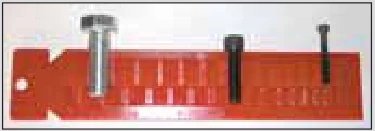
“It’s the only tool of its kind for sorting out bolts and other threaded fasteners,” says Mark Diehl, a tool and die maker who came up with a patent-pending thread identifier that’s small enough to fit easily into a toolbox. The Boltsorter identifies 30 sizes of bolts in inch and metric sizes. You simply lay the end of a bolt into the dies and when you find the one where the bolt fits, that’s it. Sells for just $12.50, including S&H (www.boltsorter.com; ph 937 492-4149).

From the archive · Full text
Reader shop tip

Wesley Marsh

Wesley Marsh, Tallahassee, Fla.

“I use empty 1-gal. metal cans for all kinds of jobs around the farm such as a dust pan, feed barrel scoop, spreading oil dry, etc. Just cut out one end and part of the side of each can, then turn in the sharp edge about 1/8 in. to eliminate the sharp edge.”

From the archive · Full text
Reader shop tip

Dean Kirtley

Dean Kirtley, 670 County Road 1707, Jacksonville, Texas 75766 (ph 903 830- 5189)

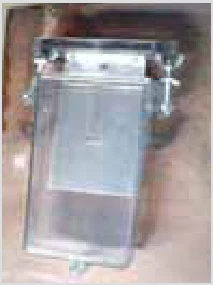
Dean makes a waterproof, clear plastic document holder that has a metal clipboard with plastic clip to hold documents. The documents are visible without having to open the case. The removeable lid is waterproof. It’s held tight with 2 bolts and wing nuts that are loosened and moved out of the way for opening and easy removal of documents.

“It works great on tractors, trucks, trailers, boats and shipping containers to hold licenses, warranties, maintenance and repair receipts, load weights and bills of lading,” says Dean.

“Boaters can put licenses and cell phones in the holder to keep them dry while on the water. The holder can be conveniently mounted on the frame of flatbed trailers, or mounted on back of box trailers.” Sells for $17.50 including S&H.

Shop feature stories

From the archive · Full text
Feature story

Portable Chainsaw Bench Clamp

Featured source: Stephen Nelson

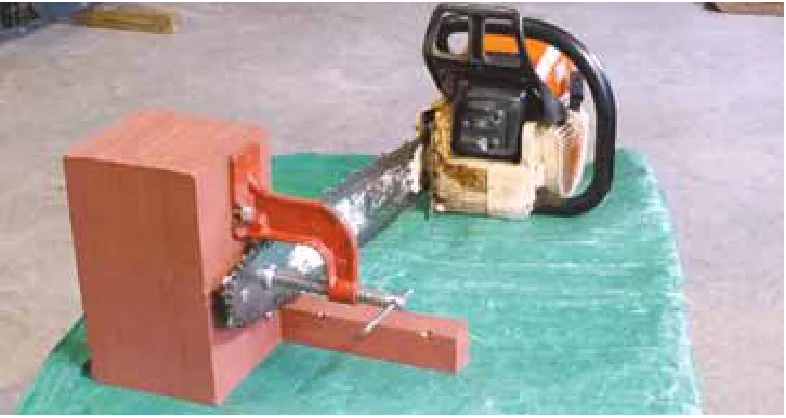
Stephen Nelson, Winston-Salem, N.C., made a portable chainsaw bench clamp to hold his chainsaw’s guide bar steady for chain tightening and hand sharpening. He started with a 10-in. long, 6-in. sq. wood block fitted with a screw clamp. A short 2 by 2 piece of scrap wood attached to the block stabilizes it.

“I just insert the end of the bar into the device and lift the bar slightly so the chain can turn, then tighten the clamp,” says Nelson.

“It can be easily placed on a bench or tailgate, and it can be easily lifted and turned around to work on the other side.

“It holds the bar level and is much more handy than sitting on the ground wrestling with the saw’s power head.” Contact: FARM SHOW Followup, Stephen Nelson, 207 Elaines Way, Winston-Salem, N.C. 27127 (ph 336 764-8929; [email protected]).

From the archive · Full text
Feature story

Cheap Welding Rod Storage Cabinet

Featured source: Doug Clark

“I have an inventory of almost 400 lbs. of different varieties of welding rod that I picked up about 15 years ago at an auction sale for $5. However, in our wet climate welding rod usually doesn’t stay dry for too long if we leave it sitting around in the shop,” says Doug Clark, Liderton, Ontario. He needed a place to store the rods, so he made a cheap storage cabinet out of an old upright freezer.

“The freezer provides a lot more space than a refrigerator because it has 4 full-sized shelves that are evenly spaced,” says Clark.

“The shelves are quite strong since they’re made up of heavy stainless steel cooling tubes with wire screens on top. Each shelf holds up to 100 lbs. of welding rod while leaving space between the boxes and canisters.” Clark hung a small reading lamp from the bottom shelf and says its low-watt bulb produces enough heat to keep air inside the freezer dry and a bit above room temperature all year long.

“The light hangs a few inches above the bottom of the freezer and faces up, which allows heat from the bulb to rise through the spaces between the boxes and canisters.” Contact: FARM SHOW Followup, Doug Clark, Liderton, Ontario Canada ([email protected]).

From the archive · Full text
Feature story

Gasket Problem With V-10 Truck Engine Solved

Featured source: Mike Anderson

Mike Anderson, Chichester, New Hampshire, recently called FARM SHOW to tell us how he saved money repairing the V-10 gas engine on his Ford dump truck.

“The problem is that the gasket between the head and exhaust manifold is too thin and has very little ‘give’ to it,” says Anderson.

“As a result, in cold weather the exhaust manifold cools quickly and the gasket contracts, causing the bolts in the gasket to break off inside the block. The gasket then has to be replaced at a cost of about $1,300.

“This problem happened 3 different times on my truck’s engine. The last time I asked the dealer to install a different gasket that had more cushion, but he said the company wouldn’t approve of that. I said I don’t care what the company says because I can’t afford to keep replacing gaskets. I called the company to ask for a different gasket, but they said nothing else on the market would work on my engine.” So 1 1/2 years ago Anderson went to a local hotrod machine shop and paid $75 for a new Remflex Exhaust gasket (ph 866 641-7325; [email protected]).

“The Remflex gasket is a full 1/8 in. thick, which produces a cushioning effect so it won’t warp. And it can withstand engine temperatures up to 3,000 degrees,” says Anderson.

“Problem solved.” Contact: FARM SHOW Followup, Mike Anderson, Chichester, New Hampshire ([email protected]).

From the archive · Full text
Feature story

Fence Staple Puller Made To Last

Featured source: Ralph E. Curtiss Jr.

“I’m 75 years old and have used this staple puller for much of my life. It works so well, I don’t want the design to be lost so I thought I’d share it with other FARM SHOW readers,” says Ralph E. Curtiss Jr., West Grove, Penn.

“The original tool was forged for my father in about 1950 by an African-American blacksmith named Henry Sims in Falls Church, Va. I’ve never seen another one like it and it has worked superbly for everyone in our family.

“I have made many of them for family and friends over the years. Anyone with a means of heating metal can forge it from a piece of 1/2-in. steel rod. You can also grind a brick-pointing chisel down into this shape.” Contact: FARM SHOW Followup, Ralph E. Curtiss, Jr., 152 Hipkins Road, West Grove, Penn. 19390.

From the archive · Full text
Feature story

Rolling Hydraulic Repair Table

Featured source: Karl Oysmueller

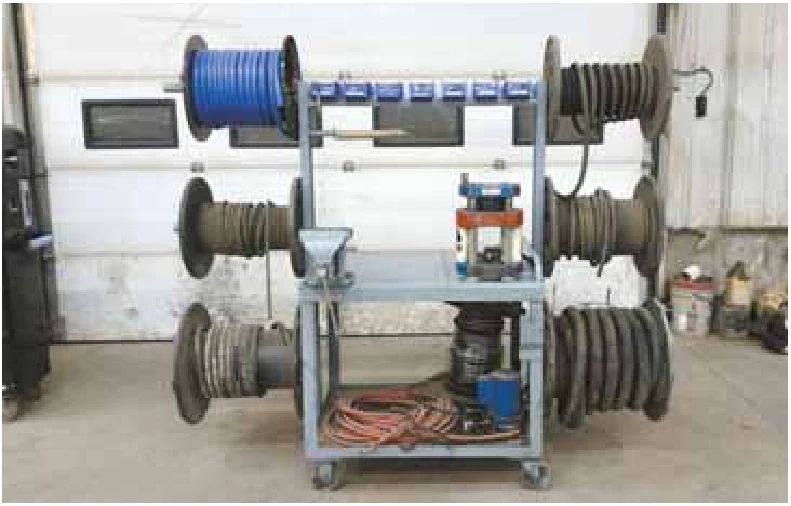
Karl Oysmueller saves time and hassle with his rolling repair table with hydraulic tools and parts. Whether for his own equipment or custom repairs, if a hose end needs work, he just rolls the table to wherever he’s working.

“I don’t have to remove the hose or go looking for parts,” says Oysmueller.

“Everything is right there, easy to find.” The repair table is a simple 3 by 3-ft. twin level with angle iron legs and rolling casters. A vise is bolted down on one corner, and a hydraulic press for installing new tips is on the other corner. A motor to drive the press is stored underneath.

“We have our own metal brake and do some fabricating for customers, so we were able to build the table out of 1/4-in. flat steel scraps that were lying around,” says Oysmueller.

“We just bent the angles we needed and welded them together. The castor wheels are about the only parts we purchased.” Oysmueller has a 160 by 160-ft. shop that he uses when maintaining or repairing his farm equipment. The shop also gets a lot of custom work fixing trucks and heavy equipment for the oil drilling industry and others. While having a worktable is handy, it is the uprights to either side of the table that make it stand out. Six hose reels mounted 3 to a side carry the most common sizes and types of replacement hoses. A shelf between the two uprights holds different dies for the different hose sizes. Well-labeled blue trays make it easy to find needed dies.

“In the past, we kept hose reels in a storage closet,” recalls Oysmueller.

“Whenever we needed hose, we had to dig through the stack. This makes the work much faster and easier.” Over time, he and others in the shop have made slight alterations for even more convenience.

“A holder for an angle grinder has been added below the hose press,” says Oysmueller.

“We even have a hanger for a roll of paper towels. The only thing we haven’t added is storage for fittings.”

Contact: FARM SHOW Followup, Karl Oysmueller, Box 84, Pink Mountain, B.C. Canada V0C 2B0 (ph 250 263-3803).

From the archive · Full text
Feature story

Old-Style Plowshares Work “Better Than New”

Featured source: Steve Rea

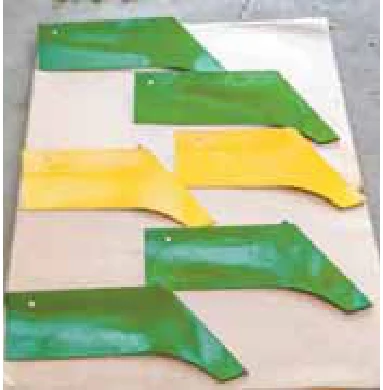
Steve Rea of Ploworx makes plow shares and other plow and tillage parts the old fashioned way with a forge, press, and old parts tooling. He says he has data that proves they will out perform modern-style plow shares, a fact that many competitive plowmen believe but find hard to prove.

“I searched high and low for any kind of information on the draft of old-style plows and found none, even though all the manufacturers did their own draft testing,” says Rea.

“So when I was invited to a plowing test in Illinois by some Amish customers, I brought along a hydraulic load cell and a digital gauge to test the draft on a variety of plows.” As a manufacturer of low-draft, high performance replacement parts for older plows and tillage equipment, Rea had something to prove, and he says he did.

“The old-style plows, regardless of color, took between 1/2 and 1/3 the draft of new plows,” reports Rea.

“Of all the plows we tested, the Oliver with Raydex bottoms stacked the soil higher and pulverized it better.” Rea specializes in fitted or blacksmith shares and moldboards, shins, landsides and other tillage parts. He offers parts for popular models of a wide range of brands, including Ford-Ferguson, AC, Minneapolis Moline and Oliver.

“We’re in the process of getting more tooling for different models,” says Rea. Most of the tooling he has is from the Crescent Forge and Shovel Co., Havana, Ill. Crescent was a leading supplier of old plow parts until the company closed its doors in 2009.

“In 2013, I had the opportunity to buy the tooling that wasn’t wanted by White Horse Manufacturing when they purchased Crescent’s tooling,” explains Rea.

“I was told by the man who ran the press that the tooling was about all that was left of its kind in the country.” In order to put the tooling to use, Rea built his own forge and press. He has also built some of his own tooling. Rea credits Earl Seamands, a former salesman for Crescent, as being instrumental in saving the old tooling, as well as helping and encouraging him to get into the business. Slowly, Rea has built up a following among the Amish, collectors, plowing competitors, and people who use old plows for gardening or small plots. As the reputation of Ploworx has grown, so have sales. He has shipped parts to Denmark, Ireland and Canada. One Canadian plow contest competitor ordered a certain kind of share, followed by an order for 100 more. If you need a part for an old plow, Rea is eager to help.

“Take the part off the plow and identify the plow brand and model number if you can,” says Rea.

“Look at the back side of the part for a parts number. It’s nice to have the landside number, too, but if we can identify the moldboard number and the plowshare number we can usually marry bottoms together.” Parts numbers may not match up with the brand or model, warns Rea.

“As blacksmith shares have become fewer and fewer, folks have been creative,” he says.

“Two weeks ago an Amish customer with a Moline 12-in. plow discovered it had a Dearborn share.” Rea says that if he doesn’t have a needed part on hand, he can usually provide it in about 3 weeks. However, as a one-man shop, he appreciates all the heads-up time he can get. Pricing varies, but Rea says he uses the same pricing that Crescent did before they closed their doors. Contact: FARM SHOW Followup, Ploworx, 13909 Duck Creek Rd., Salem, Ohio 44460 (ph 330 332-9386; [email protected]; www.ploworx.com).

From the archive · Full text
Feature story

Website Delivers Powerstroke Expertise

Featured source: Bill Hewitt

When FARM SHOW reader Ron Payne ran across the powerstrokehelp.com website, he had to share the news with fellow readers. The website is produced and hosted by Bill Hewitt, a Georgia mechanic who specializes in Powerstroke diesels. His Powerstroke Specialty business is located in Buford, Ga.

“He’s in Georgia and I’m in Oklahoma, but if I lived closer, I would use his shop,” says Payne.

“He has the most marvelous videos about Powerstroke Ford trucks, covering everything from overhauls to maintenance.” In fact, Hewitt has developed such a strong reputation that he can claim customers from every state in the U.S. and Panama. Some people actually ship their trucks to his shop for work. He notes that a customer from Nome, Alaska, spent more to ship his truck to Georgia and back than it cost originally! Hewitt says that he appreciates the business and is glad to fix the trucks. However, he made the videos to help people avoid expensive repairs or to help them fix the trucks themselves. He explains on his site that he was inspired to make them by all the customers who arrived angry after being told by other repair shops or dealers that they needed expensive repairs. Hewitt defends the Ford Powerstroke diesel as an engineering masterpiece and a rock-solid platform. The problem, he says, is that the Powerstroke is different from other diesel engines, and Ford has made non-compatible changes from model year to model year.

“The end result is that very few repair shops or even dealers have the technical knowledge, experience or equipment to repair and maintain your truck,” proclaims Hewitt. His in-depth knowledge of Powerstroke diesels from every model year is a result of the fact that they are the only engines he has worked on for the past 15 years. That depth of knowledge is clearly communicated in the videos.

“Hewitt has a way of explaining things so anyone can understand,” says Payne. The website has 2 sections. One offers free videos on more than 75 topics related to maintenance. The other focuses on performance of specific models and model years.

“Maintenance” covers everything from how and when to change oil and other fluids and filters, to often overlooked but vital checks. Performance gets into how to get better fuel economy and power without hurting the truck. It covers what upgrades are available and how to make them. A great place to start is a section entitled Common Information For All Powerstroke Diesel Trucks. It covers how to use the site with topics like How to Purchase A Used Powerstroke Diesel. A seemingly minor topic named $5 Part Will Save Your Engine is the single most important subject put on video, according to Hewitt. This part is the coolant cap. Hewitt explains how and why Ford coolant caps tend to fail when used in a diesel application. It is wonderful, down-to-earth writing with clear, yet extensive explanations, just as Payne describes. If more technical information is desired, Hewitt offers graduate level videos on troubleshooting and repair of major problems in the website’s second section. They include the 6.0 and 7.3 Powerstroke Master Mechanic Training Series. A $99.95 subscription to either set provides 30 days of unlimited access. Combined subscriptions to both sets are also available and for longer time periods. The one-year combo is priced at $499.95. The series cover a variety of major repairs such as head gasket and EGR repairs, as well as how to pull the engine, do diagnostics and special tool work-arounds. As Payne said in his note to FARM SHOW, “I couldn’t stop watching the videos, much like I can’t put down the latest FARM SHOW until I have read it cover to cover. If you own a Ford Powerstroke, I know you will love this site.” Contact: FARM SHOW Followup, Powerstroke Specialty, 1046 Parkway Ct. D, Buford, Ga. 30518 (ph 770 931-4070; www.powerstrokehelp.com).

From the archive · Full text
Feature story

Kit Tightens Seed Boots On Deere Drills

Featured source: jddrillfix.com

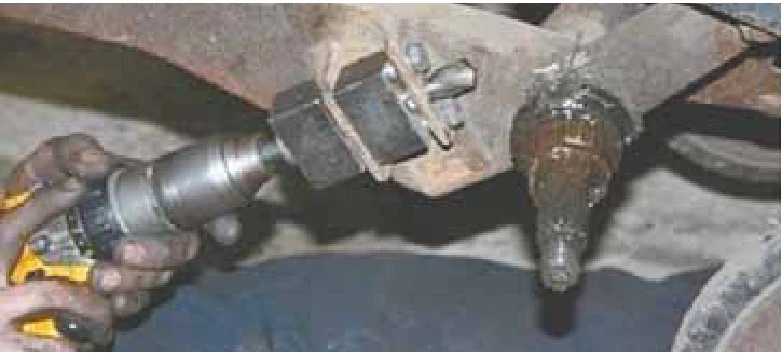
If poor stands are affecting yields in fields planted with Deere no-till drills, www.jddrillfix.com may have the answer. The company makes and markets repair kits that let you tighten up loose seed boot mounts. Over time, bolt holes in the cast iron mounts can wear from round to egg-shaped. Resulting excess play affects seed placement. Jddrillfix.com was started by a group of North Carolina farmers who noticed their Deere 750 drills were no longer producing desired stands. The cause was worn mounts and loose boots, so they bored out the worn holes and installed bushings that fit the new holes. The bushing’s inside diameter matches the boot mounting bolts. When neighbors heard about the repair, demand built, and the company was born. Repair kits and bushings have now been sold worldwide for all models of Deere single opener seed drills. According to jddrillfix.com, “We’ve not found a Deere drill that could not be repaired using our technique.” Available direct from jddrillfix.com, the kit includes drill bits and a drill fixture that gets installed between the ears of the cast mount. The kit also includes a driver for placing bushings as well as a hole hog, a fluted device for use with extra-worn holes. It is used to reduce burrs at the start and end of the drilling. The company emphasizes the care needed when drilling cast iron. Mistakes can result in the need to replace the entire arm. Instructions advise the use of a lower power drill with a clutch as bits have a tendency to catch and snag. Repair kits are priced at $295 with individual bushings priced at $12.50 each. They fit Deere 50 and 60/90 series drills. Contact: FARM SHOW Followup, jddrillfix.com, 865 Swamp Rd., Hertford, N.C. 27944 (ph 252 426-9676; [email protected]; www.jddrillfix.com).

From the archive · Full text
Feature story

Vintage Small Engine Parts Specialist

Featured source: Norman Ng

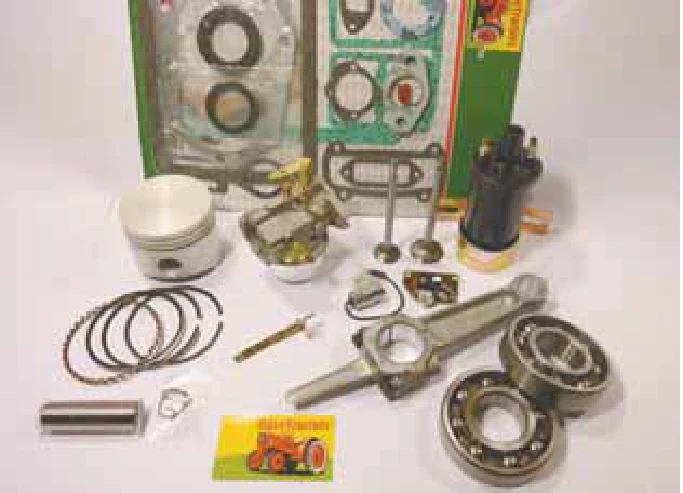
Small engine owners ordering parts from iSaveTractors know they are getting well-tested products. Company owner Norman Ng has used every product he sells in his own vintage small engines. He has more than 50 engines that he has rebuilt. Some power the collection of garden tractors he uses on his 8 acres.

“We use our machines daily in every weather condition, 365 days a year,” says Ng.

“Tested products have been worked hard.” He has restored about 15 garden tractors for his own collection and about 10 for customers. As the parts business has grown, the restoration sideline has been set aside. iSaveTractors was started when Ng couldn’t find parts for his first garden tractor restoration about 4 years ago. His then 2-year old son Lucas was born deaf and had just received cochlear implants.

“The restoration was a way to work with him to help him understand language,” says Ng.

“Some of his first words were engine part names.” He reports the project worked, and no one would know his son was born deaf from the way he talks. The project also opened Ng up to the frustrations of not finding parts for small Kohler engines. He began using his computer skills to reverse engineer and design hard-to-find parts and then find parts makers. Soon he was selling to other Kohler collectors and users.

“We are now shipping around 500 parts a month and expanding with a new office and parts warehouse,” says Ng.

“We ship throughout the U.S. and Canada, as well as to South Africa, Australia, the United Kingdom and more.” In addition to individual parts, he also assembles kits, such as a bundle pack to restore carburetor systems and an ignition pack.

“A new enthusiast may not know what all to replace, so we give them all the parts needed,” explains Ng. While he started with Kohler engines, he is now offering parts for older Wisconsin, Tecumseh, and Briggs & Strattons, some dating back to the 1950’s. Eventually he hopes to have parts for engines going back to the 1920’s and 30’s.

“We are committed to bringing rare parts back to the market,” says Ng.

“Every month we are reverse engineering and prototyping new parts. We’ve carried about 150 parts and just added another 100 this past month.” Several things make iSaveTractors unique. One is the on-farm testing of every product added to the list. Another is Ng’s projects that show up on You Tube. Many are very basic for less experienced mechanics.

“We did a multi-part series of videos on the transformation of an ordinary Cub Cadet 149 into a tractor loader/backhoe dually,” says Ng.

“We covered everything from where we got the plans to how we did it, the entire build process.” Ng’s website is loaded with how-to information from links to videos to articles explaining the anatomy of an ignition coil.

“In addition to developing parts, our mission is to also spread quality and easy-to-understand information relating to engine and tractor technology,” says Ng. As he expands the list of products he carries, Ng has need for more engines, not only for reverse engineering parts, but also for testing parts.

“We are always looking for old engines,” he says.

“The more rare, the better.” Contact: FARM SHOW Followup, iSave-Tractors, P.O. Box 214, Hollis Center, Maine 04042 (ph 207 298-9701; [email protected]; www.isavetractors.com).

From the archive · Full text
Feature story

Valve Maintenance Made Easier

Featured source: Ken Burtard

Ken Burtard of Therasa, Wis., recently sent FARM SHOW photos of a method he uses to put valves back into engine blocks.

“I buy a lot of used equipment at auctions and rummage sales, including machines equipped with air-cooled motors,” says Burtard.

“Quite often the valves lack compression so I have to fix them, but putting valves back into an air-cooled motor is quite a job. You have to hold the valve down with one hand and use your other hand with a screwdriver to try to put the springs and retainers back on, without much room to maneuver.” He says that before he rebuilds valves he first takes the motor apart to see if the pistons can move up or down.

“Often when I do this I’ll see there’s no clearance between the tappet and valve, so I remove the valve and grind a little off the end to increase the valve clearance anywhere from .015 to .025.

“As long as I’ve got the valves out I clean them on a wire wheel. I use a dremel cut-off wheel to grind a notch part way down into the center of the valve head. Then I use my 1/4-in. variable speed drill with a straight blade screwdriver to turn the valves to mate the valve end seats. I put a little coarse valve grinding compound on the valve faces. I then repeat the process but use a grinding compound with a finer grit.

“A few years ago I came up with a way to make the job easier. I drill a hole into one end of a short metal bar and insert a short 5/16-in. head bolt into the block. I notch out the other end of the bar to allow some play for various head bolt patterns on different motors. The bar goes across the valves to keep them from popping up as I put the springs and retainers back on.

“An even easier method is to place a large fender washer or 2 under a short bolt so that the washer extends across the valves. Contact: FARM SHOW Followup, Kenneth Burtard, W660 Co. Rd. DD, Theresa, Wis. 53091 (ph 920 251-2726; cell ph [email protected]).