Practical ideas from FARM SHOW MagazineSubscribe · Free issue · Send us your shop tip
Subscribe to FARM SHOW
Issues / Vol. 44, No. 4 (2020)

Vol. 44, No. 4 (2020)

Money-Saving Repairs & Maintenance Shortcuts · Printed section pp. 32–35

41 selected entries · Complete text of selected entries

This issue’s section includes reader tips and feature-length shop stories. Held items and editorial notices are not reproduced.

Archive text: prices, coupons, availability and contact details reflect the original publication, not current offers. Reader methods are not universal instructions; follow manufacturer guidance and proper safety practices.

Reader shop tips

From the archive · Full text
Reader shop tip 1 of 3

Ben Parks

Individual tip 1 of 3 from this reader’s published contribution.
Ben Parks, Austin, Texas

“When I did a mechanical restoration of my 1970 Jeep, the first thing I did was to replace the distributor points with a Pertronix ignition kit (www.pertronixbrands.com; ph 909-599-5955). I also installed a Pertronix ignitor coil. With the ignition slightly advanced, the jeep runs great and will start right up with the first turn of the key even after sitting for weeks in 20 degree weather. I recommend refitting ignition points in any older road vehicle, tractor or other machine with a gas engine.

From the archive · Full text
Reader shop tip 2 of 3

Ben Parks

Individual tip 2 of 3 from this reader’s published contribution.
Ben Parks, Austin, Texas

“I did have a problem with the jeep overheating when sitting still in traffic in hot weather. After upgrading the radiator, I looked around for a better cooling fan to replace the original 4-blade fan and found a Derale Performance 6-blade cooling fan. What a difference it made! The jeep runs cooler and will not overheat even in 100 degree weather (www.derale.com; ph 323-266-3850).

From the archive · Full text
Reader shop tip 3 of 3

Ben Parks

Individual tip 3 of 3 from this reader’s published contribution.
Ben Parks, Austin, Texas

“When the Jeep’s speedometer quit working, I sent it to Bob’s Speedometer to repair. They customized it with a voltmeter, repaired the fuel gauge, and recolored the face. Their service is expensive but worth the money and it looks great (www.bobsspeedometer.com; ph 800 592-9673).”

From the archive · Full text
Reader shop tip

David A. Crooks

David A. Crooks, Ottawa, Kan.

“I found a way to make diesel engines run better on low sulfur fuel. When refueling, I use a skinny funnel and small tube to mix in 2-cycle outboard motor oil at a ration of 200:1, or 6 oz. per 10 gal. It mixes readily in the tank and adds lubricity that was lost from the low sulphur content. The result is happy, smooth-running diesel engines.”

From the archive · Full text
Reader shop tip

Fritz Groszkruger

Fritz Groszkruger, Dumont, Iowa

“Our 2015 VW Golf TDI diesel has a feature that prevents you from making a mistake and putting gas into it. When we started storing diesel in a tank that used to hold gas, I had to find a way to fuel up the TDI. So I cut off a piece of an old BBQ axle, which fits into the fuel opening. Works just fine.”

From the archive · Full text
Reader shop tip

David Hansmeyer

David Hansmeyer, Gainsville, Texas

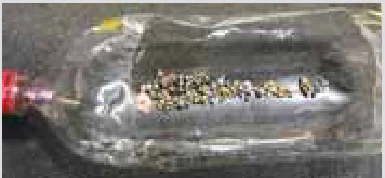
“Here’s a good way to sort nuts and bolts or other small parts. Take a 2-liter pop bottle and lay it on its side. Cut a large piece out of the top, being sure to leave at least 2 in. at each end. Cut the hole wide enough to get your hand in and leave the cap on. Pour the items in the bottle and pull out what you need. Then unscrew the cap and pour the small items back into the bottle or what you store them in. You won’t spill because it’s so easy to see what you’re doing.”

From the archive · Full text
Reader shop tip

Greg Balzer

Greg Balzer, Magnolia, Ill.

“To boost traction, I insert 1/2-in. #8 sheet metal into the drive wheels on self-propelled equipment, like lawn mower wheels and snowblowers. You can also use this idea on the steering wheels of small riding mowers and even on the soles of old work boots to use when it’s icy out in winter.”

From the archive · Full text
Reader shop tip

Don Klassen

Don Klassen, Harrisburg, S.Dak.

“Our garage door springs broke repeatedly until I added another pulley at the wall and put one in a yoke that the spring attaches to. Works like a block and tackle on each side. No more broken springs.”

From the archive · Full text
Reader shop tip

Bill Nadeau

Bill Nadeau, Warren, Maine

“I attached a receiver hitch to a post in my shop and mounted a large vise in it. I can also mount the vise in any other receiver.”

From the archive · Full text
Reader shop tip 1 of 2

Aaron M. Miller

Individual tip 1 of 2 from this reader’s published contribution.
Aaron M. Miller, Orwell, Ohio

“The recoil spring on one of our Honda engines broke at one end. To fix it, we heated it and bent it to match the angle of the old one. It lasted for 8 more years after that.

From the archive · Full text
Reader shop tip 2 of 2

Aaron M. Miller

Individual tip 2 of 2 from this reader’s published contribution.
Aaron M. Miller, Orwell, Ohio

“To keep grass from sticking under a mower deck, first clean the deck as well as you can. Then coat liberally with Fluid Film undercoating. Then heat with a propane torch so the film soaks into the rusted areas. Afterwards, grass washes off easily with a garden hose.”

From the archive · Full text
Reader shop tip

Joe Johnson

Joe Johnson, Meridian, Miss.

“I was working on a 3-cyl. Perkins diesel engine from a Massey Ferguson 150. I needed a way to keep debris from falling into the cylinder bores when cleaning the engine block surface for head gasket replacement.

“Everyone says to stuff rags into the bores but that’s not every effective. Instead, I decided to use coffee filters and grease. Rotate the crankshaft until all pistons are as far from top dead center as possible. Cut each filter (if necessary) so it will fit neatly into the bore without extending above the surface. Place a ring of grease around each bore and press the edges of the filters into the grease. After scraping and sanding the block, carefully remove each filter and wipe down the bores. No debris will have gotten into the cylinders.”

From the archive · Full text
Reader shop tip

Henry Yoder

Henry Yoder, Mt. Vernon, Mo.

“After I use a shovel, spade, digger, hoe or other digging tool, I clean it off thoroughly and then spray it with WD40. You can keep the cost down by buying a gallon of WD40 and using an inexpensive spray bottle to apply it. Keeps tools looking like new.”

From the archive · Full text
Reader shop tip

Bob Moty

Bob Moty, Crystal Lake, Ill.

“I bought several Kangas Flex-Lube grease hose assemblies about 20 years ago after reading about them in FARM SHOW. They were made by Roy Kangas in Dodgeville, Mich., and are among the handiest tools I’ve ever bought. It’s a simple grease hose that has a continuous swivel on the grease gun end and a compact angle coupler at the other. Great for reaching fittings in tight places and can handle up to 3,000 psi.

“Now when someone sees it on my grease gun, they want to know where to get one. But Roy quit selling them several years ago. I would like to see a manufacturer pick up on the idea and bring them back to market.”

From the archive · Full text
Reader shop tip

Fritz Groszkruger

Fritz Groszkruger, Dumont, Iowa

Zip ties can be used for lots of things. Fritz noticed this repair his neighbor made to a broken tarp strap. A tightly closed zip tie was placed over the broken ends and it works like new.

From the archive · Full text
Reader shop tip

Kenneth Lebold

Kenneth Lebold, Earlton, Ont.

“I find that an air chisel is the handiest tool in my toolbox. It can be used in so many ways, especially for freeing up rusted parts. Wouldn’t want to be without it.”

From the archive · Full text
Reader shop tip 1 of 2

Eugene Yoder

Individual tip 1 of 2 from this reader’s published contribution.
Eugene Yoder, Goshen, Ind.

“My diesel fuel tank is outside, so I wrapped the filter and fuel lines with batt insulation and now my filter doesn’t gel anymore in the winter.

From the archive · Full text
Reader shop tip 2 of 2

Eugene Yoder

Individual tip 2 of 2 from this reader’s published contribution.
Eugene Yoder, Goshen, Ind.

I also found it works well to use a portable pallet jack to lift a large walk-behind mower.”

From the archive · Full text
Reader shop tip

T. G. Skaggs

T. G. Skaggs, Campbellsville, Ky.

“If you have weak shocks that hold up trunk lids or car hoods you can take a piece of pvc slightly larger than the shock. I cut to fit the small end and install over the shock. When you open the shock, the pvc will fall into place and keep it from closing.”

From the archive · Full text
Reader shop tip

Kyle Sand

Kyle Sand, Clearwater, Minn.

“Some of my best, or most user-friendly, funnels for adding engine oil have been the quart or gallon plastic oil containers themselves with the bottoms cut out.”

From the archive · Full text
Reader shop tip

Jake Buit

Jake Buit, Marshall, Va.

“If you have a nut and a bolt that you never want to loosen, dip the bolt threads in battery acid and tighten the nut. It will not loosen.”

From the archive · Full text
Reader shop tip

James Nelson

James Nelson, Woodville, Wis.

James built his own “indestructible” work bench with a 30 in. x 7 ft. x 3/4 in. steel plate and, 36-in. long 4-in. square tube legs welded with bracing. He put an adjustable screw in the bottom of one leg so the table could be adjusted for uneven floors.

From the archive · Full text
Reader shop tip 1 of 2

Marvin Anderson

Individual tip 1 of 2 from this reader’s published contribution.
Marvin Anderson, Glyndon, Minn.

“My Harbor Freight sawzall wasn’t running right so I took it apart to find out why. The problem was the gearbox contained light-duty grease that looked like vasoline, allowing too much metal-to-metal contact between gears.

“I replaced the original gearbox grease with high quality wheel bearing grease, which solved the problem. Wheel bearing grease is very tacky so it clings to the gears in a gearbox, even when it’s operated at high speeds.

“I also replaced the grease in my angle grinder and cordless drill. It’s relatively easy to take these tools apart, as I just had to remove 4 screws on the angle grinder and 7 on the drill. With the new grease, these tools should last a long time.

From the archive · Full text
Reader shop tip 2 of 2

Marvin Anderson

Individual tip 2 of 2 from this reader’s published contribution.
Marvin Anderson, Glyndon, Minn.

“The valve lifters in my Ford Ranger’s engine were getting noisy so I added Schaeffer Moly E.P. engine oil treatment. It solved the problem (www.schaefferoil.com). This additive provides extreme pressure protection for an engine’s bearings, valve train, pistons and piston rings.”

From the archive · Full text
Reader shop tip 1 of 2

David Simpler

Individual tip 1 of 2 from this reader’s published contribution.
David Simpler, Elkton, Md.

“There are times when a conventional C-clamp can’t be used to hold an object in place, such as when you’re welding something on a flat surface. So I welded a large nut onto the clamp, then torqued the clamp to hold the piece of metal. I can screw a bolt through the nut to apply pressure from another point. If I want to use the clamp at an angle, I use a second nut to adjust the clamp to the desired angle.

From the archive · Full text
Reader shop tip 2 of 2

David Simpler

Individual tip 2 of 2 from this reader’s published contribution.
David Simpler, Elkton, Md.

“I bought a tire changer specially designed for riding mower and ATV tires, but it didn’t work very well so I came up with a way to use a masonry block hammer along with a 3-lb. hammer. It works great. I start with a 6-in. long, 5/8-in. dia. bolt, weld a piece of 3 by 3 by 1/4-in. thick plate onto the head, and then clamp the plate in my bench vise. I mount the tire on the bolt and tighten the nut (not shown), then use the 3-lb. hammer to hit the head end of the masonry hammer in order to break the bead.”

From the archive · Full text
Reader shop tip

David Pichler

David Pichler, Eau Claire, Wis.

“I made an adapter for my bottle jack that lets me use a chain with the jack to straighten out bent tools or equipment. The adapter holds the chain securely on top of the jack’s spindle, and consists of a small notched metal rod welded to a 1 1/2-in. long pipe that goes on over the spindle.

“I jack the spindle up about 1 1/2 in. and slip the pipe over it, then attach both ends of the chain to whatever I want to straighten. It keeps the chain from slipping off the spindle, which saves a lot of frustration. The same idea would work with any size bottle jack if you sized the adapter to fit the jack’s spindle.”

From the archive · Full text
Reader shop tip

John Matthews

John Matthews, Welland, Ontario

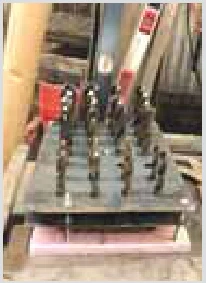
“My son David enjoys finding ways to organize tools in his shop. He made a holder for oversized (1/2-in. shank) drill bits by drilling through 2 sheets of 14-ga. plate that were welded together. He drilled 28 holes for the shanks that are 33/64-in. wide, ground off the welds, and used 1/4-in. all-thread to separate the plates and to serve as legs. There’s a layer of foam at the bottom for bits that don’t have a shoulder.”

Shop feature stories

From the archive · Full text
Feature story

Wall-Mounted Compressor Saves Space

Featured source: Matt Thoreson

“Forklift drivers in our seed warehouse haul boxes or pallets of seed without a lot of visibility in front of them, so we mounted our high-capacity air compressor 8 ft. off the floor in a corner of the building to keep the drivers and the equipment safe,” says Matt Thoreson of Kenyon Ag Service.

The 80-gal. Nitro compressor, which weighs more than 500 lbs., is bolted to the wood pallet it was shipped on and chained it to a heavy-duty metal frame made of reinforced angle iron. That frame is secured with lag bolts into the wall of the building. Extra support for the platform is provided by a 2 by 4 cross member underneath the frame and by two chains connected to large eye hooks on each side of the frame extending to a 2 by 8 ceiling truss.

Power for the compressor is hard-wired to an on/off switch near the building’s power panel. Air lines are routed to connectors near a large entry door and near the seed treating equipment.

Thoreson says the setup works great because their employees can use the air pressure to clean heavy equipment outside the entry door and the other line can be used to clean the treating equipment. Seed boxes or pallets can be stacked under the compressor to maximize storage space in the 75 by 160-ft. warehouse. Thoreson says the idea was a collective decision by everyone who works in the warehouse and was completed by the employees when the shed was built.

Contact: FARM SHOW Followup, Kenyon Ag Service, 550 Huseth St., Kenyon, Minn. 55946.

From the archive · Full text
Feature story

He Repairs Old Steering Cylinders

Featured source: Bob Hunter

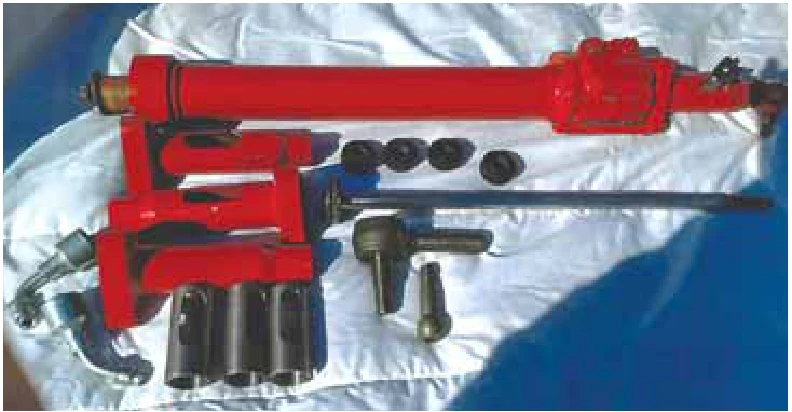
“People restoring or repairing tractors often run up against power steering cylinders that aren’t working and parts are difficult to find, so I’m able to help them out,” says Oklahoma shop owner Bob Hunter.

Hunter repairs steering cylinders and builds his own new replacement parts. He specializes in parts for Case 200, 300, 400, and 500 series tractors, Ford 700, 800 and 900 series tractors, and Long 360 tractors. Hunter has extensive experience producing new rods, pistons, seals and cylinders with his shop equipment.

Hunter says parts for older tractors may be available from dealers or salvage yards, but new replacement parts are expensive and those from a salvage yard may already have problems from inactivity and sitting outside in the weather.

“When I rebuild cylinders I repair or replace whatever is needed so the finished cylinder is as good as a new one,” Hunter says. Anyone interested in cylinder repairs should contact Hunter to discuss the cylinder problems they’re having and he’ll provide a rough cost estimate.

Contact: FARM SHOW Followup, Bob Hunter, Pioneer Hydraulics, 5807 E. Hayward Rd., Waukomis, Okla. 73773 (ph 580 603-0063; [email protected]).

From the archive · Full text
Feature story

1940 Deere Fitted With Power Steering

Featured source: John Bipes

When it turned 80, John Bipes gave his beloved 1940 John B tractor the gift of power steering. Bipes is just 4 years younger than his tractor and the two of them have been working buddies for decades. But after moving a lot of snow this past winter for a neighbor, which required a lot of hard cranking on the steering wheel, Bipes was left with aches and pains in his shoulders and arthritic joints. So he decided to find a way to add power steering to his old friend. The tractor’s hydraulics - 2 gal./min. @3000 psi – are enough to power an Eaton torque generator Bipes ordered off eBay (John added hydraulics to the tractor previously, as featured in Vol. 34, No. 1).

“It broke my heart to take a hacksaw to her on her birthday,” Bipes says of his tractor. But he cut out about 8 in. of the steering shaft to make room for the torque generator and shaft couplings. Fortunately the shaft and generator fittings were both 7/8-in. Bipes decided to use parts he had on hand - and make parts - rather than go to a hardware store during the coronavirus pandemic this spring. He had one coupling on hand and machined the other one from a piece of water pipe. He also machined a port plate and a couple other small parts. There was one problem when finished.

“When I put it together the torque generator would stick, making it jerky. I contacted the seller and he sent me a replacement right away. It’s velvet smooth,” Bipes says. He paid $275 for the torque generator (Eaton Part # 227-1051-002). The new power steering unit is placed in the existing Gresen 2515 dual control’s hydraulic return line. So, when operating the other hydraulic cylinders there’s no fluid for power steering but it works fine for the way the tractor is used. Because the Gresen’s relief is set at 3,000 psi for 3-pt. muscle power, Bipes phoned an Eaton engineer who recommended a limit of 1,000 psi. Bipes purchased a second relief valve ($40 from eBay) that is plumbed in parallel with the new torque generator and set to bypass at 1,000 psi. That diminishes potential damage to the new torque generator and the tractor’s steering sector gears. With help from his friend Mark, farm boy-turned-auto-mechanic, he finished the job and the steering system is now in top shape. With power steering, backing up equipment, lifting, loading and splitting logs for firewood (using other tools he made) is easier and there’s no pain afterward. Contact: FARM SHOW Follow-up, John Bipes, 906 Adams St., Mankato, Minn. 56001 (ph 507 387-3840; [email protected]).

From the archive · Full text
Feature story

Do-It-Yourself Commercial Hose

By By Jim Ruen, Contributing Editor
Featured source: Dramm

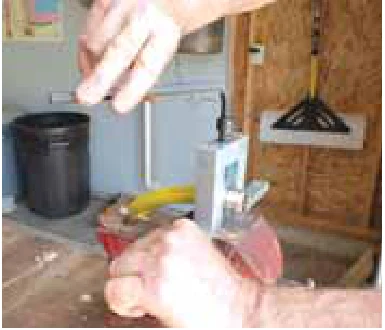
You can make commercial grade hose cut to the length you need with OEM-style crimped fittings. Dramm offers its commercial grade, abrasion and weather resistant, ColorStorm hose in up to a 330-ft. bulk reel. Cut the hose to length, then use the Dramm Hose Crimper Press to crimp Dramm fittings in place. No external clamps, screws or wires are needed. I recently tried out the Dramm system and it’s far superior to other DIY devices like Clamptite or the Clamper that use wire to clamp fittings into place. It’s also better than other commercial hose clamps I’ve tried. I’ve replaced fittings on dozens of hose ends over my 40-plus years of gardening. Most aftermarket fittings seldom fit as tight as claimed and never last as long as the OEM crimped fittings. The Dramm combination eliminates the frustration and comes as close to OEM quality as you can get. Dramm’s Professional ColorStorm hose is the heart of the system. Designed with greenhouse and professional growers in mind, the company reports sales of more than 20 million ft. It is made with ethylene propylene diene monomer (EPDM) rubber. EPDM is known for enhanced resistance to heat, light and ozone and can be formulated for high and low temperatures. ColorStorm has a maximum operating pressure of 130 psi and 500 psi burst strength. It can handle water up to 160°F and stays flexible to -24°F. The hexagonal shape reduces kinking, and the soft surface makes for a comfortable grip. The commercial grade hose is available in 50, 75 and 100-ft. lengths in addition to a 330-ft. bulk reel. Once hose is cut to length, ferrules slide over ends, and male and female fittings are pushed into place. The ends are then inserted into the Hose Crimper Press. The beauty of the design is in its simplicity, backed up by common sense engineering. The frame is designed to be bolted to a flat surface. I clamped mine in a small, bench-top vise. The crimper comes with an L-wrench for manual tightening. A bit for use with a power driver is included, but requires a driver with torque. Once the jaws meet, the ferrule has crimped the hose to the fitting. There is no question about over tightening or under tightening.

Switching from 5/8 to 3/4-in. hose and fittings is easy as well. Simply remove 2 set screws at the top of the frame, remove the frame top and slide out the jaws. Dramm’s nickel-plated brass male and female hose fittings, as well as splice fittings with matching ferrules, are sold in sets of 12. Gemplers is a Dramm dealer. They offer the 330-ft. length of 5/8-in. ColorStorm hose for $347.99. The crimper is priced at $106.99 and a set of jaws for $83.99. A 12 pack of 5/8-in. male fixtures is $63.99 and a set of females is $65.99. Matching ferrules are included.

The first-time cost would run about $2 a foot for commercial quality hose with OEM-style crimped fittings. Depending on the need for more fittings, hose costs quickly drop nearly in half. Dramm recommends using the crimper and fittings only on ColorStorm hose. But I tried using them on an older 5/8-in. hose purchased from a big box store. When put under 60 lbs. pressure, both male and female ends blew out. Contact: FARM SHOW Followup, Dramm Corp., 2000 N 18th St., Manitowoc, Wis. 54221 (ph 800 258-0848; www.dramm.com).

From the archive · Full text
Feature story

Custom-Built Replacement Cylinders

Featured source: Devon Petre

“I build replacement hydraulic cylinders for skid steers and sell them direct to customers for about 30 to 40 percent less than what they’d be paying at a dealer,” says Pennsylvania machinist Devon Petre.

“I use quality components that are primarily made in the USA and do all the machining, welding and assembly in-house.”

Petre started his business in 2017 after working at a hydraulic repair shop to gain experience.

“We have an understanding between us that I build custom-made cylinders and don’t compete with their shop for repairs,” Petre says.

“My specialty is aftermarket replacement cylinders for skid steers. Presently I have replacements for most Bobcat models and a few for Case. Not all the cylinders I have available are manufactured in-house. I’m working on getting all the specifications together to do that. The ones I buy are high quality units made in Europe. Eventually, I hope to manufacture most of what I sell in-house. I also sell seal kits for leaking cylinders for many popular brands of skid steeers, backhoes, excavators, etc. I can also build a specialty cylinder if I know all of the specifications.”

Petre says pricing for his cylinders is generally 1/2 to 2/3 the cost of OEM replacements. He cited as an example a Bobcat latch cylinder that he produces and sells for $385 that costs $625 at the dealer.

“Their products probably go through a couple different hands or companies that need to make some money, so that’s why they cost what they do. My cylinders go from me direct to the customer without any middleman.”

In addition to his machining and manufacturing background, Petre says he understands equipment because he was raised on a farm and worked with machinery from a young age.

“There’s definitely a benefit to growing up around equipment. I liked working on it when I was young and I enjoy doing what I’m doing now, making good products at a price that saves people money.”

Contact: FARM SHOW Followup, Devon Petre, Fairview Metalworks, 13911 Ditto Road, Mercersburg, Pa. 17236 (ph 240 707-8239).

From the archive · Full text
Feature story

Quilting Spray Handy In Shop, Too

By By Dee Goerge, Contributing Editor
Featured source: Dee Goerge

Keeping the sandpaper discs on orbital and other handheld sanders is frustrating when the hook and loop sanding pads start to wear out. Instead of buying a replacement pad, I found a solution in my quilting supplies - basting spray. It’s used to hold the backing, batting and tops of quilts in place while quilting them together. The adhesive holds well, but it’s also temporary. I spray it on the back of the sanding disc and stick it to the pad. When the disc wears out, it pulls off easily and completely. It only takes a little spray, so a can lasts a long time. Best of all, if there’s a quilter in the family you won’t’ have to buy any. You can just use hers, if she’ll let you. Just don’t touch her sewing shears. Contact: FARM SHOW Followup, Dee Goerge, [email protected].

From the archive · Full text
Feature story

Foam Pipe Insulation Keeps “Tire Slime” From Leaking

Featured source: Harry Tichavsky

Harry Tichavsky uses a tractor and brush shredder to maintain 30 acres in central Texas. With an abundance of mesquite and cactus, flat tires are a constant problem, especially on the tractor’s front tires.

“I wanted to use commercial tire slime as a puncture sealant, but it isn’t supposed to be used in tube tires because slime doesn’t seal as well around the wheel rim of a tube tire as it does with a tubeless tire,” says Tichavsky.

“I solved the problem by removing the tube and wrapping foam pipe insulation around both sides of the rim. Then I filled the tire with air, injected tire slime, and trimmed off any excess material from the foam pipe insulation.

“Problem solved - no more air leaked out around the rim,” says Tichavsky.

“The same idea should work with any size automotive, tractor, ATV or lawn mower tire. It also might help with tires that have damaged or rusted rims.” Contact: FARM SHOW Followup, Harry Tichavsky, 603 Prause Rd., China Spring, Texas 76633 (ph 254 723-3462; [email protected]).

From the archive · Full text
Feature story

Lubing Equipment Just Got Easier

Featured source: Jay Boren

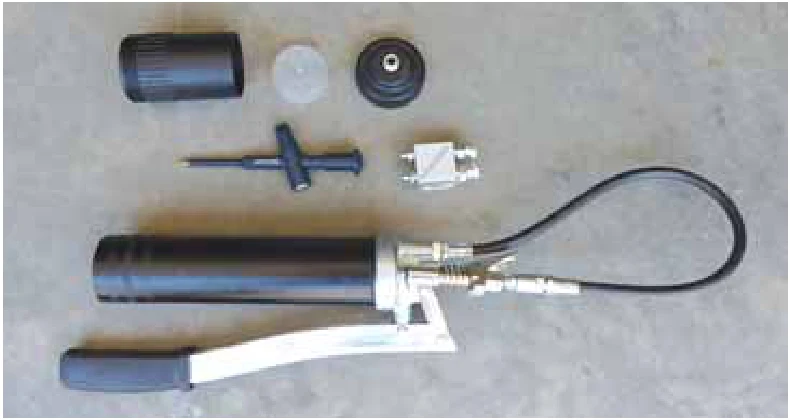
LockNLube introduced its grease coupler that locks onto zerks several years ago (Vol. 38, No. 3). Now it has introduced a new grease gun that eliminates the “follower” – the plunger that pushes grease out of the gun. LockNLube has also made it easier to relocate zerks and has introduced a mini-gun for precision lubrication without zerks.

“Our new Easy-Prime grease gun is a collaboration with Pressol, the German company that invented the press-the-bottom oil can in the early 1900’s,” says Jay Boren, LockNLube.

“It’s a lever action grease gun that has no follower, and never loses prime. It is lighter, more compact and doesn’t leak.” The new grease gun uses vacuum to move grease forward with a follower cap that moves up the cartridge. To use, you remove the pop-top from the grease cartridge, then remove the cap from the other end of the cartridge, and push a plastic follower cap into the tube and against the grease. You then thread the barrel into the pump head, and pump the lever to create the needed vacuum. Continued pumping pulls the grease and the follower cap up the tube. List price on the Easy-Prime Grease Gun with zerk lock is $94.99. LockNLube’s Magnetic Zerk Grease Relocation Block makes grease zerks more accessible. Simply replace up to 2 male zerks with female zerk fittings, attach high-pressure grease hoses, and run them to the machined aluminum block. The relocation block is priced at $34.99.

“The rare earth magnet on the block makes it easy to mount to your machine and it stays put,” says Boren.

“If used with a single fitting, and our 12-in. relocation kit, you’ll spend less than $50 to relocate a zerk.” A third new product from the company offers exacting lubrication for machining tools, impact and air tools, firearms, bikes, and home use. It is available with a needle tip or zerk tip and can be operated with one hand. The Lubrication/Injection Gun can be threaded to 9/16-in. grease tubes. Simply remove the cap and screw on the gun.

“The Lubrication/Injection Gun is designed for use with high value grease, but you can also use it with a standard grease cartridge,” says Boren.

“The machined brass tip lets you apply lubricant anywhere it is needed.” An adapter head and sleeve allow the gun to be used with bulk grease or with a threaded cartridge. It’s priced at $29.99. FARM SHOW had an opportunity to try out the new guns and check out the relocation block. All the equipment worked as described, definitely making lubrication a much easier job. Contact: FARM SHOW Followup, LockNLube, 21 Technology Drive #2, West Lebanon, N.H. 03784 (ph 603 795-2298; [email protected]; www.locknlube.com).

From the archive · Full text
Feature story

Built-From-Scratch Truck-Mounted Workbench

Featured source: Konnor Bjelland

Instead of bending over to work on equipment, 6-ft. 2-in. tall Konnor Bjelland built a big workbench on back of his service truck that stands more than 1 ft. taller than the small factory bumper it replaced. He built it by welding together 2 steel frames, one off a wrecked combine header and the other off a wrecked grain drill.

“It’s mounted on my 2012 Ford F-350 Super Duty 1-ton service truck,” says Bjelland, who farms and also works as a mechanic for a local Deere dealer.

“I looked at the workbenches on commercial service trucks and borrowed ideas as I went along.” One side of the truck is equipped with a big, electric-hydraulic crane that reaches out up to 20 ft.

“I use the crane at work to do field service chores, such as lifting final drive axles off sprayers and combines, and on my farm to lift water tanks and air compressors. The crane often would cause the truck to rock when lifting anything heavy, so I added outrigger jack stands to both ends of the workbench to help keep the truck stable. They fit into receiver hitches that I welded to both ends of the workbench.” An 8-in. vise is bolted to the workbench, and a small hinged door with a latch handle is built into both ends for storing tools. The workbench is as wide as the truck and measures 14 in. deep by 10 in. tall. Bjelland built it by cutting a 7 by 9-in. chunk of square tubing off the header frame and a length of 6-in. tubing off the drill frame, and then welding them together. The 7 by 9-in. tubing forms the back side of the workbench, and the 6-in. tubing forms the front side. A 3/8-in. thick steel plate was welded on top of both frames. To attach the workbench he welded short lengths of 3-in. square tubing on front of the workbench and welded them to factory brackets on the truck’s body. Contact: FARM SHOW Followup, Konnor Bjelland, 19517 Sollid Rd., Conrad, Mont. 59425 (ph 406 781-5011; [email protected]).

From the archive · Full text
Feature story

“Handee Clamp” Holds Small Parts

Featured source: Handee Clamp, LLC

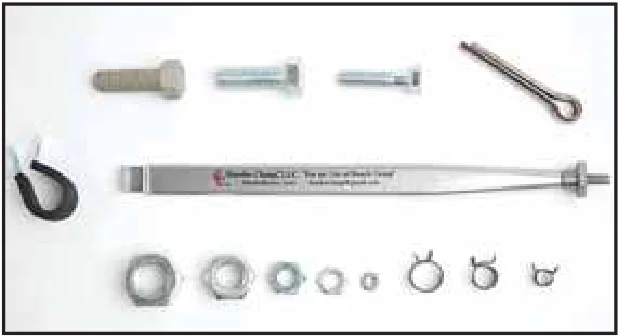
This new tool is designed to attach nuts, bolts or hose clamps in hard-to-reach places where your hands or other bulky tools can’t reach. The powder-coated Handee Clamp measures 10 in. long by 5/8 in. wide and comes with a sliding “jaw” on one end and an adjustable nut on the other end. The jaw opens to a little over 1 1/8 in. You slide the jaw out and place the nut, bolt or other part on it, then tighten the nut to lock the jaw in place. The jaw can handle bolts and nuts from 1/8 to 3/4 in. According to the company, the Handee Clamp works better than a needle nose pliers because there are no handles in the way as you reach into the tight space. Also, pliers require constant pressure which you don’t need to worry about with the Handee Clamp. Sells for $21.50 plus S&H. A zinc-coated model is also available and sells for $18.50 plus S&H. Contact: FARM SHOW Followup, Handee Clamp, LLC, 2826 Smith Ave., Marshalltown, Iowa 50158 (ph 641 485-3868; [email protected]; www.handeeclamp.com).

From the archive · Full text
Feature story

Company Offers High End Custom Machining

Featured source: Ezra Crawford

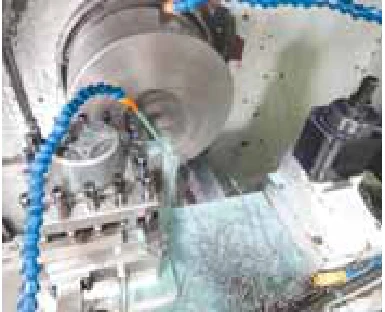
WM Machine started with manual milling in the corner of a barn, but today it features the latest computer-automated equipment and has regular customers in a 200-mile radius. Customers include local businesses and farmers needing a replacement part no longer available from the OEM, as well as prototype components for new equipment.

“Willie Fisher started small in 1989, but in the last 4 years we have moved into higher end machining,” says Ezra Crawford, WM Machine.

“We have the precision capability to make any customized part needed, from a replacement gear for a European tedder to prototype parts for the auto industry. We can do one-off pieces or work with a business looking for a high-volume production run.” Crawford says the highly technical job shop offers more than just machining capability. Staff can do reverse engineering on a part or help design a new part.

“We can provide advice for the design of a new machine and the parts to build it,” says Crawford.

“We don’t do fabrication. There are lots of shops to build the equipment. We want to be exceptionally good at the machining side.” While most customers are within 50 miles, Crawford is open to working at a greater distance. Prospective customers can request a quote by describing the part and uploading drawings of it to the company website.

“The farther away a customer is, the more challenging it is to get approval of a piece,” says Crawford.

“However, we have full internet access and our shop system works on software in the cloud. We can communicate via email or through other internet methods.” Contact: FARM SHOW Followup, WM Machine, 148-B Harristown Rd., Paradise, Penn. 17562 (ph 717 442-6344; [email protected]; www.wmmachining.com).