Practical ideas from FARM SHOW MagazineSubscribe · Free issue · Send us your shop tip
Subscribe to FARM SHOW
Issues / Vol. 48, No. 3 (2024)

Vol. 48, No. 3 (2024)

Money-Saving Repairs & Maintenance Shortcuts · Printed section pp. 32–35

44 selected entries · Complete text of selected entries

This issue’s section includes reader tips and feature-length shop stories. Held items and editorial notices are not reproduced.

Archive text: prices, coupons, availability and contact details reflect the original publication, not current offers. Reader methods are not universal instructions; follow manufacturer guidance and proper safety practices.

Reader shop tips

From the archive · Full text
Reader shop tip

Jim Seaton

Jim Seaton, Delavan, Ill.

“When you shut off a 1-cyl. engine, put it in the compression position by pulling the cable to where it’s hard. This puts it where both valves are closed so they won’t stick open if it has no spark. Stop the magnets on the flywheel and the shunt under the coil.”

From the archive · Full text
Reader shop tip

Eric Philippsen

Eric Philippsen, North Fort Myers, Fla.

“I use a ‘trickle charger’ on our 12-volt batteries. As a result, the machinery starts right away every time.”

From the archive · Full text
Reader shop tip

Dale Rogers

Dale Rogers, Mayfair, Sask.

“Welding up a shaft often causes it to warp. So, I put a low rpm motor at the end of the lathe and run a belt up to the main big pulley. This way, I can still use all the gear settings to adjust the rpm of the chuck. Then, while the mounted shaft is slowly turning, I use the MIG welder to build up the shaft. Then, while the shaft is cooling down, I continue to turn the shaft, so it doesn’t warp. After it’s well cooled, I can take the extra belt off and lathe it down to size.”

From the archive · Full text
Reader shop tip 1 of 4

Paul Scholand

Individual tip 1 of 4 from this reader’s published contribution.
Paul Scholand, Ypsilanti, Mich.

“I have a tractor with a front-end loader. The battery is just inside the front grill. If the loader isn’t in the raised position, it’s hard to connect a charger or jump pack to the side battery terminals because the hood is blocked from fully opening. I connected a charging block with cables and quick disconnects from a UPS to let me access the terminals with the hood down.

From the archive · Full text
Reader shop tip 2 of 4

Paul Scholand

Individual tip 2 of 4 from this reader’s published contribution.
Paul Scholand, Ypsilanti, Mich.

“A lawn mower deck can break at the side discharge opening. I’ve used a ratchet strap to pull the edges of the break together and use flat steel and self-tapper screws to hold it together. It’s quick and avoids breaking out the welder.

From the archive · Full text
Reader shop tip 3 of 4

Paul Scholand

Individual tip 3 of 4 from this reader’s published contribution.
Paul Scholand, Ypsilanti, Mich.

“I had taller trusses put into my garage ceiling and laid some angle iron across three to anchor an electrical lift. I can put heavy snowblowers and generators onto my roll-around worktable easily and safely.

From the archive · Full text
Reader shop tip 4 of 4

Paul Scholand

Individual tip 4 of 4 from this reader’s published contribution.
Paul Scholand, Ypsilanti, Mich.

“Before you shut down an air compressor and unhook the lines, use the air nozzle to blow the dirt off and out of your shoes.”

From the archive · Full text
Reader shop tip 1 of 3

Bill Kendall

Individual tip 1 of 3 from this reader’s published contribution.
Bill Kendall, Maryville, Tenn.

“I had a diesel fuel tank from a piece of equipment with rust inside. I added a couple of gallons of clean gravel with a gallon of white vinegar, tied it in my concrete mixer, and let it stir for about an hour. After removing it from the mixer, I gave it a good rinsing with clean water, let it dry, poured in a quart of sealer, and sloshed it around to cover all inner surfaces. I let it cure for a full day. I installed the tank, put in 15 gal. of diesel, changed the filters, and it runs great.

From the archive · Full text
Reader shop tip 2 of 3

Bill Kendall

Individual tip 2 of 3 from this reader’s published contribution.
Bill Kendall, Maryville, Tenn.

“John Deere asks $245 per tie rod end for my 3032E tractor. I found replacement ends by going to Auto Zone. It had a box of N.O.S. ends that weren’t marked. It took a little time, but with the store’s help and patience, we found both the left and right ends. Remember, one of them has left-hand threads. The next best thing was they came with Alemite grease fittings. The best thing was the $18.79 price tag per end. The manager couldn’t tell me what they fit. No part numbers. Life is good!

From the archive · Full text
Reader shop tip 3 of 3

Bill Kendall

Individual tip 3 of 3 from this reader’s published contribution.
Bill Kendall, Maryville, Tenn.

“I replaced the 8-ft. fluorescents in my shop with LED lights, reduced the amp draw and 13.9 amps per circuit to 4.8 amps per circuit. The luminosity is greatly improved, I can see much better in the work area, and the cold weather doesn’t affect the brightness as it did with fluorescents. Illumination is instant when you flip the switch, unlike fluorescents. The total cost was $427.90. The LEDs also have a much longer lifespan. My shop is 30 ft. by 60 ft. I found the LEDs on eBay.”

From the archive · Full text
Reader shop tip 1 of 2

Toby Haiste

Individual tip 1 of 2 from this reader’s published contribution.
Toby Haiste, Prince George, B.C.

“I needed to replace the upper hay roller bearings on a John Deere round baler without an overhead hoist. I fashioned an 8-ft. long square tube with a round bar to fit in the floor jack. It has a fork on the other end to cradle the roller. With a buddy’s help, I removed the roller to replace the bearings on the bench. You can save a lot of money by getting the bearing from a jobber, not Deere.

From the archive · Full text
Reader shop tip 2 of 2

Toby Haiste

Individual tip 2 of 2 from this reader’s published contribution.
Toby Haiste, Prince George, B.C.

“Also, getting a vehicle hoist made life in the shop so much better.”

From the archive · Full text
Reader shop tip 1 of 4

Barry Anderson

Individual tip 1 of 4 from this reader’s published contribution.
Barry Anderson, Granite Falls, Minn.

“I use rubber 12-qt. pails to replace pto shields. I add a hinge and can then do maintenance without removing the shield.

From the archive · Full text
Reader shop tip 2 of 4

Barry Anderson

Individual tip 2 of 4 from this reader’s published contribution.
Barry Anderson, Granite Falls, Minn.

“I mount tow hooks on frequently moved equipment so tie-down chains and straps can be quickly attached.

From the archive · Full text
Reader shop tip 3 of 4

Barry Anderson

Individual tip 3 of 4 from this reader’s published contribution.
Barry Anderson, Granite Falls, Minn.

“I tap holes from number 10 up to 5/8 in. when access to the nut is remote to the point of needing an extra person.

From the archive · Full text
Reader shop tip 4 of 4

Barry Anderson

Individual tip 4 of 4 from this reader’s published contribution.
Barry Anderson, Granite Falls, Minn.

“I’ve added a tool holder and a rotating hose reel to my portable air compressor.”

From the archive · Full text
Reader shop tip 1 of 2

Michael Halbirt

Individual tip 1 of 2 from this reader’s published contribution.
Michael Halbirt, Silverton, Ore.

“The best thread penetrating oil I’ve used is a 50/50 mix of acetone and automatic transmission fluid. I originally read about it in FARM SHOW and have used it ever since. The acetone evaporates pretty quickly, so you might need to keep adding it to the mix.

From the archive · Full text
Reader shop tip 2 of 2

Michael Halbirt

Individual tip 2 of 2 from this reader’s published contribution.
Michael Halbirt, Silverton, Ore.

“I have several Black & Decker and Sears power tools. They were designed to just plug an extension cord into the tool rather than having their own cord. But, as you’re using the tool, the extension cord falls out and the tool stops. I solved this problem by duct-taping a small ‘ball’ bungee cord to the extension cord. When you’re using the tool, you wrap the bungee cord around the tool and hook it with the ball. This holds the plug to the tool pretty well.”

From the archive · Full text
Reader shop tip 1 of 2

John Mathis

Individual tip 1 of 2 from this reader’s published contribution.
John Mathis, Smithland, Ky.

“John Deere’s disc mower has a bearing problem. The main drive bearings are enclosed in a housing. When the seals on these bearings fail and the grease dries up, the bearings fail completely. I drilled, tapped, and installed two zerk fittings and filled the cavity with grease. Now, even if the seal fails, the bearings still have grease.

From the archive · Full text
Reader shop tip 2 of 2

John Mathis

Individual tip 2 of 2 from this reader’s published contribution.
John Mathis, Smithland, Ky.

“I have a 100-ft. heavy-duty air hose that I use all the time. I keep it connected and coil it in a plastic 55-gal. drum. It’s easy to store and uncoils to its full length without problems.”

From the archive · Full text
Reader shop tip

Jim Corcoran

Jim Corcoran, Sagle, Idaho

“I’ve found the key to my shops is to organize everything. I add sticky tags to all my cabinets so I can quickly get anything I need for any job. It’s been a real time saver to me.”

From the archive · Full text
Reader shop tip

John Loder

John Loder, Redmond, Wash.

“My dad taught me years ago how to make this simple aid. Take a small plastic hand mirror and drill a small hole, about 1/4 in. When using a hand drill or hand tapping, the mirror will show if you get out-of-square.”

From the archive · Full text
Reader shop tip

Grant

Grant, Ilparpa, Australia

“When using my Cub Cadet ST 100 22-in. wheeled string trimmer, the cord breaks off regularly. Carrying enough extra cord was a problem. So, I cut a 500mm length of 50mm diameter Poly Pipe, capped the bottom end, and cable tied it to the bottom upright portion of the handle, with a cap on the top. I cut cord to length and store it in the Poly Pipe and don’t waste time walking back and forth for more cord. This isn’t really for big farm equipment, like tractors, but it’s definitely made our life easier maintaining our block. We’ve shared this idea with friends who do this now, too.”

From the archive · Full text
Reader shop tip

Roy Cowan

Roy Cowan, Edna, Texas

“I bought a large bottle of kids’ bubble soap at the dollar store and used a 50/50 mix in a spray bottle as a leak detector. Even the tiniest of leaks blow large bubbles that don’t dry as fast as soap. It works on any compressed gas system (tires, refrigeration, propane, oxygen) and costs almost nothing.”

From the archive · Full text
Reader shop tip

Larry Harrington

Larry Harrington, L & K Machine LLC, Western, Neb.

“The engine in a Cushman golf cart needed to be replaced. It was more economical to get a new engine than repair the old one. The new engine didn’t have a tapered crankshaft, and a crankshaft from a generator wasn’t the same taper. I bought an import engine and tapered the crankshaft to fit the Cushman pulley. I didn’t take the engine apart to taper the crankshaft. Instead, I took off the shroud and plug and put the whole engine into the lathe and machined the taper on the crankshaft.”

From the archive · Full text
Reader shop tip 1 of 2

Floyd Plank

Individual tip 1 of 2 from this reader’s published contribution.
Floyd Plank, Whitewater, Wis.

“I had a carburetor that was all gummed up after I put a gas stabilizer in the gas barrel. So, I took it apart as much as I could. I took it to the house, put it all in an old pot, added a quart of tomato juice, and cooked it for a half hour. (Hint: Don’t use your wife’s good cooking pots!) I went back to the shop and sprayed everything with ether while the parts were still extremely hot. Everything looked and worked like new.

From the archive · Full text
Reader shop tip 2 of 2

Floyd Plank

Individual tip 2 of 2 from this reader’s published contribution.
Floyd Plank, Whitewater, Wis.

“If power tool batteries go too low and don’t want to recharge, I take two electrical wires and bare the ends a little. I poke one end in on the plus and the other wire in the minus and then hook them up to a 12-volt car battery (plus to plus and negative to negative) and give them a boost for about half a minute. If it doesn’t work the first time, I give it another try for a little longer. It’s always worked for me.”

From the archive · Full text
Reader shop tip

Fready

Fready, Alexander, Iowa

“I recycle everything. Everything I have was someone else’s junk.

“I pull fans out of scrapped microwaves. They only use about 10 watts, not much more than an LED bulb. They’re the best little fans you could have.

“Most of the time, you just need to wash the plastic with window cleaner. I put USA Fluid on the metal and lube the shaft. Sometimes, one is worn or not working well, but that’s rare.

“They’re long-lasting and quiet. I have one I use on a small wood stove, and it runs perfectly for 24 hrs. a day, months on end. It barely picks up any dust and does a great job moving the heat around the room.”

From the archive · Full text
Reader shop tip 1 of 2

Gerald Ripps

Individual tip 1 of 2 from this reader’s published contribution.
Gerald Ripps, San Antonio, Texas

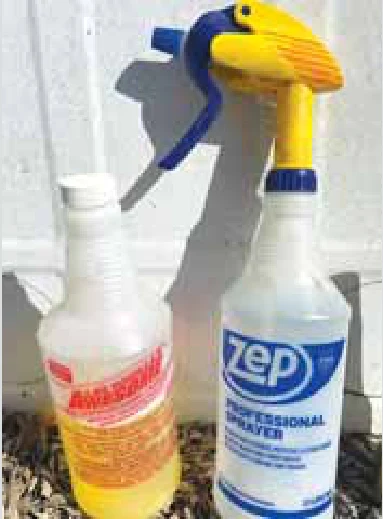
“I read online that Awesome from the dollar store is a good degreaser. I found that the ZEP spray bottle is almost identical and screws on.

From the archive · Full text
Reader shop tip 2 of 2

Gerald Ripps

Individual tip 2 of 2 from this reader’s published contribution.
Gerald Ripps, San Antonio, Texas

“The yellow cap spray oven cleaner from the dollar store cuts grease on the impossible, but it can also remove paint.”

From the archive · Full text
Reader shop tip

Steve Faber

Steve Faber, Tiffin, Ohio

In Vol. 48, No. 2, someone bought large safety pins to keep small parts from being lost in the sandblaster. This is a good idea. My dad showed me how to make safety pins from almost any wire. I make them in many different sizes for various purposes.”

Shop feature stories

From the archive · Full text
Feature story

Shop-Made Skid Steer Attachments

Featured source: Douglas Welding and Machine, Salina, Kan.

Douglas Welding and Machine (DWM) makes a post/tree puller like no other. They make a lot of unique skid steer attachments, 43 to be exact. In some cases, attachments are ones DWM owners Colby and his dad Leroy came up with. In other cases, a customer’s need drove the design. Either way, if it proves popular with customers, it becomes another product in their line of attachments.

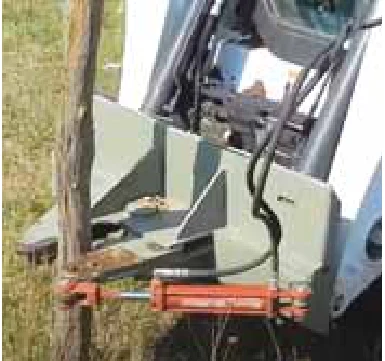
What makes the post-puller different from others is its jaws with sawtooth edges. The operator drives up to the post, and a hydraulic cylinder clamps the post between the jaws.

“When you raise the loader arms, it slides the post out, and you can drive over to the pile and drop it,” says Colby.

“It works with round or square wood posts, T-posts, and pipe posts. You can even use it to pull trees. It’s only limited by the lifting power of your skid steer.”

DWM made it even more versatile by adding a pipe to one arm. The pipe is sized to fit around a T-post and push it into the ground.

Other attachments are equally unique. They include a tree saw, stump grinder, and a combination attachment they call the grinder saw. It has a 1/2-in. by 30-in. dia. blade with five replaceable, 4-sided Quadco teeth on its perimeter, four on top, and 10 additional teeth on the bottom. As it cuts trees up to 6 in. in diameter, the teeth grind away at the wood. When finished cutting, simply lower the blade over the stump to grind it away.

“The grinder saw can cut even bigger trees by driving around them,” says Colby.

“With the rugged blade, you can cut the tree stem up to 3 in. below ground level.”

Colby and Leroy are quick to accept suggestions from customers. Colby recalls struggling with the design of their hydraulic-powered high-reach saw. The challenge was mounting a reservoir for saw chain/bar oil.

“A customer looked at it and suggested plumbing a line into the hydraulic line to feed a little oil to the chain,” says Colby.

“It worked, and the amount of oil used wasn’t a problem for the hydraulics.”

“We also make a 6-ft. wide, hydraulic motor-driven, rotary harrow. It’s great for finishing the ground surface around construction jobs, smoothing driveways and ruts, and fixing up arenas,” says Colby.

“It does a great job restoring packed driveways, bringing the rock back to the surface.”

In addition to skid steer attachments, DWM fabricates steel benches and worktables and does all types of custom fabrication, from food processing and packaging equipment to wheelchair ramps and even custom motorcycles.

Contact: FARM SHOW Followup, Douglas Welding & Machine, 116 W. Main St., Salina, Kan. 67401 (ph 785-536-4902; www.douglasweldingmachine.com).

From the archive · Full text
Feature story

Curved Welding Helmet Glass Offers Extra Benefits

Featured source: 3M, St. Paul, Minn.

Curved glass technology has long been a part of many industries and is now entering the welding trade.

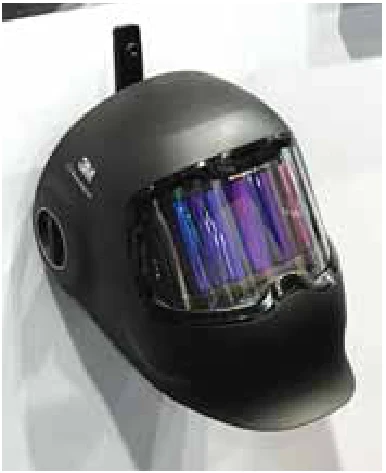
3M recently introduced the Speedglas G5-02 welding helmet featuring one of their newest innovations—a curved, auto-darkening welding filter following the shape of the head. This positioning also brings viewing more in line with the range of peripheral vision for high-performance, critical work.

“With the curved G5-02 auto-darkening filter (ADF), there are no compromises. A curved ADF means a significantly slimmer helmet positioned closer to your eyes,” says a 3M spokesperson in a recent promotion.

“With its wider field of view and auto-darkening feature, you’re better able to see what’s on either side during welding. It delivers great clarity, not only before and after, but during welding.”

The G5-02 helmet is TIG optimized but works well with most arc welding processes. Reflection and glare are reduced due to the narrowed shape, making working in tight spaces easier.

“The filter automatically turns on when you pick up the helmet, so it’s ready when you are,” 3M says.

Four arc detection sensors on the helmet ensure the filter reliably switches even in challenging applications.

The Speedglas G5-02 welding helmet is priced in the $860 range plus S&H and is available across North America.

Contact: FARM SHOW Followup, 3M Corporate Headquarters, 3M Center, St. Paul, Minn. 55144 (ph 888-364-3577; www.3m.com).

From the archive · Full text
Feature story

Moped Wheels Drive Shop-Built Bandsaw

Featured source: Tony Foale

Tony Foale has designed, machined, and built over 100 homemade parts and tools in the past 5 decades. Often, he uses spare metal from one job to fashion a tool or part for another, but a recent creation used two moped wheels he found at a flea market.

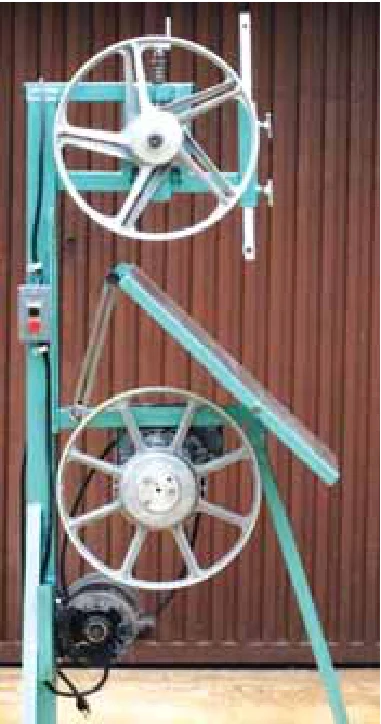
Foale says the 1-in. wide by 16-in. dia. wheels were perfect to run the 1/2-in. blade on his shop-built bandsaw. One was a front wheel with bearings and a brake, and the other was a rear wheel without bearings, just right for a single-sided mounting. Foale built the frame and tilting table for the saw from his inventory metal and mounted an electric motor to drive the blade.

Foale says he knew from experience making motorcycle wheels years ago that the original rim shape of the moped wheels would need to be modified. The slightly curved edges needed to be removed and the rim well in the center had to be filled completely so the surface was smooth. He used his 55-year-old Burgess bandsaw to cut off the outside curved portion of the rims. He smoothed the cut edges to create a true outer diameter, then used stripper to remove the old paint and bead blasting to remove metal residue. Minimal machining was needed to true the outer diameter.

Foale filled the center rim well with polyester car body filler, a product he says is easy to apply, adheres well to metal, and sets hard. He machined the filler smooth to the edges with a slight crown on the center, then glued a thin rubber belt made from the moped inner tube to the surface to provide traction for the blade.

Foale machined a triangular spacer to fit inside one of the wheel housings. The spacer and wheel bolt securely to the output flange of the bandsaw’s 25:1 gearbox. The idler wheel didn’t require a spacer.

No stranger to design and building, Foale taught himself machining and welding, using those skills on projects small and large. For 15 years, he owned a business that designed and built chassis for racing motorcycles, many of which won championships in several countries. He also worked for 3 years as Director of Advance Design for Segway. He’s written books on chassis design and authored technical articles on motorcycle and automobile handling.

Foale says he’ll use his bandsaw for cutting different types of sheet metal, aluminum, and some steel. His motor uses a compound reduction gearbox to slow the blade speed to less than a tenth of that required for cutting wood. The motor is mounted on a pivot so he can easily change speeds for cutting different metals.

Contact: FARM SHOW Followup, Tony Foale (www.motochassis.com).

From the archive · Full text
Feature story

Air Filter Pre-Cleaner Preserves Fuel

Featured source: Redekop Manufacturing, Saskatoon, Sask., Canada

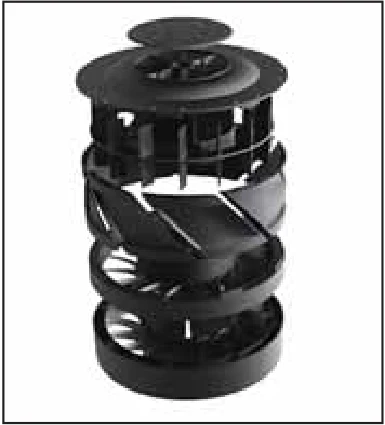
The Redekop KAS Intake Pre-Cleaner works to extend the life of air filters in farming and construction equipment by cleaning the air before it enters the engine. As a result, you’ll get easier filter maintenance over the long run and better engine performance with less downtime.

Redekop’s patent-pending design prevents contaminants from entering the engine’s intake system, improving filter efficiency. The KAS Intake Pre-Cleaners make it possible to run equipment all day without concern about replacement filters. It’s engineered for the ideal balance between airflow and particulate removal. This results in optimal engine performance and reductions in maintenance costs and downtime.

With the Pre-Cleaner, you get lower air restrictions for better fuel economy and performance. The Pre-Cleaner takes just 5 min. to install, allows for the highest particulate removal efficiency for an increase in filter life, and offers a drastic reduction in downtime and operating costs. Best of all, the filtration results in a lower overall carbon footprint.

Customer reviews show that the pre-cleaners are easy to install and work as promised. Many praised their ability to save significant money on fuel and maintenance costs. Pricing varies by model but averages $1,125.

Contact: FARM SHOW Followup, Redekop Manufacturing, PO Box 178A, RR #4 Hwy #16 West, Saskatoon, Sask., Canada S7K 3J7 (www.redekopmfg.com).

From the archive · Full text
Feature story

Using A Tote To Collect Used Oil

Featured source: 139 MFG, Elk Point, Alberta, Canada

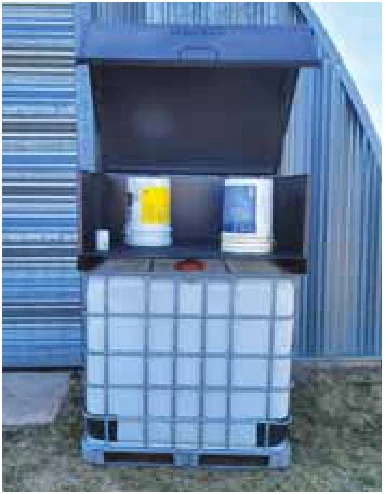
DrainMaster from 139 MFG helps keep your shop and tools clean by providing an all-in-one space for collecting oil and a convenient storage space for oil change equipment. While there are many models to choose from, each DrainMaster boasts a sleek design and durable construction. Each DrainMaster slopes down in the center so water will drain into the tote. Just place your filters and tools on top, and gravity will do the rest. Excess oil will drain through the grates and filter into the bucket you place directly under the spigot, putting the oil in a receptacle, which you can dispose of at your convenience. So, DrainMasters are an ideal setup for any shop that wants to contain mess while protecting the environment by preventing hazardous liquids from going down the drain or making it outside. The covers are also waterproof to prevent rain contamination. The DrainMaster Tote Elite weighs about 150 lbs. and top mounts on a 1,000-liter tote. It’s easy to open and close one-handed, thanks to two 80-lb gas shocks that assist with lifting and lowering. The Tote Elite’s heavy-duty grate allows for an angled gravity drain, and the large surface area offers ample space for filters, tools, and other equipment. The Tote Elite also has a hinged lid for outdoor use, ensuring you can keep out rain and other elements. Other models are suitable for use with barrels, top mounts on 1,000-liter totes, and simple drainage into buckets. Pricing ranges from $299 CAD ($220 USD) for the DrainMaster Barrel Pro to $1,499 CAD ($1,100 USD) for both the DrainMaster Tote Elite and Wheeler Elite. Customer reviews show that the DrainMaster is well worth the price in lube shops for keeping things clean and tidy. Contact: FARM SHOW Followup, 139 MFG, Elk Point, Alberta, Canada (ph 780-808-1429; [email protected]; www.139mfg.ca).

From the archive · Full text
Feature story

Company Makes Professional Tire Equipment

Featured source: Sandy Ochoa, Alamogordo, N.M.

TKO Solutions, LLC is a family business that specializes in innovative tools for changing tires. Founder Sandy Ochoa invented the Cheetah bead seater in the early ‘90s. Since then, the Cheetah has become so standard that the brand name no longer refers to a specific company’s product, similar to how tissues are called Kleenex.

“It’s so popular we don’t even use the name anymore,” he laughs.

“But everyone respects the product. We target quality and user-friendliness.”

A rural childhood influenced Ochoa’s career path.

“I grew up with agriculture but hated tires. That motivated me to invent easier ways to deal with them!” he says.

“And it worked. My granddaughter can’t weigh over a hundred pounds, but she’s taking tires on and off giant tractors with ease with our equipment. That’s a testament to how user-friendly it is,” he says. All TKO Solutions undergo rigorous testing and are built for dependability.

To date, TKO Solutions is one of few businesses that offer professional-built tire tools suitable for dealers, independent truckers, farmers, and ranchers. It provides top-of-the-line large bore coupler nipples and the next generation of bead seaters. Says Ochoa, “Everyone knows me in the tire industry. What I hear from people all the time is that ‘you guys are expensive, but you make really good equipment.’” In the early days, the company grew primarily by word of mouth.

“My trucker friends said our bead seaters and other equipment were too good, that I needed to market it. So, we set up at Las Vegas conventions and grew a loyal following that liked seeing all the new products getting released.”

Today, the company maintains a store in New Mexico while Ochoa’s son sells TKO Solution’s equipment through Canada and the western U.S.

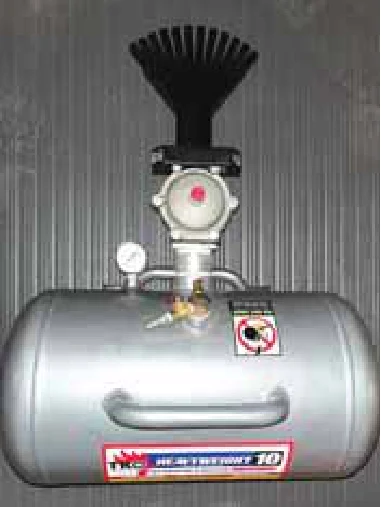
Though the product list is varied, the company sells some of the most powerful bead seaters on the market, including the Heavyweight 10. Its patented design features heavy gauge aluminum, and is ASME, and CE certified. The Heavyweight has a two-handle system for added safety and control. This eliminates the need to use two or three seaters on one tire. Better yet, it’s rated at 150 psi pop-off, well below certified testing levels. And, since it never touches the wheel, wheel damage isn’t a risk. The Heavyweight 10 is priced at $635, excluding sales tax. The company offers free shipping on orders over $50.

Contact: FARM SHOW Followup, TKO Solutions, 505 24th St., Alamogordo, N.M. 88310 (ph 575-439-1561; [email protected]; www.tkocorner.com).

From the archive · Full text
Feature story

Chain Oiler Offer Mess-Free Lubrication

Featured source: Ferrell McCollough and Brooke McCollough, Laurel, Md.

Ferrell McCollough, two-time motocross champion, invented the Oinker after years of frustration with the mess and inefficiency of traditional chain lubrication methods.

“Not knowing what would happen, he posted his prototype to Instagram,” says daughter and business partner Brooke McCollough.

“The response was overwhelming—within hours, his invention captivated the attention of the motorcycle community, amassing 30 million views.”

Today, the father-daughter duo runs the company.

“Our name, Oinker, originated during the development of the prototype,” McCollough explains.

“Printed on the product was the name “Oiler.” My mom looked at the tool and misread the name as Oinker. I agreed with the name. After all, a greased pig is hard to catch!”

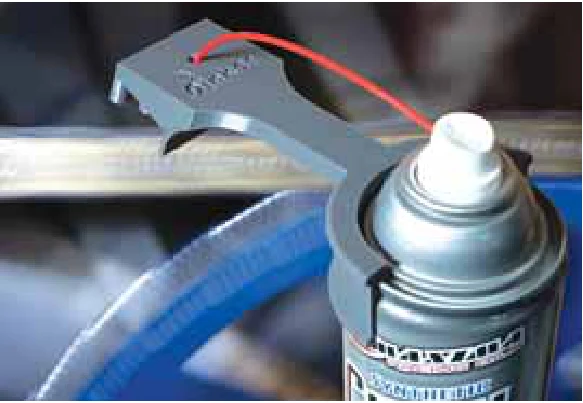
Each Oinker clips onto the appropriately sized aerosol can and comes with dual inlets for large and small straws. There’s a skirt that fits around the aerosol can to stabilize the Oinker as it rubs against the chain. Attaching the Oinker to the valve housing allows it to rotate while it rubs against the chain, resulting in proper chain lubrication without chain kinks, more responsive acceleration, and better handling.

“Unlike the traditional straw method, which often results in either over-oiling or under-oiling, Oinker guarantees the perfect lubrication every time, thanks to its precisely spaced exit holes tailored to the chain size,” explains McCollough. The tool minimizes the risk of over-spraying, wasting chain lube, or accidentally hitting critical components like the tires or brake rotors.

“Designed to accommodate a wide range of chain sizes (428, 520, 525, and 530), it’s perfect for ATVs, motorcycles, scooters, and side-by-sides used in agricultural settings, says McCollough.

“Farmers will appreciate the ease of maintenance and the reliability. We’re capable of manufacturing small runs that allow for custom solutions for double and triple-strand chains and leaf chains.”

Customer reviews indicated that the Oinker is high quality and performs precisely as advertised. Users report that the functional design saved them time and money on chain lube. While some mention that it doesn’t seem to snap in place on first use, adding pressure appears to solve the problem.

The Oinker is made in the USA and is patent-pending. A wide variety of styles are available, each retailing for $21.99. Current models can be found on the company website.

Contact: FARM SHOW Followup, Oinker Chain Oil, 8384 Sand Cherry Ln., Laurel, Md. (ph 240-909-6330; [email protected]; www.oinker.shop).

From the archive · Full text
Feature story

Slide-Out Toolboxes Open To Either Side

Featured source: Greg Hillman, Lincoln, Neb.

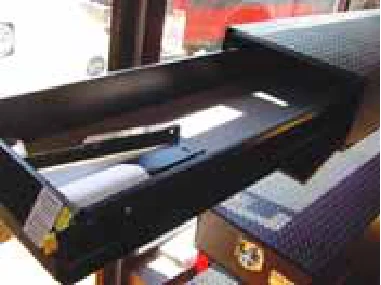
The Quick Draw Toolboxes are designed to let you skip jumping into the truck or onto the flatbed to grab the right tool. Instead of opening from the top like a traditional toolbox, these pull out from the sides.

“They pull out 60 percent from either side,” says Greg Hillman of Gary Gross Truck and Accessories in Lincoln, Neb.

“That means every tool in that box will be accessible from either side.”

The Quick Draw Toolboxes also come in different shapes and sizes for any application.

One example is an angled box for a flatbed so that round bales can fit right up next to it. There’s a square box so you can mount a welder or air compressor on it for a service truck.

If you need more room, there’s also a 9-in. extension box to bolt underneath for more storage.

If you don’t have a flatbed, there’s a Quick Draw toolbox designed for a regular pickup truck that sits up on the bed rails.

“They come in either steel or aluminum and are made here in the USA,” Hillman says.

Each toolbox will hold approximately 400 lbs. of tools evenly distributed throughout the toolbox.

“The doors are sealed so the tools will stay dry,” he says.

“They have a rubber gasket along the edges that help seal them.”

There’s also a triple-lock system on each end for safety.

The toolboxes have rubber mat floors and feature a powder-coat finish. They also come with accessories, including a bolt bin, 4-pack dividers, a half-tray, and a tool organizer.

Hillman says toolboxes range in price from $1,000 to $1,500, and anyone interested should call for more information.

Contact: FARM SHOW Followup, Greg Hillman, Gary Gross Truck and Accessories, 4000 Cornhusker Highway, Lincoln, Neb. 68504 (ph 402-466-5351; [email protected]; www.garygrosstrucks.com).

From the archive · Full text
Feature story

Cordless Welder Exceeds Expectations

Featured source: Aaron Denstad and Gary Denstad

By Jim Ruen, Contributing Editor

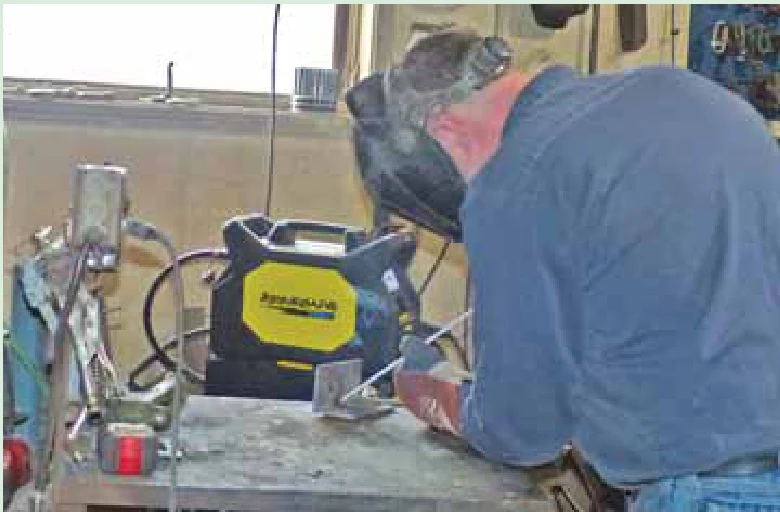
The introduction of the Renegade VOLT ES 200i cordless welder got FARM SHOW’s attention this past fall (Vol. 47, No. 6). When ESAB offered to lend us one to try out, we jumped at it.

Determined to get an expert opinion, we handed the welder and four 12Ah DeWalt batteries to Aaron Denstad and his dad, Gary. They’re professional fabricators with at least 80 years of welding experience between them. They know what it takes to make a good weld.

“I was a little skeptical of a battery-powered welder when I first heard about it,” says Aaron.

“After using it, I have to say it’s a pretty impressive little power unit.”

Aaron recognized the welding industry reputation behind the ESAB name, as well as DeWalt’s history in cordless tools.

“The fact that they had teamed up impressed me right away,” he says.

“Before you even turn it on, sit down and study the book,” says Gary.

“Get familiar with it, or you’ll likely be unhappy. We found the electronics much more sophisticated than any of our big welders.”

“The user interface is a little complicated, but the manual walks you through how to set it up,” says Aaron.

“It’s more complicated than a typical arc welder. The Renegade lets you pick out the electrode you want to use and select from a range of settings on the welder.”

He suggests this feature would be especially beneficial for less experienced welders.

“If you’re trying to figure out the process and get more confidence, it would be helpful,” says Aaron.

“Once you get started with the Renegade, you can fine-tune it. Getting the puddle right and not too active while still getting penetration is knowledge you have to glean from using it.”

Aaron and Gary worked with a variety of electrodes, including 7018s.

“They’re user-friendly and commonly found,” says Aaron.

“We got tuned to the welder, and the 7018s laid a pretty nice bead. It didn’t penetrate through the backside of 1/4-in. steel, but the pieces were not going to come apart when we finished the bead.”

Gary and Aaron spent about an hour welding various pieces of scrap and firming up their opinions of the welder.

“After about 20 min. of actual welding, the batteries still had a 25 percent charge,” says Aaron.

“If you were broken down in the field, this welder could get you out of trouble and back to the shop.”

He suggests that it could handle pieces thicker than a 1/4-in. with the aid of a cordless grinder to open up a V.

“You’ll likely need a grinder anyway, depending on the type of repair, just to clean out the edges,” he says.

“Once you have the V opened up, you could lay a root patch and then build it up.”

Field repairs are one reason Gary and Aaron recommend having a second set of batteries for the welder. They note that all four batteries must be at the same level of charge to operate the welder. Substituting one charged battery when the others have run down is not an option.

“If you’re remote and making a repair, the question will be, ‘Do I have enough battery power?” says Aaron.

“Maybe getting halfway done will be enough to limp home, but an extra set of batteries is a nice backup.”

An attractive feature of the welder is the ability to plug its power cord into a wall outlet. While the Denstads approved of the feature, they had a recommendation for ESAB.

“They need to make it possible to disconnect the cable,” says Aaron.

“When using the battery power, the cable is just in the way.”

Both the Denstads were impressed with the welder and feel it fits in farm shops in particular.

“The concept is good, and it definitely has a place for some folks,” says Gary.

“The welds we did were structurally sound, if not as pretty as with a wire feed.”

“If you’re looking to replace an older stick welder, or simply want a dual-purpose welder, the Renegade would be fine,” says Aaron.

“Plug it into the wall in the shop, or pop in the batteries and go remote.”

Contact: FARM SHOW Followup, ESAB Corporation, 909 Rose Ave., North Bethesda, Md. 20852 (ph 301-323-9099; [email protected]; www.esab.com).

From the archive · Full text
Feature story

Corrosion Cure Has Many Uses

Featured source: USAfluid.com, Alexander, Iowa

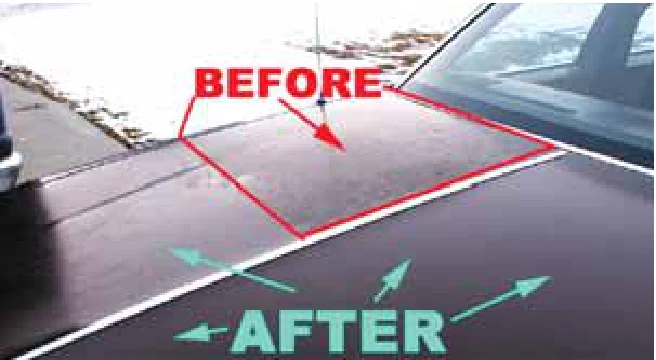
Unlimited Strong Arm (USA) Fluid was developed as a lubricant to prevent corrosion in high-voltage equipment. However, it’s since been used for waterproofing, rust removal, chrome cleaning, lubrication, paint undercoating, salt proofing, and much, much more. The company owner (he goes by the name Fready due to multiple identity thefts) was part of the team that developed it. After years of using and selling the product, he says he’s no longer surprised by customer testimonials.

“Acceptance evolved over time. People didn’t think you could take a lubricant and do anything else with it. As they tried it for other uses, they told us. Today, our website has 500 pages of unsolicited testimonials and thousands of before and after pictures from customers,” says Fready.

Visit the product use page and links to individual testimonials that start with freeing up a garden tractor motor, rusted and frozen for more than 40 years. Other stuck items posted include a waterlogged car transmission, small engines, bearings, and old tools. Testimonials cover the restoration of metal and vinyl surfaces, including rubber gaskets on old cars and wood and metal surfaces on old firearms.

Product claims made by the company and its customers include stopping rust in its tracks and preventing continued rusting, preventing corrosion on copper pipe subject to sweating, and providing superior adhesion and penetration of paint when used as an undercoat. Virtually every type of surface, including steel, chrome, brass, wood, and silver, is included.

Salt proofing with USA Fluid has its own website covering uses on equipment at the Bonneville Salt Flats. It includes testimonials, images, and a link to a salt proofing Facebook page.

“I work with lots of folks at Bonneville,” says Fready.

“Vehicles and trailers of all kinds get so coated with salt that they look like they’ve been in an ice storm. Within 6 mos., a chassis will fall apart. USA Fluid shuts down all the rust.”

USA Fluid offers a 100 percent, 30-day, money back guarantee. Purchase options range from quart bottles listed for $34.80 to 5-gal. pails for $428. Apply by spraying on with the nipple bottle or wiping and brushing on. In the case of rust removal, application is usually followed by using a wire brush.

Contact: FARM SHOW Followup, USAfluid.com, Central Order Fulfillment, Box 111, Alexander, Iowa 50420 (ph 641-745-9360; [email protected]; www.usafluid.com).

From the archive · Full text
Feature story

Truckers Stop The Sunburn With Sun Blocker

Featured source: Scott Catuzza, Buffalo, N.Y.

“Truckers tan” is common for people who spend a lot of time in trucks. It can lead to skin disorders, including cancer.

Scott Catuzza’s $70 Arm Rocker Sun Blocker is inexpensive insurance to avoid that. As a former trucker, he experienced the pain of a sunburned left arm that hurt every day he drove truck. His simple but well-tested and patented invention has the perfect curve and size with two thin posts that slip in between the glass and rubber stripping of the driver-side window.

“The angle and shape completely cover the arm no matter where the sun is,” Catuzza says.

“It doesn’t obstruct the view or block mirrors.”

He’s tested the Arm Rocker Sun Blocker with an open window, driving 75 mph to prove how well it stays in place. Tough enough to survive being driven over, the UV-resistant polypropylene will last through many miles on the road or hours in line at the elevator.

Manufactured in the U.S.A., Catuzza had his first run of 250 sun blockers pressed in August 2022 and debuted them in local truck shops. In March 2023, he introduced them at the Mid-America Trucking Show in Louisville, Ky. The response was overwhelming, says Catuzza, from truckers and Automann, a global distributor.

“It’s exciting to see this idea come to life and grow from a local idea to availability throughout the nation,” Catuzza says.

Besides being available at wholesale prices through Automann, he sells the sun blocker on his website in silver and black. Customers interested in large orders in other colors can contact him.

Catuzza notes that the Arm Rocker Sun Blocker also works in utility vans, pickups, and large SUVs. He doesn’t recommend them for cars as they could block the view.

Contact: FARM SHOW Followup, Arm Rocker Sun Blocker, Buffalo, N.Y. (www.truckerstan.com).