Practical ideas from FARM SHOW MagazineSubscribe · Free issue · Send us your shop tip
Subscribe to FARM SHOW
Issues / Vol. 31, No. 4 (2007)

Vol. 31, No. 4 (2007)

Money-Saving Repairs & Maintenance Shortcuts · Printed section pp. 36–39

28 selected entries · Complete text of selected entries

This issue’s section includes reader tips and feature-length shop stories. Held items and editorial notices are not reproduced.

Archive text: prices, coupons, availability and contact details reflect the original publication, not current offers. Reader methods are not universal instructions; follow manufacturer guidance and proper safety practices.

Reader shop tips

From the archive · Full text
Reader shop tip 1 of 2

Bob Aubrey

Individual tip 1 of 2 from this reader’s published contribution.
Bob Aubrey, Batavia, N.Y.

“The fuel line on my neighbor’s Geo Metro car leaked near the gas tank. To get at the line I had to first remove the tank. However, all the bolts that secured the tank were rusted tight and I couldn’t risk using a torch to remove them.

“To solve the problem I used an aerosol can of shaving cream as a seal, spreading the shaving cream all around the tank and into any grooves on it. Then I used a fine flame from a cutting torch, directing it away from the tank, to heat the bolt heads so that I could remove them. It was a relatively safe way to solve the problem and really worked well. I made certain there were no gas fumes around the tank before using the torch.

From the archive · Full text
Reader shop tip 2 of 2

Bob Aubrey

Individual tip 2 of 2 from this reader’s published contribution.
Bob Aubrey, Batavia, N.Y.

“I collect classic cars. To undercoat cars safely without rotting the rubber seals, I use a mixture of 95 percent vegetable oil and 5 percent Marvel Mystery oil in a Windex spray bottle. It really works great because I can squirt the mixture into small places. The Marvel Mystery oil isn’t harmful to rubber. It’s inexpensive and works better than using used oil to undercoat. It coats the surface and creeps into seams and small, fine areas where parts are bolted in place to keep water out. Also, it isn’t messy like the stuff used by undercoating shops. It takes only a half gallon of oil to treat an average car. It isn’t flammable so I can spray it any place under the car.”

From the archive · Full text
Reader shop tip

Elmer Pinkerton

Elmer Pinkerton, Elmwood, Neb.

“I bought an old oak library table at a sale and mounted wheels on it from old grocery carts. Then I attached a big sheet of 1/2-in. steel plate on top with a vise attached. It makes a great welding table. The only problem is that the table soon became so covered with junk that I’m never able to use it.”

From the archive · Full text
Reader shop tip 1 of 2

James McGowan

Individual tip 1 of 2 from this reader’s published contribution.
James McGowan, Russell Springs, Ky.

“All the seals at the bottom of the gearbox leaked on my Bush Hog bat wing mower. To solve the problem, I drilled a hole in the filler plug and then threaded it and screwed a zerk in. Now I can use a grease gun to fill it up. It has worked for 25 years.

From the archive · Full text
Reader shop tip 2 of 2

James McGowan

Individual tip 2 of 2 from this reader’s published contribution.
James McGowan, Russell Springs, Ky.

“I drilled holes in a cement floor and installed bolts in order to keep my ramps from sliding. Makes changing the oil a lot easier.”

From the archive · Full text
Reader shop tip

Duane Crandon

Duane Crandon, Lyons, N.Y.

“One of the common problems on International Harvester 06 series tractors is wear in the shift linkage joints. To solve the problem I lengthened the throw on the range shift lever, allowing it to compensate for wear and enabling it to reach reverse and high much more easily.”

From the archive · Full text
Reader shop tip

Pat Fenton

Pat Fenton, Richland Center, Wis.

“I had a problem with the guide shoes on my haybine wearing out prematurely. To stop the wear, I used plastic 55-gal. barrels to make my own shoe covers. I cut the barrels into pieces to fit over the shoes and drilled three 1/4-in. dia. holes in the shoes and the plastic pieces, then bolted them in place. The plastic shoe covers lasted three years. New shoes covers would have cost about $100 apiece.”

From the archive · Full text
Reader shop tip 1 of 2

Philip G. Lumley

Individual tip 1 of 2 from this reader’s published contribution.
Philip G. Lumley, Wilkesport, Ontario

“My Deere 1963 1010 30 hp tractor sat in the mud for so long that the wheels and tires were no longer any good. As a temporary solution I replaced them with the steel wheels off an old International Harvester H tractor. Fortunately, the wheels fit right onto the axle. I use the tractor to haul firewood out of the woods. The new wheels are bigger which somewhat reduces the tractor’s power, but they also increase its speed.

From the archive · Full text
Reader shop tip 2 of 2

Philip G. Lumley

Individual tip 2 of 2 from this reader’s published contribution.
Philip G. Lumley, Wilkesport, Ontario

“I didn’t want to risk climbing a ladder to clean the 30-ft. high chimney on our house so I built a chimney sweep that lets me clean the chimney by simply turning a crank at ground level. I installed a square metal frame over the top of the chimney with a small pulley fastened to it. A stainless steel cable runs from a spool attached to the crank and is attached to a 10-in. wide brush that has a 15-lb. weight attached to it. The crank extends through a small hole that I cut into the bottom of the chimney. When I turn the crank one way it winds the brush all the way to the top. Then I turn the crank the other way to let the brush back down. It takes 16 turns of the crank to completely clean out the chimney.

“Whenever I’m not using the brush it stays at the bottom of the chimney below the inlet where my stove pipe goes into the cleanout area.

“I used 2-in. angle iron to make the frame and set it right on top of the brick chimney. I use a pair of threaded rods, one on each side, to hold the frame tight to the brick.

“Now it’s an easy job to clean the chim-ney whenever I want. It takes only 5 or 10 minutes to clean it out.”

From the archive · Full text
Reader shop tip

Dale Denton

Dale Denton, Cowden, Ill.

Dale developed a method of rebuilding the wheel hubs on Deere 4020 tractors at a fraction of the cost of new ones. It’s all a case of precision matching of new holes with the original ones in the hubs. The problem happens because the threads go bad.

Denton uses 1/4 or 5/16-in. thick steel to build a template ring with holes that perfectly match up with the original holes in the hub. He makes the new holes between the original ones and then welds the template to the hub. He puts the template piece in a mill so that he can get a precise match - within 10 seconds of a degree. Then he’s ready to drill new holes. Once the new holes are drilled he grinds off the welds that hold the template.

New replacement hubs can cost about $350, but Denton says he can rebuild them for a lot less money.

From the archive · Full text
Reader shop tip

Royal Weber

Royal Weber, Nokomis, Ill.

Royal’s no dentist but he has quite a record at repairing teeth. He recently repaired the teeth on two huge vintage tractor wheels for auctioneer Kurt Aumann of Nokomis, Ill. Famous for his tractor auctions, Aumann decided to re-juvenate an ancient Big Four tractor. It has powerful, heavy wheels with open gears.

After years of use the teeth would wear down. Aumann decided to have Weber, an 83-year-old master welder, rebuild them.

Weber, who is called upon for all kinds of welding jobs, worked on the wheels as time allowed. He says it took 30 lbs. of welding rod and 30 hours of welding time on one wheel and 40 lbs. of rod and 40 hours of welding time on the other.

From the archive · Full text
Reader shop tip

Linden Alwardt

Linden Alwardt, Altamont, Ill.

Linden gets a lot of use out of an electric hacksaw that he made out of an old pump jack. The pump jack had been used for years on the family farm. He started by building an elongated metal platform on legs about 12 in. high, then mounted the pump jack at one end in its normal position for operating with vertical reciprocation, so the gears would run in oil. To switch from vertical reciprocation to horizontal he remounted the arms of the pump jack at right angles.

On the near side of the mechanism he built an elongated guide for the hacksaw out of a length of box steel. It allows a square rod to telescope forward and backward. Originally, the pump jack was powered by a pulley that was belt-driven off a gas engine. He replaced it with grooved pulleys and a V-belt powered by an electric motor. Now it’s a valued tool in his shop. He uses it to cut large pieces of steel for various equipment and appliances.

From the archive · Full text
Reader shop tip

Elmer Pinkerton

Elmer Pinkerton, Elmwood, Neb.

“In a recent issue Art Gomez of Scott City, Kansas, found a way to install a fuel pump on his V-8 engine. I’ve been a mechanic all my life and have come up with an easier way.

“Many V-8 engines have a fuel pump that doesn’t reach the camshaft so there’s a short shaft between. It often is slanted and will fall out, making assembly difficult. There’s usually a bolt in the front face of the engine that lines up with the shaft at a 90 degree angle. I remove that bolt and insert a longer, all-thread bolt that’s long enough to hold the shaft in place and keep it from falling out. Don’t forget to remove the long bolt and re-install the original bolt.”

From the archive · Full text
Reader shop tip

Dale Collins

Dale Collins, LeRoy, Mich.

“I kept bruis-ing my left arm because of the location of the gearshift lever on my Allis Chalmers WD tractor. I solved the problem by heating and bending the gearshift lever back toward the seat.”

From the archive · Full text
Reader shop tip

Marty Abfall

Marty Abfall, Ag Repower, LLC, 6030 Waterside Drive, Columbus, Ind. 47201 (ph 812 342-2421; [email protected]; www.agrepower.com)

Marty Abfall re-cently contacted FARM SHOW regarding his new diesel engine repower business.

“I started Ag Repower in 2006 and have purchased some of the conversion kits from Hunley Sales and Service. We also offer several new conversion kits.

“We purchased the Spra-Coupe engine conversion business from Hunley Sales and Service. In addition, we offer new replacement Cummins engines and Cummins Re-con remanufactured engines, as well as Cummins power units to meet stationary application needs. Conversion kits are available for Allis Chalmers, White, Oliver, Agco-Allis/Deutz Allis, Steiger, and Versatile tractors as well as Gleaner combines. Kits come with a two-year/2,000-hour new engine warranty with access to Cummins’ extensive parts and service network throughout North America.

“We can repower equipment ranging from 30 to 500 hp. Kits can be shipped direct to individuals for do-it-yourself installation. We can also do custom conversion kits.”

From the archive · Full text
Reader shop tip

Mel Primrose

Mel Primrose, Westlock, Alberta

Sometimes a good tool can be improved by the way it’s set up. Mel Primrose’s 14-in. metal chop saw is one example of this.

He mounted a bracket between two sec-tions of work bench. The bracket holds the saw so that it’s flush with the table.

“On the right side table, I mounted a wooden straight edge with an adjustable ruler on it (slide block) that I can adjust to cut different lengths, up to a maximum of 5 ft.,” he explains.

“On the left side, to guide the metal into the saw, I mounted a piece of aluminum angle iron to the table. If you want to cut up 20 pieces of metal to all the same length, you don’t have to guess. You just put them in and do it, and you know they’ll all be the same.”

Another nice feature of the setup is that the saw just sits in the bracket and Primrose can lift it out and take it to another location if he needs to.

From the archive · Full text
Reader shop tip

Steve Perkins

Steve Perkins, Hammondsport, N.Y.

Faced with cutting up an old IH TD9 bull-dozer for scrap because the motor was shot, Perkins decided to look for another option. He ended up installing a 1971 Pontiac 350 engine with a 3-speed transmission in the dozer.

“People told me it wouldn’t be big enough, but I figured a lot of diesel engines are under 100 hp and this one was over 300 hp,” re-calls Perkins.

“It works fine. The big car motor just has to idle. I don’t even touch the throttle.”

He did have to make some changes to the motor and transmission to get it to fit. He started by attaching a mid-70s Chevy 3-speed transmission. He then made and attached a flat plate on the back of the transmission to the Pontiac bell housing, cutting the tail shaft assembly off even with the plate. In place of the assembly, he mounted a chain sprocket.

He then mounted an identical sprocket on the front of the bulldozer transmission and butted the two together. A double roller chain on the two sprockets provides power transfer.

For hydraulic power, Perkins removed the harmonic balancer pulley from the Pontiac and replaced it with the hydraulic pump from the original IH motor.

“The toughest part was getting everything perfectly in line,” he says.

“I made my own motor mounts and did a lot of measuring.”

Perkins also made new exhaust manifolds out of 3-in. square tubing since the original Pontiac manifolds didn’t fit between the frame rails. He also installed a truck radiator with an electric fan, which saved him from having to connect pulleys and shafts to power it.

After six to seven years of use, the Pontiac “dozer” is still working well. Perkins uses it to move dirt, pull logs, fix driveways and even move snow after big storms. Not only does the engine seldom get above an idle, but the Chevy transmission never gets out of first gear.

“I just used the three speed to get enough power down low so the engine wouldn’t have to wind,” explains Perkins.

“I use the IH transmission for gear selection. It has never lacked for power.”

Shop feature stories

From the archive · Full text
Feature story

Replacement Tailgates For Older Pickups

Featured source: Bruce Horkey

If you have an older pickup, chances are your tailgate is pretty beaten up. That’s where Bruce Horkey comes in.

Horkey has 50 pickups in a “museum” yard that are used to fabricate perfect replacement parts.

“Our products blend current technology with the classic look of the past,” says Horkey.

“We offer parts for Ford, Chevrolet, and Dodge pickups. Complete pickup boxes are available for 1934 to 1978 Fords and Chevys, and we have quite a few box-related parts for Dodges.

“We specialize in products for pickup beds, including the ‘Show Deck’ which is a hardwood and stainless floor overlay in which metal skid strips alternate with wooden boards. The skid strip screws are attached to an aluminum subframe, eliminating the need to drill any holes in the bed. The design allows you to remove the Show Deck for hauling and everyday use.”

The rubber-padded, extruded aluminum subframe prevents scratches as well as allows proper air movement to ensure moisture control between the wood deck and pickup floor, says Horkey.

The decks are available finished or unfinished and are also available with steel, stainless steel or polished stainless steel hardware. A screwdriver and tape measure are all the tools needed to assemble the deck.

Price varies according to the type of wood, metal and finish.

Some other pickup restoration parts available include tailgates with embossed-brand name, stamped-logo, and no-name styles. Also front bed panels, box sides, subframe cross members, running boards/steps, wheel tubs, roll pans, gas tanks, grilles, front and rear bumpers, front and rear fenders, door shells, tonneau covers, and wood side racks.

New steel tailgates that are ready for paint are also available, as are tailgate chains, hinges, decals, and wood plaques.

Contact: FARM SHOW Followup, Bruce Horkey’s Wood and Parts, 46284 440th St., Windom, Minn. 56101 (ph 507 831-5625; fax 507 831-0280; bruce @horkeys woodandparts .com; www.horkeyswoodand parts.com).

From the archive · Full text
Feature story

Where To Find Sickle Parts (And More!)

Featured source: John Webb

Looking for cutterbar replacement parts? You don’t have to look any farther than Webb’s Sickle Service, Grand Island, Neb. John Webb carries parts for 20 different major manufacturers and 10 to 12 short line companies.

“We carry all the major wear components from stationary items to moving sickle components,” says Webb.

“A majority of parts are custom made, including sickles for horse drawn mowers. With enough lead time, we can make almost any component.”

Webb bought the business from a couple who started it in their barn. Today the company sells through dealers across the country, as well as direct from the company’s mail order catalog and over the internet. Sales methods aren’t all that has changed since the company was started in 1992.

“The biggest change in the industry is the decreased number of farmers, but the biggest change in equipment is the increased size of machines,” says Webb.

What hasn’t changed, he says, is quality of parts.

“We use cold rolled, high carbon steel on most components. We use the best grade we can. I believe parts should be hard and sharp.”

Webb says the best way to save money on sickle mowers is to adjust hold-downs to maintain the scissors action. That also helps keep cutting edges sharp longer and requires less horsepower.

Anybody who’s ever cut with a sicklebar knows what a hassle it is to sharpen section knives. Webb has an answer with his roll frame sickle sharpener. It lets the operator sharpen up to a 9-ft. sickle with just one setup. The sharpener attaches to the sickle, and the operator swings the sharpening stone over the knife to be sharpened.

Another time-saving tool offered by Webb is the sickle bolt tool for removing and re-placing section bolts while the guard remains in place.

Parts prices range from under a dollar to nearly $1,000 for the full size sickle bar sharpener. Reproduction work is priced by the piece, and all prices are subject to increases in steel prices.

“We get people sending us an old part they need reproduced,” says Webb.

“We can do it, but that work gets done fastest during the off season.”

Contact: FARM SHOW Followup, Webb’s Sickle Service, Inc., 204 South Claude Road, Grand Island, Neb. 68803 (ph 308 381-7090; toll free 800 578-1480; fax 308 398-1966; john @sickleservice.com; www.sickle service.com).

From the archive · Full text
Feature story

Fuel Shut-Off Switch For 4-Cycle Engines

Featured source: Hans Hawn

Leaving the fuel lever in the “on” position on a 4-cycle recoil engine during transport can let fuel seep into the crankcase, which may greatly reduce engine life. This patented new fuel shut-off kit automatically turns off the fuel for you.

“It solves a common problem for anyone who uses 4-cycle engines on power washers, pumps, generators, welders, compressors, etc.,” says inventor Mike Hanshaw.

“The problem happens when the operator completes a job and is in a hurry to get somewhere else. He shuts the engine down using the factory shut-off switch on the engine, but doesn’t bother to slide the fuel lever over that’s designed to ground the ignition and shut off the flow of fuel from the carburetor. So the fuel lever remains in the ‘on’ position when he loads the engine on a trailer and goes bouncing down the highway, allowing fuel to enter the engine crankcase. When he un-loads the engine he often finds that it won’t start. The contaminated oil can even ruin an engine.”

He says the problem is particularly troublesome on Honda GX series engines since they’re used on many different types of equipment.

The fuel shut-off system consists of a switch that forces the operator to turn the fuel off in order to kill the engine.

To install the kit, you unscrew a shroud that surrounds the fuel lever, drill a hole where you want the switch, then screw the switch into place and re-install the shroud.

Installation takes about a half hour, “but once you know what you’re doing it’s only a 10-minute job, says Hanshaw.

“My kit isn’t needed for every 4-cycle engine, because some of them come with a factory auxiliary shut-off switch or some other kind of additional safety switch.”

Sells for $29.99 plus $8.95 S&H. Contact: FARM SHOW Followup, Hanshaw Enterprise, LLC, 109 Heather Lane, Springville, Iowa 52336 ph 319 981-8171; [email protected]; www.fueloff.com).

From the archive · Full text
Feature story

Where To Buy “Orchard Tractor” Parts

Featured source: John Craig

Collectors of Deere Orchard tractors will have an easier time restoring their tractors to original condition if they work with John Craig. As co-owner of Craig Welding in Mentone, Indiana, and a collector of Deere tractors himself, he hadn’t thought about making parts for others until a Michigan collector convinced him many other collectors would be interested in reproduction parts.

“He told me there are a lot of tractors sitting in people’s barns just waiting for metal,” Craig says.

“There has been surprisingly good demand.” He’s been selling reproduction orchard metal parts for about three years.

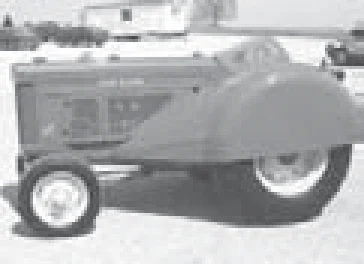
Customers tell Craig that without the orchard metal, their tractors are ordinary utility tractors. Orchard tractors were designed to protect hanging limbs and fruit, by using large metal shields to brush them aside. They were used in orchards all over the country, for oranges in Florida, cherries orchards in Michigan, and pecans in Arkansas, for example. When orchards started trimming lower branches to make it easier for workers and equipment, the orchard tractor was no longer needed.

The orchard metal is often damaged or missing, Craig explains, because it was removed to change a tire and not put back on.

Working with original blueprints and using the cold-rolled sheet metal as used on the original orchard tractors, Craig makes exact replicas selling individual parts or complete sets.

When Craig attends tractor shows he takes his own orchard tractor plus the primed orchard metal pieces. He’s working on restoring an orchard disc to show younger people what type work the Orchard tractor did.

Customers often arrange to pick up orchard metal parts at shows, or they can be sent by freight. The whole unit weighs 350 to 400 lbs.

Contact: FARM SHOW Followup, John Craig, Craig Welding Mfg., Inc., 5158 North 825 East, Mentone, Indiana 46539 (ph 574 353-7912; 800 863-6584; [email protected]; www.craigwelding.com/orchard).

From the archive · Full text
Feature story

Idler Pulley Repair Saves Farmers $640

Featured source: Dale Denton

Dale Denton, Cowden, Ill., is a retired machinist with a well-equipped country shop. He has a reputation for being able to rebuild expensive farm equipment parts for a lot less than new. One of his most cost-effective re-pairs is the way he rebuilds the main idler pulley on older New Holland combines. New pulleys cost about $700 but he rebuilds the old ones for only about $60.

Denton bores out the old pulley and puts in a new sleeve so he can install the original size bearing.

Contact: FARM SHOW Followup, Dale Denton, RR 1, P.O. Box 168, Cowden, Ill. 62422 (ph 217 783-6530).

From the archive · Full text
Feature story

Bump Shocks Protect “Hard-Use” Pickups

Featured source: Light Racing

Light Racing’s new JounceShock is a patent pending new form of air shock that’s never before been available to the public in bolt-on kit form. The technology originated from desert racing and has now been adapted for everyday full-size pickups.

Also referred to as secondary suspension, or a bump shock, it has the ability to dissipate extra-hard jolts, saving a vehicle’s suspension.

The system is made for trucks that have not had their ride height altered. It’s compatible with ’01 and newer GM 1/2-ton pickups, the new Toyota FJ, 4Runner and Tacoma (full bolt-on kits), the new F150 (rear package only) and 3/4-ton GM pickups (some drilling and welding required). The company also has complete packages for several Jeep, Nissan and other Ford models.

Because it’s “nitrogen charged,” the JounceShock adds additional compression damping and controlled rebound to the vehicle’s system. This translates into keeping the tires on the ground in rough terrain, even at higher speeds.

The small cylinders convert mechanical energy into heat when the shock’s piston compresses a cavity of nitrogen, quickly changing the would-be violent energy into heat and reducing the harshness of the impact. This softens a landing that would normally destroy the bumpstops of any stock suspension.

“JouceShock’s main advantages are that it eliminates suspension bottoming, increases stability, improves handling at all speeds, enhances rock crawling ability and improves towing stability and load capacity,” says Jeff Hargash of Light Racing.

“Also, because of its compact size, which comes in 1.5-in. and 3-in. travel units, it can be utilized in limited spaces. It’s externally adjustable for compression and rebound, and has various threaded end mounts that reduce fabrication and installation time for a custom build.”

The product has almost no effect on a vehicle’s ground clearance.

Complete JounceShock systems with all the bracketry, retail for between $1,300 and $1,500 plus S&H. Each components is also available separately.

Contact: FARM SHOW Followup, Light Racing, 4045 Specialty Place, Longmont, Colo. 80501 (ph 800 525-6505; jhargash @specprod.com; www.lightracing.com).

From the archive · Full text
Feature story

Air Filter Makes Diesels Run Smooth

Featured source: Charles Ekstam

Rough idling, lost torque at high rpm’s, and hard starting are common results of getting air in diesel fuel, says Charles Ekstam. To get the air out, he developed the Air Dog system for large and small diesels, including pickups and diesel tractors.

While other filtration systems remove water and contaminates, Ekstam says air re-moval is vital.

“When fuel sloshes around in the tank, it mixes with air,” explains Ekstam.

“Air gets in the fuel filter and creates a void. When you start up, it has to be pumped through, and that creates white smoke and makes the engine hard to start.”

The problem doesn’t end there. Pump cavi-tation is caused when the fuel pump creates a vacuum in the tank. Atmospheric pressure drives air into the pump and into the fuel. The air vapor in the operating engine delays compression and retards timing, creating black smoke when the engine starts to pull.

Ekstam’s solution is to pull the air out of the fuel, cycling it back to the tank so positive pressure is maintained in the tank, eliminating cavitation. The PureFlow system also maintains positive fuel flow pressure on the transfer pump so the engine is always provided with needed fuel. Excess fuel, like the air, cycles back to the tank.

“It lets diesel engines run at maximum efficiency,” says Ekstam.

“It’s like a constant tune-up on the engine. A side benefit is that they burn much cleaner.”

The system also takes water and particu-lates out of the fuel. Ekstam says the latest version has 2-micron filters. That is especially important with diesel engines that sit for extended periods between firing, such as combines, high horsepower tractors used for tillage and semi tractors used mainly at harvest.

“As diesel fuel degrades and ages, it forms insoluble gums 0.5 to 1.5 microns in size,” explains Ekstam.

“When you get water in the fuel, these gums will bind in clumps of up to 130 microns and plug a standard fuel filter. The trick is to keep the water out before you start the engine.”

“You can put a switch on the line to run the filter without starting the engine and even put it on a timer to cycle fuel on a regular basis,” says Ekstam.

“It makes starting after sitting for 6 months like you just shut it off.”

The system is easy to install, especially on single fuel tank trucks. The AirDog is only 3 in. wide by 7 in. long by 10 in. high and simply bolts in place. Installation is made on the fuel line between the tank and the transfer pump. The wiring harness includes a line to the fuel solenoid on the pump and an indicator light on the dash that tells when to change the filter.

“I have seen late 1980’s diesels burn as clean as today’s emission-controlled diesels,” says Ekstam.

“When you drive a diesel with one of these, it is completely different from before it was installed. One firm has had them on 30 trucks for 7 years and only lost three injectors.”

Ekstam also produces large units for bigger diesels. He built his first unit in 1993 and got into production in 1996. He says the company has foundered due to personal health problems and licensing it to two different companies in the intervening years. With his health restored, he has regrouped and is expanding from trucking and bus fleet markets to the smaller diesel market.

The AirDog is priced at $639. Larger models for the biggest diesels cost more.

Contact: FARM SHOW Followup, PureFlow Technologies, Inc., 5400 Business 50 W, Suite 8, Jefferson City, Mo. 65109 (ph 573 635-0555; toll free 877 463-4373; fax 573 635-0778; www.pureflowtechnologies.com).

From the archive · Full text
Feature story

Quick-Tach Tools For Farmer’s Prosthetic Arm

Featured source: Matt Biel

When Matt Biel of Dickinson, N. Dak., lost his lower right arm in a tragic 2006 auger accident, the prosthetic arm he got was of the “plain Jane” variety. It didn’t give him any fine motor skills, making it very difficult to grasp things such as tools.

But Biel wanted to continue farming with his dad, so he acted on an idea he’d been given by the sales rep who sold him the arm.

First, he cut the handles off a hammer, ratchet, vice grip and crescent wrench, and then welded a bolt onto each one. Next, Biel bought four special adapters from the salesman, and threaded them onto the bolt on each of the four tools. Now, he can connect which-ever tool he needs directly to the arm for much better ease of use.

“The modifications make each tool like a quick-tach that pushes into the prosthetic, and locks in,” he explains.

“All I have to do is press a release button, and they come off.”

Because Biel’s vice grip was the type that self-adjusts its size, he was able to weld the bolt where the adjusting screw would have been.

Thanks to the simple tool modifications, this young farmer says he can still do most everything he did around the farm before his accident. Tasks just take a bit longer.

“These tools allow me to have better fine motor skills than with the prosthetic alone,” he says.

On equipment such as the swather and combine, the family made modifications to convert hand-operated controls to foot ped-als or buttons. Biel does the majority of the seeding and spraying on the 2,000-acre farm.

The adapters were priced at close to $50 each; however, Rehabilitation Consulting Service covered the entire cost for Biel.

Contact: FARM SHOW Followup, Matt Biel, 480 Jade St., Dickinson, N. Dak. 58601 (ph 701 483-4321; matt_biel @nd supernet.com).

From the archive · Full text
Feature story

“All Portable” Farm Workshop

Featured source: Ben Hach

Ben Hach, Dysart, Iowa, recently sent FARM SHOW photos of how he puts all of his shop tools, storage racks, and work tables on metal stands. They’re designed so he can use a pallet jack to move them around.

“The only tool inside my shop that’s bolted to the floor is the air compressor,” says Hach.

“All the other tools, work benches, and racks are easily moveable with a pallet jack.

“This system works great because it lets me move my tools wherever I need them. It also makes it easier to keep the entire building clean, as I can simply move everything out of the way to sweep the floor.”

Here’s what he came up with: Hach’s nut and bolt rack and many other items. Made from 2-in. rectangular tubing and with bolted-on plywood shelves, it measures 8 ft. long by 32 in. wide by 53 in. high. 30 in. wide by 30 in. high and has a 6-ft. high pegboard on both sides.

“I park the rack 2 ft. away from the shop wall so I have access to the tools on back. I get a lot more storage use that way.” by 36 in. wide by 25 in. high. The top is made from 1/2-in. thick steel bought at a salvage yard.

“Works great for welding and many other jobs,” says Hach.

“A lot of times I roll it over to whatever I’m working on, such as a tractor or combine cab, and stand on it. It works nice when I’m tearing something apart, because as I take the parts off I can set them on the table surface. Also, it’s low enough that I can sit down in a chair to do all my welding. I built it low because I have a nerve disorder that causes a lot of pain in my feet and legs so I do a lot of sitting.” • Vice table.

“I bought this table at an auction and mounted my vice on it. The table had been used by a family blacksmith shop. I added two steel tubes to make it work with my pallet jack.” • Oil storage rack. It consists of a storage table and a pair of metal “pallets” that each hold a 55-gal. plastic barrel. One barrel holds transmission oil and the other holds diesel engine oil.

“When more oil is needed I can lift off the drums with my skid steer loader and put them in back of my pickup so that I can have them refilled by my bulk oil dealer. Each barrel sets on just three pieces of steel tubing. I recommend anyone who uses plastic barrels to make a full cradle under the bottom side of the barrel, as I found my plastic barrels tend to bulge whenever they’re full of oil which could cause them to break,” says Hach. converted a pair of bulldog jacks into roller stands. When spaced 5 to 10 ft. apart, they provide a sliding surface for moving objects along.

The jacks were originally designed to weld onto a trailer tongue. Instead, Hach welded a metal base onto the bottom of each jack, and he also welded a short length of 1-in. vertical rectangular tubing onto one side. Another length of telescopic tubing supports a roller and can be adjusted up or down by changing the position of a metal pin. He can also turn a crank to adjust the height of each jack so that everything is level.

“It works great when using a drill press to drill multiple holes in sheet metal, because I can roll the metal along with me,” says Hach.

“It also works great when using an electric bandsaw to cut short pieces off long pieces - I can roll it along to the next cut and cut it.” metal stand onto most of his power tools, including his bandsaw, drill press, and wheel grinder, so that he can move them with a pallet jack. He even bolted a stand onto an electric cord reel built out of an old car wheel rim.

“The cord is long enough that no matter where I plug it in I reach anywhere inside my shop. I can also move the cord stand outside on the concrete apron in front of the shop.”

Portable tools can come in handy for social reasons, too, says Hach.

“Sometimes I’ll invite friends to come over on a Saturday night to play cards in my shop. I move all the tool to one end of the shop and sweep the floor clean. Then there’s lots of room to play cards.”

Contact: FARM SHOW Followup, Ben Hach, 5541 11th Ave., Dysart, Iowa 52224 (ph 319 476-7991; [email protected]).

From the archive · Full text
Feature story

Chainsaw-Charged Battery

Featured source: Steven Koenig

When Steven Koenig and his five-man crew found themselves with a dead battery, no communications and an 8-mile walk back down a mountain, they made do with what they had.

The crew was doing road cleanup.

“Someone had left the two-way radio on and drained the battery while we were clearing roads,” recalls Koenig.

“We started brainstorming. The truck was an automatic so we couldn’t push start it. All we had was our chainsaw.”

That was enough. Koenig took the chain and bar off the chainsaw and then took off the belt that powered the alternator. He slipped it over the sprocket on the chain saw and went to work. He recalls sitting on the fender and leaning back to maintain tension.

“It took about 10 minutes of running the chainsaw to get enough juice to start the engine,” says Koenig.

“It did tear up the belt enough that we worried about getting back down the mountain with it.”

He still has the Stihl 051 chainsaw with its 32-in bar. While newer saws don’t have the old star sprocket, Koenig thinks today‘s ser-pentine belts would still work.

“If you ever have to do it, don’t forget to turn the key on to complete the circuit back to the battery,” he notes.

Contact: FARM SHOW Followup, Steven C. Koenig, P.O. Box 106, 121 Carr Rd., Trout Lake, Wash. 98650 (ph 509 395-2684).