Practical ideas from FARM SHOW MagazineSubscribe · Free issue · Send us your shop tip
Subscribe to FARM SHOW
Issues / Vol. 42, No. 1 (2018)

Vol. 42, No. 1 (2018)

Money-Saving Repairs & Maintenance Shortcuts · Printed section pp. 32–35

39 selected entries · Complete text of selected entries

This issue’s section includes reader tips and feature-length shop stories. Held items and editorial notices are not reproduced.

Archive text: prices, coupons, availability and contact details reflect the original publication, not current offers. Reader methods are not universal instructions; follow manufacturer guidance and proper safety practices.

Reader shop tips

From the archive · Full text
Reader shop tip

Alvin Francis

Alvin Francis, Evansville, Wis.

“For the second time in 20 years, the rear axle on my Case IH 60 Series combine broke. It must be a common problem because our local dealer has a skid loader attachment designed to lift the rear end of the machine to replace a broken axle with a heavier one in about 3 hrs.”

From the archive · Full text
Reader shop tip

Phillip Taylor

Phillip Taylor, Haleyville, Ala.

“You can make worn and rusty files like new by soaking them in white vinegar inside a glass gallon jug. Put the jug in a window so the sun warms the vinegar, causing it to bubble. Leave it for at least 5 days. Then wash them off and you’ll have files that are sharp and look brand new.”

From the archive · Full text
Reader shop tip

Ken Siroky

Ken Siroky, Roy, Mont.

“I couldn’t see whether or not the twine was moving on my Vermeer 554 XL round baler so I wasn’t sure if the tying cycle was engaged or not. To solve the problem, I looped the twine around a small wheel that’s painted half white so you can easily see when it’s turning.”

From the archive · Full text
Reader shop tip

Doug Clark

Doug Clark, Ilderton, Ontario

“I was reading my copy of your “Great Shop Ideas – Volume III” and came across an idea from a fellow who suggested adding a couple gallons of gas to the fuel tank of a worn-out diesel engine to reduce smoke and misfiring.

“I think almost any mechanic would agree that there is almost always a good solution to problems with old engines that does not include gasoline. After millions of revolutions, the cogs on timing gears tend to wear enough to slow down injection timing. Late fuel injection causes poor starting, lack of power, and excess smoke. Injector pumps are normally mounted on 3 studs and have elongated curved slots that enable simple timing adjustment. Just loosen the 3 nuts on the pump mounting flange, start the engine at idle, and slowly turn the pump forward 2 to 3 degrees. At idle the engine will speed up a little as you advance the timing. Then check the engine under load at higher rpm’s. It should smoke less, produce more torque, and stop misfiring.”

From the archive · Full text
Reader shop tip

D.S. Lindsay

D.S. Lindsay, Val Caron, Ontario

“I regularly fill old flat tires with expanding foam designed for insulating cracks in buildings. It works great on the right tires. You don’t use it on high-speed car or truck tires. But for tires used around the farm, it’s a money-saver.”

From the archive · Full text
Reader shop tip 1 of 2

Ron Byelich

Individual tip 1 of 2 from this reader’s published contribution.
Ron Byelich, Higgins Lake, Mich.

“My best advice to anyone when it comes to maintaining equipment is to look, listen, and keep things greased.

From the archive · Full text
Reader shop tip 2 of 2

Ron Byelich

Individual tip 2 of 2 from this reader’s published contribution.
Ron Byelich, Higgins Lake, Mich.

“The best additions to my shop are steel-top work tables. They’re great to work on and you don’t have to worry about damaging them or burning them up.”

From the archive · Full text
Reader shop tip

Don Holzerland

Don Holzerland, Waubay, S. Dak.

I drill holes in wheel bearing caps to install grease zerks. Lets me grease bearings quickly and easily whenever I want. Haven’t replaced a bearing in a long time.”

From the archive · Full text
Reader shop tip

Bob Moty

Bob Moty, Crystal Lake, Ill.

“I was a welder for 35 years and always kept a bottle of Vitamin E cream in my toolbox. Everyone in the shop would use it because it worked so well on burns and even cuts. I’ve seen burns that would be considered second degree and the skin didn’t even blister. When applied immediately, the pain will go away in a matter of minutes and it’ll heal in half the time. You can buy cream online or at a health food store, or break open Vitain E liquid capsules.”

From the archive · Full text
Reader shop tip

Tony Ryba

Tony Ryba, Johnstown, Penn.

“I have a 2016 Ford F150 XL truck. Sometimes, when backing up, I’ll open the door and look behind me. The warning chime goes off and the warning lights come on telling me the transmission is not in park, the door ajar, and more. To get rid of the annoyance, I removed the door panel and unplugged the electrical connector to the door latch, placing a jumper wire across the two terminals to fool the computer into thinking the door is shut. A switch and two wires in place of the jumper wire gives use of the dome light. As an added bonus, the parking lights stay off when I leave the truck.”

From the archive · Full text
Reader shop tip

Allen Pederson

Allen Pederson, Nashua, Iowa

“You left out a crucial piece of information in your blurb in the last issue about how I attach a microwave magnet to a 3-ft. chain in order to pick up nails in the driveway and around my yard. The key to this idea is that I attach the chain to my dog. It doesn’t seem to slow him down and, as he runs around the yard, lots of nails and other small objects stick to the magnet. Works great.”

From the archive · Full text
Reader shop tip 1 of 2

Martin E. Matousek

Individual tip 1 of 2 from this reader’s published contribution.
Martin E. Matousek, Lake Geneva, Wis.

“After working on vehicle brake systems, I smear chassis grease on the brake bleeder screws and over the threads on steel brake lines and hoses. It seals them to keep out road salt and water. Next time you have to work on them, just wipe off the grease.

From the archive · Full text
Reader shop tip 2 of 2

Martin E. Matousek

Individual tip 2 of 2 from this reader’s published contribution.
Martin E. Matousek, Lake Geneva, Wis.

“I made a transmission jack out of an old engine hoist to use under my car lift. A transmission cradle from Harbor Freight mounts on the end of a hand-pumped hydraulic cylinder off an engine hoist. It’s U-bolted to an upright mast welded to the top of the rolling base off the engine hoist stand. It works great.”

From the archive · Full text
Reader shop tip

Frank Brossart

Frank Brossart, Rugby, N. Dak.

“I converted an old gas grill that didn’t work any more into a portable table saw stand. I replaced the grill with a piece of 1/2-in. thick plywood and set the saw on top of it.

“The grill’s side shelves are level with the top of the table. The plywood fits into the grill opening nice and solid. The nice thing about this table saw stand is that I can roll it around my shop with ease.”

From the archive · Full text
Reader shop tip 1 of 2

Paul Moore

Individual tip 1 of 2 from this reader’s published contribution.
Paul Moore, Batavia, Ohio

“I had a problem with rust forming on the hydraulic cylinder on my moldboard plow. The cylinder is used to raise and lower the moldboard bottoms, and the chromed rod was exposed to dirt and rocks. I solved the problem by flipping the cylinder upside down so that the rod end of the cylinder stays up out of the dirt.

From the archive · Full text
Reader shop tip 2 of 2

Paul Moore

Individual tip 2 of 2 from this reader’s published contribution.
Paul Moore, Batavia, Ohio

“Oil began forming on the brake pads on my 1955 Minneapolis Moline 435 Mini Mo tractor. Roller bearings on both sides of the brakes were worn, which knocked out the seal between the transmission and brake shoes and allowed oil to escape onto the shoes. Normally I would have had to split the tractor, remove the gearbox, and pull out a shaft so I could pull the seal out from the inside. Instead, I used an auto body dent puller to remove the seal from the outside. I drilled a hole in the seal and then used the dent puller to pull the seal to the outside. It popped right out. I then used a homemade spacer to install a new seal with a slightly smaller circumference in the hole. It saved me a lot of time and trouble.”

From the archive · Full text
Reader shop tip 1 of 2

Shawn Wagner

Individual tip 1 of 2 from this reader’s published contribution.
Shawn Wagner, Plainwell, Mich.

“We had problems on my grandfather’s farm with panels on the combine breaking and cracking but were able to use JB Weld to solve the problem.

From the archive · Full text
Reader shop tip 2 of 2

Shawn Wagner

Individual tip 2 of 2 from this reader’s published contribution.
Shawn Wagner, Plainwell, Mich.

We also used it to repair a 2-in. shaft on my stump grinder. We filled in a worn out spot on the shaft and let the material harden, then used a lathe to turn it down. It has held up great for years.”

From the archive · Full text
Reader shop tip

Garlon Peterson

Garlon Peterson, Wild Rose, Wis.

“My old Sears riding mower sat around for a long time because the steering gear on it didn’t work. I finally got it fixed, but by that time the mower’s tires were flat from sitting so long. I tried putting air in the tires, but they went flat after only a day or two because the sidewalls were cracked and porous.

“I’m too cheap to buy Green Slime or other tire sealants, so I tried adding old motor oil instead. I removed the core from the valve stem and used a funnel to pour the oil in, adding one pint to each of the front tires and one quart in the bigger rear tires. After 3 months the tires still haven’t lost any air, and no oil is seeping out of the sidewalls. Apparently the oil makes the rubber expand, and the oil molecules won’t go through the cracks as easy as air molecules would.”

From the archive · Full text
Reader shop tip

Combined Manufacturing, Inc.

Combined Manufacturing, Inc., Wildwood, Mo. (www.ezpourspout. com)

Their EZ-Pour Replacement Spout is designed to fit a variety of fuel and water containers that have some sort of safety spout automatic shutoff and no vent. Two threaded collars are included to fit most fuel cans, and you can add a vent that will securely fit over a 1/2-in. dia. hole. Adapters are available for traditional “jerry” cans and old metal cans.

From the archive · Full text
Reader shop tip

Bob Payne

Bob Payne, Coldwater, Miss.

“I bolted my stationary grinder onto an inexpensive 2-wheeler cart so that I can move it around wherever there’s good light and ventilation. The cart also makes the grinder easy to store out of the way. The base attaches to the foot of the 2-wheeler with 2 big bolts and washers.”

From the archive · Full text
Reader shop tip

Roger H. Keil

Roger H. Keil, Bellevue, Iowa

“I used old 8-in. long railroad spikes to replace some of the worn-out teeth on a 10-ft. drag that I pull behind my roller harrow. The drag has 2 rows of teeth which are bolted to pipes. I got the leftover spikes for free after a nearby railroad track was rebuilt.

“I cut off the square head on each spike and welded a 5/16-in. dia. bolt in its place. Then I ran the spike through the pipe, welded a washer onto the bolt, and added a nut. I also bent the washer slightly to keep the spike from unscrewing. I’ve replaced my drag’s teeth this way for several years. Railroad spikes are very hard so they don’t wear out easily.”

From the archive · Full text
Reader shop tip

Jim Ellinger

Jim Ellinger, Hanna, Ind.

“In a recent issue of FARM SHOW a reader said the Behr DeckOver coating he applied to his deck was peeling off. I think the problem was that he didn’t prep the wood properly. You have to pressure wash it good first. I used this product on two porches and a deck totaling more than 1,000 square feet, and three years later it still looks perfect.”

From the archive · Full text
Reader shop tip

Spra-Tool Aerosol Spray Gun

Spra-Tool Aerosol Spray Gun, Eastwood Garage (as printed)

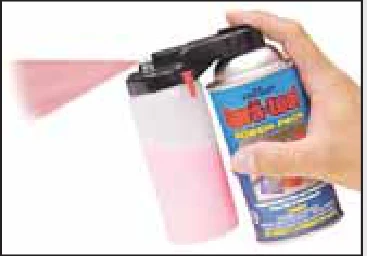
Want to do a small paint touch-up but don’t like the hassle of having to clean a paint gun? Eastwood Garage makes a reusable aerosol sprayer called the Spra-Tool (www.eastwood.com). It consists of an 8-oz. plastic bottle attached to an aerosol can. You just pour the paint into the bottle and screw it into place, and then pull a trigger. The Spra-Tool can be used to spray most paints and liquids up to the viscosity of light oil. The spray head comes with 3 interchangeable spray tip inserts.

From the archive · Full text
Reader shop tip

Start Your Engines Fuel Systems Revitalizer

Start Your Engines Fuel Systems Revitalizer, www.startyourenginesus.com (as printed)

This fuel system additive is designed to ensure easy starting of equipment that has been sitting for a long time (www.startyourenginesus.com; ph 773 376-4400). It works by adding combustibility to old fuel and removes gum and varnish sediment in the fuel system.

According to the company, Start Your Engines should be used any time an engine begins to run rough or becomes difficult to start. They say it’s particularly useful after long term storage. The product is not recommended for diesel.

From the archive · Full text
Reader shop tip

Milwaukee Electric Tool Corp.

Milwaukee Electric Tool Corp.

Its magnetic Torpedo Pocket Level works similar to a protractor or angle finder, while also working as a traditional pocket level for quick checks. It comes with a locking, rotating 360-degree adjustable vial that lets you identify and repeat any angle needed. The level vial is clear and easy to read, and has one-degree increments on one side and common angles marked on the other for less clutter. The bubble is magnified which makes it easy to read. Sells for $24.97 at Home Depot (www.homedepot.com).

Shop feature stories

From the archive · Full text
Feature story

“Poor Man’s” Plasma Cutting Table

Featured source: Michael Merrigan

The cost of an expensive plasma table prompted Michael Merrigan of Hampton, Nova Scotia, to build his own out of a bathtub and some old bandsaw blades. The bathtub is screwed onto a 4-legged wooden stand with wheels at one end so he can easily move it around.

“I built it for almost nothing. Commercial plasma tables sell for $500 or more,” says Merrigan.

“Those tables come with a slotted angle iron frame and have expandable 1/8-in. by 1-in. flat bar pieces spaced 2 in. apart that serve as the work surface. I added the tub, an idea that’s used on CNC plasma tables, as a spark catcher.” He started with a 5-ft. long, 32-in. wide tub. He cut up a 1-in. angle iron bed frame and welded it together at the corners to make a frame, which friction fits to the top of the bathtub. He used a 14-in. abrasive chopsaw to cut a series of 3/16-in. wide, 1/2-in. deep slots into the frame, spacing them 2 in. apart. Then he cut up an old bandsaw blade into 18-in. lengths and inserted them - cutting edges down, into the slots to form the table’s working surface.

“It works as good as I hoped it would,” says Merrigan.

“The stand sets on 4 by 4 wood legs and places the bathtub at a comfortable 32-in. working height. Water in the tub catches the sparks from my cutting torch so I don’t have to worry about anything catching on fire.

“I already had all the materials, so my only cost was a couple hours of my time. The blades came off my bandsaw mill.” Contact: FARM SHOW Followup, Michael Merrigan, 8140 Shore Rd. West, Hampton, Nova Scotia Canada B0S 1L0 (ph 902 665-2098; [email protected]).

From the archive · Full text
Feature story

Grease Gun Extension Helps Reach Mower Zerks

Featured source: Marlin Galde

A homemade grease gun extension makes it easy for Marlin Galde to lubricate the deck pulleys on his Deere 325 all-wheel-steer riding mower equipped with a 48-in. deck.

“The zerks on this deck’s 3 pulleys are difficult to get at, and using a flexible hose on my grease gun didn’t work very well. I made a 15-in. long straight pipe extension that works much better,” says Galde.

“I also use the extension on my New Holland Boomer compact tractor equipped with a 72-in. belly-mount deck.” He removed the grease gun’s fixed tube and replaced it with a 15-in. length of plumbing pipe that’s threaded on both ends. He threaded a T fitting onto the end of the pipe and then threaded a 2-in. long grease fitting onto the bottom of the T. He also threaded another grease fitting onto the far end of the T. He caps it off when using the other fitting.

“I use the pipe extension mainly for vertical access to zerks on mower belt pulleys,” explains Galde.

“I just reach in and push down to lock the grease fitting onto the zerk and then start pumping. I use another grease gun on zerks that are easier to access.” Galde says he’s considering manufacturing the grease gun attachment. Contact: FARM SHOW Followup, Marlin Galde, 18075 78th St. S.E., Wahpeton, N. Dak. 58075 (ph 701 899-1676; [email protected]).

From the archive · Full text
Feature story

“Sabre Saw” Paint Can Shaker

Featured source: James Nicholson

James Nicholson made a wall-mounted, automatic aerosol paint can “shaker” that makes use of an old sabre saw. The paint can sets inside a piece of pvc tubing, which attaches to the saw in place of the blade.

“I came up with the idea because I was tired of shaking spray cans,” says Nicholson. He cut a 10-in. length of 3-in. dia. pvc tubing in half lengthwise and screwed round pieces of 1/2-in. thick plywood onto both ends of the tube to close it off. He installed a small spring in one of the pieces to hold the can in place. He then riveted the tube onto a length of 1/2-in. key stock that serves as a support. A length of light-duty channel iron is bolted to the base of the saw and serves as a support and guide for the key stock and pvc tube.

“It works great and really comes in handy since I do a lot of spray painting and varnishing in my work shop,” says Nicholson.

“I bought the 3-speed sabre saw at a yard sale for $7. I run the saw on low speed so it’s not too aggressive. Because the saw is wall-mounted, it stays nice and stable and doesn’t jump around. I cut a hole into each side of the tube so that when I’m done I can stick my fingers through and pop the can out.” Contact: FARM SHOW Followup, James Nicholson, 12412 S.R. 45, Lisbon, Ohio 44432 ([email protected]).

From the archive · Full text
Feature story

Need Power? Check Out These Hydro-Pacs

Featured source: John Beiler

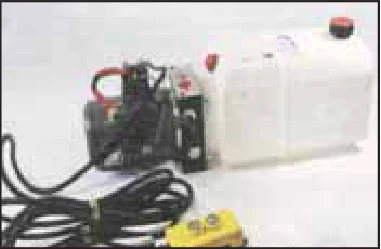
Power Systems & Supply has hydraulic power systems available for nearly any need. Their Hydro-Pac DC power units start at 1 1/2 gpm and 2,500 psi. Gas -powered systems range from 4 1/2 gpm to 10 gpm with pressure ranging from 1,000 to 2,000 psi.

“Hydraulics are convenient for many things around the farm, but sometimes hydraulic power isn’t available,” says John Beiler, Power Systems & Supply.

“That shouldn’t stop you from developing an idea that requires hydraulic power.” He points out that 12-volt power packs are very affordable and easy to install. However, flow rate/speed is limited. If speed is needed, he recommends gas engine-powered hydraulic packs. Either way, Beiler’s company can meet your needs.

“We offer a variety of valve types and sizes of pumps and reservoirs,” says Beiler.

“Valve options vary from manual to remote and multi-valve, 3-way, 4-way, variable speed and more.” Hydro-Pac DC power units have heavy-duty, 2-post motors and double action valves with stationary switch mounting options. Remote controls are also available. Gas hydraulic power units offer frame and no-frame options, as well as electric start and wheeled versions. If planning a project that could benefit from hydraulic power, Beiler suggests you contact the company to discuss your needs.

“We have many years of experience and keep all parts in stock,” says Beiler.

“Many great inventions are initiated from meeting a need.” Contact: FARM SHOW Followup, Power Systems & Supply, 10381 S. 800 W., Waveland, Ind. 47989 (ph 765 435-3733).

From the archive · Full text
Feature story

Two-Post Auto Lift For Tight Spaces

Featured source: Chris McClure

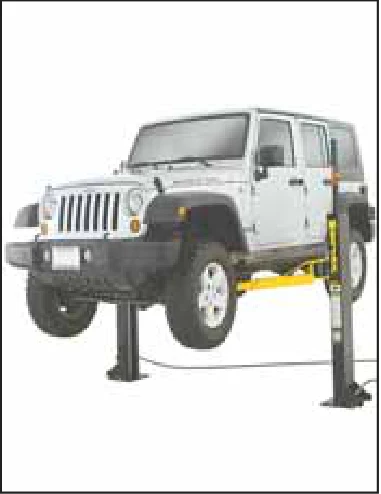
The MaxJax lifting system by Danmar is a portable, two-post lift that can fit in any garage. Roll it into place and bolt it to preplaced, drop-in anchors. Hook it up to the mobile power unit, attach the hydraulic couplers, and install the adjustable lift arms. MaxJax can lift 6,000 lbs. up to 4 ft. high in 30 secs. The fully integrated hydraulic system powers up on any 20-amp, 110-volt circuit.

“The MaxJax is designed for the home garage,” says Chris McClure, Danmar.

“It can be installed in less than 30 mins. When not in use, the posts and power unit roll away into a corner, taking up minimal floor space.” The recessed drop-in anchors are a one-time installation. The internally threaded anchors flush mount. Each properly installed anchor has a holding power in excess of 14,500 lbs. when installed in at least 4-in. thick concrete. Lift installation can vary depending on the size of vehicles being serviced. If you’re working on a garden tractor, motorcycle, or ATV, you can use just one lift post with an optional attachment. The original MaxJax sells for $1,899. It has manual locks. Once the lift is at the desired height, a locking bar between the arms secures it in place.

“We have just introduced a new version, the MX-6 with automatic locks and safety releases at 7 different heights,” says McClure. The MX-6 is priced at $2,299. The price includes free delivery. It also includes a 3-year extended warranty on parts and labor. Contact: FARM SHOW Followup, MaxJax, 646 Flinn Ave., Moorpark, Calif. 93021 (ph 844 629-5291; toll free 877 397-8225; [email protected]; www.maxjaxusa.com).

From the archive · Full text
Feature story

Energy-Saving Engine Heater

Featured source: Jeff Aiello

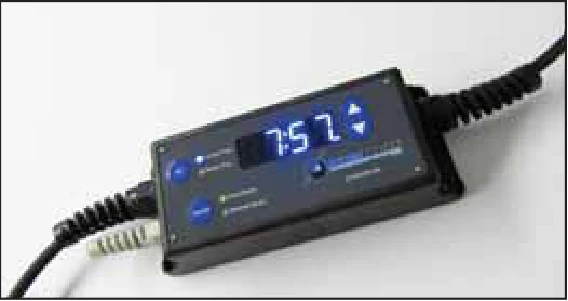
A new engine heater controller can reduce the cost of running a block heater by up to 80 percent, says Jeff Aiello of Bostic Motors, Inc., Bostic, N.C. The Power Badger™ can be used with engine block heaters, pan/tank heaters, battery warmers, and the like. The block heater plugs into it, and it works by sensing the outside temperature and then adjusting automatically. The unit has 2 different modes. The first is used to “ready” your engine for a specific start time, and the other mode is used to maintain the engine so that it’s ready to start at any time. An LED display monitor shows the “ready” time in large blue digits that are easily readable day or night.

“It works for any kind of engine but is targeted at diesels,” says Aiello.

“Most people don’t know how much time to allow the heater to fire at a given temperature and/or don’t want to make daily adjustments to a timer to achieve optimal savings.” Until now engine heaters have been uncontrolled energy wasters, says Aiello.

“Most engine block heaters use energy as soon as they’re plugged in. Yet most people simply plug in their heater when they get home and let it run constantly, all night long, often wasting 500 to 1,500 watts of power per hour. That comes out to $1.15 to $5.45 of wasted energy per day, depending on your heater wattage, climate and local power rates. In cases like these, the Power Badger™ can pay for itself in less than one season’s use, and will almost always pay for itself within 2 seasons of use.” The Power Badger sells for $99 plus $14.95 S&H. Contact: FARM SHOW Followup, Bostic Motors, Inc., 157 North Main Street, Bostic, N.C. 28018 (ph 828 453-7779; [email protected]; www.thepowerbadger.com or www.6-5liter.com).

From the archive · Full text
Feature story

Old Hand Truck Makes Handy Welder Cart

Featured source: Harrell Cummings

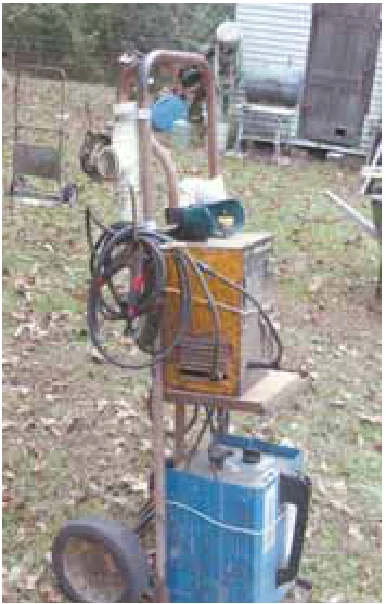
Last spring when Harrell Cummings bought a new hand truck, he didn’t throw out the old one. Instead he repurposed it into a useful welding cart.

“I had two welders, and I got tired of carrying them around,” says the retired small engine mechanic who likes to help out his Fairmont, N.C., neighbors by fixing broken lawn mowers and other things. He replaced the cart’s old tires with solid rubber wheels from an old Murray lawn mower. And he beefed up the deteriorated platform base with angle iron to hold one of the welders. To accommodate a second welder, he welded an angle iron frame between the handle sides to hold a piece of plywood about halfway up.

“I have it spaced so the load is even,” Cummings says. Welder cables are held in place by the metal handles of old paint rollers bent in the shape of an L and tacked to the hand truck frame. Welding rods are convenient in an 8-in. piece of 3-in PVC pipe with a cap in the bottom that is mounted to the hand truck with tape. Though he purchased a new 115/220-amp welder that he uses occasionally, Cummings notes he uses his 40-year-old, 100-amp welder for most projects. Because everything is handy on his welder cart, Cummings says it’s easier for him to tackle a project whether it’s fixing something or when he has an idea to make something out of scrap. Contact: FARM SHOW Followup, Harrell Cummings, 455 Reva Rd., Fairmont, N.C. 28340 (ph 910 628-7378; [email protected]).

From the archive · Full text
Feature story

Split-Molded Urethane Sprockets

Featured source: Kevin Healy

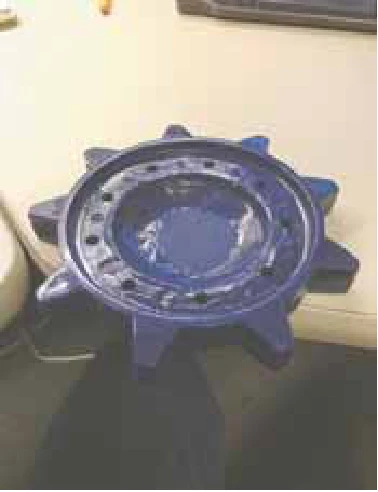
Plan Tech uses a split-mold method instead of injection molding to make cast polyurethane drive and gear sprockets, pads and more. The result is a superior product with a process that can be used for custom parts, as well as production runs for agriculture and other industries.

“Most polyurethane products today are injection molded,” says Kevin Healy, Plan Tech.

“We use a 2-part cured system that produces parts that are twice as good as injection molding in terms of tensile strength, rebound, compression, etc.” Plan Tech starts out by making compression molds for each side, creating mirror images of up to 9 parts per mold. Technicians then hand mix each batch of polyurethane and pour it into the molds. Once the materials have cured, pairs of parts are put together under 50 tons of pressure.

“The pressure chemically bonds the two together, and it then cures as one form,” says Healy.

“The process is economical, too. A sprocket that we make and sell for $10 originally sold for $25.”

The company has perfected the process, enabling the production of thousands of parts of different sizes each month. Each is perfect and requires no machining. However the process also lends itself to smaller, even individual runs. Custom sprockets can be produced as small as 1/2 in. or as large as 4 ft. in dia. Existing sprockets with a hub or core that are still in good shape can be recoated, cleaned and refurbished with a new urethane coating. Gear sprockets can also be reverse-engineered or redesigned with a new profile or detail added. In high stress applications, a steel core can be added to increase load capacity.

“If you have a part that is already in circulation, we can engineer, mold and make it in your preferred color and hardness,” says Healy. Not all the jobs require the double cast molding process. Parts can also be machined out of urethane.

“We do a lot of parts for antique farm equipment,” adds Healy. A recent custom job was a 50-year old track tractor drive sprocket. Previous coatings had worn away to the original steel core. After cleaning the wheel cores, marks were made for machining. A low cost mold was made to over pour the wheel into a solid blank disk, which was then machined to the exact shape needed. Contact: FARM SHOW Followup, Plan Tech, 7031 Shaker Rd., Loudon, N.H. 03307 (ph 877 349-0620; [email protected]; www.plantech.com).

From the archive · Full text
Feature story

Handy Air Brake Service Tool

Featured source: Perry Adams

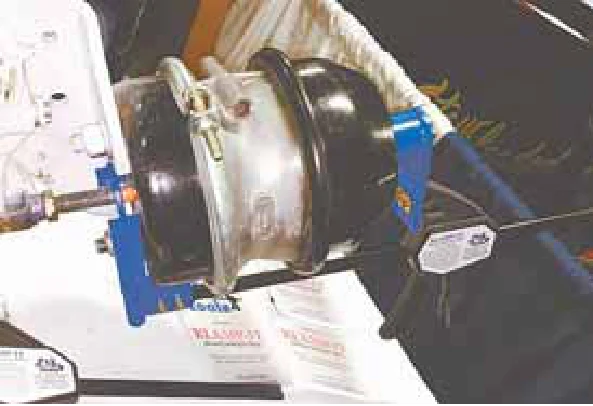
“Our new Klamp-It Brake Service Tool makes it easy to change the brake diaphragms and/or brake parking chambers right on your truck. It turns a tedious job that normally requires 2 people into a quick and easy job one person can do,” says Perry Adams, P&K Tools, LLC, Phelps, N.Y. Adams grew up on a dairy farm in New York where the family also had trucking interests.

“After more than 30 years of doing my own brake maintenance on trucks, I came up with the idea for an air brake tool.

“The problem is that the rubber diaphragm on air brakes occasionally fails, and to replace it you have to line up the diaphragm, service chamber and parking brake chamber perfectly,” says Adams.

“A 2-piece clamp connects the two chambers together, with the diaphragm between them. The problem has always been getting the replacement parts aligned properly, and also getting the clamp to seal properly. The Klamp-It holds all these components in place, while leaving both your hands free to line everything up properly and to re-attach, align and tighten the 2-piece clamp.” The Klamp-It is equipped with a “hook” at one end and a trigger-type handle on the other end. The operator installs a cage bolt in the parking brake chamber and then backs off the brake’s slack adjuster to pull the push rod out. He places the hook over the push rod and then pushes the handle over the cage bolt, squeezing the trigger handle to pull everything in place.

The 2-piece clamp is then removed and then the parking brake chamber, allowing the diaphragm to be replaced. The operator then re-installs the Klamp-It with the brake chamber to align and then tighten with the trigger handle, leaving both hands free to install and tighten the clamp.

“The hook has a built-in swivel feature so you can use it either from the left or right side of the air brake assembly.” You can watch a demonstration video of the tool on his company’s website. The Klamp-It Brake Service Tool sells for $149.95 plus S&H. The company also offers a brake return spring installation tool that sells for $19.95 plus S&H. Contact: FARM SHOW Followup, Perry Adams, P&K Tools, LLC, 643 S. Marbletown Rd., Phelps, N.Y. 14532 (ph 315 359-7397; [email protected]; www.klamp-it.com).

From the archive · Full text
Feature story

Engine-Driven Welder Converted To Pto Drive

Featured source: Don Prestien

Don Prestien, Wildwood, Mo., turned an old engine-driven 10k generator into a pto-driven unit that can operate off any tractor’s 540 rpm pto. He took the fan drive pulley and pto shaft off an old portable grain dryer to do the job. The generator mounts on a home-built 2-wheeled trailer that’s designed to hook up to a tractor’s 3-pt. hitch or drawbar.

“I already had the generator, which I had bought years ago but never used because I didn’t have a gas engine for it,” says Prestien.

“The generator was designed to operate at 3,600 rpm’s, but all my tractors are equipped with a 540 pto. I calculated that I would need a 2-ft. dia. drive pulley to belt-drive the generator. The pulley from the grain dryer happened to be just the right size.” He used steel tubing to build a trailer frame that supports the generator and pto shaft and welded 3-pt. brackets onto it. The trailer’s tires and spindles are off an old Deere 110 garden tractor. The generator is equipped with a circuit breaker box that includes a 220-volt outlet and three 110-volt outlets – one 30-amp and the others 20-amp.

“It works as good as commercial pto-driven generators that sell for thousands of dollars. I use a pair of jacks to stabilize the unit whenever I run the generator. I added metal shrouding over the pulley to serve as a safety guard. I paid $200 for the generator and already had most of the materials that I needed to convert it.

“Since there’s very little mechanical resistance in the pulley drive system, it can generate electricity very efficiently. One time we had a bad wind storm that knocked out the power for about 12 hrs.

“After running the generator to power both my home and my neighbor’s, fuel use came out to just one pint per hour. My small 2-cyl. diesel Yanmar tractor is very fuel efficient.” Prestien says others could try this idea, too.

“There are a lot of old portable grain dryers sitting around that can be used to convert a generator like I did.” Contact: FARM SHOW Followup, Don Prestien, 3028 Lake Country Lane, Wildwood, Mo. 63038 (ph 314 680-1122; [email protected]).