Practical ideas from FARM SHOW MagazineSubscribe · Free issue · Send us your shop tip
Subscribe to FARM SHOW
Issues / Vol. 29, No. 6 (2005)

Vol. 29, No. 6 (2005)

Money-Saving Repairs & Maintenance Shortcuts · Printed section pp. 36–39

37 selected entries · Complete text of selected entries

This issue’s section includes reader tips and feature-length shop stories. Held items and editorial notices are not reproduced.

Archive text: prices, coupons, availability and contact details reflect the original publication, not current offers. Reader methods are not universal instructions; follow manufacturer guidance and proper safety practices.

Reader shop tips

From the archive · Full text
Reader shop tip 1 of 2

Allen Ahlbrecht

Individual tip 1 of 2 from this reader’s published contribution.
Allen Ahlbrecht, Hector, Minn.

“We had been having a lot of problems with wheel bearings on equipment, especially the smaller tag axles bolted to our trucks to get past road restrictions each spring. After switching to a synthetic grease, the problem went away. Now that’s all I use. It’s a bit more expensive than ordinary grease but it works much better.

From the archive · Full text
Reader shop tip 2 of 2

Allen Ahlbrecht

Individual tip 2 of 2 from this reader’s published contribution.
Allen Ahlbrecht, Hector, Minn.

“I was interested in the article in your last issue about using a hospital gurney as a portable workbench, because I’ve used the idea myself for awhile. My gurney has 10-in. wheels that’ll roll right over hoses and tools. It’s made of tough steel and has railings on each side to raise and lower as you see fit, and has a large open area to work on. When the work is done, you can roll it back to replace all your tools and parts. And, if you have a lot of visitors, you’ll get a lot of comments about the ‘doctor’ trying to save his ‘patients’.”

From the archive · Full text
Reader shop tip 1 of 3

Arco Rosenow

Individual tip 1 of 3 from this reader’s published contribution.
Arco Rosenow, Chillicothe, Ill.

“By welding a pair of sickle sections to the back of a cheap machete I made an inexpensive, heavy-duty cutter for getting rid of undesirable vegetation such as wild grape, multi-flora rose and light brush. The wedging action between the sickles, and their added weight, allows the tool to easily cut overhead vines. A friend of mine told me this thing is so scary looking that it’s probably illegal to own.

From the archive · Full text
Reader shop tip 2 of 3

Arco Rosenow

Individual tip 2 of 3 from this reader’s published contribution.
Arco Rosenow, Chillicothe, Ill.

“Trying to carry small parts and wrenches for maintaining your machinery can be a hassle. The tools and parts can easily get lost or get exposed to the weather and rust out. To solve the problem, I make a mini tool box for each machine out of pieces of 3 and 4-in. dia. pvc pipe. I glue a cap to one end and put a removable cap over the other end. You can leave the ‘tool tube’ on the machine all year long, or you can label each one and store them on a shelf until needed.

“This same idea works for keeping repair manuals and service records out of the weather, without being rolled too tight.

From the archive · Full text
Reader shop tip 3 of 3

Arco Rosenow

Individual tip 3 of 3 from this reader’s published contribution.
Arco Rosenow, Chillicothe, Ill.

“Individual drill bits can be carried inside 1/2 or 3/4-in. dia. lengths of pvc in a toolbox without being damaged. Label the pipe with an indelible marker for easier identification. A 2-in. pipe will carry quite a few drill bits or even a small flashlight. I put a wad of paper in the tubing to protect the tips.”

From the archive · Full text
Reader shop tip

Mell C. English

Mell C. English, Belmont, N.C.

“If there is a recessed nut on an extended bolt that you can’t get a wrench on, saw a deep socket in half and weld a hollow steel pipe between the two halves of the socket. The extra length will let you reach the nut.”

From the archive · Full text
Reader shop tip 1 of 3

Gary Elston

Individual tip 1 of 3 from this reader’s published contribution.
Gary Elston, Mulvane, Kansas

“Removing worn out gang bearings from a disk is a tough mechanical problem that many farmers face at one time or another. The problem is that the bearing almost always seizes to the shaft. I find the easiest way to remove the collar is to either heat it with a torch and beat it off, or carefully torch it off. After the collar is off, use a grinder with a wire wheel to thoroughly clean off all the rust and dirt. Once the surface is cleaned, inspect for nicks or burrs which may interfere with installation of the new bearing. Before installing the bearing, use an anti-seize lubricant to thoroughly coat both the bearing and the shaft. The next time the bearing has to be removed, it’ll slide right off.

From the archive · Full text
Reader shop tip 2 of 3

Gary Elston

Individual tip 2 of 3 from this reader’s published contribution.
Gary Elston, Mulvane, Kansas

“Broken or bad wiring due to poor connections is a headache for anyone. I’ve found that dielectric grease is a cheap and easy way to protect electrical plug-ins and couplers from water and to keep dirt from corroding them. Just coat any connections with it.

From the archive · Full text
Reader shop tip 3 of 3

Gary Elston

Individual tip 3 of 3 from this reader’s published contribution.
Gary Elston, Mulvane, Kansas

“A good way to repair broken wiring is to strip the two wires to be joined, then solder them and use heat shrink tube to seal the fix. A better and simpler fix is to pick up a pack of butt connectors with the solder already inside the heat shrink tube. Strip the wires to be joined, crimp on the connector in the normal fashion, and use a lighter to heat up the connector. The solder will melt to the wire strand for a sure connection, and the outer sleeve will shrink down to make a weather-tight seal. The connectors cost a little more, but the time and money you’ll save later will make it worth the extra expense.”

From the archive · Full text
Reader shop tip 1 of 2

Eugene P. Yavorski

Individual tip 1 of 2 from this reader’s published contribution.
Eugene P. Yavorski, Palm Coast, Fla.

“Sometimes I use my 2004 Volvo all-wheel-drive car to pull a tandem axle utility trailer. One time when I was backing up to the trailer, I accidentally overshot the ball hitch on back of the car and the trailer’s tongue just nicked the car’s plastic bumper. Luckily, the impact didn’t crack the bumper. To prevent that accident from ever happening again, I welded a 6-in. long by 3-in. wide, 3/8-in. thick steel plate to the top of the hitch. Now if I ever overshoot the ball, the steel plate will keep the trailer tongue from ever hitting the bumper.

From the archive · Full text
Reader shop tip 2 of 2

Eugene P. Yavorski

Individual tip 2 of 2 from this reader’s published contribution.
Eugene P. Yavorski, Palm Coast, Fla.

“I use a Honda 3,400-lb. psi pressure washer around my home to clean my driveway, etc. With that much pressure the wand is always exerting an upward pressure on my arms, which really gets tiring. To counterbal-ance the upward pressure, I added a 2-ft. length of 5/8-in. thick rebar to the wand, securing the rebar to the wand with plastic wire tires. Now the wand actually floats, and all I have to do is guide it. I’ve used this idea for several years and it works great.”

From the archive · Full text
Reader shop tip 1 of 3

Bill Reeks

Individual tip 1 of 3 from this reader’s published contribution.
Bill Reeks, Cromwell, Ky.

“It’s surprising how much stuff this 7.62 mm ammuni-tion box will hold. I use it to hold a chain, rope, wrench, pliers, screwdrivers, tape, vise grips, crescent wrench, wire, etc. I keep re-serve gas in a 24 oz. bottle. The plastic bev-erage bottle comes in handy, too. I seldom have to walk back to my shop for anything.

From the archive · Full text
Reader shop tip 2 of 3

Bill Reeks

Individual tip 2 of 3 from this reader’s published contribution.
Bill Reeks, Cromwell, Ky.

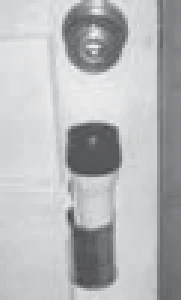
“My flashlight always seems to be ‘hiding’ whenever I need to go outside after dark, so I converted an old tomato paste can into a flashlight holder. The can is screwed to the back door where I can always find it.

From the archive · Full text
Reader shop tip 3 of 3

Bill Reeks

Individual tip 3 of 3 from this reader’s published contribution.
Bill Reeks, Cromwell, Ky.

“This 1 1/2 by 5/16-in. bar attached over the wheel on my mowers had a tendency to scrub bark on trees as I mowed around the base. So I covered the axle nut with a piece of galvanized bar stock. The bar rubs over the tree bark with no damage.

From the archive · Full text
Reader shop tip 1 of 2

Gary Noblit

Individual tip 1 of 2 from this reader’s published contribution.
Gary Noblit, Jonesville, Mich.

“The bolts that held the starter in place on my Deere 6300 tractor kept vibrating loose. The starter is very hard to reach so it’s difficult to tighten up the bolts. To solve the problem, I replaced the bolts with studs. The studs are threaded on each end. I put two nuts on the outside end of the stud and then ran it as tight as I could into the bolt hole. Then I took the nuts off, replaced the starter and put the double nuts back on. I made this change more than a year ago and it completely solved the problem.

From the archive · Full text
Reader shop tip 2 of 2

Gary Noblit

Individual tip 2 of 2 from this reader’s published contribution.
Gary Noblit, Jonesville, Mich.

“The wheel hubs on a lot of new equipment - such as hay tedders, inverters and riding mowers - come without any grease zerks, which is unfortunate because it can lead to premature failure of the wheel bearings. I think it’s worth taking the time to install your own grease zerks. All you need is a drill and a wrench. Just drill a hole in the hub, tap in threads, and use a wrench to screw in the zerk. I installed grease zerks 1 1/2 yrs ago on a Case 580 backhoe. I had to take the wheels apart anyway because the hubs were worn out and needed to be replaced, so I decided to install grease zerks at the same time. I haven’t had any problems with it since then. Even if you don’t have to replace the wheel hubs, you should take the wheel apart anyway in order to keep metal shavings from getting inside the hub as you drill the hole.

“The grease zerks make it easy to the bearings well-greased and should greatly extend their life. And by filling the inside of the hub with grease, you also keep most foreign material out.”

From the archive · Full text
Reader shop tip

Danny Hege

Danny Hege, Olar, S.C.

“It’s amazing how much money you can save by doing your own repair work with just a welder and a cutting torch. For example, when the feed roll disintegrated on our Case IH 881 forage harvester, we made the repair ourselves. About half of a 6-in. dia. pipe that served as the feed roll had worn through. We removed the feed roll and cut it apart, then welded in a length of irrigation pipe as a substitute for the original. It saved us a lot of money.”

From the archive · Full text
Reader shop tip

John Chestnut

John Chestnut, Wernersville, Penn.

“At about 35,000 miles the transmission on my 1999 Dodge 2500 pickup started having problems. In an attempt to avoid an expensive transmission repair, I switched to synthetic transmission fluid and added a bottle of Lucas Hydraulic Oil Booster and Stop Leak (Tractor Parts, Inc., Glasgow, Ky. (ph 270 651-2547; www.tractorpartsinc.com). It really made a difference. Now my pickup drives better than new. Apparently, the factory transmission fluid wasn’t up to snuff.”

From the archive · Full text
Reader shop tip

John & Peg Szoke

John & Peg Szoke, The Arthur I. Platt Company, Inc., 160 Rock Lane, Milford, Conn. 06460 (ph 203 874-0091; fax 203 876 0637; www.toolclip.com)

“Our little company makes all kinds of adjustable tool holding clips. They’re great for mounting everything from brooms to screwdrivers to big shop tools on a shop wall. Our website makes it easy to figure out which size clip you need. All you have to know is the tool diameter.”

From the archive · Full text
Reader shop tip

RN Johnson, Inc.

RN Johnson, Inc., 269 Main Street, P.O. Box 448P, Walpole, N.Y. 03608 (ph 603 756-3321; www.rnjohnsoninc.com)

This company sells old Deere parts.

“We are one of the half-dozen oldest Deere dealers in the world,” the company says.

“We have in excess of a half million dollars in parts no longer available through Deere. We can locate new and used parts for equipment of any brand and age. If it’s not here, we’ll find it.”

From the archive · Full text
Reader shop tip 1 of 2

Daniel Krenzel

Individual tip 1 of 2 from this reader’s published contribution.
Daniel Krenzel, Cullman, Ala.

“I repaired a weed eater motor rod by welding it while it was nearly submerged in distilled water. I welded it right up against the needle bearing on the ends without loosing the composite needle spacers inside the bearing.

From the archive · Full text
Reader shop tip 2 of 2

Daniel Krenzel

Individual tip 2 of 2 from this reader’s published contribution.
Daniel Krenzel, Cullman, Ala.

“Here’s an idea I saw a long time ago but have never tried myself. A welder was rebuilding an oil well drill head using a 1/4-in. dia. stainless steel pipe filled with tungsten carbide chips. It acted as a hard surfacing filler rod. Worked really well. Might work for other hard-surfacing jobs.”

From the archive · Full text
Reader shop tip

Rodney L. Pervier

Rodney L. Pervier, E. Templeton, Mass.

“I used to run a lot of old International trucks with radiators that would get pinhole leaks. You couldn’t fix them without burning a hole in the tubing. I’d take a regular gasket jell and paste it over the hole while it was hot. Just dab it on and go back to work. It’s an easy way to fix something in the field and better than buying a new radiator.”

From the archive · Full text
Reader shop tip

Noel Hicks

Noel Hicks, Palmyra, Ill.

“When a wind blew down a building that belonged to a nearby steel dealer, I bought the twisted gird-ers for $27 each and straightened them out using a jig. I used them, along with I-beams from an old railroad bridge, to build my 66 by 100-ft. farm shop.”

From the archive · Full text
Reader shop tip

Louis Trepainer

Louis Trepainer, Ontario

“To add more life to your deep cell battery when out troll-ing in a fishing boat with a DC-powered motor, just hook up a 5-watt solar panel to the battery posts and you’ll be able to stay out a lot longer.”

From the archive · Full text
Reader shop tip

Greg Herling

Greg Herling

“You should add Stabil or a similar product to your gas on any motor that is going to sit for more than a month, because the new formulated gasolines deteriorate much faster nowadays. Mowers, cars, trimmers, tractors, chainsaws, and so on, all need this to avoid gummed-up carbs, and to make starting easier when you need it. The other option is to remove all gas from the tank and carb.”

Shop feature stories

From the archive · Full text
Feature story

Power Modules Provide More Hp On Less Fuel

Featured source: Jason Penzo

Jason Penzo’s power modules increase engine power and fuel efficiency by hijacking engine sensor information. They’re designed for use on a wide range of Deere tractors and combines and New Holland combines, as well as Mack trucks.

“Instead of writing new code into the computer to make the engine produce more power, we simply trick it,” explains Penzo.

The power modules plug into the existing connections to intercept the signal from sensors. The power module modifies the signal. The operator selects either a low or high output setting from his in-cab controls. The high setting is still well within the range of engine limits, while the low setting requires less fuel.

“You get 15 to 30 percent more power from the same engine,” says Penzo.

“If you look at 8000 series Deere tractors, each one is identical except in power output. This module takes an 8120 and gives it the same power as an 8420, but saves you about $40,000.”

Penzo admits that some dealers won’t endorse use of the boxes while others sell the $500 units. In the past two years, he says he has sold more than 2,000 units with no problems on any tractor.

Penzo has concentrated on Deere tractors, making different versions for different tractor series. He is getting ready to release units for Case-IH MX series tractors. All products are marketed through four distribution warehouses in the U.S. and Canada.

Contact: FARM SHOW Followup, Jason Penzo, Penzo Performance, LLC, 619 40th St, Springdale, Ark. 72762 (ph 479 530-2488; www.penzoperformance.com; Jason@penzo performance.com).

From the archive · Full text
Feature story

Add-On Fan Keeps ATV Engine Cool

Featured source: Doug Fluit

Doug Fluit of Lynden, Wash., uses a 1996 Honda ATV equipped with an air-cooled engine to do a lot of spraying and fertilizing in his commercial nursery. With rows and rows of tree branches overhead there’s little air movement, which often caused the ATV’s engine to overheat.

He eliminated the problem by mounting a 6-in. dia., swivel-mount electric fan alongside the engine. The fan is powered by the ATV’s battery and is activated by a switch on the handlebars.

The fan came off an old school bus where it mounted on the dashboard. Fluit used 1/4-in. thick steel plate to make a bracket that bolts to the fan’s base and also clamps onto the ATV’s frame.

“It lets me operate the ATV at idle all day long without ever overheating the engine,” says Fluit.

“I’ve put hundreds of hours on my ATV since I added the fan, with no problems. I think the same idea could be used on any ATV equipped with a 12-volt battery.

“Most of the engines on newer ATV’s are water cooled but they still don’t have a fan, so you have to keep the ATV moving in order to force air through the radiator. Therefore I think the basic idea would work on newer ATV’s, too.”

Contact: FARM SHOW Followup, Doug Fluit, 2003 Bangbron Road, Lynden,Wash. 98264 (ph 360 354-8486 or 360 815-7061).

From the archive · Full text
Feature story

Frozen Brake Rotors Wear Longer

Featured source: Craig Weber

Cryogenically frozen brake rotors will last two to three times longer and extend the life of brake pads, says Craig Weber, manufacturers representative for Diversified Cryogen-ics, Inc. (DCI). The company sells frozen rotors or will custom-treat rotors, drums and nearly anything else at 300 degrees below zero.

“We have custom-treated just about anything that wears out or can be reshaped, from drill bits to gun barrels, razor blades and saw blades,” say Weber.

“Drill bits are a big business. You can treat a $14 bit and it will do the same job as a $500 diamond bit. We’ve even treated pantyhose so they don’t run as easily.”

Buying a frozen rotor from DCI may be more economical than sending one to be custom-treated. Custom treatment runs $56 per car rotor and $75 per truck rotor.

“We can get deep discounts on rotors with our buying power,” he explains.

“Plus then the customer doesn’t have to wait for his rotor to be treated. He gets one right away.”

The company advises against treating old rotors as they may already have internal cracks. The proprietary 60-hour freezing process causes the molecules, whether steel or pantyhose, to collapse, and yet the lattice structure remains unchanged. Weber compares it to compressing honeycomb and squeezing the honey out. The wax that’s left retains the structure.

The dense structure is harder with fewer impurities. In the case of rotors, they don’t heat up as fast against pads, thus prolonging pad life. They also offer a better meeting surface against the pads.

Frozen rotors first gained popularity among race car drivers and for off-road use.

“We have Jeep dealers in Northern California who swear by them,” says Weber.

“Their customers burn through brakes in the mountains.”

Increasingly individuals are ordering them for everyday use, adds Weber. The company also supplies fleets such as police departments, municipal buses and school buses with the frozen rotors.

Contact: FARM SHOW Followup, Craig Weber, Diversified Cryogenics, Inc., 16579 Kentucky Ave., Lakeville, Minn. (ph 612 968-0839 or 888 323-8456; ml@frozen rotors.com; www.frozenrotors com).

From the archive · Full text
Feature story

Virtual “Dash” Pinpoints Engine Problems

Featured source: B&B Electronics

If your car or pickup is less than 10 years old, you can troubleshoot problems with the AutoTap OBDII Diagnostic Scanner. It lets you create a virtual dashboard of function monitors on a PDA (like a Palm Pilot) or a laptop computer.

“AutoTap lets you set up a host of graphs and displays for sensors in your power train,” explains Mike Fahrion, B&B Electronics, maker of AutoTap.

He gives the Check Engine Light as an example. It comes on when an engine sensor goes out of range, but that’s all the driver knows. AutoTap reveals one of several trouble codes, such as one that suggests the engine fuel mix is too lean. Then you can look at the sensor while the engine is running to gather more information.

“Other diagnostic tools stop at giving you the code,” explains Fahrion.

“Tell an auto parts store that the code indicates too lean a fuel mix and the first suggestion they’ll give you is to replace the oxygen sensors. That can run from $30 to several hundred dollars and might not solve the problem.”

AutoTap, he says, allows you to graph the oxygen sensor and compare it to a graph of how the sensor should look. If it’s okay, then you can go on to the next possibility.

“You can go to an auto parts store and choose from a whole lineup of diagnostic tools from $120 to $200, and they will read the code and clear it, but not gather data,” suggests Fahrion.

“AutoTap starts at $200 and runs up to $500, depending on what features you want. It gathers real time data on about 20 different inputs like temperature, rpm, etc., as well as manufacturer’s enhanced or pro-prietary real time data. We can do color gauges as well as graphs of the data.”

Fahrion says customers range from “do-it-yourselfers” to people who simply want information before going into a shop.

“If you can go in with a printout, codes, graphs and other output, it starts a different level of discussion with a mechanic,” he says.

Unfortunately, Fahrion adds, “It’s hard to tell somebody to buy AutoTap up front as a preventative measure. Too many customers order the tool after blowing $300 and a weekend blindly replacing parts.”

To fully utilize the scanner, the company recommends the customer buy a diagnostic manual for the vehicle. B&B also sells online software called Sensor Guide. It tells where to find different sensors, how the engine runs and if you use the scanner, how output will look. The company’s website is also loaded with documentation and articles on trouble-shooting with the scanner as well as a couple of videos.

“The bulk of our sales are to people who have never used a scanner before,” says Fahrion.

“We have a pretty intensive user manual and lots of support material. Service manuals for a vehicle have a troubleshooting tree that gives step-by-step instructions.”

Although B&B’s primary business is data communications, employee interest in automobiles led to development of the scanner. It has also been adapted for use with heavy-duty diesel engines.

Contact: FARM SHOW Followup, B&B Electronics Mfg. Co., 707 Dayton Road, P.O. Box 1040, Ottawa, Ill. 61350 (ph 815 433-5100; fax 815 433-5105; [email protected]; www.autotap.com and www.obdii.com).

From the archive · Full text
Feature story

New Shop Tools Make Work Easier

Featured source:

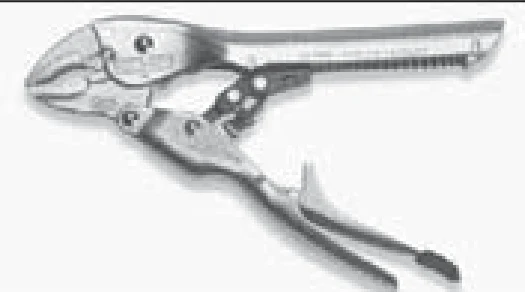
If you hate having to size your vise grip to fit every nut, then you’ll be interested in the LockJaw Automatic Locking Pliers. Thanks to a special locking mechanism, it adjusts to fit thick and thin nuts with the same amount of pressure each time.

It’s available at Ace Hardware (www.acehardware.com) and select Home Depot stores for between $20 and $25.

Contact: FARM SHOW Followup, LockJaw, LLC, P.O. Box 285, Crystal Lake, Ill. 60039 ([email protected]; www.lockjawpliers.com).

The Extractor pulls nails, staples, screws and other fasteners much faster than a hammer or crowbar.

Its nose lets you grip the complete fastener and roll it out without bending it instead of jerking at an angle. Because it has serrated teeth, it can also pull out screws without stripping them.

Sells for between $20 and $30 online and at different retailers.

Contact: FARM SHOW Followup, Jefferson Tool, LLC, P.O. Box 31535, Charleston. S.C. 29417 (ph 843 556-0455; fax 843 556-0687; [email protected]; www.nailextractor.com).

Thanks to the Bionic Wrench, you can throw out many of your box end wrenches and put away the vice grip or pliers. This tool has a multi sizing hex head.

The 8-in. tool replaces six box end wrenches from 7/16 to 3/4 in. (or 10 metric sizes - 11 to 20 mm).

Sells for about $29 plus S&H.

Dan Brown with Loggerhead Tools says a 6-in. tool to replace 12 wrenches between 1/4 in. to 1/2 in. (6 metric sizes - 7 to 12 mm) will be on the market in Jan. 2006. In March 2006, the company will introduce a 10-in. tool which covers 8 sizes between 3/4 in. to 1 1/4 in. (10 metric sizes - 19 to 30 mm) wrenches.

Contact: FARM SHOW Followup, Loggerhead Tools LLC, 208 South LaSalle St., Suite 189, Chicago, Ill. 60604 (ph 888 564-4374 or 312 419-1091; fax 312 251-5154; www.loggerheadtools.com).

Forget about finding the right socket or open-end wrench the next time you change oil. The Multi Oil Wrench fits oil pan plugs for up to 95 percent of all domestic and import cars, light trucks and other motors.

Although the 8-in-1 wrench was designed with the service mechanic in mind, it makes a handy addition to any toolbox. A rotating head on each end of the wrench has four mounted sockets for a total of 8 different sizes. The rotating socket heads allow the wrench access to spots hard to reach with standard wrenches.

The Multi Oil Wrench is made from drop forged steel and priced at $34.55. It comes with a lifetime warranty. Distributor Innovative Products of America (IPA) promises to repair or replace any wrench that fails because of workmanship or material within 24 hours. Contact: FARM SHOW Followup, Peter Vinci, IPA, P.O. Box 266, Mt. Tremper, N.Y. 12457 (ph 845 688-2300 or 888 786-7899; fax 845 688-2400; [email protected]; www.ipatools.com).

From the archive · Full text
Feature story

Aluminum Radiators Provide Extra Cooling

Featured source: Doug Schulz

“Our new aluminum radiators transfer heat much more efficiently than conventional radiators made from copper and brass. They work great for anyone whose vehicle has extra cooling needs, but limited space,” says Doug Schulz, Ron Davis Racing Products, Glendale, Arizona.

The company specializes in custom high performance aluminum radiators for racing and street use. However, they also manufacture aluminum radiators for motor homes, laboratory test rigs, competition pulling tractors, and vintage tractors.

“Aluminum radiators cool about 30 percent better than copper or brass because they’re built with wider tubes, and because there is no solder or brass which are basically insulators to heat transfer,” says Schulz.

“You get some weight savings with aluminum. However, most of our customers buy not for the weight savings, but for the added cooling.

“We build a lot of radiators for tractor pull tractors. These tractors often have an incredibly huge engine, yet the owner wants to keep the radiator in the same small place it used to be. We can build to exact dimensions from a drawing or sample radiator,” he notes.

Prices vary depending on degree of customization. Standard stock car-type radiators start at $239. An aluminum radiator for a 1960’s Mustang sells for about $400. A stock car-type equipped with dual fans and shroud starts at about $650.

Contact: FARM SHOW Followup, Ron Davis Racing Products, 7334 N. 108th Ave., Glendale, Ariz. 85307 (ph 623 877-5000; [email protected]; www.rondavisradiators.com).

From the archive · Full text
Feature story

Handy Tools Help Hold Wrenches

Featured source: Cary Urka

A couple of handy helpers let Cary Urka do more with his wrenches.

“I was reaching down into a bulldozer to tighten a bolt on the transmission,” explains Urka.

“I needed more leverage, and I didn’t want to try to use one wrench on another.”

Urka’s solution was to take a 14-in. long piece of 2-in. steel bar and tap two 1/2-in. holes through it near one end.

“I screwed two 1/2-in. bolts into the holes, leaving the heads high enough for the wrench to fit under,” says Urka.

The wrench is held in place between the two bolts while the extended handle provides increased leverage.

The pressure against the wrench holds it in place,” he says.

Another tool Urka made is a pipe wrench floor vise. When he had to work on two cylinders too large to fit on his workbench, he recalled seeing a floor vise made from a pipe wrench and a support frame. To make the frame, he put a bend in a piece of 1/2 by 3-in. flat bar to create a slight arch. At the center of the arch’s top, he welded a piece of steel tubing large enough for a pipe wrench handle to slide through. Scrap angle feet were welded to the ends of the support frame to stabilize it.

To stabilize the pipe wrench handle, Urka installed a keeper. The keeper consisted of a short piece of bar that fit inside the length of steel tubing. A U-bolt extends up over the tubing and welds to either end of the short bar, letting it move back and forth. Urka then drilled a hole in one side of the steel tubing and welded a nut to the outside of the hole. To secure the pipe wrench handle in the tubing, he simply screws a bolt through the nut until it pushes the keeper against the wrench handle.

“It only took about half an hour to make, but using it, we can work a 30-ft. length of pipe,” says Urka.

Contact: FARM SHOW Followup, Cary Urka, 16919 Pole Rd., Bretheren, Mich. 49619 (ph 231 477-5364; [email protected]).

From the archive · Full text
Feature story

Chop Saw Cabinet Cuts Down Mess

Featured source: Cary Urka

Cary Urka’s chop saw cabinet makes cleanup easy. The 275-gal. fuel oil tank catches fines, traps sparks and provides an easy-to-clean work surface.

“I used to have my chop saw on a bench, and it blew grit everywhere,” says Urka.

“This cabinet catches all the drops, and I figure I won’t have to clean it out for years. Even then, I will just pull off the top and dump it out.”

To make the cabinet/bench, Urka set the barrel on its side and cut away 2/3 of one side of the barrel, leaving both ends in place. He placed two sections of 10-in. I-beams salvaged from a trailer house frame under the barrel for legs. Angle iron supports were welded in across the opening where to hold the chop saw. A piece of perforated metal screening with 1/4-in. holes laid across the angle irons gave Urka a table about three feet off the ground. Pegs inserted in the angle irons directly under the saw keeps it from moving while in use.

A slot removed beneath the saw lets large bits fall straight through. Fines blow through the perforations. Two pieces of flexible dryer vent tubing direct fresh air at the motor to keep it clean and cool, while a furnace filter set behind the chop saw catches sparks that bounce off the walls.

Urka hung two lights from the remaining end and connected two electrical circuits to the unit. One circuit feeds the lights and an electrical outlet, while the other supplies the chop saw.

“I put in the electrical outlet so I could plug in a grinder and catch the grinder dust as well,” says Urka.

Contact: FARM SHOW Followup, Cary Urka, 16919 Pole Rd., Bretheren, Mich. 49619 (ph 231 477-5364; [email protected]).

From the archive · Full text
Feature story

3-Wheeled Pressure Washer Cart

Featured source: Gale Courson

Gale Courson, Farina, Ill., made a cart for his Aladdin pressure washer that makes it much easier to move it around the farm.

The pressure washer components originally came mounted on a metal frame supported by a pair of small, 6-in. high wheels. Courson replaced them with bigger 15-in. wheels off an old riding mower. He used angle iron to extend the frame out front where he mounted a single 15-in. caster wheel. The cart was originally designed to tilt back for steering and still has the original handles on back. Courson added another handle on front (not shown) above the front wheel.

He also added a new hose reel up front, allowing him to neatly store the pressure washer’s hose.

“Most of the time we use the pressure washer outside in our yard. The bigger tires make the unit much easier to roll on gravel,Ó notes Courson.

Contact: FARM SHOW Followup, Gale Courson, P.O. Box 75, Farina, Ill. 62838 (ph 618 245-2294).